North Shore Exterior Stair and Deck Railing Considerations
What North Vancouver homeowners should know about exterior stairs, deck railings, and finishes that handle the wetter North Shore climate, from galvanizing to drainage to permit jurisdiction.
North Shore exterior metalwork needs finish and drainage planning that accounts for higher rainfall and hillside exposure. Here is what to specify for stairs and railings that last.
North Vancouver exterior stair and railing projects face a simple reality: the North Shore is wetter than most of Metro Vancouver. Lynn Valley, Deep Cove, and the mountain-adjacent neighbourhoods receive more annual rainfall, and that moisture affects every exterior metalwork decision, from steel protection to drainage to hardware selection. A finish strategy that holds up in Richmond or Burnaby may start showing wear in Lynn Valley years earlier.
The rainfall difference is real
Central Vancouver and Burnaby see significant rain, but the North Shore takes it further. The mountains pull moisture out of the air, and neighbourhoods like Lynn Valley, Edgemont, and the upper reaches of Deep Cove get measurably more precipitation than areas just across the inlet.
Environment Canada records show some upper North Shore stations measuring 3,000–4,000mm of annual precipitation, compared to roughly 1,150mm at YVR. That is not a small difference. For exterior stairs, deck railings, and balcony guards, this means the finish strategy is not a cosmetic question. It is a maintenance and lifecycle question.
Hot-dip galvanizing is the baseline for fully exposed steel
For exterior steel stairs and railings without roof cover, awnings, or meaningful shelter, those that will be rained on directly from above, hot-dip galvanizing provides the most reliable long-term protection.
In hot-dip galvanizing, fabricated steel is cleaned, fluxed, and submerged in a bath of molten zinc at around 450°C. The zinc bonds metallurgically with the steel surface, forming a series of zinc-iron alloy layers. The outermost layer is nearly pure zinc. When it is exposed to the atmosphere, the zinc oxidizes slowly and forms a stable zinc carbonate patina that further protects the underlying alloy layers.
The zinc coating sacrifices itself preferentially to protect the underlying steel, this is cathodic protection. Even at cut edges, drilled holes, and minor surface damage, the zinc continues to protect adjacent steel. A well-specified galvanized exterior stair on the North Shore can look acceptable and perform structurally for 30–50 years.
Powder coating alone does not provide the same protection. Powder coat is a surface film. When it is chipped at a weld, corner, or connection point, as it inevitably is in an exterior environment, moisture reaches the bare steel. Rust begins at that point and spreads under the coating. On the North Shore, this process is accelerated by the rainfall volume and the sustained wet periods through fall and winter.
For projects where colour matters, the correct specification is a duplex system: galvanize first, then apply powder coating over the galvanized surface. This gives both the cathodic protection of the zinc and the colour control of the coating. The duplex system costs more than either finish alone but has the lowest lifecycle cost for fully exposed North Shore conditions.
Powder coating is appropriate in some exterior situations
Not all exterior metalwork needs galvanizing. Powder coating alone is a legitimate choice when:
- The stair or railing is sheltered under a covered porch, carport, or roof overhang
- The installation is in a partially enclosed space (attached garage, covered entryway)
- The stair connects to an entry landing that sheds water reliably and does not pool
In these situations, a quality two-coat powder coating system, zinc phosphate primer plus a UV-stable top coat, provides adequate protection for decades with normal maintenance. The deciding factor is an honest assessment of how much exposure the metalwork will actually see. A powder-coated stair under a 900mm overhang in Lynn Valley is a different risk than the same stair in the open on a hillside lot.
Steep lots create drainage challenges
Lynn Valley and Deep Cove properties often sit on hillsides. Exterior stairs built into slopes need to shed water, not trap it. This seems obvious, but drainage failures on hillside stairs are common and expensive to fix after the fact.
Tread design is the first decision. Open grating or perforated steel plate allows water to drain through the tread surface. Solid steel plate treads or chequerplate need a surface slope, minimum 1:50 fall toward the open edge, and should not have a lip or nosing that creates a water trap.
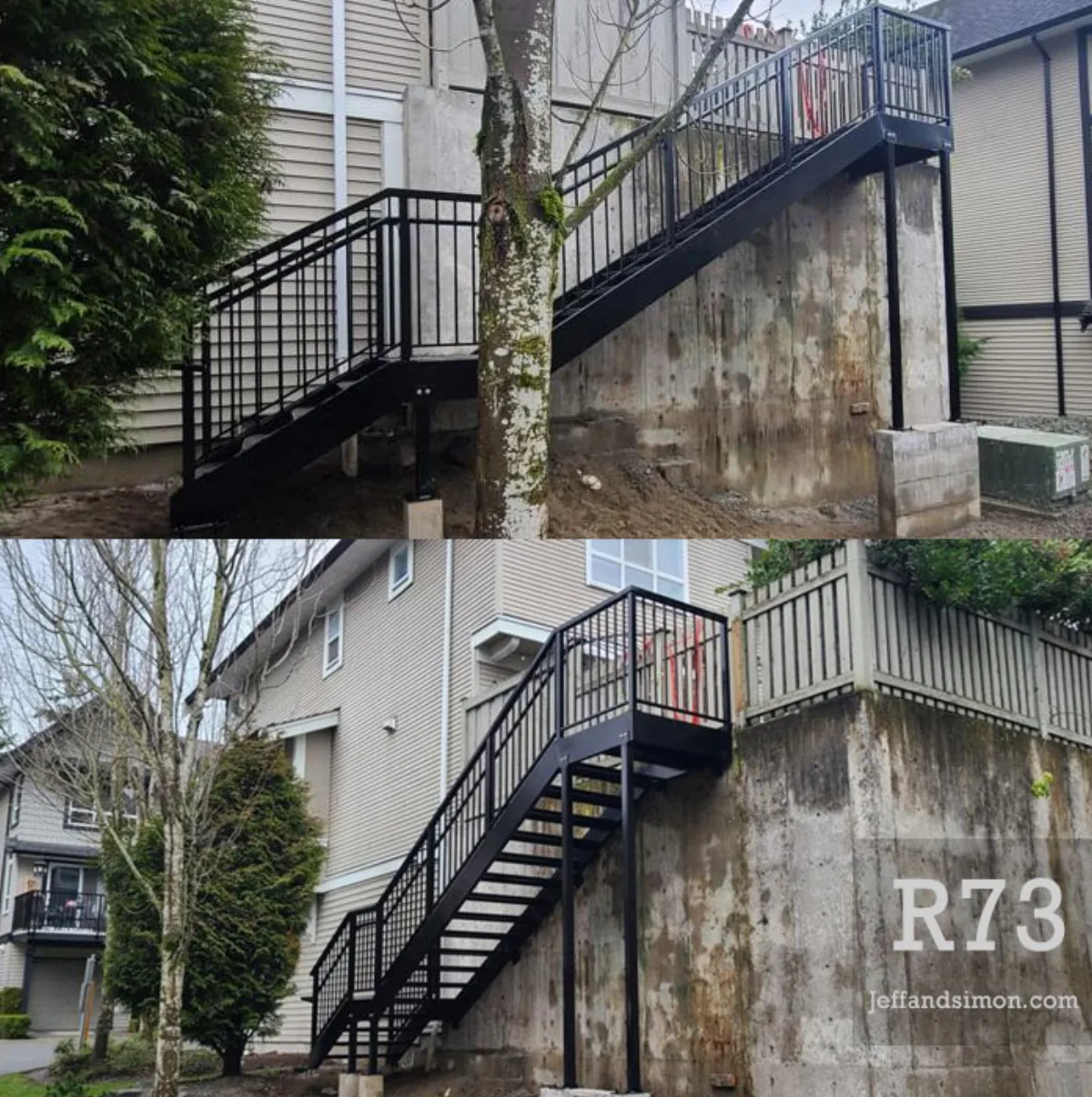
Stringer orientation affects drainage differently depending on the profile. A closed stringer (a solid plate stringer with treads welded to the top) traps water inside the stringer profile unless drain holes are added at the low points. An open stringer (structural tube or channel with treads bolted or welded to the top face) sheds water more readily and is often the right call on a fully exposed hillside site.
The landing at the base of a hillside stair is a common water collection point. Grated landing surfaces, slope directed away from the base of the stair, and a gravel drainage bed below the landing are worth designing in at the shop drawing stage, not retrofitting after the stair is installed.
Post base details matter most structurally. Cable railing posts and steel picket posts anchored into concrete or wood framing should have base plates designed to shed water, not trap it. A flat base plate sitting directly on a concrete pad will pool water at the anchor bolts and accelerate rust at the connection, the most structurally critical point.
Cable railing hardware specification on the North Shore
Cable railing is a popular choice for North Shore exterior applications because it is durable and minimizes the visual obstruction of a hillside view. But not all cable hardware performs equally in a wet environment.
The wire rope itself should be 316 stainless steel. Type 316 contains molybdenum, which significantly improves chloride resistance compared to 304. On the North Shore, the threat is not just coastal salt, it is the sustained moisture, tannins from forest debris, and the mild acidity of rainfall in forested areas. 316 handles all of these better than 304.
End fittings, tensioners, and turnbuckles should also be 316. A common mistake is to use 316 wire with 304 fittings because the fittings are less expensive. The fittings are the first place corrosion appears, and they are the connection point between the cable and the post. Corroded fittings compromise the cable tension and the structural integrity of the guard.
Posts should be sized for the cable tension load. Horizontal cable railings impose significant horizontal force on the end posts at each end of the run. Posts at corners and runs longer than 3000mm typically need an intermediate post or a larger section to limit deflection to the code maximum of L/60.
Exterior stair connections to wood decks and framing
Many North Shore exterior stair projects connect to wood-framed decks. The connection between steel and wood introduces a detail challenge: galvanic corrosion between the steel fastener and the treated lumber, and moisture trapping at the bearing surface.
Specifications that reduce long-term problems:
- Hot-dip galvanized bolts or 316 stainless bolts at all steel-to-treated-lumber connections
- Neoprene or EPDM isolation pads between steel base plates and wood framing to prevent direct metal-to-wood contact and moisture trapping
- Flashing or cap detail at the top of any ledger-to-house connection where the stair stringer bears against a rim joist
- Drainage slope at any landing surface that sits against the house
The connection between the stair and the deck structure is where failures begin on older North Shore properties. It is worth spending time on the connection detail at the design stage.
City vs District permit jurisdiction
North Vancouver is split between two separate municipal jurisdictions with separate building departments:
City of North Vancouver covers Lower Lonsdale, Central Lonsdale, and the areas west of Lynn Creek down to the waterfront. The City uses the BC Building Code as adopted with municipal amendments.
District of North Vancouver covers Lynn Valley, Deep Cove, Edgemont, Seymour, and the upper North Shore. The District is geographically much larger and administers its own building department.
Permit requirements for exterior stairs, deck guards, and structural attachments can differ between the two. Both require a permit for new construction and for work that changes the load path or structure. Both follow BC Building Code guard height requirements, minimum 1070mm for drops over 1800mm on residential decks.
When in doubt, confirm the permit requirements with the local building department before finalizing shop drawings. A shop drawing that assumes one connection detail may need to be revised if the building official requires a different approach. The cost of a permit review is small compared to the cost of modifying fabricated steel after the fact.
Scheduling around North Shore weather
North Shore winter installation windows are narrow. From November through February, dry days that are also above 5°C, the minimum temperature for powder coating to cure properly, are infrequent. Exterior painting and coating work during winter typically needs tarping, temporary heat, and careful surface preparation to manage moisture.
Projects with an exterior coating requirement that are planned for fall or winter delivery should factor in:
- Extended cure time for powder coat in cool weather
- Potential for moisture condensation on steel surfaces before coating, which requires re-blasting
- Shorter daily install windows (weather windows close faster)
- Access limitations from snow or ice on steep driveways
A stair project that is fabricated in the summer but installed in December on a steep Lynn Valley lot is a different scope than the same project installed in May. Build the weather variable into the schedule.
What to look for in a quote for a North Shore exterior stair
The way a fabricator scopes a North Shore exterior stair tells you a lot about their experience with the conditions. A quote that specifies 304 stainless fittings on a cable railing, omits drain holes from hollow post sections, or leaves the finish system as “powder coat TBD” is one that has not accounted for the exposure. A quote that calls out 316 hardware, a duplex system for the structural steel, base plate drainage details, and the correct permit jurisdiction is one that has.
Fabricators who work regularly on the North Shore do not treat these as upgrades, they treat them as defaults. When reviewing a quote, the right question is not whether these items appear but whether they are called out with enough specificity to hold the contractor to them at installation. Generic finishes get resolved generically. Specified finishes get delivered.
See also the North Vancouver service area page and the West Vancouver service area page for project context specific to each jurisdiction.
Related questions
How much more rainfall does the North Shore get?
Lynn Valley and the mountain-adjacent areas receive significantly more rainfall than central Metro Vancouver. Environment Canada climate normals show upper North Shore stations recording three to four times more annual precipitation than the YVR reference station. Exterior metalwork needs to be specified with this exposure in mind. A finish system that works in Richmond may fail in Lynn Valley years earlier.
Should exterior stairs be galvanized or powder coated?
Hot-dip galvanizing provides the best long-term corrosion protection for fully exposed steel. Powder coating can be applied over galvanizing for colour, but powder coating alone is not sufficient for fully exposed North Shore conditions. A duplex system, galvanize then powder coat, is the most durable option.
Do I need a permit for a deck railing replacement in North Vancouver?
Yes, in most cases. Guard and handrail work that changes the structural connection or guard height triggers a building permit in both the City and District of North Vancouver. Like-for-like replacement of the same railing type in the same configuration may qualify as maintenance, but confirm with your local building department before starting.
What cable railing hardware works best on the North Shore?
316 stainless steel fittings and wire rope rated for marine environments. The molybdenum in 316 stainless resists chloride corrosion better than 304. In Lynn Valley and upper North Shore neighbourhoods, rainfall-driven moisture is as damaging as coastal salt air, 316 is the right choice regardless of whether you are a waterfront property.