Cable Railing Spec for Vancouver Decks & Stairs: Spacing, Code, Hardware
BC Building Code cable railing requirements for Vancouver decks and stairs: cable spacing ≤102mm, guard ≥910mm residential, 304 vs 316 stainless. Full spec checklist from a Metro Vancouver fabricator.
Cable railings look minimal, but guard height, sphere openings, cable deflection, and coastal hardware all need decisions before fabrication.
Cable railing infill uses tensioned stainless strands instead of glass sheets or vertical pickets. The visual weight stays low, but the assembly is still a guard. Height, structural loading, opening limits under deflection, and attachment details all need to line up before stainless is cut.
This article is not a substitute for code review by the authority having jurisdiction, an architect, or an engineer. It describes how cable guards usually fit into Vancouver-area residential and light commercial work so fabrication can track the drawing set.
For a shorter overview of stair and guard topics in BC, see the BC stair code requirements for metal stair projects article. Product-specific scope for supply and installation is summarized on the cable railings Vancouver page.
Cable infill is a full guard assembly
The frame and posts carry the guard loads. The cables only work once they are tensioned to a predictable line. Loose cables open gaps under hand pressure or wind-driven sway, so shop drawings should show post spacing, cable diameter, termination hardware, and tensioning method together.
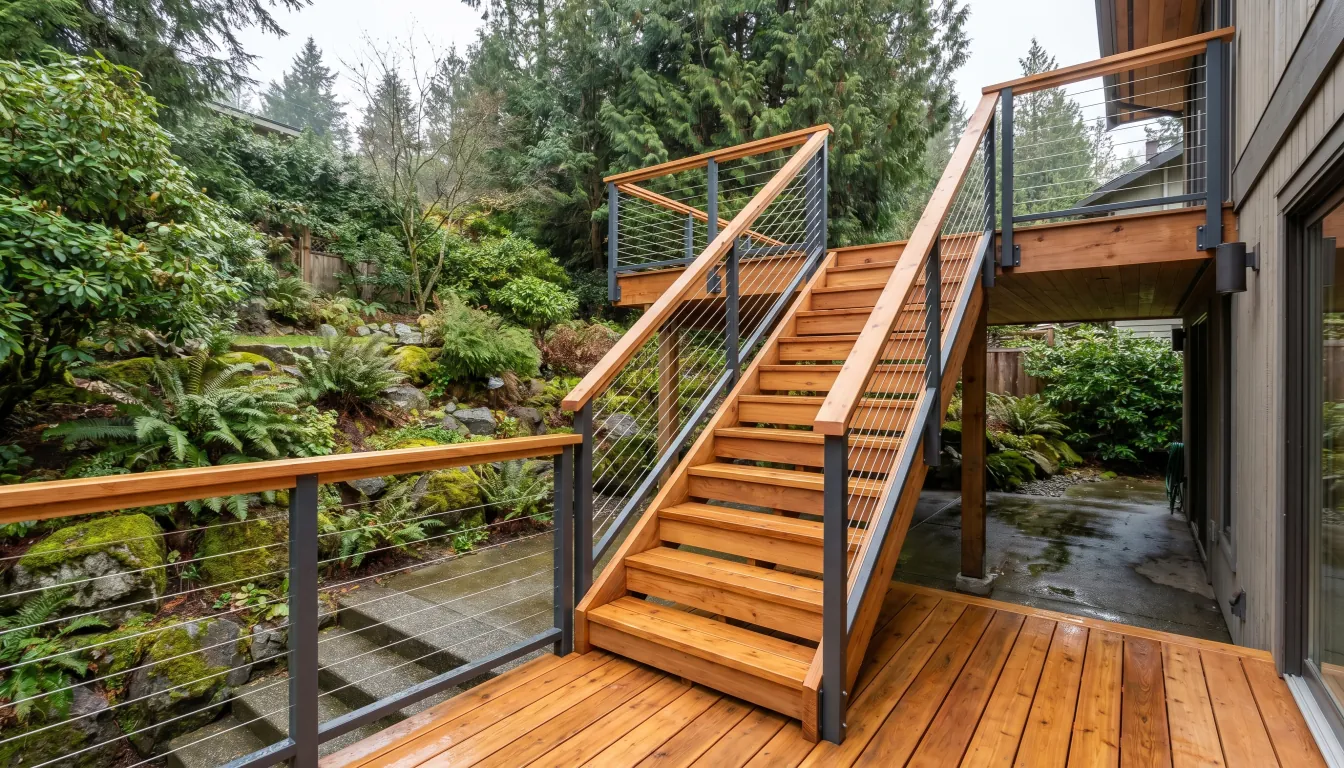
Horizontal cable runs on decks behave differently from raked cables on stairs. On stairs the cables follow the pitch and meet the bottom rail or shoe at an angle that changes with tread depth and guard offset. That geometry affects bracket placement on stringers or on shoe-mounted posts.
Metro Vancouver projects often pair cable guards with metal stair fabrication scopes where the same fabricator controls both the stair steel and the guard attachments. When the stair and railing are split between suppliers, the connection plates and bolt patterns need explicit coordination so field welding or drilling is not left to guesswork.
Turnbuckles, proprietary wedge grips, and hydraulic swaging kits each change how tension is applied and checked in the field. The drawing set should show which system governs so inspectors see matching hardware on site. Mixed kits from two brands on one guard line usually create review delays even when both parts look similar in photos.
Guard height follows the same BC rules as glass or pickets
The BC Building Code Division B Section 9.8 limits guard heights by situation. Sentences in Article 9.8.8.3 state that many guards must be not less than 1070 mm high, with exceptions including guards within dwelling units at not less than 900 mm and exterior guards serving not more than one dwelling unit at not less than 900 mm where the walking surface is not more than 1800 mm above finished grade.
Stair flights outside required exit stairs also have a 900 mm minimum guard height under Sentence 9.8.8.3.(4) of that Section. The exact sentence that applies depends on occupancy, whether the stair is part of a means of egress, and site geometry.
Cable projects sometimes fail review when the design fixes the top rail height from unfinished substrate while the finished deck surface or stair nosings were modelled thin. The measured guard height is taken relative to the walking surface people stand on when the work is complete.
Municipal plan reviewers in Vancouver, Burnaby, and Surrey apply the same BCBC framework but may ask for different drawing completeness on residential decks versus strata exterior upgrades. Strata jobs sometimes bundle guard replacement with envelope work, which adds coordination with the envelope consultant and with staged occupant access.
Openings must stay closed when cables flex
Article 9.8.8.5 of Section 9.8 addresses openings in guards. Sentence 9.8.8.5.(1) requires that openings through guards prevent passage of a sphere 100 mm in diameter except where later sentences permit larger openings for specific industrial or non-required guards.
Cable is flexible. The sphere test is evaluated after realistic deflection, not only at rest. That is why catalogue spacing alone is risky without engineering or supplier drawings that spell out tension targets, post spacing, and cable diameter together.
Feeney CableRail FAQs note that installers should account for cable flex when spacing strands and recommend checking with the local building department. Their documents reference the common 100 mm (approximately 4 in) sphere intent and suggest tighter on-centre spacing than rigid infill might need so openings do not widen past the limit under load.
Vertical helpers or intermediate pickets are often used not as decoration but to shorten the span of flex between cables. A run with posts every 1.8 m on paper can behave differently in review than a run with vertical members roughly every 900 mm that limit how far a cable can bow sideways.
Coastal exposure changes the stainless conversation
Type 304 stainless resists everyday rain well when surfaces stay clean and drainage is good. Salt spray from Burrard Inlet, coastal West Vancouver lots, or walkways salted in winter pushes projects toward type 316 for fittings, threaded tensioners, and hidden brackets.
The cables themselves are usually austenitic stainless in modern kits. The failure points are more often swaged ends, turnbuckles, and anchor screws where crevice corrosion starts. Duplex coatings or isolating sleeves matter where aluminum guard caps contact stainless hardware.
Isolating dissimilar metals reduces galvanic staining where stainless bolts bite aluminum posts or where powder-coated steel bases meet stainless fittings. Those small isolation washers are easy to omit during a fast install and expensive to retrofit once stains telegraph through a white post sleeve.
Exterior decks in Richmond, Delta, and Tsawwassen see different wind-driven spray than sheltered lanes in East Vancouver. The material call should match the worst exposure the guard will see over its service life, not only the first sunny summer after occupancy.

Post stiffness and anchorage carry the load path
Article 9.8.8.2 of Section 9.8 sets specified horizontal and vertical loads for guards and individual elements. The numbers belong in the structural calculation package. Cable railing suppliers publish assembly capacities only when tested as a system.
Concrete slab edges, steel pans, and wood framed decks each need anchorage patterns that respect edge distance and reinforcement placement. A cable guard replacing wood pickets on an older deck may discover rim joists or blocking that cannot accept the pull-out loads from high tension without reinforcement.
The fabricator should receive substrate photos or coring reports when anchors sit on questionable wood or vintage concrete toppings. Retrofits on Kitsilano or Mount Pleasant character homes often expose surprises once the old railing comes off.
Article 9.8.8.6 in the same Section addresses climbability. Horizontal rails close together can be treated as a ladder by some interpretations. Cable patterns differ from horizontal bar guards, but reviewers still examine whether the assembly facilitates climbing, particularly near childcare or strata common areas where risk tolerance is lower.
Stair geometry and railing layout should lock before steel orders
Rise, run, tread thickness, nosing projection, and planned finished floor levels feed directly into guard offsets and shoe heights. A mono stringer stair with open treads leaves little room to hide mismatched offsets between the bottom cable termination and the tread edge.
Handrails are separate from guards though they often share posts. Handrail height, extension past top and bottom nosings, and graspable profiles interact with where cable runs terminate at corners and landings.
Early coordination also covers how installers access tensioners after finishes are in place. Some systems hide adjusters under caps that need removable trim. Others expose barrel fittings that conflict with adjacent drywall or cladding returns.
Shop drawings should flag headroom conflicts where cable termination barrels project past the stair centreline on narrow flights. A stair that looked generous in plan view can lose usable width once barrel hardware stacks beside a guard shoe.
Projects beside ocean-view glazing sometimes mix cable guards outdoors with glass railing strategies indoors. The transitions at door thresholds need aligned sightlines and compatible metal finishes so one zone does not fight the next.
Maintenance stays focused on tension and corrosion
Cable stretches slightly over the first seasons. Most residential guards benefit from an annual check that pulls gently at mid-span and verifies locknuts or wedge fittings have not loosened. Fasteners at the deck surface should be inspected for staining or weeping rust that signals galvanic issues.
Exterior guards near landscaping need clearance from sprinklers that blast fertilizer-laden water into stainless creases. Hard water staining on cables is cosmetic but can hide pitting if never washed.
Strata and rental properties should document who is allowed to retension cables after tenant damage. Over-tightening without gauge guidance can overload end posts or strip threads.
Winter checks matter on coastal houses where freeze-thaw cycling moves fasteners microscopically over seasons. A fitting that read tight in September can show thread creep after January storms if washers crush into soft cedar blocking.
When an exterior assembly serves a steep North Shore lot, drainage at post bases matters as much as on glass jobs described in the North Shore exterior stair and deck considerations article. Ponded water at a buried post plate accelerates corrosion regardless of cable grade.
Sources
- British Columbia Building Code 2018 Division B Section 9.8, Stairs, Ramps, Landings, Handrails and Guards (accessed 2026-05-01)
- Feeney, CableRail FAQs (spacing, posts, deflection) (accessed 2026-05-01)
The strongest cable railing packages pair explicit structural sheets with hardware schedules that name stainless grades and tensioning torque where the engineer requires it. Bring photos, approved drawings, guard heights taken from finished surfaces, and the site address early so scope splits between stair steel and cable infill close before material lead times drive the schedule.
Related questions
Does BC Building Code allow cable railings?
Yes when the assembly meets the same guard requirements as other infill types. The authority having jurisdiction reviews height, openings under load, structural capacity, and climbability on the submitted drawings. Cable is not an exemption from those reviews.
How far apart can cables be spaced?
Spacing depends on preventing a 100 mm sphere from passing through openings after the cables deflect under load. Manufacturers often suggest roughly 3 in (76 mm) on centre as a starting point with frequent intermediate posts, but the stamped drawing set governs. Vancouver Stairs does not replace AHJ review.
Is 304 stainless enough outdoors in Vancouver?
304 stainless often performs well on sheltered decks. Fully exposed waterfront or high-spray locations usually justify 316 stainless for fittings and tension hardware. The right grade depends on exposure, cleaning access, and whether the assembly sits beside salted walkways or marine air.