Glass Railings for West Vancouver View Homes
Glass railing for West Vancouver view homes: marine exposure, hardware selection, and hillside installation in the British Properties and Caulfeild.
Glass railings on North Shore view lots need hardware and drainage details that handle waterfront exposure and steep site access. Here is what to specify and why.
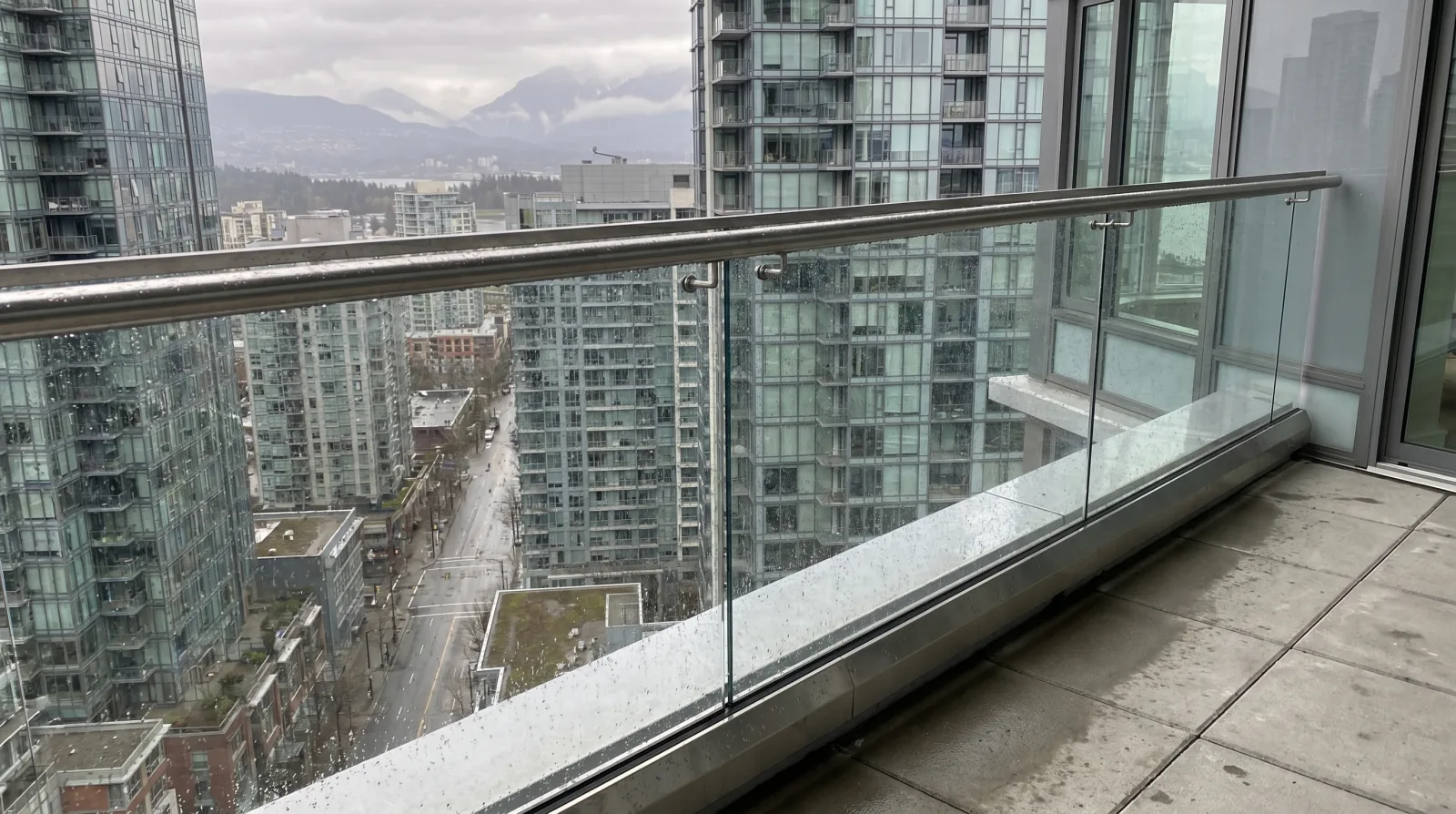
West Vancouver glass railing projects have one thing in common: the view matters more than the guard. Homeowners in the British Properties, Ambleside, Dundarave, and Caulfeild choose glass because it keeps sightlines open while satisfying BC Building Code guard requirements. The challenge is making the railing last. Marine salt air, higher rainfall, steep access, and exposed hillside sites all affect specification and installation decisions.
Marine exposure changes the hardware conversation
Glass panels themselves are not affected by salt air. Tempered and laminated safety glass is chemically inert, the marine environment does not etch, corrode, or structurally weaken the glass over time.
But every fitting, fastener, bracket, and base shoe around the glass can corrode if the wrong material is specified.
For waterfront and inlet-facing properties along Marine Drive, Bellevue Avenue, and the lower British Properties, 316 stainless steel hardware is worth the upgrade over standard 304 stainless. The difference is the addition of molybdenum in the 316 alloy, which significantly improves chloride resistance. On a deck that faces Burrard Inlet or Howe Sound, 304 hardware can begin showing surface rust within a few years. The 316 equivalent can last decades with minimal maintenance.
The hardware upgrade from 304 to 316 stainless on a typical residential project is a modest cost difference, modest compared to the cost of replacing corroded fittings or repainting a stained deck. Confirm the current premium with your fabricator, as hardware pricing varies with project scale and stainless market pricing.
What to specify: base shoe vs post systems
Two structural approaches dominate residential glass railing installation:
Base shoe (channel) systems mount a continuous aluminum or stainless channel to the deck or stringer surface. Glass panels slot into the channel and are secured with setting blocks and pressure plates. The channel distributes load along its full length.
Base shoe systems work well on flat decks and balconies. They require a level substrate and a drainage detail, water that pools in the channel base accelerates corrosion and leaves mineral deposits on the glass base edge.
Spigot or post systems mount individual hardware points under or beside each panel. Spigots set flush into the deck surface give a clean look but require precise layout. Side-mounted posts are more forgiving of substrate variations.
For sloped decks and irregular surfaces common on West Vancouver hillside sites, spigot and post systems often adapt more easily than continuous base shoe.
Glass specification: thickness, type, and edge treatment
BC Building Code classifies glass railing infill as safety glazing. The minimum requirement is fully tempered glass. Where glass retention after breakage is critical, a high deck above a steep slope, a stair guard with a long drop, laminated safety glass is the appropriate upgrade.
Tempered glass is heated and rapidly cooled to create internal tension. When it breaks, it shatters into small granular pieces rather than sharp shards. Minimum 10mm thickness for guard infill; 12mm is more common on exposed sites. Laminated safety glass uses two lites bonded with a PVB or SentryGlas interlayer. When the glass breaks, the interlayer holds the pieces together. The common spec is 10.76mm (two 5mm lites with 0.76mm interlayer) or 13.52mm (two 6mm lites) for applications where panel retention after breakage matters.
Edge treatment also matters. Polished edges are standard. For base shoe systems, the bottom edge is often left flat-polished. For frameless designs where all four edges are exposed, all-polished edges are specified.
Drainage details prevent long-term problems
Frameless glass railings with base shoe systems need drainage channels or weep slots at the base. On flat decks or balconies where water pools, standing moisture accelerates corrosion at the channel connections and leaves calcium and mineral deposits on the glass.
West Vancouver’s rainfall, heavier than central Metro Vancouver, particularly in the fall and winter, makes drainage planning more important than it would be on a covered patio in Burnaby. Environment Canada climate normals show higher precipitation totals at West Vancouver’s upper elevation stations than at the valley floor reference sites. Wind-driven rain at elevation can push water into joints that appear to drain by gravity.
Design details that matter on these sites:
- Continuous weep slots along the base shoe bottom, at 300–400mm spacing
- Deck slope directing water away from the railing base (minimum 1:50 fall)
- Sealant at channel end caps and wall returns that uses a silicone rated for UV and wet conditions
- Post base plates with raised edges or drainage gaps, not flat-set against the deck membrane
Panel sizing for hillside sites
Many British Properties and Chartwell sites have steep driveways, narrow entry paths, and limited staging areas. Glass panels are heavy. A 12mm tempered panel measuring 1000mm wide × 1100mm tall weighs approximately 33 kg. A larger panel at 1500mm wide runs 50 kg.
For sites where panels cannot be brought in by vehicle, glass panels should be sized for two-person carry from the street or driveway staging point to the installation location. This often means panels no wider than 900–1000mm and no taller than 1200mm, depending on the geometry of the access path.
Trying to deliver oversized panels to a site that cannot accommodate them leads to delays, panel breakage, and emergency resizing that is expensive and time-consuming. Site access should be discussed at the design stage, not on delivery day.
Integration with stair guard vs deck guard
The railing specification for a stair guard differs from a deck or balcony guard in one important respect: the handrail.
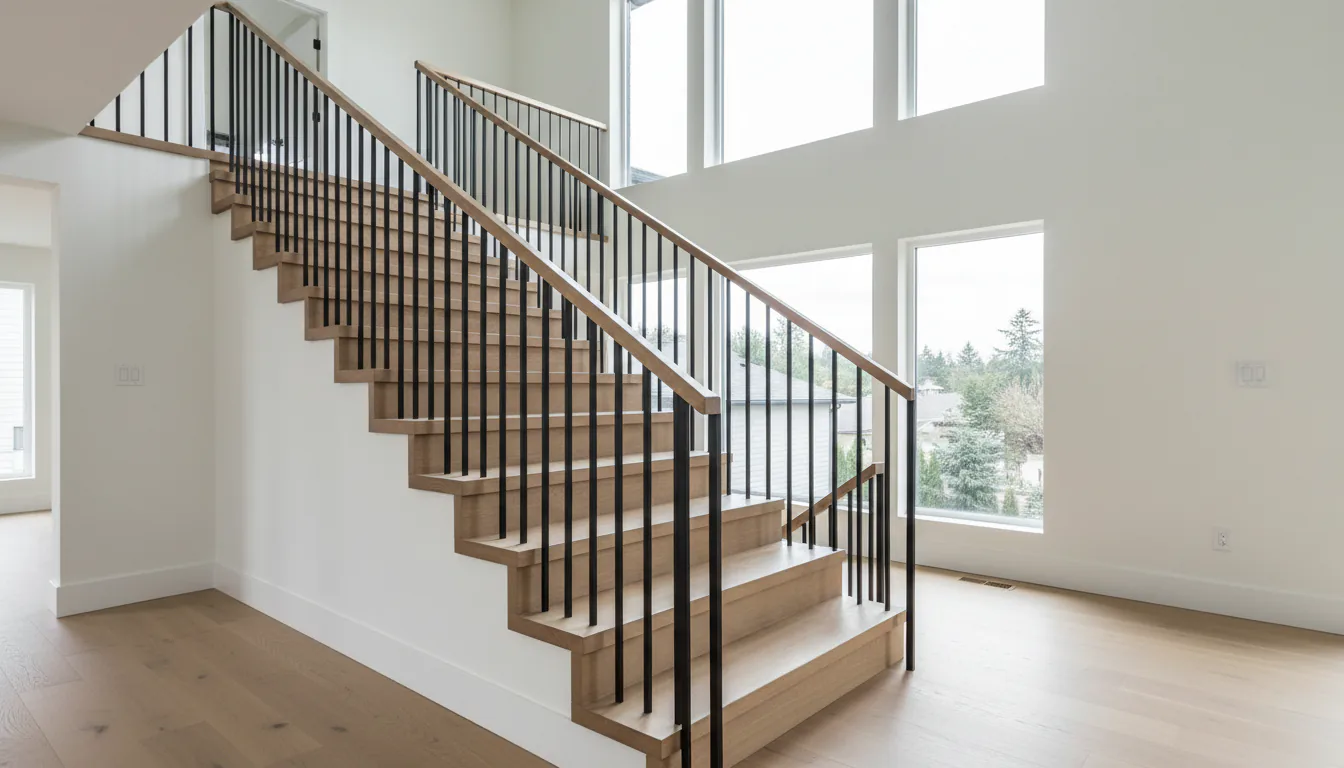
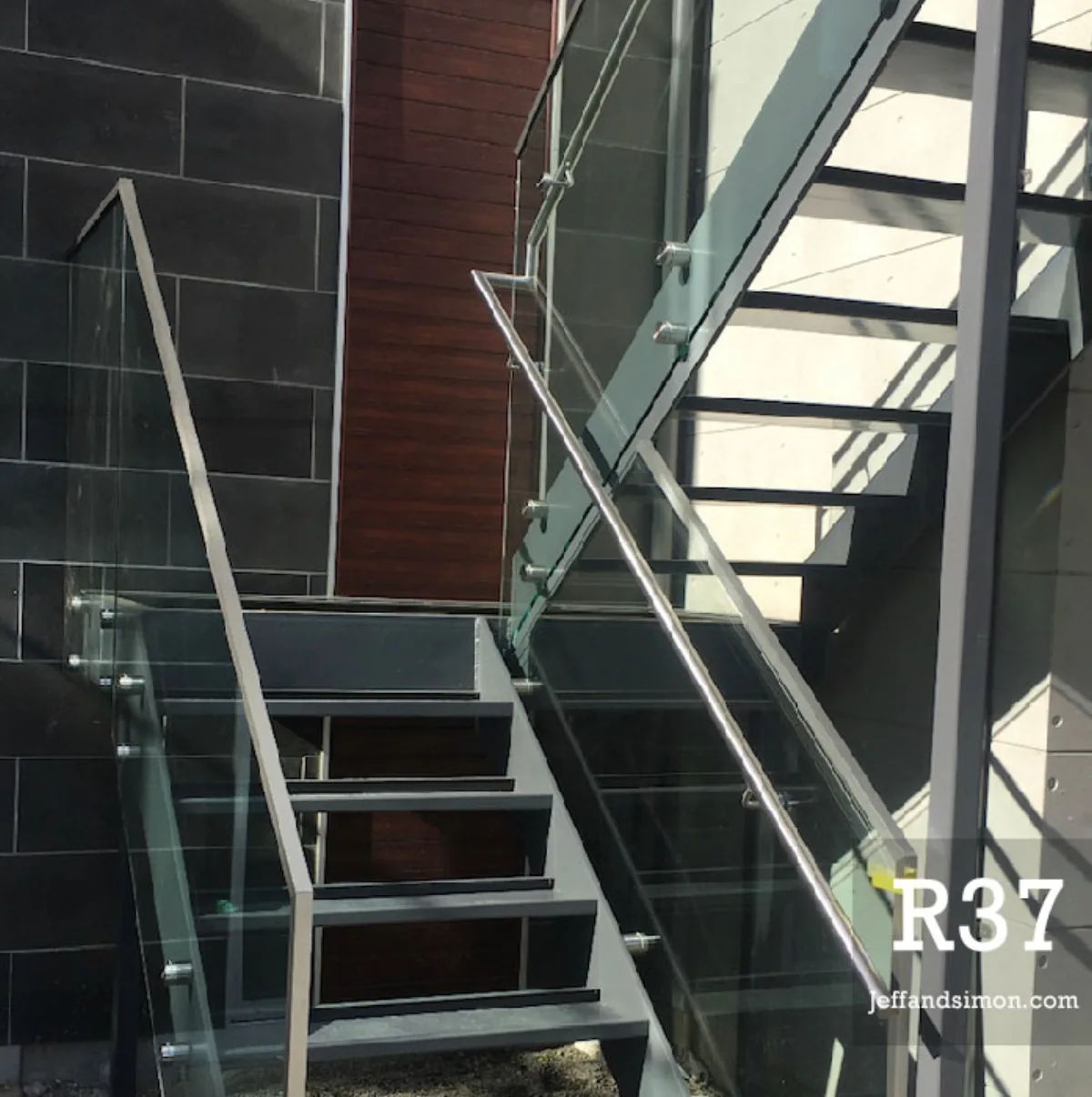
BC Building Code requires a graspable handrail on at least one side of a stair. A frameless glass guard on a stair typically pairs with a round or flat-bar top rail in 316 stainless or powder-coated steel. The top rail must be:
- Graspable (30–43mm diameter round, or equivalent for non-circular profiles)
- Continuous from the top to the bottom of the stair
- Returned to the wall or post at both ends to prevent a snagging hazard
For decks without stair access, the glass guard can be frameless with no top rail, the panels themselves form the continuous guard.
The visual difference between a stair railing (which needs a top rail) and a deck guard (which often does not) is significant. Projects that mix both should coordinate the transition detail, typically at the top of the stair where the stair rail merges into the deck guard.
Maintenance on coastal sites
West Vancouver glass railings require more maintenance than the same installation in a sheltered interior location.
Wash glass panels with fresh water and a non-abrasive cleaner twice a year. Coastal mineral deposits and salt residue build up faster than in non-marine locations. Left uncleaned, deposits etch into the glass surface. Once a year, inspect hardware, base shoe screws, spigot bolts, panel clips, for surface corrosion. 316 hardware should show no structural corrosion, but staining is possible in the first years on highly exposed sites. Replace any hardware showing pitting.
Silicone sealant in UV-exposed locations has a finite service life. Inspect and replace any sealant that has cracked, shrunk, or debonded every three to five years, before it allows water ingress.
After major storm events, inspect for movement in posts or panels. High winds can rack a panel if the base shoe set screws are not properly torqued. A railing that moves under a push test after a windstorm is not a cosmetic issue, get the fabricator involved before the hardware loosens further.
Working with the architect’s design intent
West Vancouver properties often involve architects and designers with strong opinions about railing design. The fabricator should be engaged before the design is locked, not called in after.
Conversations worth having before design is locked:
- Panel joint spacing and whether butt joints are acceptable or a caulked gap is preferred
- Top rail profile and how it transitions at the upper landing
- Post or spigot finish, and whether it needs to match other hardware on the project (door pulls, window hardware, light fixtures)
- Whether the glass has a low-iron specification for maximum clarity, or standard float glass is acceptable
The view lot premium in West Vancouver is in the details. The fabricator should be on site early enough to influence the panel sizing, hardware grade, and drainage strategy, not called in after the deck is framed and the design is fixed. On sites where access is tight and exposure is real, the spec conversation at the drawing stage is what protects the install from compounding problems later.
See also: glass railings in West Vancouver and the West Vancouver service area page.
Related questions
Do glass railings hold up to West Vancouver's marine exposure?
The glass itself is unaffected by salt air. The hardware, base shoe, and fasteners need to be specified for coastal conditions, 316 stainless steel rather than 304, and drainage details that prevent water pooling around the base shoe.
How does hillside access affect glass railing installation?
Steep driveways and limited staging areas in the British Properties and Caulfeild mean glass panels often arrive in smaller sections. Installation sequencing should account for site constraints from the start, oversized panels that cannot reach the deck cause delays and damage.
What glass thickness is required for a guard railing in BC?
BC Building Code requires safety glazing for guard railings. Tempered glass is the minimum; laminated safety glass (two lites bonded with interlayer) is required where glass retention after breakage is important, such as high decks or stairs. Common specs for guard rails are 12mm tempered or 10.76mm laminated.
Can glass railings be installed without a top rail?
Yes, in frameless guard applications where the glass panels provide the full guard height (minimum 900mm from deck surface). The glass must be engineer-specified for the point load and infill load requirements of BC Building Code. Most residential installations include a top rail for graspability on stairs.