Commercial Staircase Design in Vancouver: Egress, Switchback, Lobby
What separates a commercial stair from a residential stair in Vancouver, code path, egress geometry, finish, and the shop coordination that ties them together.
Vancouver Stairs fabricates commercial staircases governed by Part 3 of the BC Building Code, a different code section, shaft requirement, and shop drawing path than the residential stair next door.
A commercial stair in Vancouver is governed by a different part of the BC Building Code than a residential stair, sits in a different kind of opening, and follows a different shop drawing path. The decisions a GC or architect makes early, code path, egress width, finish, feature versus function, shape the steel package long before any tread is fabricated.
The code path forks at Part 3 versus Part 9
Part 9 of the BC Building Code 2018 covers small buildings, typically Group C residential up to three storeys, plus some Group D and E business and mercantile occupancies under a building area limit. Anything outside those limits sits under Part 3, which has its own stair clauses and tighter requirements for egress, fire-rating, and accessibility. The first conversation on any commercial stair is which part of the code applies, because it changes everything from minimum width to handrail specifications.
In practice, most TI work in Vancouver office, retail, and assembly buildings sits under Part 3. The stair is part of the means of egress, which means it has to meet capacity requirements, fire-rating requirements, and continuity requirements that residential stairs do not. This article is not a substitute for code review by the authority having jurisdiction.
Egress geometry follows the occupant load
Commercial egress stair width starts from occupant load. BCBC 3.4.3.2 sets minimum stair width at 9 mm per person for typical assembly and business occupancies with risers up to 180 mm and runs of at least 280 mm. For a stair serving 100 occupants, that is 900 mm minimum, but most commercial stairs in Vancouver are built at 1,100 mm or wider so that two-way movement works during normal use, not just during evacuation.
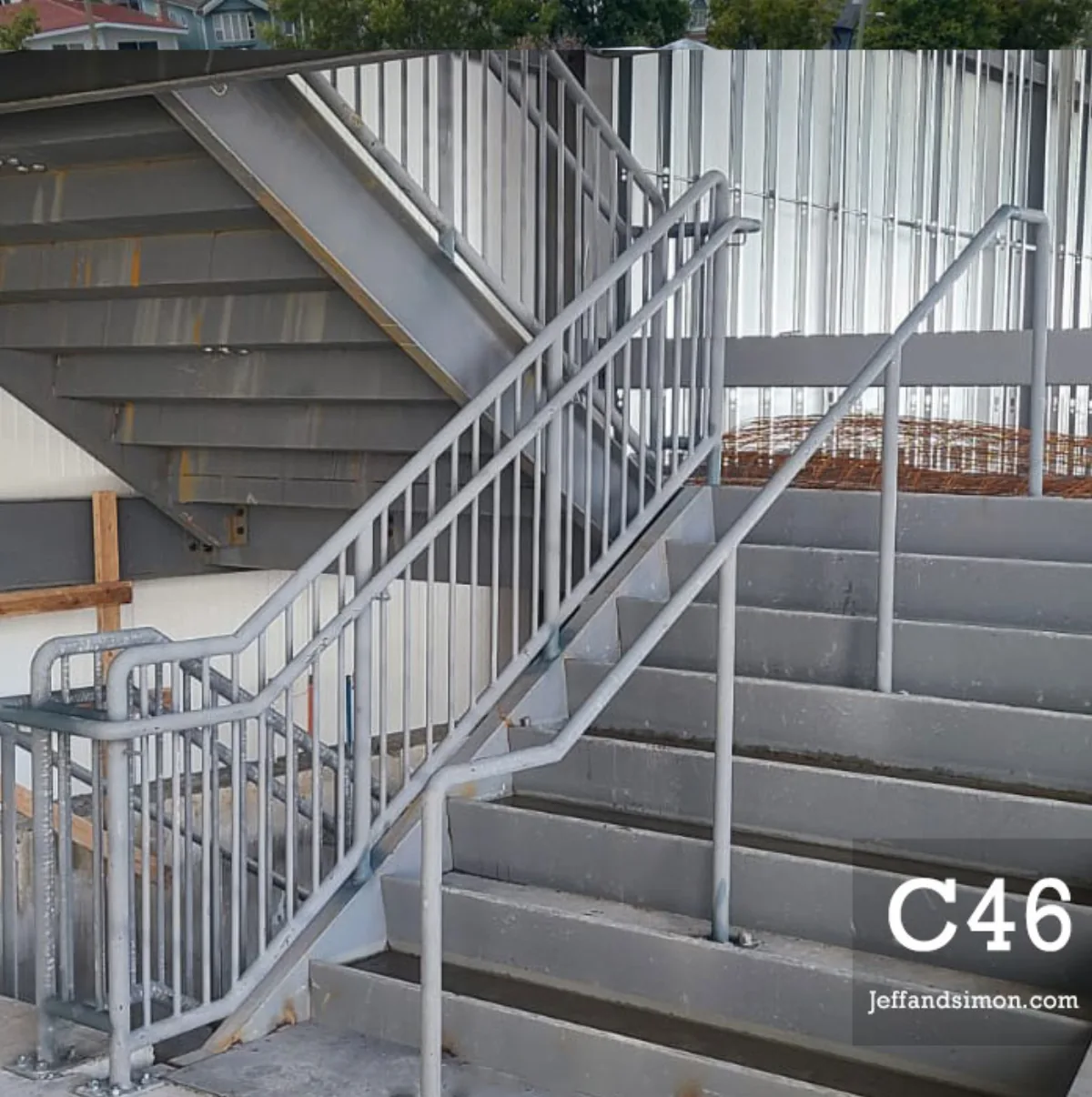
Handrails are required on both sides of any stair over 1,100 mm and on both sides of egress stairs in commercial occupancies regardless of width per BCBC 3.4.6.5. Handrails are continuous through landings, mounted between 865 mm and 965 mm above tread nosings, and returned at the top and bottom of each run. Handrails and stringers cannot project more than 100 mm into the required stair width. These numbers govern the steel package as much as the geometry does.
Switchback and scissor stairs handle the multi-storey rise
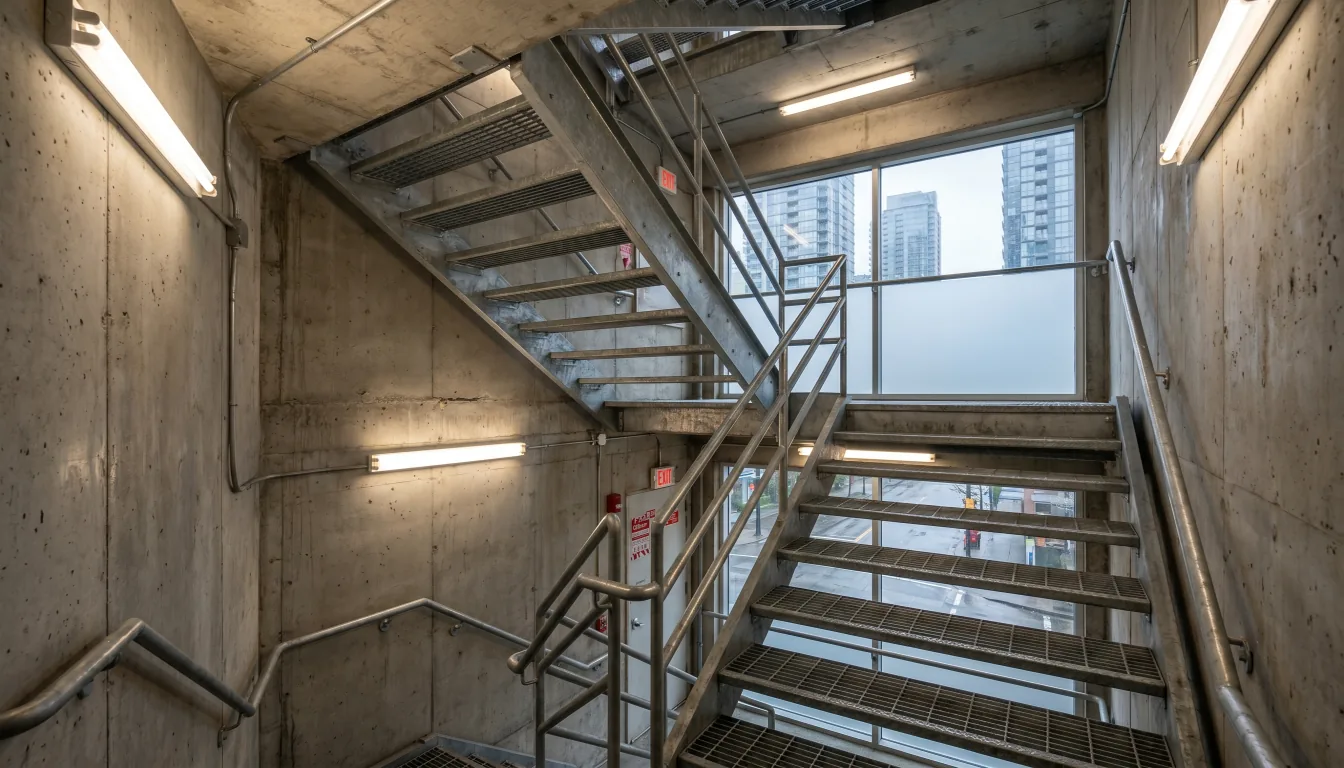
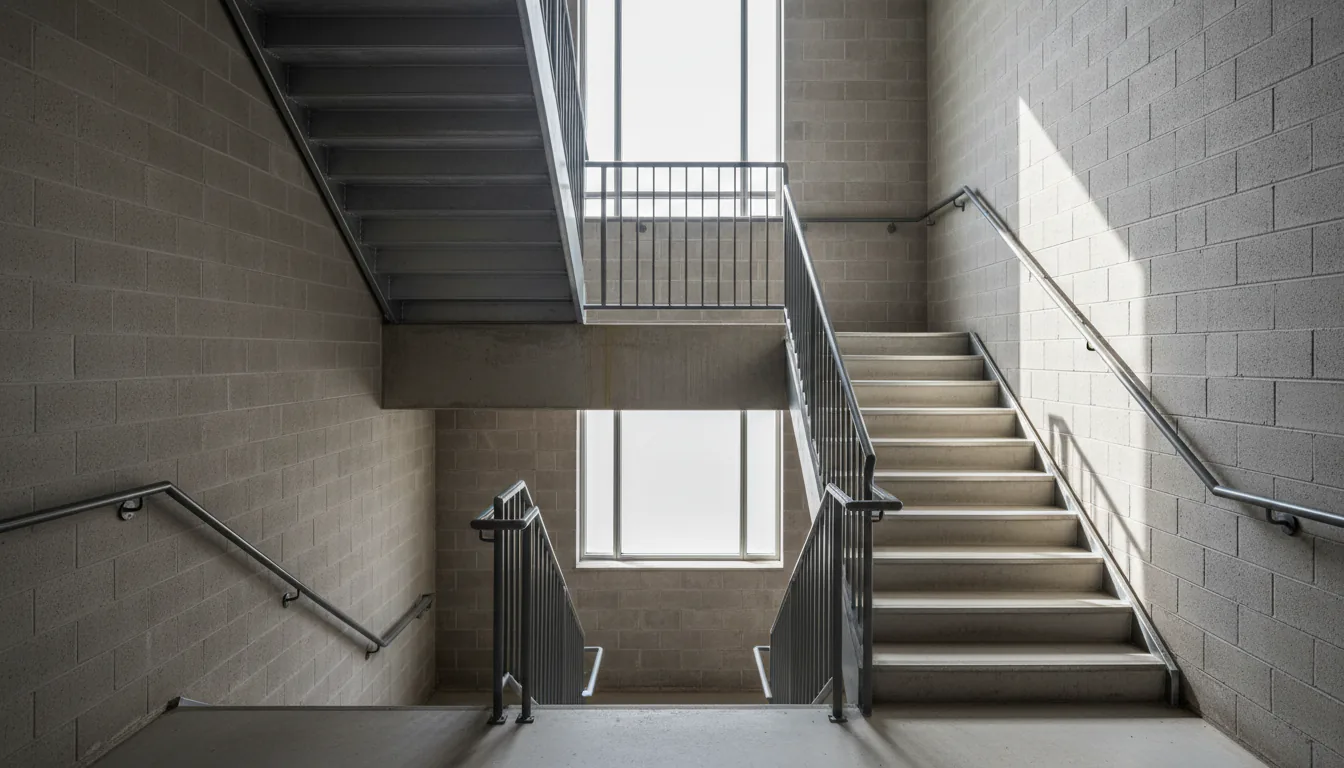
Most commercial stairs in Vancouver are switchback or scissor configurations because of the rise. A switchback stair runs up, hits a half-height landing, and reverses direction for the next flight, which fits cleanly into a stair shaft about 5 feet by 8 feet plus the landing. A scissor stair pairs two independent stairs in the same shaft footprint with one going up while the other goes down, which is occasionally used where two means of egress need to share a single shaft.
The fabrication detail differs between the two but the structural grammar is similar: two outer stringers, a steel-pan tread that takes a concrete fill, and a half-landing framed into the shaft. The steel pan is what gets specified on most TI projects because it gives a flat finished tread surface, takes a concrete topping that can match the rest of the floor, and fire-rates well when the shaft is rated.
Lobby and feature stairs are usually a second stair
A code-driven egress stair lives in a shaft, has limited finish, and follows tight clearance rules. A feature stair in a lobby has none of those constraints, it can be open, can use mixed materials, and can carry the design intent of the building. Trying to make one stair do both jobs usually compromises both, which is why most commercial buildings end up with at least two stairs: an egress stair in a shaft and a feature stair in the open.
When the lobby stair is the focus, the structural choice tends to be a mono stringer or a hidden double stringer to keep the read clean. When the egress stair has to be visible at the same time, the finish on the lobby stair often gets darker or lighter than the egress stair to break the visual link. The early conversation between the architect and the fabricator on the lobby stair is the conversation that pays off in the install.
Finish strategy depends on visibility and fire rating
The default Vancouver commercial egress stair is hot-dip galvanized stringers with steel-pan treads. Galvanizing is durable, takes no on-site finish work, and gives a service life that fits the rest of the building envelope. American Galvanizers Association data on coastal-environment performance shows multi-decade life when the galv layer is intact, which is usually the case inside a fire-rated shaft.
Where the stair is exposed to public view, a duplex finish, galvanizing plus a high-performance topcoat, extends life and gives a colour. Tnemec’s Series 90-75 zinc-rich epoxy and Series 132 sit in the spec range used on commercial stairs in coastal environments. Powder coat over galvanizing is also common on lobby stairs, but it requires the shop to follow the manufacturer’s surface-prep guidance because powder over zinc is not a guaranteed bond without intermediate prep, as documented in Tnemec Technical Bulletin 10-78R2.
Shop drawings, mock-ups, and the P.Eng stamp
Commercial stairs in Vancouver almost always go through a P.Eng review. The structural engineer of record reviews the connection details, the guard load case, the seismic restraint, and the fire-rated assembly interface. Shop drawings come back with stamps before steel is cut. Skipping that loop and trying to fabricate from architectural drawings is one of the most common ways a TI commercial stair ends up with a change order on site.
For feature stairs in lobbies, mock-ups become useful. A 1:1 mock-up of one tread, one stringer connection, and one guard post catches the proportional decisions that drawings cannot, and gives the design team a chance to adjust before the full run is in fabrication. In our shop, we usually recommend a mock-up on any feature stair where the proportions or the finish are a stretch from the standard package.
Site coordination is what protects the schedule
Commercial stairs are installed into shafts that have already been built and into lobbies that are already framed. Site access, the elevator versus stair construction sequence, and how the steel comes in through the building all determine when the stair can land. The strongest commercial projects we work on coordinate the stair install before the shaft drywall is closed and before the lobby ceilings are up.
The deliverables that protect the schedule on a commercial TI stair are: stamped shop drawings before fabrication, dimensional verification on site before the stringers ship, and a clear lift plan for the stringers and treads. For more on the residential parallel of these decisions, the BC stair code requirements for metal stairs covers the smaller-building path. For finish strategy on exposed lobby stairs, the North Shore exterior stair and deck considerations cover the duplex coating decisions in detail. For the full commercial stair specification library, egress geometry, switchback vs straight run, pan-formed vs grating treads, and BC code for commercial builds, see the commercial stairs hub.
Sources
Related questions
When does a stair fall under BC Building Code Part 3 instead of Part 9?
Part 9 covers small buildings, typically Group C residential up to three storeys with a building area threshold. Larger or higher-occupancy buildings sit under Part 3, which has tighter egress, fire-rating, and stair geometry rules. Confirm the path with the AHJ; this article does not substitute for a code review.
Why are most commercial egress stairs built at 1,100 mm wide?
BC Building Code 3.4.6.5 requires handrails on both sides for stairs over 1,100 mm wide and on both sides of all egress stairs in commercial occupancies regardless of width. Building at 1,100 mm gives the simultaneous two-way movement most occupancies need without bumping into the wider-stair requirements above that threshold.
What finish is most common on a Vancouver commercial egress stair?
Hot-dip galvanized stringers with steel-pan treads filled with concrete is the workhorse spec. For exposed feature stairs in lobbies, powder coat over a galvanized base or a duplex coating system is common; for fully enclosed shafts, galvanized-only is often acceptable. The decision usually comes down to visibility, fire-rating, and the building owner's recoat tolerance.
Does a feature lobby stair share the egress stair?
Rarely. Most commercial buildings end up with two separate stairs: a code-driven egress stair in the shaft and a feature lobby stair in the open. Trying to make one stair do both jobs usually compromises both. The egress stair has tight code rules; the feature stair carries the design intent.
Does a commercial stair in Vancouver require a P.Eng stamp?
Almost always, yes. Part 3 buildings require a Designated Structural Engineer to seal the shop drawings for the stair connection details, guard load case, and seismic restraint. The structural engineer of record reviews the stair as part of the building's structural design. Attempting to fabricate from architectural drawings without an engineering review cycle is one of the most common sources of site change orders on commercial TI stairs.
What is a steel-pan tread and why is it used on commercial stairs?
A steel-pan tread is a formed steel pan welded to the stringers and filled with concrete on site. The concrete fill provides a flat, fire-rated surface that can match the rest of the floor finish. Steel-pan treads are standard on BC egress stairs because they perform well in fire-rated shaft assemblies, take heavy use, and can be finished to match building materials.
What is the minimum riser height and tread depth for a BC Part 3 commercial stair?
BC Building Code 3.4.6.3 sets risers between 125 mm and 180 mm, and runs (tread depth excluding nosing) at minimum 280 mm. All risers and treads in the same stair flight must be uniform within 5 mm. Confirm the specific requirements with the AHJ and the engineer of record on any project, this article is not a substitute for a code review.
What is a scissor stair and when is it used in Vancouver commercial buildings?
A scissor stair places two independent stair flights in the same shaft footprint, one going up while the other goes down, separated by a fire-rated partition. It satisfies the requirement for two separate means of egress from a single shaft, useful on tight floorplates where there is no room for two separate shafts. Scissor stairs are less common than switchback stairs in Metro Vancouver TI work but appear on high-rise residential and office buildings where the core geometry demands it.
What does a switchback stair look like versus a straight-run commercial stair?
A switchback stair runs up one flight, hits a half-height landing, then reverses direction for the next flight, the plan view looks like two parallel rectangles sharing a landing. A straight-run stair continues in one direction without reversing. Switchback stairs fit into a shaft roughly 1,500 mm wide by 2,500 mm long plus the landing, which is why they are standard in BC commercial buildings where floor area is constrained.
How long does a commercial staircase fabrication take in Vancouver?
Lead time depends on the engineering review cycle, drawing approval, finish, and shop load. A switchback egress stair with standard steel-pan treads and a galvanized finish typically moves faster than a feature lobby stair with custom geometry and a mock-up cycle. Confirm with a current quote, the schedule depends on what the drawing set requires, and P.Eng review cycles vary by engineer and project complexity.