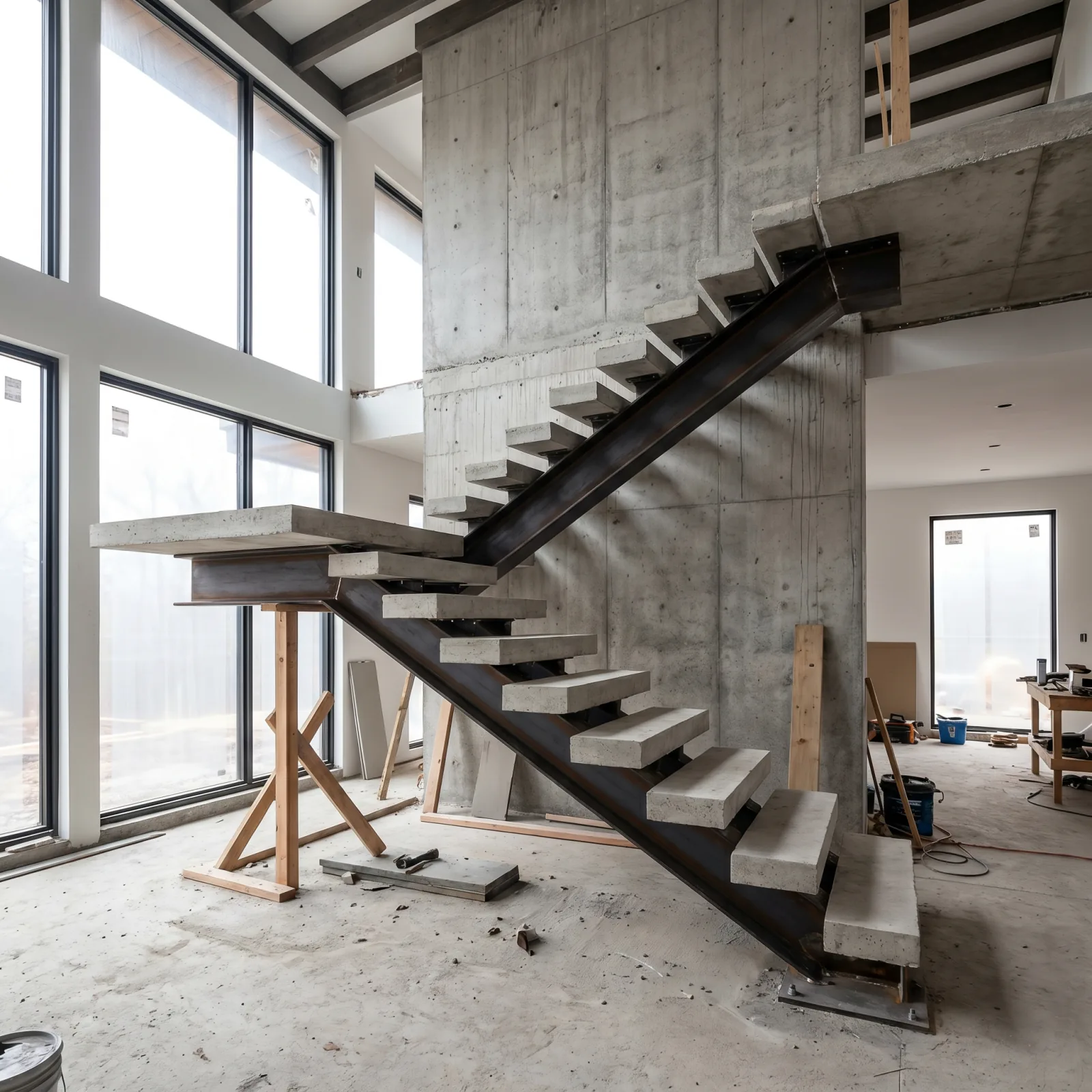
Most clients who say they want a floating stair are choosing between two real options: a mono stringer with a visible central beam, or a cantilevered stair with treads anchored into a hidden wall structure. The look is different. The engineering is different. The framing schedule is different. Decide between them before drywall, not after.
Mono stringer: visible spine, simple coordination
A mono stringer floating stair uses one central steel beam. The beam is part of the stair, not part of the building. Brackets cantilever the treads off the beam to both sides. Open risers stay open because the beam carries everything from beneath. Engineering is contained inside the stair package.
- Single beam (typically a structural rectangular tube) anchored at the lower landing and the upper floor edge.
- Treads cantilever equally on both sides of the beam.
- No reliance on the adjacent wall, the wall is finish, not structure.
- Engineering review focuses on the beam, the brackets, and the two anchor points.
Cantilevered: invisible support, structural wall
A cantilevered floating stair has no visible steel. Each tread is anchored into the wall behind it through a stud-pack, a hidden steel knife-plate, or a continuous back-plate. The stair vanishes, but only because the wall is doing all of the work. That wall has to be engineered, framed, and signed off before drywall.
- Tread loads transfer into the wall at every step.
- Wall behind the stair is structural, usually a continuous LVL or steel back-plate behind multiple stud-packs.
- Embed locations are fixed by tread positions and cannot be moved later.
- Inspection windows often required during framing to verify the embeds.
Side-by-side comparison
Both stairs can read as floating in finished photos. The decisions behind them are very different.
- Visible structure: mono stringer has one. Cantilevered has none.
- Engineering scope: mono stringer engineering lives inside the stair. Cantilevered engineering extends into the wall framing.
- Coordination with the framer: mono stringer is light. Cantilevered is heavy and time-sensitive.
- Fix-after-the-fact: mono stringer brackets can sometimes be re-shimmed in the field. Cantilevered embed errors mean re-opening drywall.
- Budget direction: mono stringer is usually less expensive for a given tread schedule. Cantilevered shifts cost into framing and engineering.
Which one fits the project
Choose mono stringer when the project wants a designed steel feature, when the wall behind the stair cannot accept structural embeds, or when budget predictability is more important than absolute minimalism. Choose cantilevered when the architecture demands no visible support, the wall is already structural (concrete, masonry, or steel-stud-packed), and the framing schedule has room for embed coordination.
Related questions
Is a mono stringer cheaper than a cantilevered stair?
For comparable tread material and railing, mono stringer is generally less expensive because the engineering and fabrication stay inside the stair package. A cantilevered stair adds wall framing, embed coordination, and often a sealed structural review of the wall itself.
Can both options use glass railings?
Yes. Glass guards work with both mono stringer and cantilevered stairs. The attachment detail differs, a mono stringer carries the guard from the beam or the tread edge; a cantilevered stair usually carries the guard from the side of each tread or from a top-mounted shoe.
Can I switch from cantilevered to mono stringer mid-project?
If drywall is already in, switching to a mono stringer is usually possible because the new beam runs in front of the wall. Switching the other direction (mono stringer to cantilevered) is rarely practical without opening up the wall.
Do both options need an engineer?
Both typically require sealed engineering. Mono stringer engineering is contained, beam, brackets, two anchors. Cantilevered engineering also covers the wall back-plates, the studs, and the way embeds tie into the floor framing.
Continue planning
- Floating stairs hub overview
- All four support strategies
- Mono stringer staircase deep dive (Trends)
- Floating stair fabrication guide
Plan cantilevered vs mono stringer stairs: 2026 cost comparison for a real Vancouver project
Send drawings, photos, or a rough scope and we will help define the practical next step.