Integrated LED Stair Lighting for Vancouver Homes
Under-tread, side-wall, and handrail-integrated LED options for Vancouver stairs, power, color temperature, and the fabrication coordination that makes them look intentional.
LED stair lighting reads like a finishing detail. The fabrication decisions behind it have to happen before steel is cut.
Integrated LED stair lighting reads as a finishing detail in the photographs, but the decisions that make it look intentional have to happen before the steel is cut. Channels, wire paths, transformer location, and the colour temperature all interact with the structure of the stair, and a late lighting spec almost always compromises either the steel or the lighting.
Three lighting strategies cover most projects
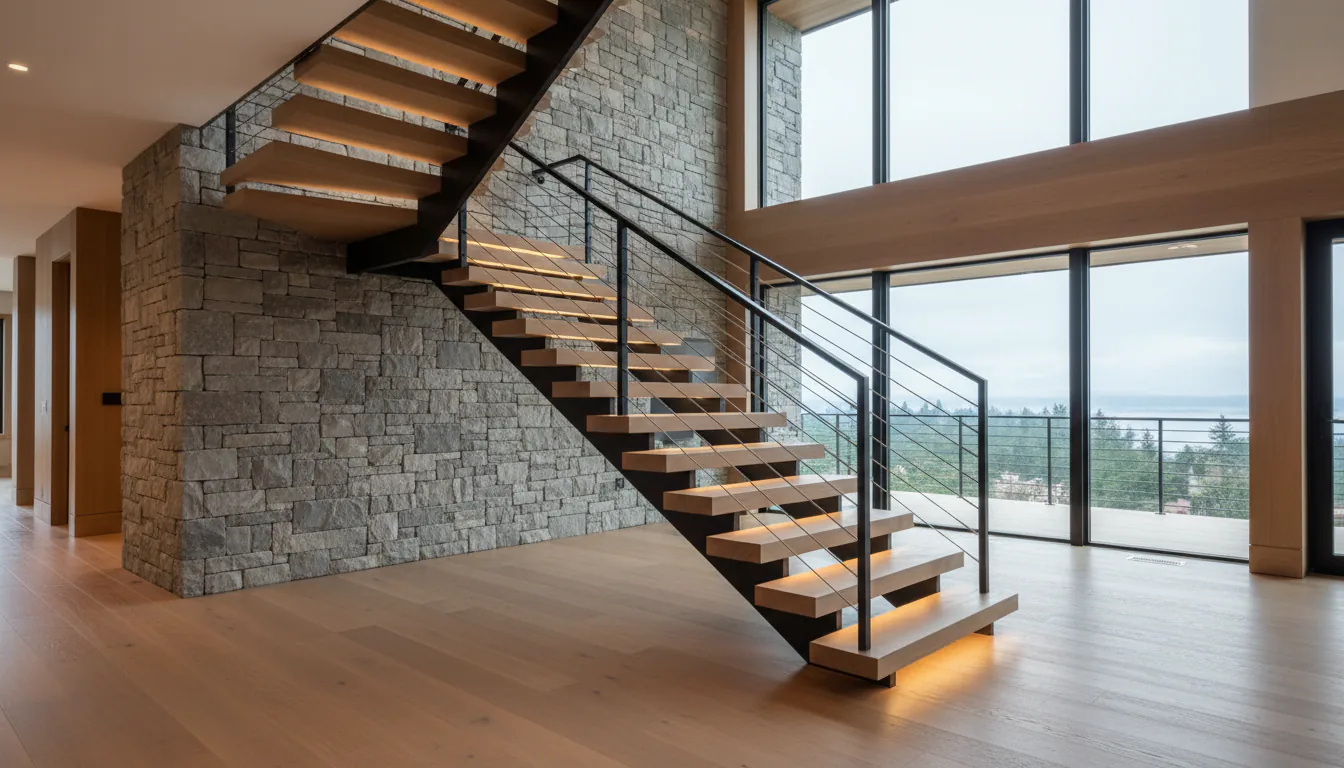
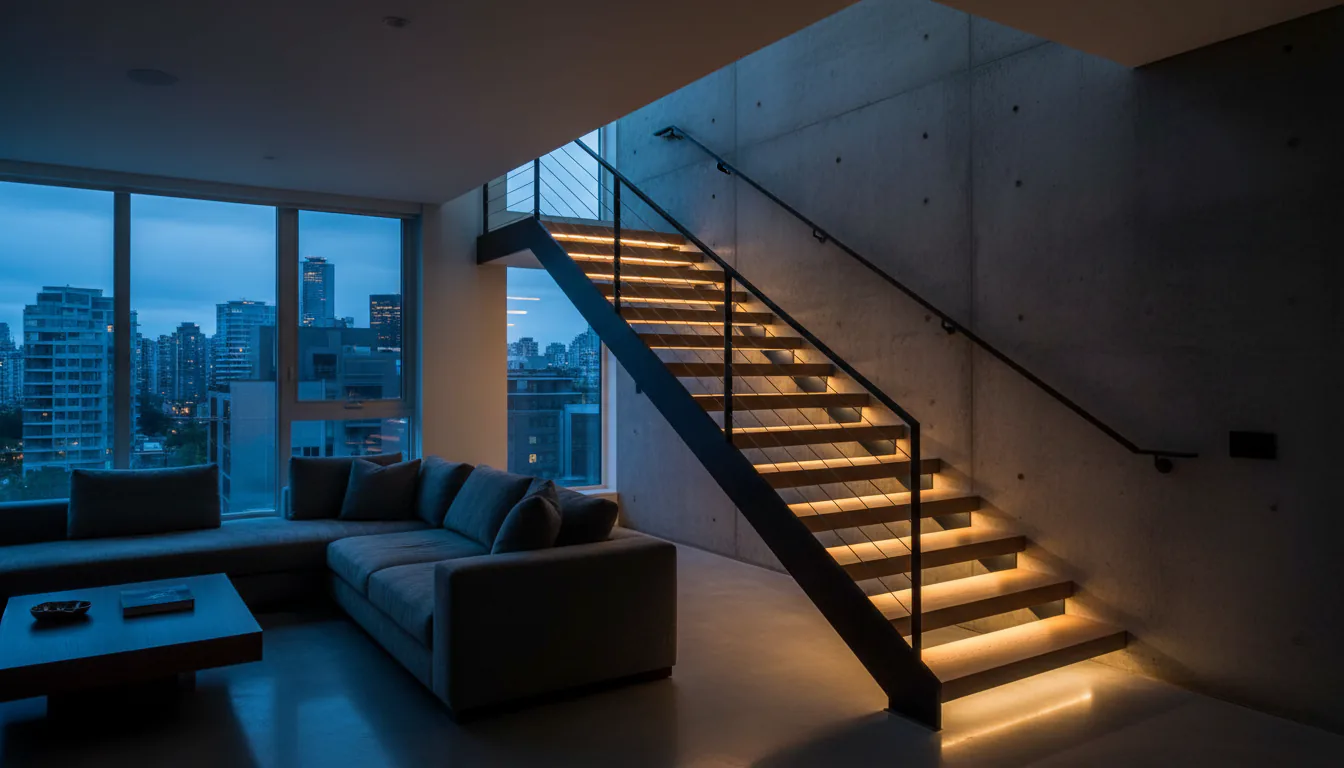
Under-tread strip lighting puts a continuous LED inside an aluminum channel mounted to the underside of each tread, washing the tread below with a soft line of light. Side-wall recessed step lights are individual fixtures set into the adjacent wall at tread height, casting a focused pool on each tread nosing. Handrail-integrated lighting hides a strip in the underside of the handrail and lights both the tread and the user’s hand position. Each is specified differently and each interacts with the stair structure in a different way.
The strongest projects we see usually use one strategy as the primary light and a second strategy as a secondary accent. Under-tread strips along a feature stair, with a single side-wall step light at the bottom landing for orientation, is a common pairing. Handrail-integrated lighting on the descent side, with no other stair lighting at all, is another. Three strategies on one stair is usually one too many.
Under-tread lighting drives the structural decision
Under-tread strips are the most common stair lighting we coordinate, and they are the strategy that has to be decided before fabrication. The aluminum channel that holds the LED strip needs a routed groove, a bolted bracket, or a continuous shadow-line in the stringer assembly to sit cleanly. On a mono stringer or hidden-stringer stair, the channel mounts to the underside of the wood tread itself, and the wire path runs through the steel toward the transformer.
The colour temperature on under-tread strips is what tends to be undersold in design conversations. Industry guidance from aspectLED puts 2700K to 3000K as the warm range that flatters white oak and walnut, and 4000K as the cooler range that suits stone and tile. CRI matters as much as the colour temperature, strips at CRI 90 or higher render wood grain naturally, while CRI 80 strips tend to push warm woods toward orange. The spec sheet should list both.
Side-wall step lights are the simpler retrofit
Side-wall recessed step lights are easier to add to a stair that is already framed because the wall is the host, not the steel. The fixture body sits inside an electrical box, and the tread cutout exposes a frosted lens at the top. They give a focused pool of light per tread rather than a continuous line, which reads as more punctuated and more architectural.
Side-wall lights are the right answer when the stair is in a finished wall on at least one side and the under-tread strategy is not feasible, usually because the tread is steel-pan-and-concrete and there is no soft underside to mount a channel to. They are also the answer when the stair is a feature in a public-facing space (a lobby or a gallery) where the user expects more deliberate, fixture-based lighting.
Handrail-integrated lighting works when the rail is the focus
Handrail-integrated lighting hides an LED strip and channel in the underside of a wood or steel handrail, lighting the user’s hand and the tread surface below. It works best on stairs where the rail is already a design feature, a continuous wood top rail on a steel guard, for example, and where the rail can be routed or fabricated with the channel from the start.
The fabrication detail is meaningful. The handrail has to be sized to accept the channel without losing its proportion, the LED needs a way to be replaced without disassembling the rail, and the wire has to enter at a post location that hides cleanly. Done well, handrail-integrated lighting reads as if the rail itself is glowing. Done poorly, the channel becomes the visible feature and the rail looks unfinished.
Power and switching are the next conversation
Most residential stair LED systems run on 24V DC because the voltage drop on a long run is much lower than on 12V. Industry guidance from FlexFireLEDs puts 24V DC as the practical default for runs longer than a few feet, with the transformer sized to the wattage of the strip plus a margin. The transformer needs a location that allows it to dissipate heat and that allows a future replacement, under the bottom landing, in a service closet, or in a small recess in the framing.
Switching is a design decision more than a technical one. Always-on at low brightness is the simplest, uses minimal energy at modern LED efficacy, and means the stair is always lit. Motion-activated brings the stair up to full brightness when someone is on it, which feels more dramatic but can leave the user in the dark for a beat at the start. The compromise, a low always-on baseline with motion-triggered ramp-up, is what we usually recommend on stairs that connect bedrooms to the main floor.
Smart-home integration belongs in the spec early
Stairs are increasingly tied to whole-house lighting controls, Lutron, Control4, Savant, or open-protocol systems, and the dimmer that drives the stair LED has to match the system. Most modern LED drivers support 0–10V dimming or DALI; some only support trailing-edge dimming. Confirming the driver compatibility with the rest of the lighting system before the stair lighting is ordered is the single piece of homework that prevents a no-dim or a flicker situation on commissioning day.
When the home has a dedicated lighting designer, the stair lighting goes on their drawings and the fabricator coordinates the channel, the wire path, and the access point. When the home does not, the stair lighting tends to fall to the electrician on site, and the channels have to be there in steel for that conversation to go anywhere.
Code touches stair lighting in a few places
Section 9.8 of the BC Building Code 2018 does not prescribe stair lighting wattage, but it does require stairs to be illuminated, and it requires nosings to be visible. A stair with low under-tread lighting and dim ambient light can fail the visibility test if the user cannot perceive the leading edge of each tread. The simplest defence is a slightly contrasting nosing material, a darker stained edge, a metallic insert, or a tone-stepped end-grain face, that the LED accent reinforces rather than masks.
Electrical work on the lighting is governed by the BC Electrical Code and reviewed by the AHJ. Low-voltage stair lighting connected to a 120V transformer is part of the renovation’s electrical scope and is permitted with the rest of the work. This article is not a substitute for code review by the authority having jurisdiction or a licensed electrician.
Commit before steel, not after install
The single most common stair lighting mistake we see is committing late. A homeowner decides on under-tread lighting after the steel has been fabricated and finished, and the channel ends up surface-mounted with a visible bracket, or the wire runs in a conduit on the visible face of the stringer. The same lighting, decided two weeks earlier, would have been routed cleanly through the steel.
The commitment that makes the difference is small: pick the strategy at shop drawing review, name the channel and the strip in the spec, and identify where the transformer lives. Everything downstream gets easier. For more on the fabrication sequencing this slots into, the floating stair process in Vancouver covers the steps where lighting decisions actually have to land.
Sources
Related questions
When should LED stair lighting be specified?
Before steel is fabricated, ideally at shop drawing review. Channels, wire paths, and access points are all easier to detail in steel than to retrofit in finished work. Late lighting decisions tend to compromise either the steel or the lighting.
What color temperature works best on white oak treads?
Warm, 2700K to 3000K, for residential stairs with white oak or walnut treads. Cooler temperatures around 4000K can work on stone and tile. CRI 90 or higher keeps the wood reading naturally rather than yellow or grey.
Are motion sensors worth it on stair lighting?
On stairs that connect a primary suite to the rest of the house, motion sensors with a low always-on baseline tend to feel right. Pure motion-activated systems can leave the user momentarily in the dark; pure always-on systems waste energy. The compromise is the answer most of the time.
Does stair lighting need an electrical permit?
Low-voltage stair lighting connected to a 120V transformer typically falls under the broader electrical scope of the renovation and is reviewed by the AHJ alongside the rest of the work. This article is not a substitute for code review by the authority having jurisdiction or a licensed electrician.