Spiral Staircases in Vancouver: When They Actually Work
Spiral stairs sound like the answer for tight Vancouver footprints, but the BC Code limits where they belong and the geometry has hard tradeoffs.
A spiral stair sells itself on footprint. Then the furniture arrives, and the code conversation starts.
Spiral stairs are the first answer that comes up when a Vancouver homeowner is short on floor area for a stair, laneway homes, secondary suites, mezzanines, rooftop decks. The footprint argument is real, but the code argument and the day-to-day usability argument both push back hard, and a spiral is rarely the right call for a primary stair in a home.
Define what a spiral stair actually is
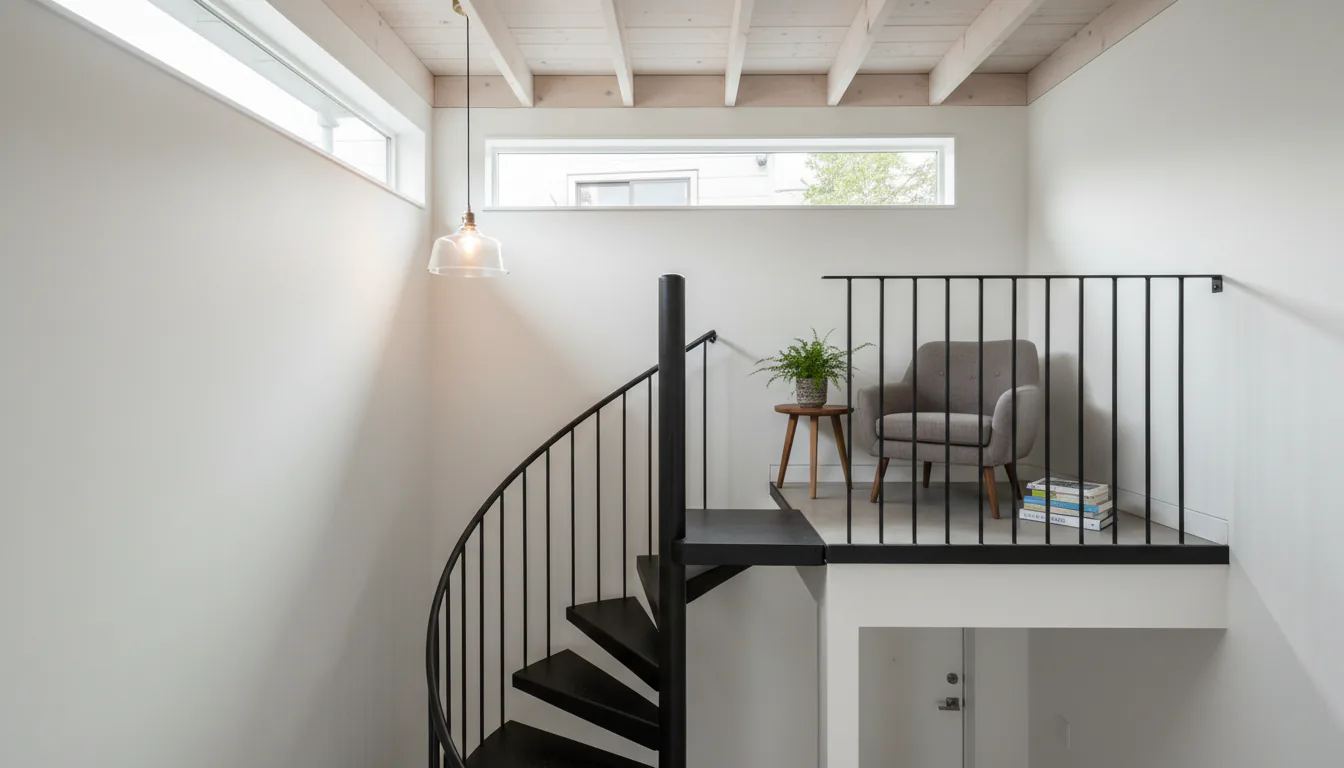
A spiral stair, in the strict sense, has wedge-shaped treads winding around a single central column. A circular stair has treads that wind around an open well rather than a column. A curved stair sweeps along a single radius without circling. The three are often used interchangeably, but they trigger different code clauses and have different fabrication paths. For this article, “spiral” means the wedge-tread, central-column type, the configuration most commonly proposed for tight Vancouver footprints.
The footprint pitch holds up, to a point
A 60-inch-diameter spiral fits in roughly a 5-foot by 5-foot floor opening, which is the smallest footprint of any code-buildable stair type. A straight run of the same vertical rise needs a stair opening closer to 3 feet by 12 feet plus a landing, and a switchback usually needs 5 by 8. For loft access in a laneway home or a mezzanine in a converted commercial space, that footprint difference is the entire reason the spiral keeps coming up.
The footprint pitch starts to weaken once furniture, mattresses, and large boxes need to move between floors. The wedge-shaped treads narrow toward the central column, so the usable width at the walking line is much less than the diameter suggests. Anything wider than that walking-line tread has to be tipped, lifted, or carried in pieces. In an actual residential build-out, that means the spiral tends to limit what can be installed upstairs after the stair goes in.
The BC Code is the bigger constraint
BC Building Code 2018 Section 9.8 is the residential reference for stair geometry. Public review materials around the 2018 edition, including a provincial review document on spiral stairs, documented changes that effectively disallow spiral stairs as the primary stair in many residential conditions. The code is more permissive on tapered treads and winders that turn through limited angles, and on stairs serving non-habitable spaces, but it tightened the door on spirals as a primary egress route.
What this means in practice is that the spiral that works for a rooftop deck access, a storage loft, or a mezzanine over a workshop is often not allowed as the only stair between two habitable floors. A homeowner planning a laneway home with the only stair to the bedroom level being a spiral usually finds that out at permit review, late, expensive, and after a lot of design work has already been done. This article is not a substitute for code review by the authority having jurisdiction.
Even where it is allowed, the geometry has limits
For the cases where a spiral is permitted, the code-driven minimums govern the design. Industry summaries of IRC R311.7 and IBC 1011.10 spiral stair requirements put minimum tread depth at 6¾ inches at the walkline 12 inches from the narrow end, minimum clear width 26 inches, maximum riser 9½ inches, and minimum headroom 6 feet 6 inches. These are American references, but they map closely onto what AHJs in BC tend to expect when reviewing the geometry.
Two consequences fall out of those numbers. First, the diameter has to grow as the tread depth requirement is satisfied at the walkline, so 5 feet is the practical minimum and 6 feet is more comfortable. Second, the headroom requirement means the floor opening above the spiral has to be sized for the rotation, not just the diameter, a smaller opening forces the user to duck for the last revolution.
Where a spiral is the right answer
A spiral is the right answer when the access is secondary, occasional, and the alternative is no stair at all. Common Vancouver use cases we see: rooftop deck access from a top-floor primary suite, mezzanine access in a workshop or studio, loft access in a laneway home where the loft is non-habitable storage, and an external steel spiral on a deck where vertical rise is short. In all of those cases the user accepts the wedge-tread reality and the alternative would be a ladder or a hatch.
External steel spirals on the coast also need a finish conversation. The American Galvanizers Association coastal-environment data shows hot-dip galvanizing as the baseline coating for any exterior steel in a wet, salt-influenced environment, and a duplex system (galvanizing plus a topcoat) extends service life noticeably. Both add cost, but on an exterior spiral they are usually the difference between a ten-year stair and a thirty-year stair.
Where a mono stringer or alternating-tread stair beats a spiral
When the floor plate has any room for a straight or switchback stair, a mono stringer almost always feels better day-to-day. The treads stay full-depth, the rise is consistent, and the stair is easy to climb with a load. A switchback in 5 by 8 feet of plan area is usually possible in a laneway home where the spiral was the first idea, and it gives back full-depth treads that solve the furniture problem.
When the footprint is genuinely too tight for a switchback and the code path for a spiral is closed, an alternating-tread stair is sometimes the answer for non-primary access. The half-tread layout cuts the footprint roughly in half compared with a normal stair while keeping a more usable walking surface than a spiral, and BC AHJs sometimes accept them for service or storage access. The same code-review caveat applies, confirm with the AHJ before designing around one.
Treat the spiral as the second-choice tool
The strongest small-footprint Vancouver projects we see treat the spiral as a tool for secondary access only. The primary stair runs straight or switches back, even if it is tight, and the spiral handles a deck, a loft, or a mezzanine where its limits are acceptable. That is also where spirals look best in the room, as a sculptural object visible from below, not as the daily route between bedroom and kitchen.
For the structural alternative when a straight run does fit, the mono stringer staircase deep dive covers the central-beam approach. For the broader stair-code reference, the BC stair code requirements for metal stairs covers where the residential and commercial paths diverge. For jurisdiction-specific permit context, see the Vancouver service area page or the steel staircases hub for the full residential staircase resource library.
Sources
Related questions
Are spiral stairs allowed as the only stair to a floor in BC?
Generally not for a habitable storey served by only one stair. Public review materials for the BC Building Code 2018 documented changes that disallow spiral stairs in many residential primary-egress conditions. Spiral stairs remain useful for secondary access, loft, mezzanine, rooftop deck, but a code reviewer should confirm any specific case.
What is the smallest spiral stair that actually works for an adult?
Most residential spiral packages start at 60-inch diameter for steel stairs. Smaller diameters exist but feel tight and limit what can be carried up and down. Diameter is also the variable that drives tread depth at the walking line, which has its own code minimums.
Can furniture be moved up a spiral stair?
Rarely without unbolting it. The wedge-shaped treads and the central column mean anything wider than the tread depth at the walking line has to be tilted, lifted, or carried in pieces. This is often the deciding factor against a spiral on the second floor of a primary residence.
When does a mono stringer or alternating-tread stair beat a spiral?
When the floor plate has the room for a straight or switchback run, even a tight one, a mono stringer almost always feels better day-to-day. An alternating-tread stair is the answer when the footprint is genuinely too tight for anything else and a spiral is not allowed.