Curved and Helical Staircases in Vancouver: What Fabrication Involves
How curved and helical stairs differ from spirals, what the shop is actually doing when steel gets rolled, and why these stairs carry a real cost premium.
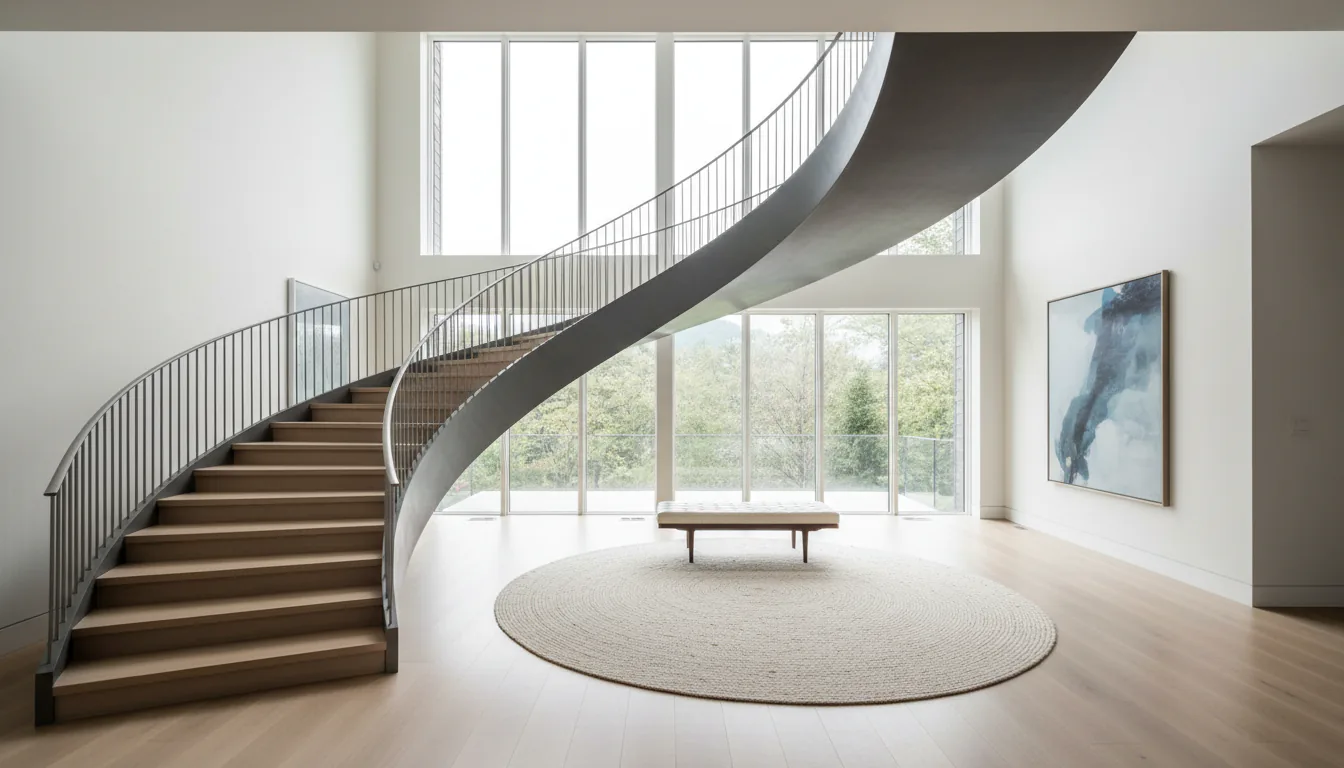
A helical stair photographs like a single sweeping object. The fabrication is anything but single.
A curved or helical stair photographs as a single sweeping object. The fabrication behind it is anything but single. The stringer gets rolled or segmented, the treads are templated to non-rectangular shapes, the railing tangents have to be drawn carefully, and the install runs in sequence around the curve. These stairs came back in 2026 because open-plan ground floors give them the room to breathe, but the fabrication conversation is meaningfully different from any straight-run stair.
Define the three terms before pricing them
The vocabulary gets used loosely. A curved stair sweeps along a single radius without completing a full revolution, it might turn 90 or 180 degrees in plan, but the stringer is part of one circle. A helical stair rotates more aggressively, often 180–360 degrees, around an open well rather than a central column, with no visible support post in the middle. A spiral stair has wedge-shaped treads winding tightly around a single central steel column.
These are three different stairs with three different fabrication paths and three different code conversations. A helical stair in a Vancouver foyer is not a “big spiral”, the structure, the engineering, and the look are different. The pricing conversations should also be separate, because conflating them is one of the reasons quotes for “spiral, helical, or curved stairs” come back wildly different from one shop to the next.
Steel rolling is what the shop is actually doing
The structural element on a curved or helical stair is a rolled steel stringer or pair of stringers. Rolling means a straight steel section, a rectangular hollow section, a structural tube, a plate beam, or a custom built-up section, gets passed through a specialty roller that bends it to a controlled radius. Industry references on helical bending services from CMRP and similar specialty rollers describe the process as pitched or sloped rolling, where the section is bent in two planes at once: the plan curve and the rise.
For tighter radii or where a roller is not available, the alternative is segmented fabrication. Short straight sections of steel are mitred at controlled angles and welded into the curve. The welds are then ground and polished so the curve reads as smooth from a distance. Segmented work is faster on the floor but requires more grinding and finishing time, and the close-up read is never quite the same as a true rolled stringer. Both approaches show up on Vancouver projects depending on the radius and the budget.
Templating is half the battle
A helical or curved stair cannot be built off plan dimensions alone. The actual floor opening, ceiling height, and wall conditions vary from drawings even in new construction, and the stringer has to land on real points. The standard templating approach is laser scanning the opening, capturing the floor plate, the upper opening edge, and any wall or ceiling that the stair touches, and importing the scan into the shop drawings.
Where laser scan equipment is not available, plywood and string templating still works for shorter curved runs. Either way, the templating step happens after the floor opening is framed and finished to as close to final dimensions as possible, which means the helical stair drops into a project later than a straight stair. In our shop, the field measurement step on a helical stair is the one that absorbs the most time and the one that protects the most cost downstream.
Why these stairs carry a real cost premium
Pricing on helical and curved stairs is not a percentage premium over a straight run. It is a multiplier. Engineering hours go up because the structural analysis has to handle a stringer in two planes. Rolling time and rolling cost go up because the radius and the pitch are unique to the project. Tread fabrication goes up because each tread is a different shape, the inner radius is shorter than the outer radius, and at the walking line the depth has to meet code, which sets the geometry.
The railing on a helical stair is its own line item. The top rail follows a continuous curve in three dimensions, and the post locations have to be drawn so the rail tangents are smooth as the user’s hand travels. A straight-run cable or glass railing kit cannot serve a helical stair; the rail has to be fabricated specifically. Indicative, confirm pricing with a current quote.
Common failure modes when shop drawings are loose
The two failure modes we see most often on helical or curved stairs are tread twist and rail tangent breaks. Tread twist happens when the tread sits across two stringers that are slightly off-radius from each other; the tread looks visually fine in isolation but the row of treads reads as if each one is rotated a few degrees from the last. The fix is tighter shop drawings on the stringer geometry and a test-fit of the assembly before paint or finish.
Rail tangent breaks happen when the rail is segmented at every post but the segments are not drawn tangent to the curve at the post. The rail travels in a series of small straight runs that almost-but-not-quite read as a curve. The fix is to draw and fabricate the rail as a continuous rolled element, with posts intersecting it rather than segmenting it. Either fix is much cheaper at shop drawing review than after install.
BC Code on tapered treads is the design-stage conversation
Section 9.8.4 of the BC Building Code 2018 governs tread and run dimensions. For curved or helical stairs, the relevant clauses are the ones on tapered treads, the rules that set how the run is measured at the walking line (typically about 230 mm from the inside edge of the tread for residential) and the minimum tread depth at that line. The code does not prohibit curved or helical stairs as primary residential stairs, and they are common in Vancouver custom homes when designed and stamped properly.
Headroom is the other clause that catches retrofit helical stairs. The clear height over the stair has to be 1,950 mm minimum in dwelling units and 2,050 mm in other occupancies, measured vertically over the clear width. On a helical stair the headroom check has to be made at the steepest point in plan, which is usually under the upper opening edge. Retrofits where the upper opening was sized for a straight stair sometimes fail headroom on the helical revision and have to be rebuilt before fabrication can proceed. This article is not a substitute for code review by the authority having jurisdiction or a structural engineer.
Lead time honesty matters most on these projects
Lead time on a helical stair is rarely the headline. Engineering review, shop drawings, steel rolling at a specialty supplier, fabrication, finish, templating, and install all have to land in sequence. Any one of them can be the long pole. In our shop, the rolling step is often where projects pause because the rolling is done at a specialty roller that has its own queue. The schedule decision on a helical stair is usually whether to lock the design early enough that the rolling slot can be reserved.
Once the project is on the floor, the fabrication tends to be linear because each step depends on the last, but the start has to be deliberate. The cleanest helical projects we work on commit to the radius and the pitch at schematic design and resist changes through engineering. Re-rolling a stringer because the radius changed late is a real cost.
Where helical lands in the design conversation
Helical and curved stairs reward early commitment more than almost any other stair type we fabricate. The rewards are real, a helical stair in a custom Vancouver home becomes the architectural anchor of the entire ground floor, and the engineering and fabrication detail are visible from every direction. The strongest projects we work on have the structural engineer, the designer, and the fabricator at the table before the floor opening is framed, with the pitch and the radius committed at schematic design.
For more on the broader sculptural-stair conversation, the sculptural statement staircases for Vancouver custom homes covers the design context. For the structural alternative when a curve is not possible, the mono stringer staircase deep dive covers what the central beam can do on a straight run.
Sources
Related questions
What is the difference between a curved, helical, and spiral staircase?
A curved stair sweeps along a single radius without circling. A helical stair rotates around an open well, often more than 180 degrees, with no central support column. A spiral stair has wedge-shaped treads winding around a central column. The three are often used interchangeably, but they are different stairs with different fabrication paths.
Why do helical stairs cost more than a straight mono stringer?
Engineering, steel rolling, templating, and longer install time all stack. The stringer has to be rolled or segmented to a specific radius, the treads are non-rectangular, the rail tangents have to be drawn carefully, and the install crew works in sequence around the curve. Helical stairs typically carry a multiple of a straight-run mono stringer, not a percentage premium.
Can a helical stair be retrofitted into an existing home?
Sometimes, but it usually requires rebuilding the floor opening to a clean ellipse or circle and reinforcing the surrounding framing. The site dimensions have to be templated tightly because the rolled stringer is fabricated to specific points. Retrofits are often easier in custom homes that were designed around an open well in the first place.
Does BC Code allow helical stairs as a primary stair?
Yes, when the geometry meets Section 9.8 of the BC Building Code, including the rules around tapered tread depth at the walking line. Helical stairs designed and stamped by a structural engineer for residential primary use are common in Vancouver custom homes. Confirm any specific design with the AHJ; this article does not substitute for a code review.