Sculptural Statement Staircases in Vancouver Custom Homes
What sculptural and statement staircases ask of a fabricator in 2026, material mixing, sightlines, and the early-coordination decisions that shape the build.
A statement staircase is rarely the most complicated object in a custom home. It is usually the first thing a visitor sees, which is why every decision around it carries weight.
Modern statement staircases in Vancouver custom homes are rarely the most complicated object in the build, but they are usually the most visible. Open-plan ground floors put the stair in three sightlines at once, and that visibility is what shifts a clean custom stair toward something sculptural. The decisions that follow, structure, material mix, rail form, finish, become design decisions for the whole room.
The stair has become the architectural anchor
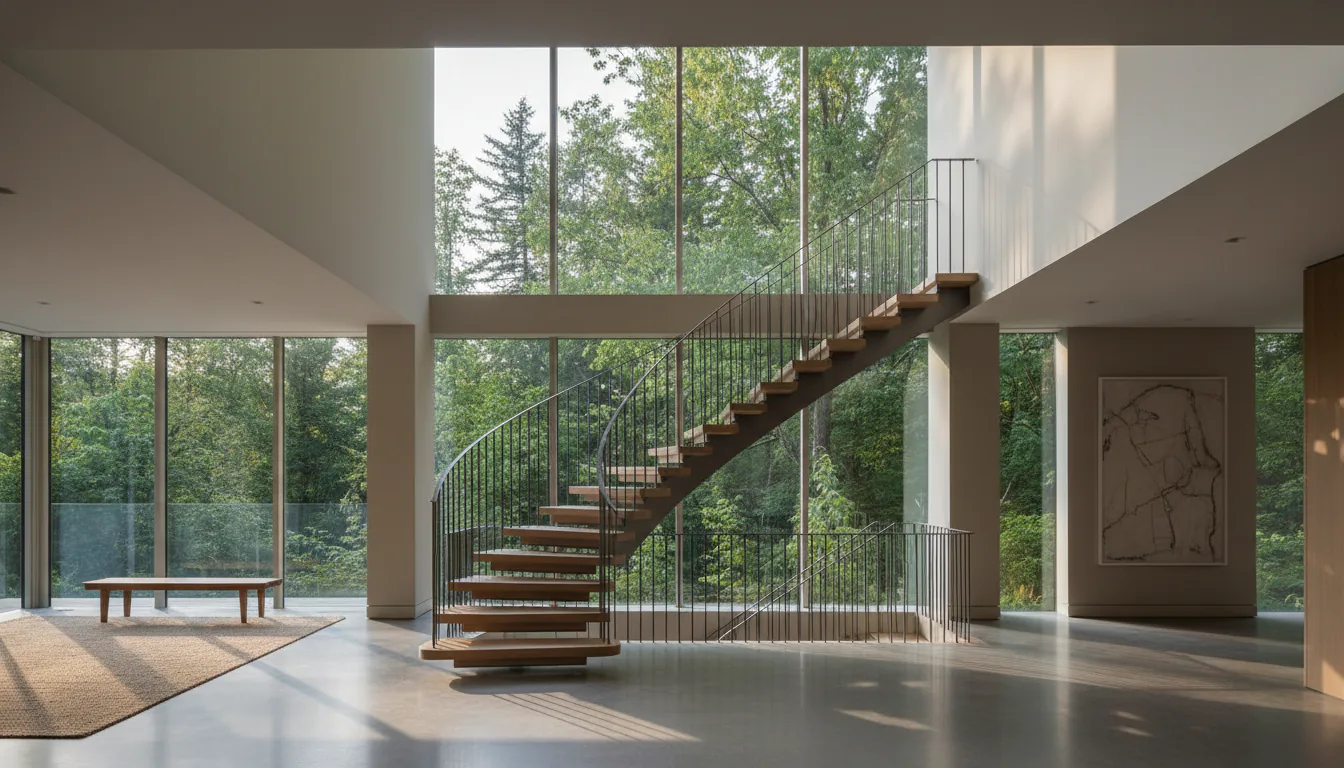
In the homes we have been fabricating for in the last few years, the stair is increasingly the first object a visitor reads when the front door opens. Open-tread structures, exposed steel, and mid-level landings that double as benches all push the stair into the room rather than against a wall. The decision a homeowner is now making is not “wood or metal” but “is this a connector or a feature?”
When the answer is “feature,” everything around the stair gets reconsidered. The wall behind it usually gets a continuous finish so the stair is the only object reading. The lighting gets specified to graze the structure rather than wash the walls. The floor finish meets the bottom tread cleanly. None of this is decorative, each one of those decisions has a fabrication implication, and resolving them early is what keeps the stair from being a compromise on site.
Material mixing is the new normal
A few years ago a residential statement stair was usually one structural material and one tread material. In 2026 the projects we see are mixing four or five: a steel central spine, white oak treads with end-grain faces, a slim brass-finished top rail, glass infill panels, and a feature stone landing at the half-height. Each interface is a fabrication detail that has to be drawn, mocked up, and tolerance-checked before steel is ordered.
Mixed material assemblies also drive the schedule. The steel beam might fabricate in three weeks, but the stone landing has its own lead time, the brass top rail comes from a specialty supplier, and the glass standoffs need to be coordinated with the guard layout. A statement stair calendar is rarely a single bar; it is several supplier timelines that have to land in the same week for install.
Curved and helical forms changed the price band
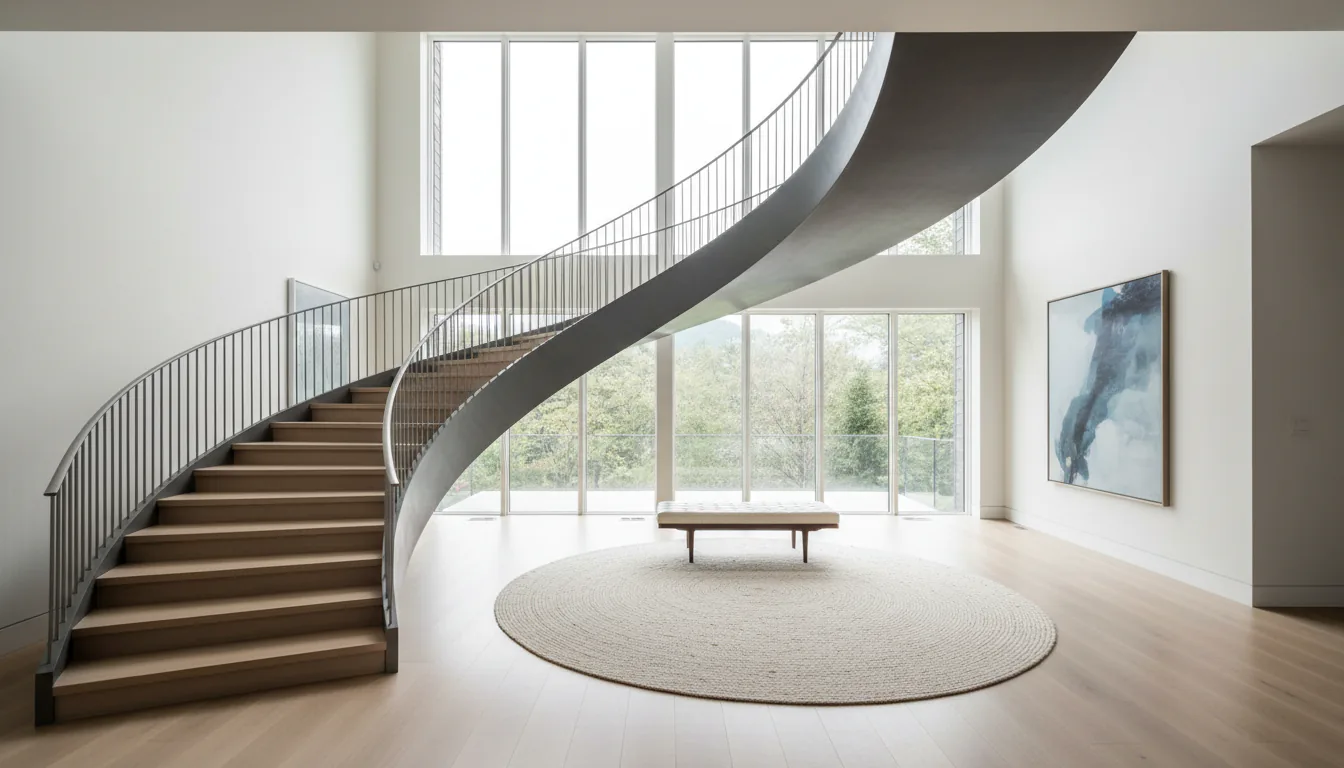
Curved and helical stairs are back in the higher tier of Vancouver residential work because the geometry reads continuous from any angle in an open-plan ground floor. The fabrication is meaningfully different from a straight run, though. Steel for a curved stringer either gets rolled at a section roller (which has its own shop and a minimum radius), or gets segmented from short straight pieces and welded into the curve. The first option is cleaner; the second is faster but requires more grinding and finishing to read smoothly.
Helical stairs, where the run rotates more than 180° around an open well, sit at the top of the residential cost band because the engineering, the templating, and the railing tangents all stack. A helical stair carries a multiple of a straight-run mono stringer in our shop, not a percentage premium, because so many of the decisions are unique to the geometry. They are also some of the most rewarding stairs to fabricate when the design is committed early.
Sightlines drive the structural choice
The structural choice on a statement stair often comes from the sightlines, not from the load case. A mono stringer reads as a single steel spine and lets the stair feel hung. A double stringer hidden inside the tread depth reads as a clean tread with no visible structure. Cantilevered treads off a wall read as treads only, with no structure visible from the room.
Each of those reads has a different cost, a different engineering requirement, and a different relationship to the surrounding finish. The cantilevered version, in particular, ties the stair into the wall framing and requires the wall finish to be coordinated tightly with the steel embeds. Resolving the structural choice against the sightline is one of the conversations that tends to happen too late on residential projects, and it is the conversation that benefits most from involving a fabricator at the schematic stage.
The rail is half the read
On a statement stair the railing is often half of what a visitor sees, and the rail decision should be made at the same time as the structural decision. A heavy guard with frequent posts will fight a delicate mono stringer. A frameless glass infill with minimum hardware will let the stringer breathe. Cable infill recedes the same way a thin steel spine does, so cable-and-mono-stringer reads as one continuous open frame.
Pricing for the railing alone scales with system. HomeGuide’s 2026 cable railing data puts professionally installed stainless cable systems at $100–$160 per linear foot, and HomeGuide’s 2026 glass railing data puts frameless and semi-frameless glass systems at $150–$600 per linear foot. On a sculptural run with a curved upper landing, the railing line item can rival the stair structure. Indicative only, confirm pricing with a current quote.
Code and engineering catch most projects
Section 9.8 of the BC Building Code 2018 sets the residential geometry, headroom, and guard requirements that a sculptural stair has to meet alongside the design intent. Guard heights are 900 mm in dwelling units and 1070 mm elsewhere. Openings in the guard cannot allow a 100 mm sphere through. Tread, riser, and run dimensions are tabulated for rectangular treads and again for tapered treads, which matters the moment a curve is introduced.
For cantilevered or floating sculptural stairs, Engineers and Geoscientists BC usually expects a structural review and stamp because the guard load and the tread connection are non-trivial. This article is not a substitute for code review by the authority having jurisdiction, an architect, or an engineer.
Early coordination is the budget protection
The strongest sculptural stair projects we work on have the structural engineer, designer, and fabricator at the table before the floor opening is framed. Every one of those parties carries decisions that constrain the others. The engineer needs to know the support strategy before sizing the beam. The designer needs to know the beam section before fixing the wall finish. The fabricator needs both to develop shop drawings and order steel.
When the order goes engineer → designer → fabricator with weeks between each handoff, the budget tends to inflate because constraints surface in sequence rather than in one room. When the three are coordinated together, the same project usually fabricates faster and the install is cleaner. The strongest projects bring the fabricator into the conversation before the stair opening, the railing strategy, and the surrounding finishes are locked.
For the structural side of that conversation, the mono stringer staircase deep dive covers what the central beam has to do. For the broader trend context, Vancouver metal stair design trends covers where the residential market is heading. For the full residential steel staircase resource library, artistic design guides, finishes, cost comparisons, and wood-to-steel replacement guides, see the steel staircases hub.
Sources
Related questions
What makes a staircase sculptural rather than just custom?
A sculptural stair is read as an object before it is read as circulation. Curved geometry, exposed structure, mixed materials, and how the stair sits in the room all push it from a clean custom stair into something architectural. Cost and lead time follow.
Why are statement staircases such a focus in Vancouver homes in 2026?
Open-plan ground floors mean the stair is visible from the front door, the kitchen, and the living room at the same time. When the stair is in three sightlines at once, it stops being a connector and becomes the room's anchor.
How early should a fabricator be involved in a statement staircase?
Before the opening is framed, ideally at the schematic stage. The structural engineer, designer, and fabricator each carry decisions that constrain the others, and resolving those once is faster than rebuilding drawings later.
Does a sculptural stair always need a P.Eng stamp?
A residential stair on a clear span with cantilevered or floating treads almost always requires engineering review. Curved geometry, helical forms, and mixed-material assemblies usually do as well. Confirm with the authority having jurisdiction; this article is not a substitute for AHJ review.