Exterior Steel Stairs on the Coast: Vancouver Finish Strategy
Why Vancouver and the North Shore demand marine-grade thinking on exterior steel, galvanized, duplex, stainless, and the connection details that fail first.
Coastal steel does not need the ocean to corrode. Wet, freeze-thaw, and a missed connection detail are usually enough.
This article is a fabrication-focused guide to coating systems and connection details. Specification decisions that affect structural integrity or code compliance belong with the authority having jurisdiction and a licensed professional engineer.
Exterior steel stairs in Vancouver and on the North Shore live in a chronic-wet, freeze-thaw, salt-influenced climate that punishes any weakness in the finish system. The decisions that matter are the coating spec, the connection detail at the post base, the touch-up cadence, and the corrosion grade of any stainless component. Most exterior stair failures we see are not catastrophic, they are slow, and they almost always start at a detail that should have been resolved before fabrication.
Coastal thinking applies even inland
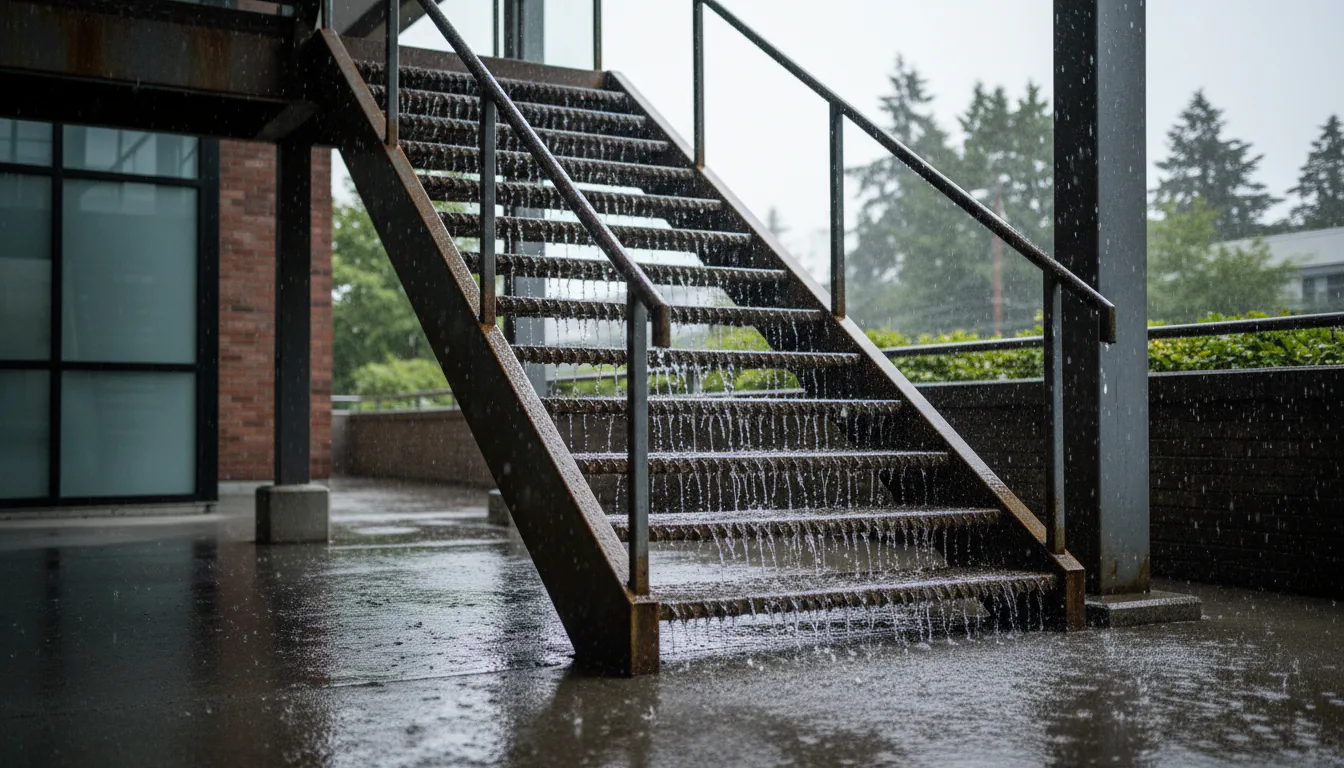
The instinct is to reserve “marine-grade” thinking for waterfront homes. The reality of Vancouver and the North Shore is that chronic wet exposure is the operative variable for any exterior steel, not just salt-air. Driveways, decks, exterior service stairs, and detached-stair access on the lower slopes of the North Shore see hundreds of wetting and drying cycles a year, plus freeze-thaw at higher elevations. Environment Canada climate data for Vancouver records over 1,100 mm of annual precipitation in the lower mainland, with much higher totals on the North Shore mountains.
That kind of wet exposure is what drives the finish conversation. Direct salt exposure is the more aggressive case, coastal homes in West Vancouver, Bowen Island, the southern Gulf Islands, but inland Vancouver exterior steel still needs a coating system designed for chronic wet, not just for a clean residential paint film.
Hot-dip galvanizing is the baseline
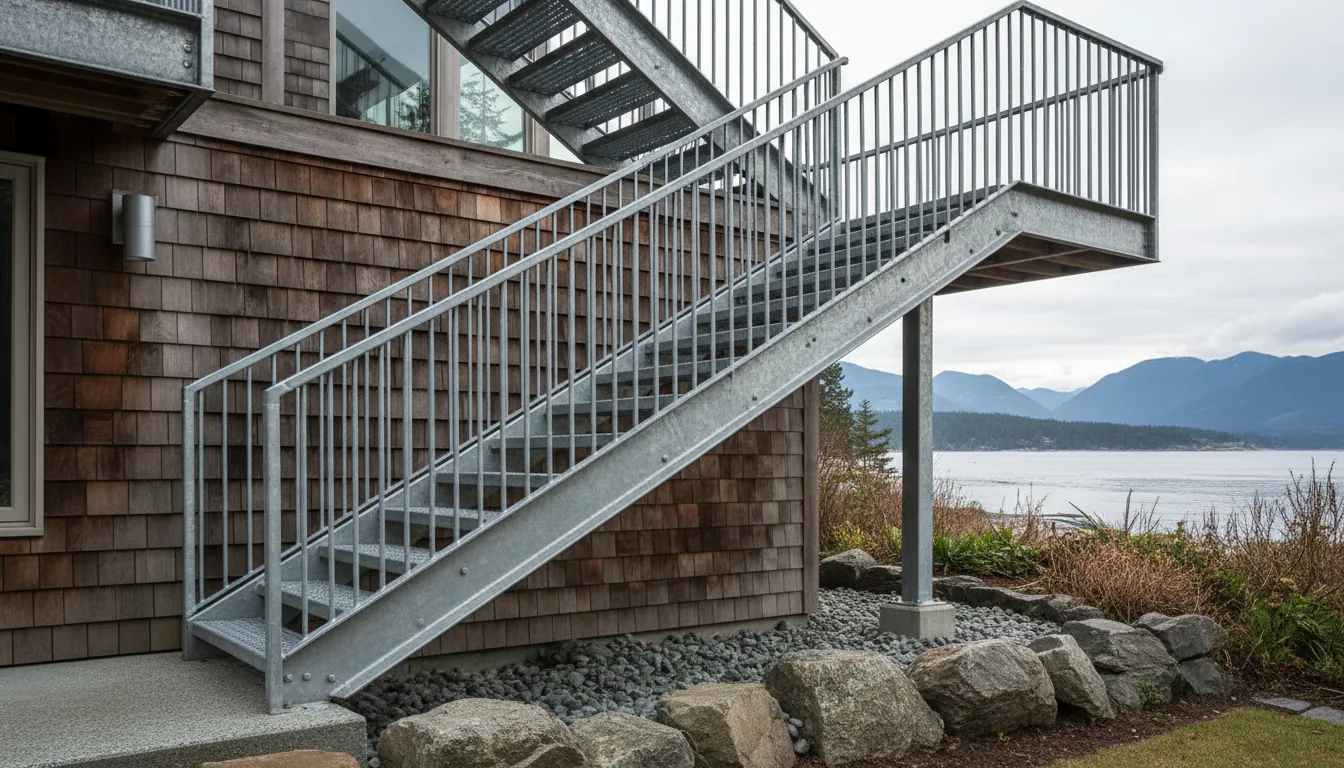
The default coating for exterior structural steel is hot-dip galvanizing. The steel is dipped in molten zinc, which forms a metallurgically bonded zinc-iron alloy layer plus a pure zinc top layer. The zinc protects the steel both as a barrier and as a sacrificial anode, even when the layer is scratched, the zinc preferentially corrodes around the scratch, protecting the underlying steel. American Galvanizers Association data on coastal environments shows multi-decade service life when the zinc layer is intact, with directly exposed coastal-zone life shorter than sheltered or inland-coastal exposures.
For a Vancouver exterior stair, hot-dip galvanizing alone is often the right call when the steel is fully galvanized after fabrication (so welds, drilled holes, and connection points are all coated), the post bases are detailed correctly, and the visible aesthetic is acceptable. Galvanized steel reads grey and slightly textured rather than black or coloured, which suits some architectural contexts and clashes with others.
Duplex extends the service life
A duplex coating system layers a high-performance topcoat over the galvanizing. The combined system typically outlasts the sum of its parts because the topcoat protects the zinc from weathering and the zinc protects the steel from any topcoat breach. American Galvanizers Association duplex-system documentation cites the synergistic effect between the layers, with combined service life exceeding the linear sum of the two coatings alone.
The topcoat conversation matters. Tnemec’s coating guide for steel substrates lists product lines suitable for marine and coastal exposures, including Series 90-75 zinc-rich epoxy and Series 132 for damp and immersion environments. Tnemec Technical Bulletin 10-78R2 on coating hot-dipped galvanized substrates sets the surface-prep guidance that turns a duplex system into a durable installation rather than a topcoat that peels off the zinc within a year. Skipping the prep step is the single most common duplex failure mode.
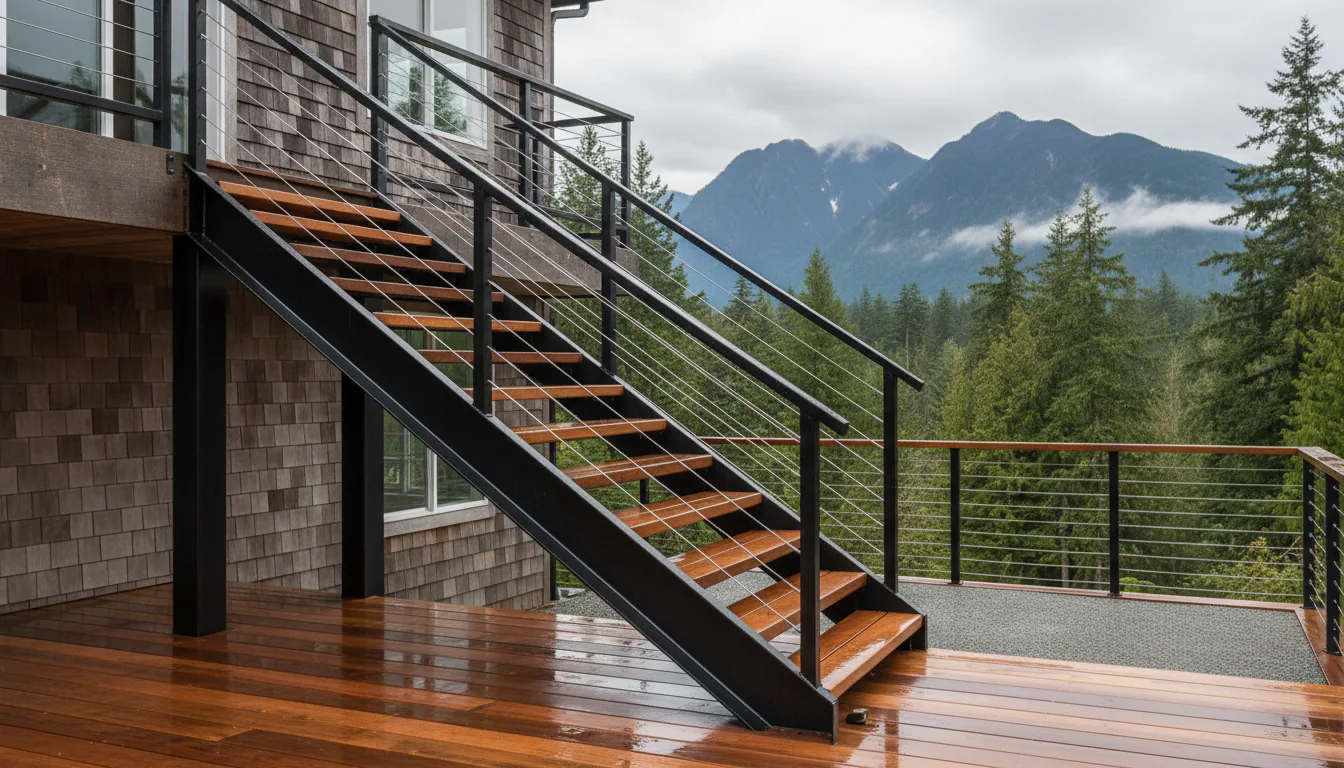
Powder coat over galvanizing is a related option that gets specified frequently for residential exterior stairs because it gives a matte black or dark bronze finish that suits modern Vancouver homes. The same surface-prep caveat applies, powder over zinc is not a guaranteed bond without specific intermediate treatment.
Connection details fail first
Catastrophic finish failure is rare on exterior steel stairs in Vancouver. What we see almost always is slow corrosion at a connection point, a post base sitting in standing water, a bolt with no washer holding moisture against the steel, a weld zone that did not get fully galvanized after fabrication. These are not coating problems; they are detail problems.
The standard exterior-stair detail for post bases is a steel base plate with a standoff, a small gap between the plate and the deck or concrete surface, that allows water to drain rather than pool. Stainless or galvanized hardware in the connection prevents galvanic corrosion against the stair structure. Welds done after galvanizing get touched up with a zinc-rich paint to restore the sacrificial protection. The stair drops onto the deck or concrete with the gap, not flat to the surface.
In our shop, the post base detail is one of the things we resolve in shop drawings before fabrication, because the alternative, figuring it out on site, usually means a compromise that shows up five years later as a stained concrete pad and a rusted post bottom.
Stainless 316 is the upgrade for waterfront
For directly exposed waterfront homes, Lions Bay, West Vancouver oceanfront, Bowen Island, the southern Gulf Islands, stainless 316 is the right call when the budget allows. AGS Stainless and Feeney CableRail datasheets document the chloride-pitting resistance of 316 versus 304, and the difference is real on direct salt exposure. Stainless is meaningfully more expensive than galvanized or duplex steel, but eliminates the recoat conversation entirely on the structure itself.
The mixed-system case is also common, stainless 316 cable infill on a galvanized-and-powder-coated steel structure, which gives the cable a maintenance-free corrosion grade while keeping the structural cost reasonable. The stainless components have to be specified carefully so that 316 hardware mates with 316 cable; mixing 304 fittings with 316 cable is a slow-failure spec.
Recoat cadence is part of the spec
Any duplex or powder-coated exterior stair needs a touch-up cycle. Manufacturer guidance on the specific topcoat is the right reference, but the typical residential touch-up cycle on a duplex system in Vancouver sits in the 7–15 year range depending on exposure, sun loading, and direct salt. Galvanized-only stairs get touched up when visual zinc loss becomes obvious, which is often a much longer cycle but eventually happens at exposed weld zones and post-base contact points.
The recoat cadence belongs in the spec conversation when the stair is built. Owners who know the stair is on a 10-year touch-up cycle plan for it; owners who are surprised by it ten years later sometimes let the corrosion progress past the easy touch-up window. For property managers and strata councils handling multi-unit exterior stair replacements, building the recoat allowance into the long-range capital plan is the simplest defence.
Where to land the spec
The strongest exterior stair specifications we see resolve four things before fabrication: the coating system (galvanized, duplex, or stainless), the post base detail and standoff, the hardware grade for any cable or stainless component, and the recoat cadence and responsibility. With those four locked, the stair holds up the way the photographs suggest, and the finish conversation does not become a maintenance crisis ten years on.
For more on the exterior decision framework, the North Shore exterior stair and deck considerations cover the moisture and detail decisions in more depth. For the multi-unit version of the same conversation, strata railing replacement on Burnaby towers covers what changes when the stair sits on a shared property.
For the full range of finishes and support strategies, see our overview of custom steel stairs in Vancouver.
Sources
- American Galvanizers Association, Hot-Dip Galvanizing in Coastal Environments
- Tnemec, High-Performance Coatings on Steel Substrates
- Tnemec, Technical Bulletin 10-78R2 Coating Hot-Dipped Galvanized
- Environment Canada, Climate Normals
- AGS Stainless, Cable Railing Systems
- Feeney, CableRail Stainless Cable Infill
Related questions
Is hot-dip galvanizing enough by itself for a Vancouver exterior stair?
Often yes for inland or sheltered installs. American Galvanizers Association data on coastal environments shows multi-decade life when the zinc layer is intact, with some shortening in directly exposed coastal zones. For exposed waterfront or salt-influenced exposure, a duplex system, galvanized plus a topcoat, extends service life noticeably.
Galvanized vs metallized vs duplex vs stainless, what's the cost order?
Generally lowest to highest: hot-dip galvanized, then metallized (thermal-sprayed zinc), then duplex (galvanized plus high-performance topcoat), then stainless 316. The right answer depends on exposure, visible aesthetic, and service-life expectation. Stainless costs more but eliminates the recoat conversation.
Why do post bases on exterior stairs fail first?
Most exterior stair failures we see are at the connection between the post and the deck or concrete. Posts sitting directly on a wet surface trap water; bolts in standing water rust the connection from inside. A standoff base plate with positive drainage is the single detail that prevents the most failures.
How often should an exterior steel stair be recoated?
On a duplex system, the topcoat usually needs a touch-up cycle in the 7–15 year range depending on exposure, with the underlying zinc layer continuing to protect the steel underneath. On a galvanized-only stair, the touch-up cycle is governed by visual zinc loss. Manufacturer guidance on the specific topcoat is the right reference.