Mono Stringer vs Double Stringer Floating Stairs
How to choose between a single central beam and two outer beams on a floating stair, sightlines, span, cost, and the cases where each is the right call.
A mono stringer reads as one steel spine. A double stringer reads as two clean beams. The choice changes the engineering, the cost, and how the stair feels in the room.
The structural choice on a floating stair is between one central beam and two outer beams. Both can produce the same open-riser, no-side-stringer look from across the room, but they sit at different points on the engineering, cost, and proportion conversation. Picking between them is the first decision after the design intent is set, and it constrains every detail that follows.
Define what each structure actually is
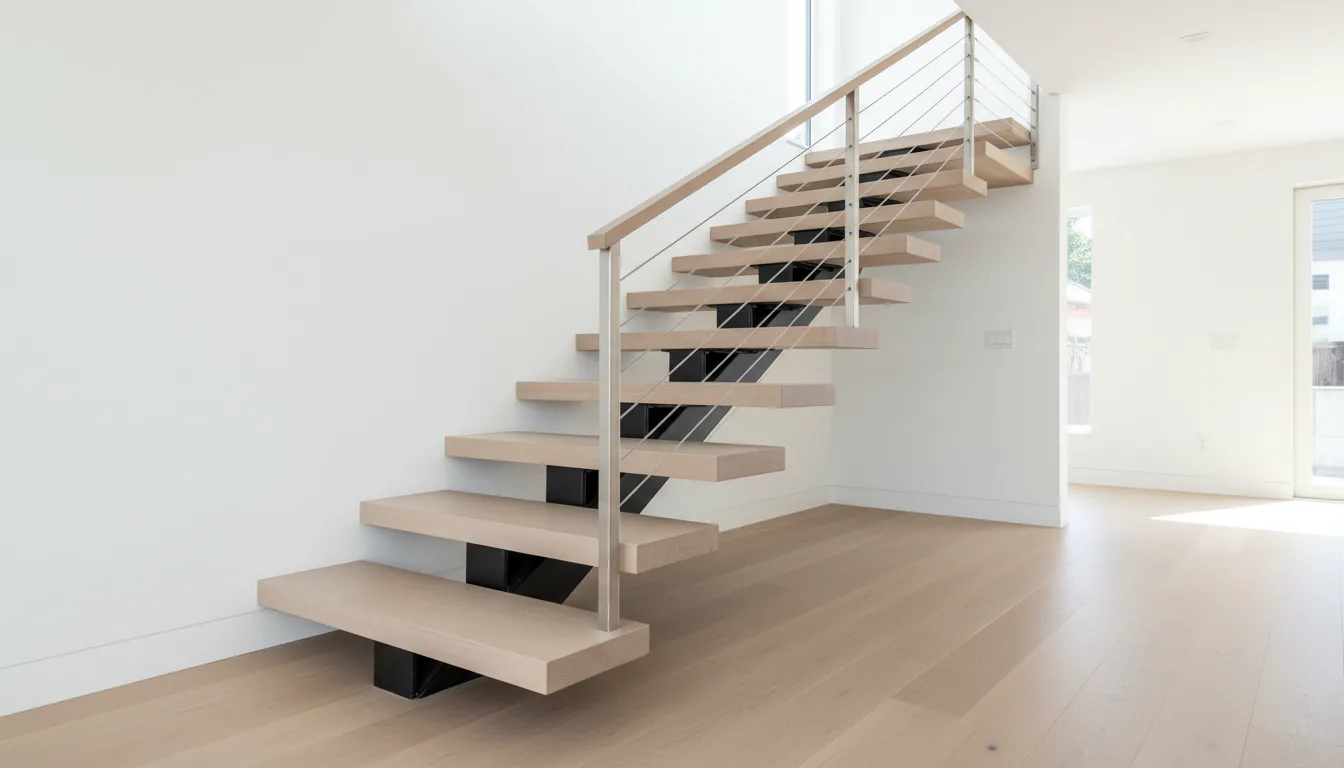
A mono stringer is a single steel beam running down the centreline of the stair, with each tread bolted or welded through a bracket to the top of the beam. The treads cantilever equally on both sides of the spine. From the side, the user sees a single beam supporting a stack of treads. The look is clean because there is one structural element doing all the work.
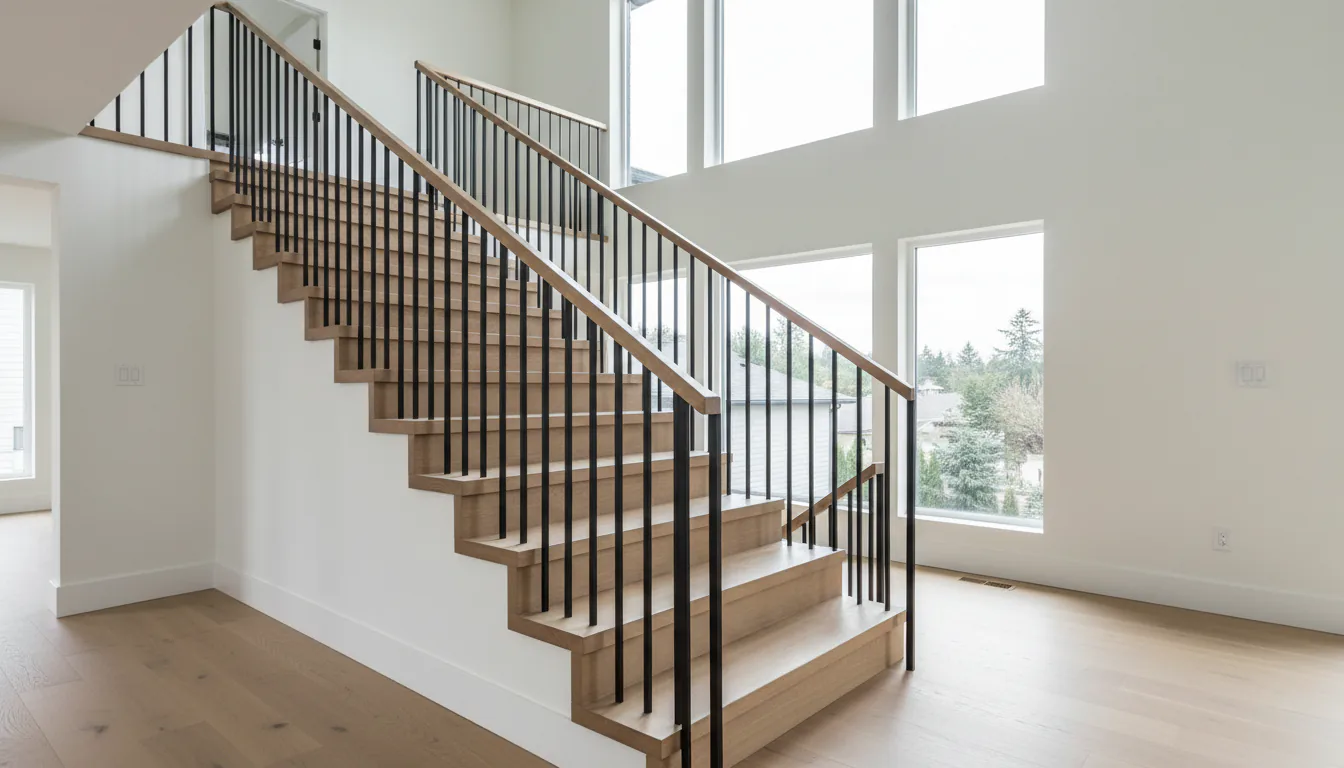
A double stringer is two parallel steel beams. They can be visible on the sides (a traditional double-stringer stair) or hidden inside the depth of the tread (a hidden double stringer, sometimes called a “concealed stringer floating stair”). When hidden, the treads still cantilever past the stringers slightly to give the floating-tread read, but the beams are inside the tread and out of view from the side. This is the most common structure on floating stairs in Vancouver homes because it gives the floating look with simpler engineering than a mono stringer.
Mono stringer wins on sightlines
The case for a mono stringer is the sightline through the stair. Because there is only one central beam, the stair is open on both sides and light passes through the structure horizontally. From the room across the foyer, the stair reads as a stack of floating treads with one delicate steel line through the centre. On a residential feature stair where the room is open-plan and the stair is visible from multiple angles, that horizontal openness is hard to match with any other structure.
The mono stringer also wins on narrow runs. When the tread is 850–1,000 mm wide, a single central beam reads better than two side beams because the side beams visually pinch the tread. On a stair built into a hallway opening or alongside a feature wall, the mono stringer keeps the stair from feeling enclosed.
Double stringer wins on span and tread width
The case for a double stringer, visible or hidden, is engineering simplicity on wider or longer runs. Once the tread is over roughly 1,200 mm wide or the run is approaching a long single span, the single-beam approach starts pushing the beam section size up significantly. A 14-foot single span carrying 1,400 mm wide steel-and-stone treads needs a beam that is no longer subtle, and the proportion fight starts. A double stringer at the same span and width keeps each beam at a reasonable section.
Heavy tread material amplifies this. A floating stair with full steel-pan treads or stone treads loads the central spine harder than the same stair with white oak treads, because the tread itself is much heavier before any live load. In our shop, we usually move toward a hidden double stringer once the tread material is steel or stone unless the run is unusually short. The engineering gets simpler, the welds are smaller, and the connection details are more forgiving.
Engineering pressure tells the cost story
The cost gap between the two structures is mostly in the engineering and the tread-to-stringer connection. On a mono stringer, every tread loads the central beam off-axis, and the bracket has to transfer that load through a single bolted or welded joint. The connection has to be designed for the live load, the guard load coming through the post on the tread, and any deflection. The shop drawings carry stamps on those connections, and the welds are tight.
On a hidden double stringer, the tread bears on top of two beams across its full depth. The connection is simpler because the two beams share the load. In most Vancouver projects we fabricate, the mono stringer carries a real premium over an equivalent hidden-stringer build for that reason, not because the steel package is bigger, but because the engineering and the welding are more concentrated on a few points. Indicative, confirm pricing with a current quote.
Aesthetic read separates two cleaned-up versions of the same look
Both structures can produce a “floating stair” photograph. What differs is the read up close and from a wider context. A mono stringer up close is one steel object running through the stair, and the eye goes to the beam first. A hidden double stringer up close is just treads, with the structure essentially invisible. From across the room, the mono stringer reads as a sculptural object; the hidden double stringer reads as a stack of suspended planks.
A heavy rectangular section reads industrial. A carefully proportioned beam, deeper than it is wide, can feel architectural and quiet. Mono stringer projects benefit from time spent on the beam proportion at the design stage, because the beam is the thing the user actually sees.
Sightline from below changes the answer
One detail that does not get enough attention: the view from below the stair. Floating stairs in open-plan homes are often visible from a lower-level living area or kitchen, looking up at the underside. A mono stringer from below shows the bottom of a single beam and the underside of the treads. A hidden double stringer from below shows the underside of the treads, the cavity between the beams, and the beams themselves hidden in shadow.
Neither is wrong, but they read differently. Some designs benefit from the visible single line of the mono stringer underside; others benefit from the cleaner, less-articulated read of the hidden double stringer underside. Walking the site at the design stage and looking up from below is the simplest way to make this call.
Code requirements are the same on both
Section 9.8 of the BC Building Code 2018 governs both. Tread, riser, and run dimensions are the same. Headroom is the same. Guard heights are the same, 900 mm in dwelling units, 1070 mm elsewhere. Both structures normally require a P.Eng-stamped design for any cantilevered or open-riser configuration in BC, with Engineers and Geoscientists BC as the registering body. This article is not a substitute for code review by the authority having jurisdiction or a structural engineer.
A four-question decision matrix
The decision usually lands quickly after four questions. Is the tread wider than 1,200 mm? Lean toward a double stringer. Is the tread material heavier than wood? Lean toward a double stringer. Is the stair visible from multiple angles in an open plan? Lean toward a mono stringer for the sightline. Is the design intent for the structure to read as a sculptural object? Lean toward a mono stringer.
Two answers in either direction usually settle it. Split answers, wide tread but the design wants a sculptural read, are where the design conversation gets longer and where a mock-up at the shop drawing stage helps most. The strongest projects bring the fabricator into the conversation before the stair opening is framed, because the structural choice constrains the floor opening, the guard post anchorage, and the surrounding finishes.
For more on the central-beam structure, the mono stringer staircase deep dive covers what the beam has to do. For the install side, the mono stringer stair installation in Vancouver walks through the sequencing.
Our hub overview of mono stringer stairs in Vancouver pulls the engineering, code, and cost detail together in one place.
Sources
Related questions
What is the structural difference between a mono stringer and a double stringer?
A mono stringer carries every tread through one central steel spine. A double stringer carries treads through two outer beams, either visible at the sides or hidden inside the tread depth. The mono stringer concentrates the engineering on the central beam and the tread connections; the double stringer distributes it across two.
Which is more expensive?
On equivalent runs, a mono stringer usually carries a fabrication premium because the tread-to-spine connection requires more engineering and tighter welding. The premium is not always large, for tight residential runs the gap can be modest, and for very long or wide runs the mono stringer can become impractical, which itself shifts the cost conversation.
When does a double stringer become the safer call?
On wider treads, typically over 1,200 mm, and on long uninterrupted spans, the double stringer takes the engineering pressure off a single beam. It also wins when the tread material is heavier (full steel or stone), where the load on a central spine starts to push the section size up.
Can a double stringer still look 'floating'?
Yes. Hidden double stringers, beams concealed inside the tread depth, give a clean cantilevered tread read while keeping the engineering simpler than a true mono stringer. This is the most common floating-stair structure we fabricate when the design wants the look without the mono stringer premium.