Metal Stair Design Trends in Vancouver Homes
A practical look at metal stair design trends in Metro Vancouver, what homeowners and designers are requesting in 2026, and how fabrication decisions shape the final result.
Modern stair design in Vancouver is moving toward quieter steel details, open sightlines, and finish choices that last. The trend is restraint, not simplicity, getting fewer elements exactly right.
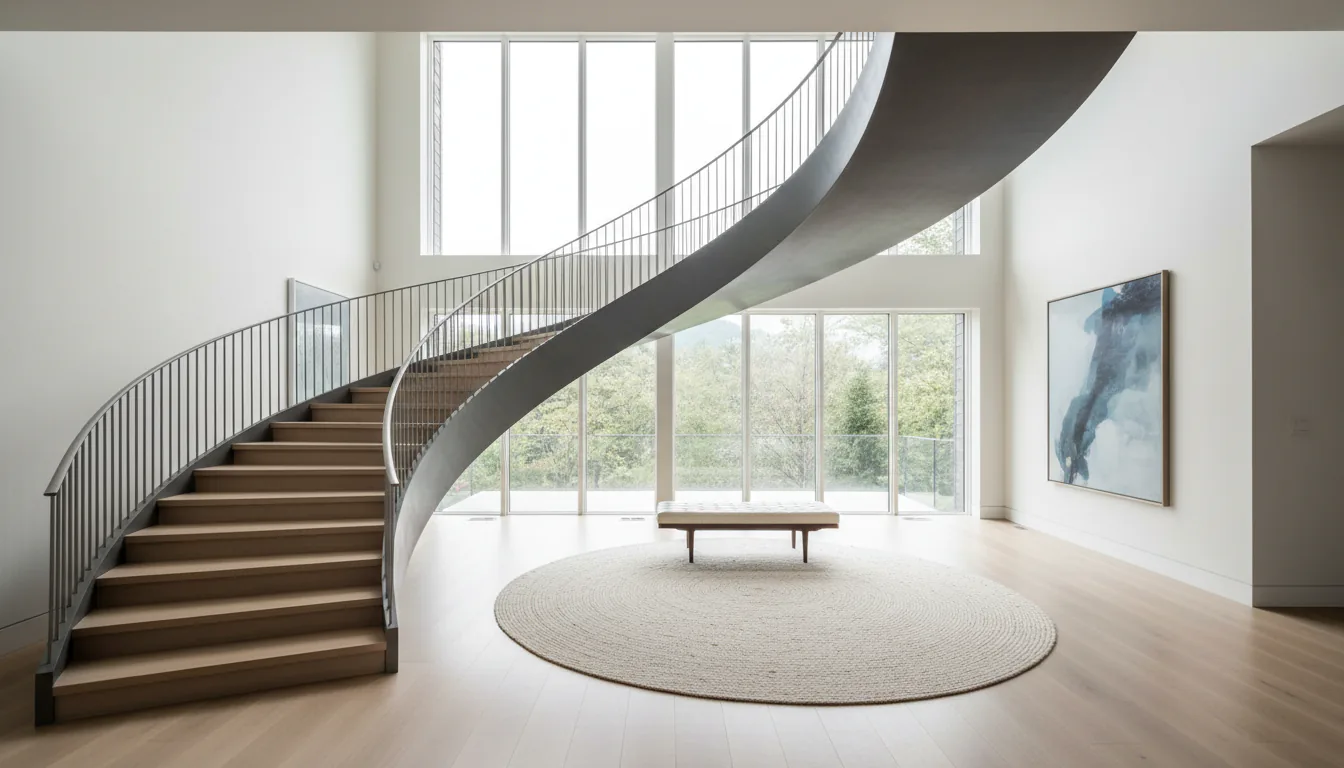
Modern metal stair design in Vancouver is less about showing off heavy steel and more about making the steel feel intentional. Homeowners still want drama, a staircase that reads as architecture, but the details are quieter: thinner visual profiles, open treads, glass or cable guards, and matte finishes that work with the rest of the interior without competing.
The trend is restraint, not simplicity. A well-executed mono stringer stair looks minimal because every proportion was deliberate. An under-designed one looks like an afterthought. The difference is almost never about style; it is about how early the fabrication decisions were brought into the design conversation.
Mono stringer stairs remain the reference point
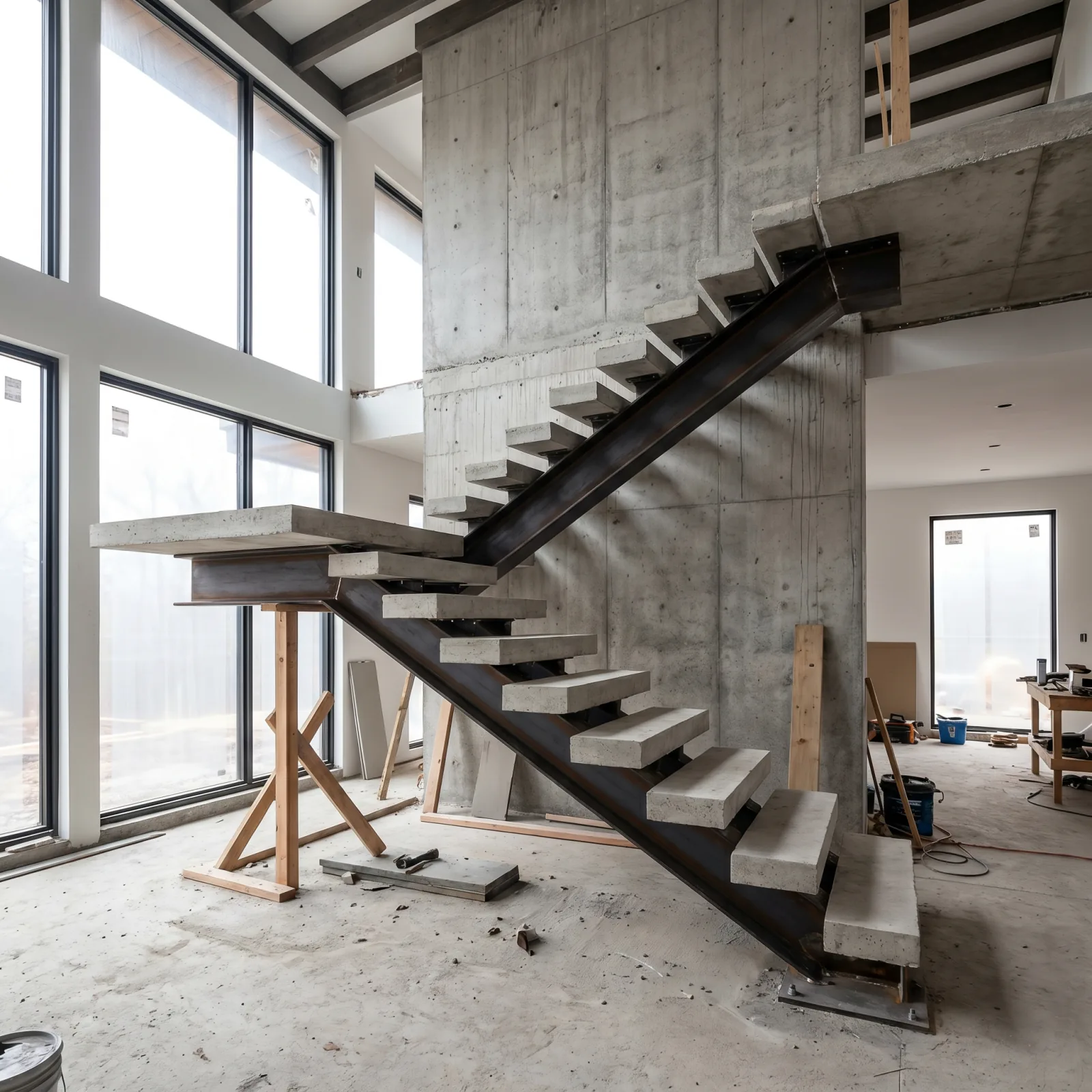
A mono stringer stair gives the cleanest balance between structure and openness. One central steel beam carries the treads, which keeps the sides visually light and leaves room for glass, cable, or slim steel guards to let light pass through the stair.
The important decision is not just the beam shape. Tread thickness, bracket layout, guard attachment, and how the stair meets the floor all affect whether the finished stair looks calm or busy. A bracket that is too thick or too abruptly detailed undercuts the minimal quality that most clients are imagining when they say they want a mono stringer.
The beam proportion relative to span matters too. A shorter residential run can accommodate a lighter beam section. A longer span or an intermediate landing adds depth requirements to control deflection, and at some point the beam starts to dominate the view through the stair rather than disappearing into it. The best beam proportion for a given stair is a fabrication judgment, not just a structural calculation.
In Vancouver new construction, mono stringer stairs are commonly specified in homes where the stair opens into a double-height living space. The stair becomes a vertical element in the room, a piece of architecture that the furniture and lighting plan around. For renovations, the same logic applies but the constraint set is tighter: existing floor framing, ceiling heights, and available run may limit span options.
Floating is a look, not one structure
People often ask for floating stairs when they mean open risers and a lighter visual effect. The term “floating” describes the visual result, not the structural method. A stair can achieve that look through a mono stringer, a hidden double stringer, cantilevered wall brackets, or a combination, and each approach has a different fabrication cost and a different engineering path.
The cleanest pricing conversations start by naming the support strategy. A hidden-stringer floating stair with two beams concealed inside the tread thickness is simpler to engineer than a true cantilever, where the tread load transfers through a single hidden beam or through the wall framing with a P.Eng-stamped design. Both look similar once the drywall is in and the treads are installed.
The choice matters most to the GC and the structural engineer at the framing stage. A cantilever needs the wall framing to be built around the hidden beam before the opening is formed. A mono stringer needs only two clean anchor points. Getting this decision locked before permit drawings are submitted prevents expensive structural changes mid-construction. The floating staircase cost guide for Vancouver in 2026 breaks down how the support strategy affects the budget.
Glass railings: still the premium choice
Glass remains the railing of choice on Vancouver feature stairs, particularly on view properties in West Vancouver, North Vancouver, and Kitsilano where the stair is a room element. Frameless and semi-frameless glass systems keep the visual plane clear, the stair reads as a floating structure, not a fenced path.
The practical constraints of glass on stairs in Vancouver are worth knowing. Glass panels are heavy, which adds to the bracket load at every post. The frameless system, where glass is set directly into a base shoe without posts, distributes load along the shoe channel. Semi-frameless systems with posts load the bracket at discrete points. Both work structurally, but the base shoe needs to be built into the tread detail during fabrication. Changing from cable to glass railing after the brackets are made means adding a weld and reworking the finish.
Exterior and near-exterior glass applications require attention to BC coastal conditions. Rain, salt spray, and cleaning access all matter for how the glass and hardware perform over a decade. Stainless fittings in 316 grade and powder-coated or galvanized base channels are the right spec for exposed applications; the hardware choices for an interior glass guard and an exterior deck guard are not the same.
Cable railings: practical for decks and mixed indoor-outdoor stairs
Cable railings have gained ground in Vancouver projects that mix interior and exterior stairs, particularly on homes where a deck stair and a covered entry stair are part of the same scope. The horizontal cable lines match the exterior aesthetic and hold up better under UV and moisture than glass in fully exposed conditions.
The critical design detail on cable railings is post spacing. Cables deflect under load, and the 100 mm sphere test that BC Code applies to guard openings (BCBC 9.8.8.5) is evaluated after deflection, not at rest. That means post spacing and cable diameter need to be engineered or confirmed with manufacturer data, not just estimated from appearance. The cable railing specification guide covers this in detail.
For raked cable runs on stairs, where the cables follow the pitch of the flight, the bracket geometry changes at every post because the angle between the cable and the post changes with the stair pitch. This is a fabrication detail that needs to be in the shop drawings, not left to field measurement.
Finish choices are becoming more restrained
Matte black remains common because it works with wood, glass, stone, and white walls. It is a neutral that rarely fights the interior palette. But the finish landscape has diversified over the past few years. Warm grey (a cooler version of the grey that was popular in the mid-2010s, applied with more precision) appears on projects where the interior uses a lot of natural wood tone and the client wants the stair to feel part of that palette rather than against it.
Bronze-black, a dark finish with visible brown undertone in certain light, is showing up on higher-end custom homes alongside unlacquered brass hardware and natural stone. It reads warmer than straight matte black and pairs with the material palette that Vancouver luxury residential projects are using more consistently.
Clear-coat and patina finishes (mill scale clear-coated, chemical patina followed by a sealer) appear on industrial-residential projects where the stair is meant to show as a fabricated steel object. These finishes require more maintenance than powder coat and are not appropriate for exterior applications, but they are the most visually distinct option when the stair is meant to be a material statement.
For exterior work, finish selection follows exposure rather than aesthetics. A beautiful colour is not a substitute for the right protective system. The standard for Vancouver coastal environments is hot-dip galvanize to ASTM A123 or CSA G164, followed by a powder coat or high-performance topcoat, a duplex system that gives both long-term corrosion protection and a finished appearance. Finishes that skip the galvanize layer on exposed exterior work typically fail within a few years regardless of how the colour looks on day one.
Tread materials define the residential character
In 2026, white oak remains the dominant tread material for residential mono stringer stairs in Vancouver. It is warm enough to humanize the steel, durable enough for residential traffic, and widely available in the widths and thicknesses that open-tread stairs need.
Walnut appears on higher-budget projects where the client wants a richer wood tone. Ash is used where the interior has a lighter palette and white oak reads too warm. Hardwood rift-sawn or quartersawn for dimensional stability on wide single-piece treads is a spec decision that fabricators and millwork suppliers usually coordinate.
Steel plate treads on residential stairs, especially perforated or checker-plate, are less common than they were five years ago but still appear on industrial-residential projects and on exterior stairs where drainage and low maintenance matter more than warmth.
The strongest trend is early coordination
The best stair projects in Vancouver in 2026 share one thing: the fabricator is involved before the opening, railing strategy, and floor finishes are locked. Changes to the stair opening or the connection points are cheap during framing and expensive after floors are in.
What a fabricator needs at the early-design stage is not full drawings, it is the floor-to-floor height, the available run (horizontal distance), the finished floor types (hardwood, tile, concrete), the stair opening dimensions, and the intended railing system. With those five pieces of information, a stair can be roughed out in a sketch that tests whether the preferred support strategy (mono stringer, hidden stringer, cantilever) is achievable within the space and budget.
For custom homes, the stair design conversation belongs at the schematic design phase alongside the structural engineer’s review of the floor framing. For renovations, a site visit before permit drawings are submitted saves the back-and-forth that happens when the permit drawings assume a framing condition that the existing structure does not actually have. The steel staircases hub covers residential and artistic staircase specifications in detail, including finishes, cost drivers, and wood-to-steel replacement guides.
Sources
Related questions
What is the most requested modern stair style in Vancouver?
Mono stringer and floating stair designs dominate Vancouver residential requests in 2026. Both keep sightlines open while making the steel part of the architecture rather than a box in the room.
Are glass railings still popular in Vancouver?
Yes. Glass remains common on feature stairs and view properties, though cable and slim steel guards are often more practical and cost-effective in projects where budget is a consideration or the stair is partially exterior.
What finishes are trending for metal stairs in 2026?
Matte black remains the default for its versatility. Warm grey and bronze-black are gaining ground on projects using natural timber or earthy interior palettes. Clear-coat and patina finishes appear on industrial-residential projects where the steel is meant to show as fabricated material.
How early should I involve the stair fabricator in a Vancouver renovation or new build?
Before the stair opening, railing strategy, and floor finishes are locked. Changes to the stair opening or connection points are cheap during framing and expensive after floors are in. Bringing the fabricator in at the drawing stage, before permit submission, is the most efficient path.