Staircase Replacement Permits in Vancouver: When and How Long
When a stair replacement triggers a Vancouver building permit, what BC Code clauses get cited, and how long the review actually takes in 2026.
A like-for-like stair swap is one conversation. A new opening with a steel mono stringer is a very different one. The permit process is the same in name, not in scope.
A staircase replacement in Vancouver can sit anywhere on a wide spectrum, from a like-for-like swap that proceeds quickly to a full structural rework that runs through the same review process as a major renovation. The permit conversation depends on what is actually changing, opening, structure, cantilever, and the timing depends on which municipality and which queue the application lands in. Knowing where the project sits before drawings start is the single thing that protects the schedule. For an overview of what Vancouver Stairs fabricates and installs during a staircase replacement in Vancouver, see the dedicated service page.
Three replacement scenarios drive the permit conversation
The first scenario is true like-for-like: the existing stair is removed and a new stair of the same configuration, same opening, same connections, and same guard heights is installed. In this case the structural framing does not change and the new stair meets the same code clauses as the old. This is the simplest path and sometimes proceeds without a separate building permit at all, depending on the AHJ.
The second scenario is replacement-with-structural-change: the new stair has a different geometry, a switchback becomes a straight run, an enclosed stair becomes open-riser, but the floor opening stays roughly the same. This usually needs a permit because the surrounding framing or the guard load engineering changes, and the AHJ wants to see the new design.
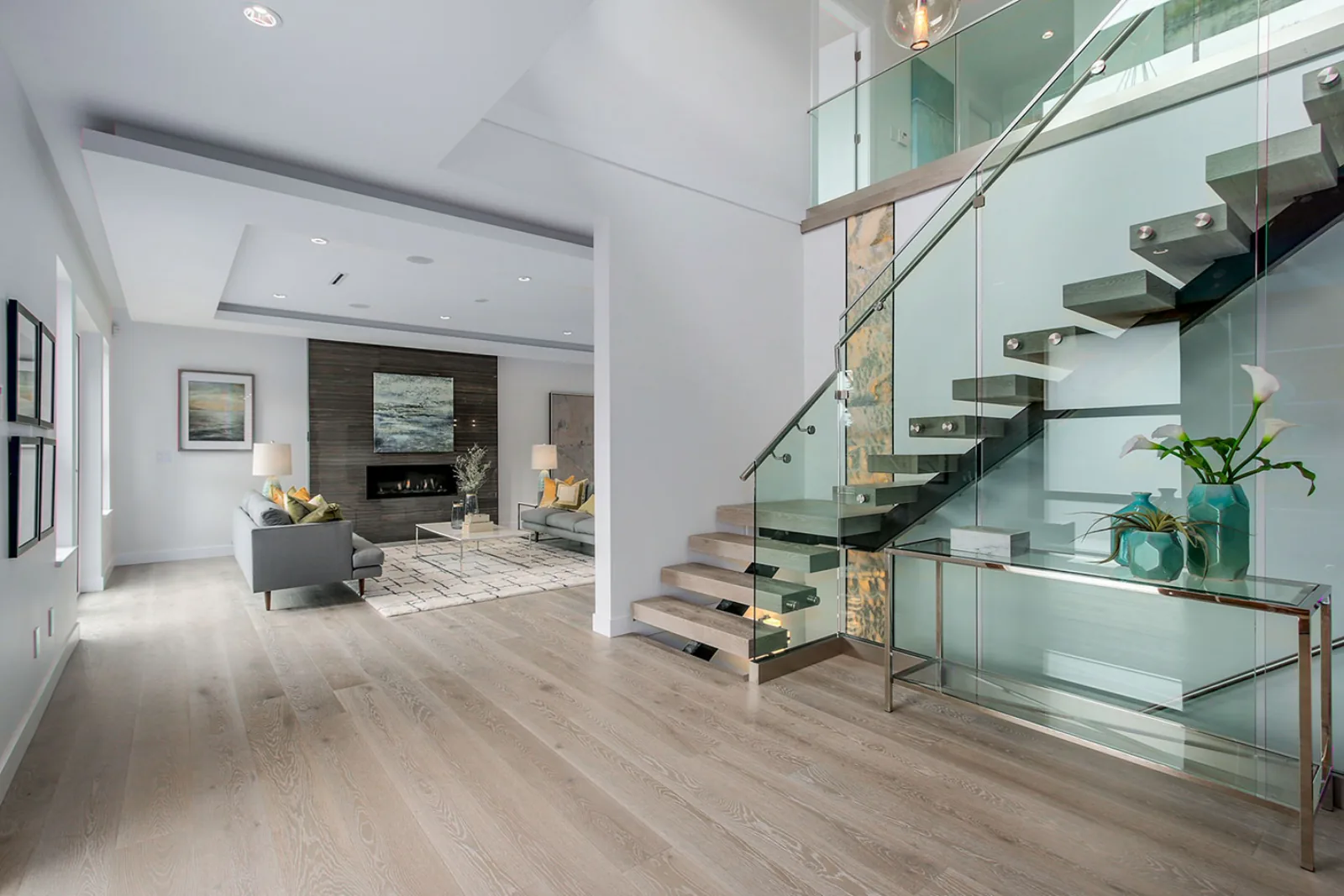
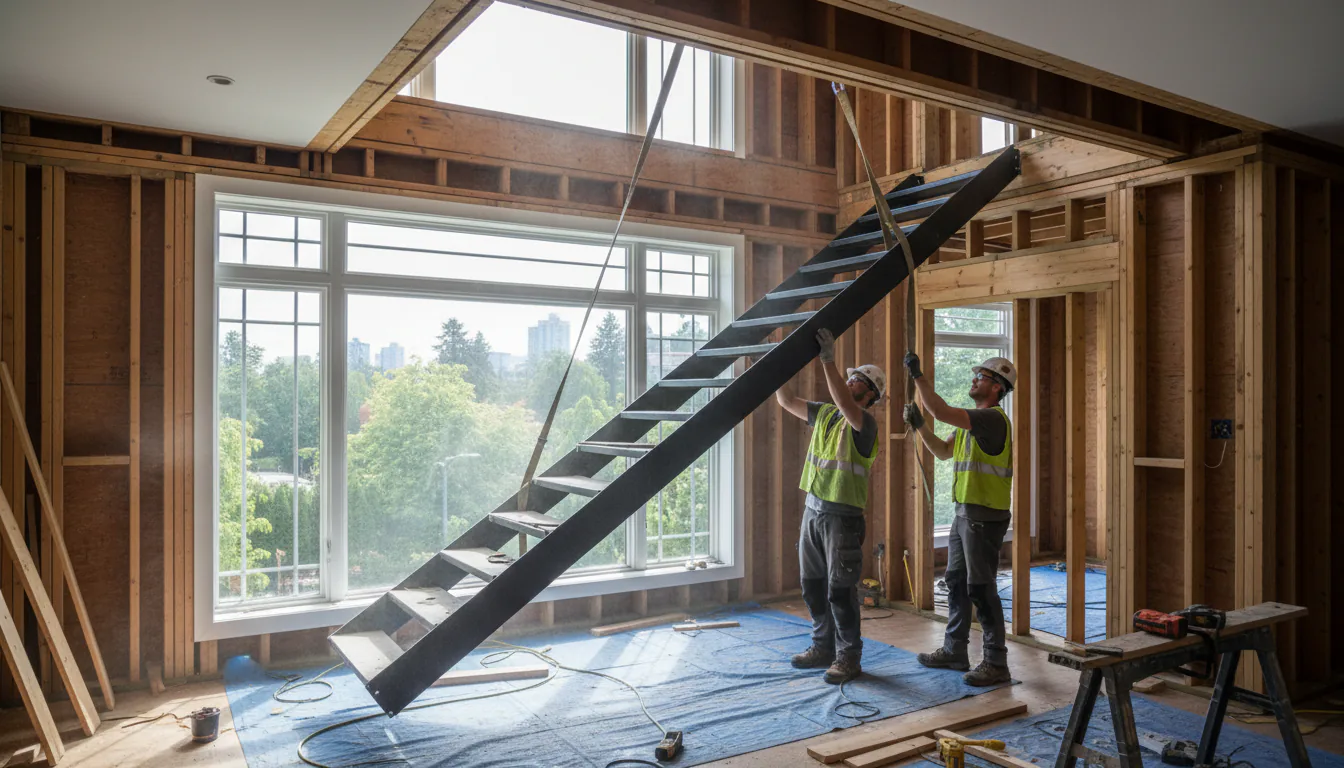
The third scenario is replacement-with-new-opening: the floor opening is reshaped, the structure changes (often to a cantilevered or mono stringer floating stair), and the surrounding framing has to be reworked. This is a structural alteration and runs through the standard permit path with engineering, drawings, and an AHJ review.
The City of Vancouver permit page is the canonical reference
The City of Vancouver building permit page is the canonical reference for current process and forms. Stair replacement that involves structural alteration, new openings, or change of structural framing falls inside the building permit scope. The application requires drawings showing the proposed stair geometry, structural details, code compliance, and any engineering stamps.
For projects involving mono stringer, cantilevered, or floating stairs, the application also typically includes a structural engineering review and stamp from a member of Engineers and Geoscientists BC. The engineer reviews the connection details, the guard load, and the structural framing where the stair anchors. The stamp comes back on the shop drawings before fabrication.
This article is not a substitute for code review by the authority having jurisdiction, an architect, or a structural engineer. The information here describes the general path; specific projects should be confirmed with the City of Vancouver building department.
BC Code clauses cited on residential stair permits
The clauses that come up most often on residential stair permit applications are concentrated in Section 9.8 of the BC Building Code 2018. Rise and run dimensions are tabulated in 9.8.4. Headroom is 1,950 mm minimum in dwelling units measured vertically over the clear width of the stair. Guard heights are 900 mm in dwelling units and 1,070 mm elsewhere, with openings in the guard limited so a 100 mm sphere cannot pass through. Handrails sit between 865 and 965 mm above the tread nosing.
These clauses are what the AHJ checks against on review. Drawings that explicitly call out the dimensions for each, the rise, the run, the headroom at the worst case, the guard height, the opening dimension between cables or pickets, the handrail height, get reviewed faster than drawings that leave the reviewer to verify each one.
Timelines vary by complexity and queue
Industry trade reporting on Vancouver permit timelines for 2026 puts simple residential permits at three to six weeks for routine work, standard residential renovations at eight to twelve weeks, and complex or structural permits at three to five months. The City of Vancouver also runs a fast-track stream that targets three days for simple home renovations valued under $95,000, which can apply to certain stair replacements.
Cross-referenced reporting from Vancouver General Contractors on 2026 permit timing cites similar ranges and notes that the pre-application work, architectural and structural drawings, P.Eng review, energy reports if the envelope is touched, adds four to eight weeks before the application is even submitted. For a stair replacement involving a new mono stringer or floating stair, that pre-application time is real and usually understated.
For projects in Burnaby, Richmond, North Vancouver District, North Vancouver City, West Vancouver, or other Lower Mainland municipalities, each has its own queue and its own typical timing. The BC Code reference is consistent across the province, but the AHJ review and timing are not.
Why permit applications get bounced
The most common reasons a stair-related permit application bounces or stalls are: incomplete drawings without rise/run/headroom/guard dimensions called out, missing engineering stamps on cantilevered or floating stair details, missing detail on the existing structure where the new stair anchors, and missing AHJ-required information on smoke alarms, fire-rating, or means of egress when the stair sits between storeys with a fire separation.
The pattern is consistent: incomplete applications cost weeks. A clean application with stamped drawings, full dimensions, and a clear scope of structural change moves through review on the lower end of the timeline range. The investment in completing the drawings before submission pays back several times over in queue time.
Strata and townhouse complications add a layer
Stair replacement in a strata-titled building or townhouse complex adds a strata approval layer on top of the municipal permit. The strata bylaws and the strata council usually have to approve any change that affects common property or structure shared with neighbouring units, and the approval process runs in parallel with the permit application but can have its own timeline. For multi-unit buildings, this is sometimes the longer pole than the municipal permit itself.
For more on the strata-side conversation on related metalwork, the strata railing replacement on Burnaby towers covers what changes when the metalwork sits on a shared property.
What the cleanest replacement projects share
The cleanest stair replacements share four things: the scope of structural change is clear before drawings start, the engineering stamp is secured before the permit application is submitted, the drawings call out every BC Code dimension explicitly, and the homeowner or GC has confirmed with the AHJ that the application path is right for the project. With those four locked, the permit timeline lands in the lower end of the range, and the fabrication and install run on schedule.
When in doubt, resolve documentation before fabrication starts. For more context on the residential code reference, the BC stair code requirements for metal stairs covers the clauses that come up most. For the install side once the permit is in hand, the floating stair process in Vancouver walks through the sequencing. For the fabrication side of the process, shop drawings, CWB certification, and material selection, see the custom metal fabrication hub.
Sources
- City of Vancouver, Building Permit
- City of Vancouver, Vancouver Building By-law
- BC Building Code 2018, Section 9.8 Stairs, Ramps, Handrails and Guards
- Engineers and Geoscientists BC
- Walker General Contractors, Vancouver Renovation Permits 2026
- Vancouver General Contractors, Vancouver Building Permits 2026
Related questions
Does every staircase replacement in Vancouver need a building permit?
Not every one. A true like-for-like replacement using the same opening, the same configuration, and no structural change can sometimes proceed without a separate permit. Anything that changes the opening, changes the structure, or introduces a cantilevered or floating stair almost always triggers a permit. Confirm any specific case with the City of Vancouver.
When does a stair require a P.Eng stamp?
Cantilevered stairs, floating stairs, mono stringer stairs with feature spans, and any stair where the guard load engineering is non-trivial require a structural engineer's stamp in BC. Engineers and Geoscientists BC is the registering body. The stamp comes with shop drawings before fabrication.
How long does a Vancouver stair-replacement permit take?
Industry trade reporting in 2026 puts simple residential permits at three to six weeks, standard residential renovations at eight to twelve weeks, and structural or complex permits at three to five months. The City of Vancouver fast-track stream targets three days for simple renovations valued under $95,000. Specific timelines depend on the application and the queue.
What about Burnaby, Richmond, and the North Shore?
Each municipality has its own permit office and its own queue. Burnaby, Richmond, North Vancouver District, North Vancouver City, West Vancouver, and the City of Vancouver all run separate processes. Confirm with the local building department; the BC Code reference is the same across the province but the AHJ review and timing are not.