Floating Stair Tread Thickness: Wood, Steel & Stone Specs
Floating stair tread thickness: hardwood 50–75mm, steel 12–20mm, stone 40–50mm, and why your support method decides which applies. Vancouver fabricator.
Tread thickness is the most underestimated decision on a floating stair. Too thin and the bracket shows. Too thick and the rise looks heavy. The right answer depends on the support strategy.
Tread thickness is the smallest dimension on a floating stair drawing and one of the most consequential. A 50 mm tread reads delicate. A 75 mm tread reads solid. Either can be the right call. The bracket geometry, the railing detail, the open-riser appearance, and the budget all shift with the number.
Most Vancouver custom-home floating stairs we build land between 50 mm (2 inches) and 75 mm (3 inches) for solid hardwood treads. Steel, stone, and microcement treads sit in different ranges. Here is how we sort through it.
Start with the support strategy
The support method determines how much tread thickness the bracket actually needs to hide.
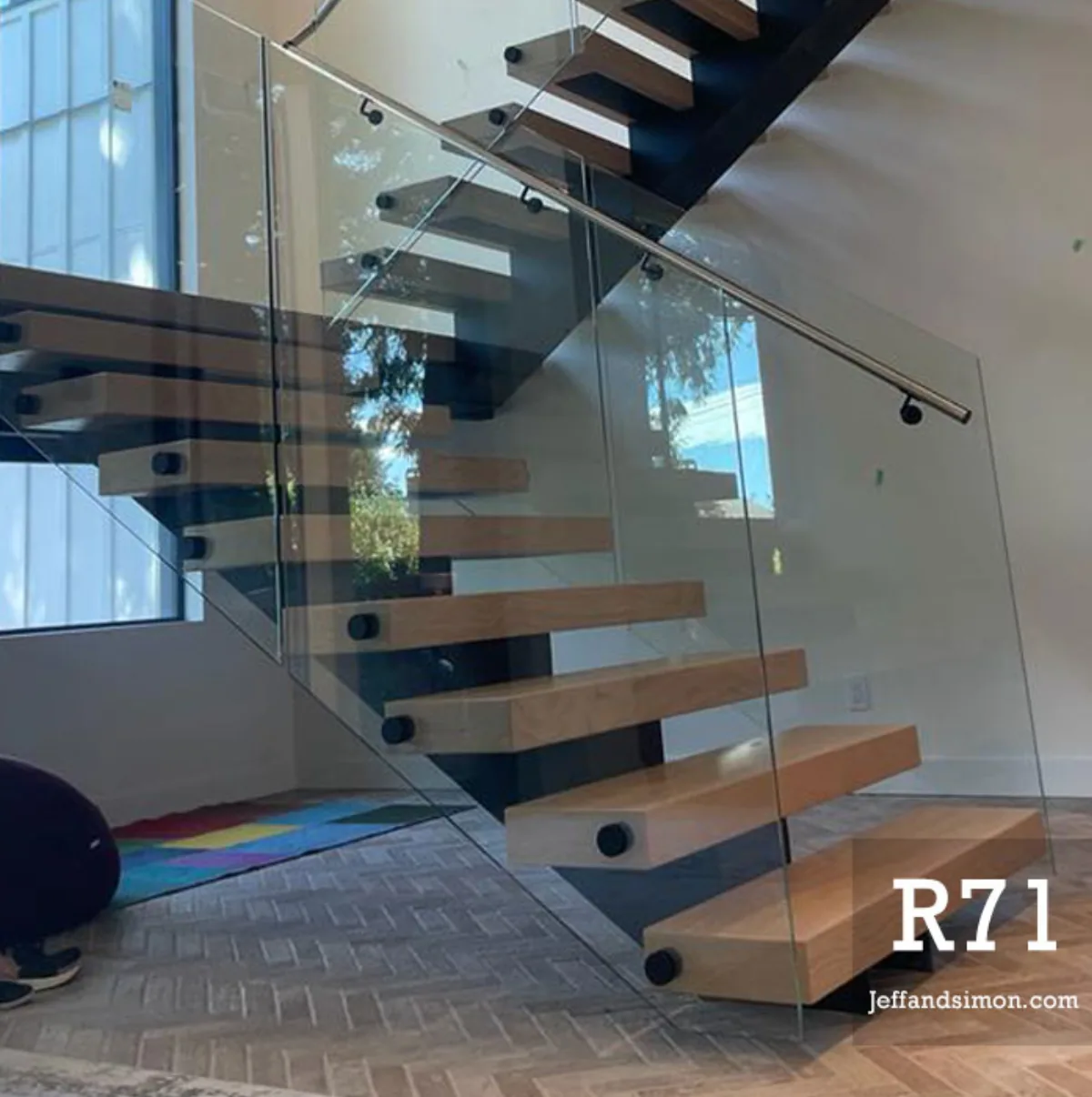
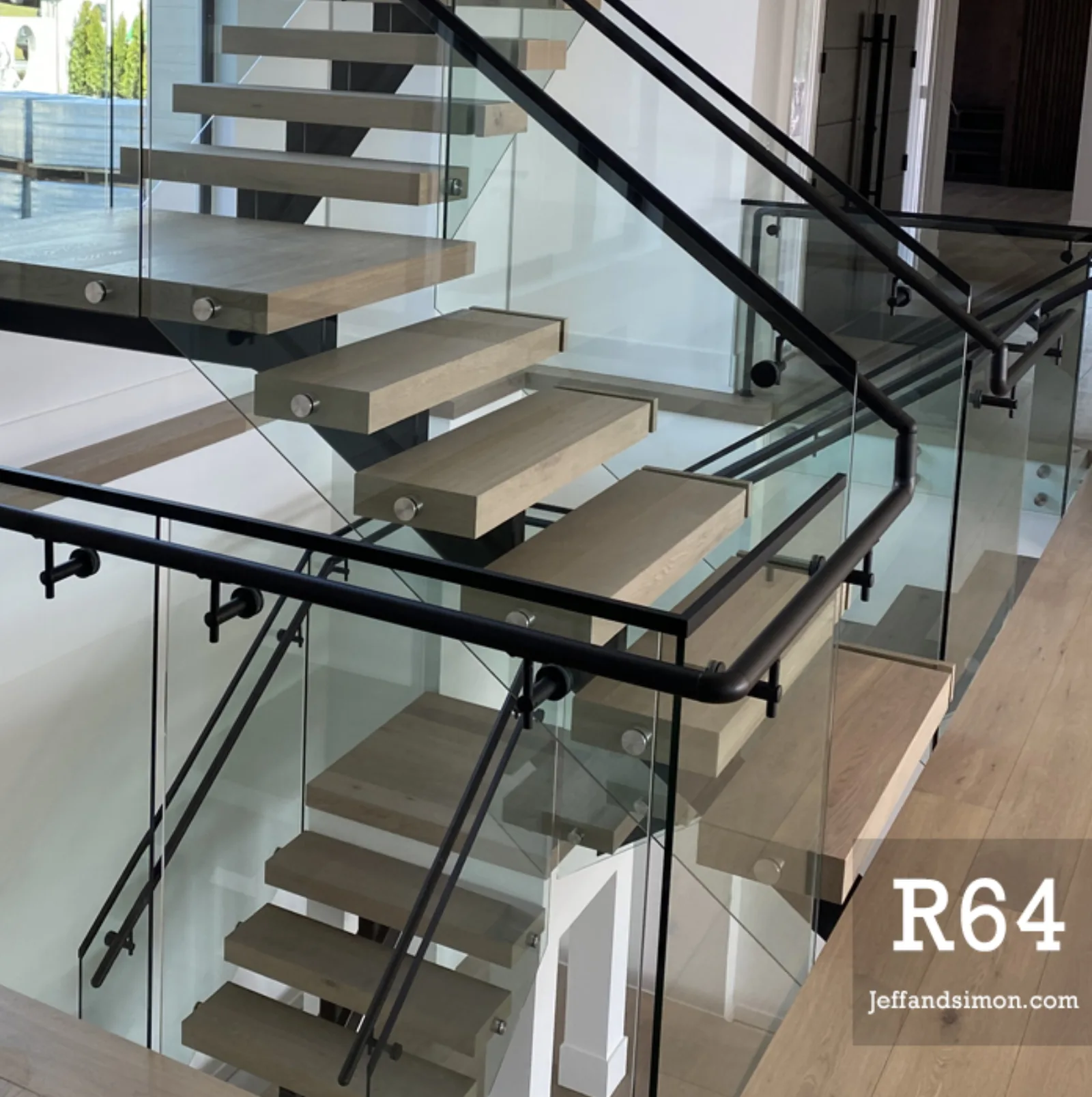
- Mono stringer: the bracket projects horizontally from the central beam to support each tread from beneath. Tread thickness has to bury the bracket plate plus enough wood above it to anchor the fasteners. Practical minimum is around 50 mm; comfortable middle is 60–65 mm; visually heavy is 75 mm and up.
- Cantilevered (wall-anchored): the embed comes out of the wall. The tread has to sleeve over the embed and hide it on three sides. This usually drives thicker treads, often 65–75 mm, because the embed cross-section is non-trivial.
- Hidden double stringer: the tread sits on top of two side stringers concealed within its own thickness. The tread effectively becomes a structural box. Thickness is set by the stringer profile, often 75 mm or more.
- Suspended (cable or rod): the tread has to anchor a cable or rod fitting at each end. Thickness depends on the fitting. Solid steel sub-treads with a wood top layer are common and reduce the thickness demand.
Pick the support strategy first; the tread thickness range follows.
Match the riser dimension
The vertical distance from one finished tread top to the next is the rise. The BC Building Code sets a maximum and a minimum rise for stairs in different occupancies; confirm the current edition and the applicable provision with your AHJ. Within the allowed range, thicker treads eat more of the open-riser dimension. A 200 mm rise with a 50 mm tread leaves 150 mm of open air. The same rise with a 75 mm tread leaves 125 mm. The difference reads from across the room.
If open-riser sphere-passage is a concern, thicker treads sometimes help by reducing the gap between consecutive treads to the sphere-passage limit specified in the BC Building Code. Confirm the exact dimension with your AHJ. Do not assume a remembered number.
Match the railing attachment
Glass guards mounted from the side of each tread need enough tread material to anchor a structural shoe or standoff. Thinner treads sometimes drive the glass to be top-mounted from a separate steel rail, which changes the look. Cable railings clamped to vertical posts are not as tread-thickness sensitive; the load goes into the posts, which mount to the stringer or the floor.
We figure the railing detail at the same time as the tread thickness. Doing them in sequence usually means re-drawing one after the other.
Material constraints
- Solid white oak, walnut, maple: straightforward at 50–75 mm. Source dictates whether the tread is a single board or a glue-up. A glue-up at 65 mm is usually more stable than a single 50 mm board on a heated floor.
- Engineered hardwood treads: a stable solid-wood top layer over a plywood or LVL core. Lets us specify thicker treads without movement risk.
- Steel pan-formed treads: thickness is set by the pan profile, often 25–40 mm visible, with the structure inside. Different conversation.
- Stone or porcelain on a steel pan: the steel pan does the structural work. The stone is finish, not structure. Total thickness is 40–60 mm typically.
- Glass treads: laminated build-ups are usually 35–50 mm including the slip-resistant top layer. Engineered as a system, not as standalone glass.
Tread material is one of the four main cost drivers on a floating stair project; settle it before the design is locked. The floating staircase cost guide for Metro Vancouver covers how tread material affects the total budget.
Code check: open-riser sphere passage
One practical note that affects thickness decisions. BC Building Code Section 9.8.4.6 requires that open risers prevent the passage of a 100 mm sphere. Tread thickness and the vertical gap between treads are evaluated together. A thicker tread shrinks the gap between consecutive tread undersides, which can help meet the sphere limit, or it can push the riser dimension tight against the maximum allowed rise. Confirm the actual gap dimension with your AHJ before finalizing the tread spec.
The nosing detail also has a code dimension. BCBC 9.8.4.5 limits nosing projection and requires a consistent profile across all treads in a flight.
Finish floor interaction
On a floating stair installed into a finished space, the top tread connects to a finished floor, typically hardwood, tile, or polished concrete. The transition detail depends on tread thickness. A 65 mm hardwood tread stepping down to a 19 mm hardwood floor means the top step has a different visual weight than every other tread. There are several ways to handle it: a thickened floor buildup at the landing, a steel transition plate, or a tread notched to match the adjacent floor thickness. None of them is elegant unless it is worked out on paper before fabrication. We draw it explicitly and confirm the landing floor build-up before steel is ordered.
Thermal movement
Wood treads on a heated floor or in a space with seasonal humidity swings will move. A 65 mm solid white oak tread in a Vancouver home with radiant heat can expand and contract by 1.5–3 mm across its width over the year. The bracket attachment has to allow for this. Fixed through-bolt connections with no slot compress the wood in summer and gap it in winter. Slotted bracket holes with a single anchor in the middle of the tread let the wood move while staying flat. For stairs over radiant floor heating specifically, the stair-over-radiant guide covers the coordination in detail, the tread spec, the bracket detail, and the tubing layout are linked decisions.
Tread overhang from the bracket face
The visible reveal of the bracket on the underside of each tread is partly a function of tread thickness and partly a function of bracket width. A slim bracket paired with a 75 mm tread nearly disappears. The same slim bracket under a 38 mm tread leaves a visible clamp at each end. If the design intent is to minimize visible metal, increase the tread thickness or shrink the bracket footprint, not both, because shrinking the bracket reduces the moment capacity of the connection.
Sketch it before you commit
Tread thickness is hard to imagine from a number on a page. We almost always render or mock up the bracket-and-tread cross-section before signing off on the drawings. A 5 mm shift in tread thickness can change how the entire stair reads from across the room.
Continue planning
- For the full structural and fabrication context, read the mono stringer staircase deep dive.
- For how tread material and thickness feed into the budget, read the floating staircase cost guide for Metro Vancouver.
- For cantilevered stair framing requirements, including what the wall needs before treads can anchor, read the cantilevered floating stair wall framing guide.
- For how tread thickness ties into the open-riser limit, headroom, and guard rules, read the BC Building Code stair requirements guide.
- For support strategies and cost drivers across every open-riser type, see our overview of floating staircases in Vancouver.
Sources
Related questions
What is the typical tread thickness for a floating stair?
For solid hardwood treads on a mono stringer or cantilevered stair in a Vancouver custom home, 50–75 mm (2–3 inches) is the typical range. Steel and stone treads sit in a different range driven by structural and slip-resistance requirements.
Does tread thickness affect the riser?
Yes. The total rise from one finished tread top to the next is fixed by code. A thicker tread eats into the open riser dimension and can change how the bracket reads.
Can I use a thinner tread to look more modern?
Sometimes, but the bracket has to be redesigned to suit. On a cantilevered stair, thinner treads usually mean smaller hidden embeds, which can require a more aggressive wall back-plate to carry the moment.