Luxury Stair Trends Vancouver Custom Homes 2026
What luxury stair trends are actually being built in Vancouver and BC custom homes in 2026, and what each one costs in fabrication terms.
The 2026 luxury stair conversation in Vancouver is quieter steel, warmer wood, integrated light, and support strategies decided before drawings are locked.
Luxury stair design in Vancouver in 2026 is less about heavier material and more about quieter detail. Clients on the West Side, the North Shore, and the Sea-to-Sky corridor still want a feature stair, but they want one that reads architectural rather than decorative. The recurring elements are a single beam, thick wood treads, a calmer guard, and a light line that only shows up at night.
This post walks through the trends actually showing up in real Vancouver custom-home drawings this year, what each one means in fabrication terms, and where the cost and code decisions live.
The mono stringer is still the reference shape
A mono stringer stair uses one central steel beam to carry the treads. That single beam is doing the structural work of two side stringers, which is why the beam profile, bracket layout, and floor connection all need to be resolved before the steel is ordered. When the geometry is right, the stair reads as a sculptural object instead of a piece of construction. When it is wrong, the beam looks heavy and the brackets fight the treads.
In 2026 Vancouver custom homes, the mono stringer is being specified more often than the true cantilever because the structural premise is cleaner. The beam takes the load down to the floor instead of into a wall, which means the framer does not have to deliver an engineered backup wall before the stair can be installed. The look is similar at a glance and the path to a permit is shorter.
Tread thickness has crept up. A 50–60 mm solid white oak tread feels right against a slim beam; a 32 mm tread looks thin in the same space. Wider treads (1100–1300 mm) are also more common than the 900 mm minimum, especially on stairs that double as a feature in a great room.
Cantilevered floating stairs are the high-end conversation
A cantilevered stair has wall-anchored treads with no visible stringer. Each tread is a structural element fixed into a backup wall designed for the load. Cantilevered stairs cost more, sometimes much more, because the engineering and the wall are expensive long before the steel reaches the shop.
The structural premise is real. Each tread has to resist bending, torsion, and asymmetric live load every time someone steps on one side. Industry guidance for cantilevered systems consistently points at solid concrete or masonry backup walls (rarely studwall), foundation reinforcement that handles the overturning forces, and a structural engineer running the load path through the wall, the embeds, and the foundation. None of that is field-fixable after framing.
The 2026 conversation is more honest about the tradeoff than it was five years ago. Architects working on West Vancouver and Point Grey projects are clearer about when the cantilever is worth the engineering and when a mono stringer with thick treads gets the same visual at a fraction of the structural cost. This article is not a substitute for code review by the authority having jurisdiction, an architect, or an engineer.
”Floating” is a look, not one structure
People keep asking for “floating stairs” when what they want is the open-riser, no-side-stringer, light-on-the-eye effect. That look can be delivered four different ways: a mono stringer with concealed brackets, a side plate buried in a wall, a true wall-anchored cantilever, or a concealed double stringer hidden under the treads.
Each path has a different cost, a different schedule, and a different framing requirement. The decision should be made with the architect and the framer in the same conversation, before the opening is dimensioned, because the wall thickness and floor framing change with the choice. The cheapest version of the look is rarely the cheapest version of the project. A misaligned opening costs more than a smarter beam.
Integrated lighting is now part of the steel package
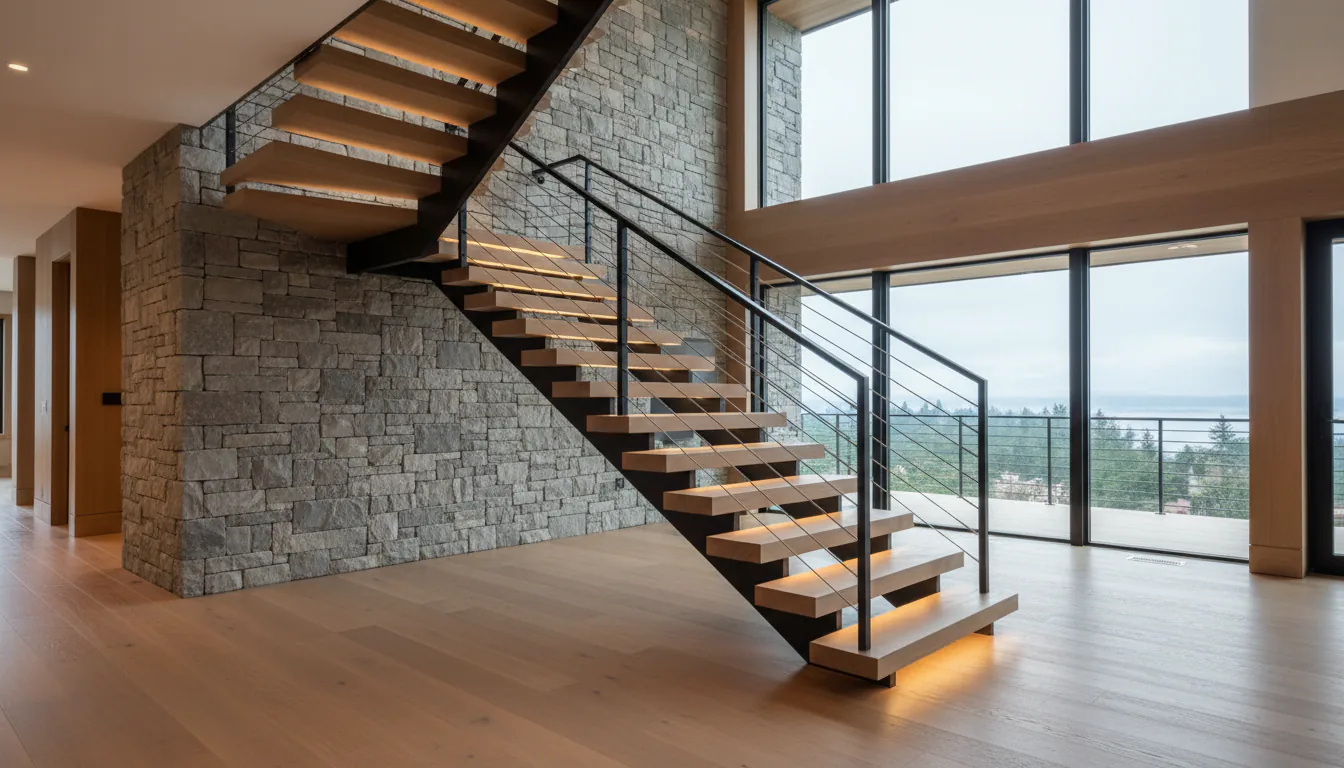
Soft warm light under the tread nosing or along the underside of the stringer is showing up on most feature stairs in 2026. Tread-edge LED strips, typically a low-profile aluminum channel profile with a diffused lens, such as the KLUS Series B or MICRO-ALU profile, are practical on open-riser stairs because the tread becomes legible at night without an overhead fixture, and architectural because the light line tracks the stair geometry without adding visual weight.
The detail that matters is when the lighting decision lands. If it is specified before fabrication, the bracket plates can carry a wiring chase, the driver location is planned, and the light runs continuously without joints visible from below. If it is added after install, the wiring is surface-mounted or routed through holes drilled into finished steel. Neither reads architectural.
Colour temperature has settled around 2700–3000 K on residential feature stairs. Cooler than 3000 K reads commercial; warmer than 2700 K shifts the wood tones. The choice should match the rest of the interior lighting plan, not be made on the stair drawing alone.
Mixed material is now the dominant palette
The all-blackened-steel-and-glass stair has not disappeared, but it has stopped being the default. The 2026 palette pairs a matte or blackened steel beam with thick solid wood treads. White oak first, then walnut, with rift-sawn or quarter-sawn grain on higher-end projects to keep the figure calm. In most projects coming through the shop this year, the move is away from cold monochrome and toward a warmer wood reading against softer metalwork tones.
Stone is showing up as a third material on the highest-end Vancouver projects, usually as a feature wall behind or alongside the stair rather than on the treads themselves. A stone backdrop wall lets the steel and wood read as the main subject and gives the stair a context that does not change with the light.
What this means in fabrication terms: the steel finish has to live with adjacent wood and stone for the life of the home. Powder coat is more durable than paint and reads cleaner on a slim beam, but the colour selection needs to be made against actual finish samples rather than a chip. Black powder coat is not one black. The same applies to the cable and railing hardware, which should match the beam tone rather than borrow a stainless brightness from the kitchen.
Glass and cable infill have reversed positions on many projects
Glass railings still appear on view properties where the sightline matters more than the guard, particularly on West Vancouver and Sea-to-Sky homes where the guard is between the room and the view. Cable railing has moved up the priority list everywhere else because the visual is lighter, the cleaning is easier, and the cost on a long run is lower.
For interior feature stairs in 2026, the most common decision goes: cable in the body of the stair, glass at the upper landing where the guard is read against a window or a soffit. Mixing the two inside the same project is not a problem if the top rail and post family are consistent. What makes mixed infill look unintentional is two different handrails, not two different infills.
Hardware specification still matters. Stainless grade 316 over 304 is the right call on coastal and waterfront sites because the salt air will find any compromise in the fittings, base shoe, and fasteners long before it touches the cable or the glass itself. The cost difference is small relative to the cost of replacing corroded hardware in five years.
Sculptural feature stairs are being earned, not bought
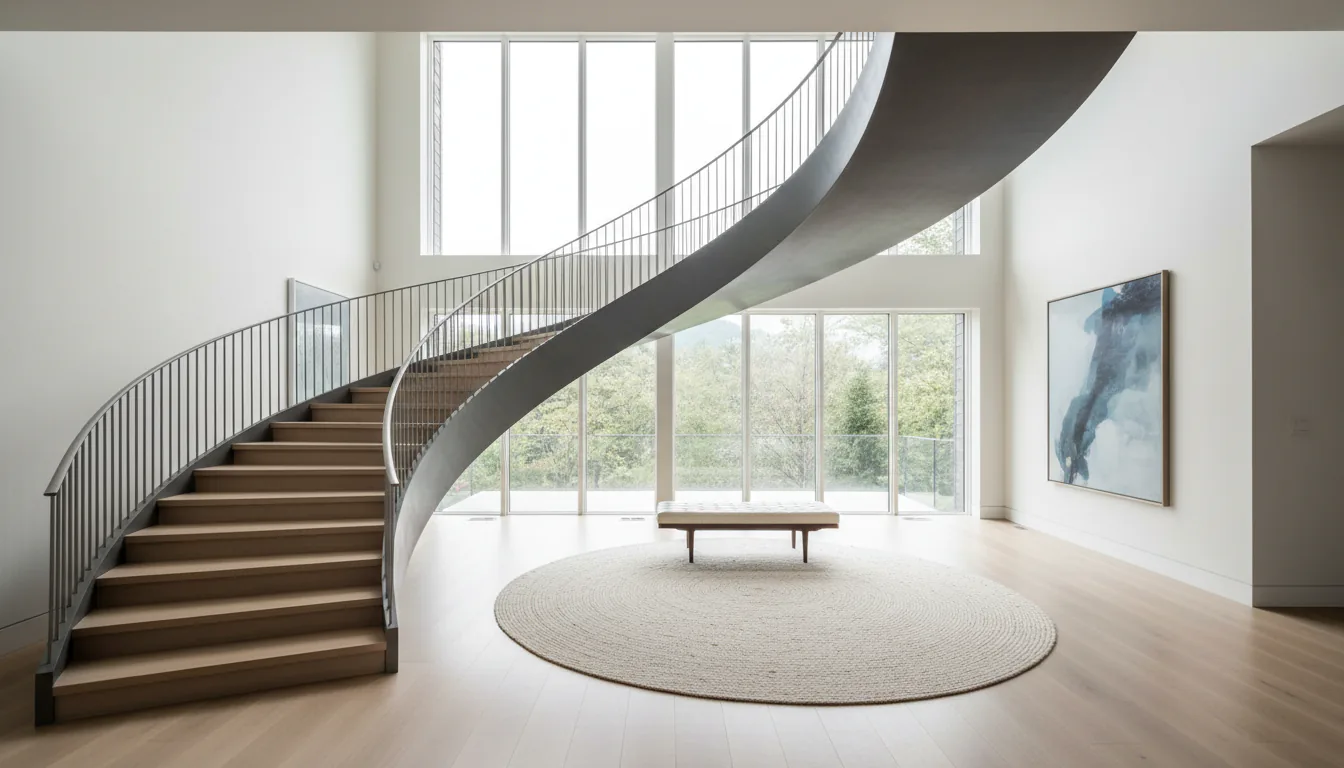
The “sculpture stair” (curved, helical, or ribbon) is the most photographed category and the smallest share of actual built work in Vancouver. The reason is the path from drawing to install. A helical stair touches structure, stair opening, finish flooring, and ceiling framing on every floor it passes through, and the engineering is not a back-of-napkin exercise.
When a true sculpture stair is the right answer, the project usually has three things lined up early: an architect who has done one before, a structural engineer comfortable with the load path, and a fabricator brought into the drawings before the opening is set. Without those three, the stair often gets value-engineered down to a switchback before the building permit is issued.
For most Vancouver custom homes that want a feature stair, the right answer in 2026 is a well-detailed mono stringer with thick wood treads, a quiet guard, and integrated lighting, not a curved stair that costs three times as much and takes twice as long.
Code and permits still set the floor
BC Building Code Section 9.8 sets the structural and dimensional baseline. Inside a dwelling unit, guards must be at least 900 mm high; guards serving spaces other than dwelling units run at least 1070 mm. Open guards on stairs above a certain run also have opening-size limits to prevent a small child climbing or passing through. The same section governs handrail height, run, and rise.
Two reminders that come up on most luxury stair quotes in 2026:
- The municipal authority having jurisdiction can interpret these clauses more strictly than the base BCBC text, particularly the City of Vancouver and the District of West Vancouver, and that interpretation is what gets you to occupancy.
- A drawing that satisfies the AHJ on guard height does not automatically satisfy it on guard opening, handrail continuity, or termination at the floor. Each detail is reviewed independently.
A feature stair is still a stair under code review. The architectural intent is not a defence at inspection. This article is not a substitute for code review by the authority having jurisdiction, an architect, or an engineer.
Sources
- BC Building Code Section 9.8, Stairs, Ramps, Landings, Handrails and Guards
- BibLus, Floating stair structural details for cantilevered systems
- KLUS Design, LED aluminum extrusion profiles for architectural stair lighting
The strongest 2026 projects bring the fabricator into the conversation before the stair opening, the railing strategy, the wiring chase, and the floor finishes are locked. Send photos, drawings, dimensions, the site address, and the target finish, and the trend conversation can become a fabrication plan instead of a moodboard.
Related reading: the mono stringer staircase deep-dive, the floating stair process, and the custom metal stair cost guide.
Related questions
What is the most requested luxury stair style in Vancouver in 2026?
Mono stringer stairs with thick white oak treads and either cable or slim glass infill are the most common request on West Side and North Shore custom homes. The visual is open and sculptural without committing to a fully cantilevered structure.
Is every floating stair cantilevered?
No. Floating is a visual category. The same look can come from a mono stringer, a side-supported stair, a wall-anchored cantilever, or a concealed double stringer. The right answer depends on the wall, the opening, and how early the structure is reviewed with the framer.
Are integrated tread lights worth the upgrade?
On a feature stair, yes. Warm low-output LED strips under the tread nosing add safety on open-riser stairs and read as architectural rather than decorative. They need to be specified before fabrication so the wiring path and driver location are coordinated, not retrofitted.