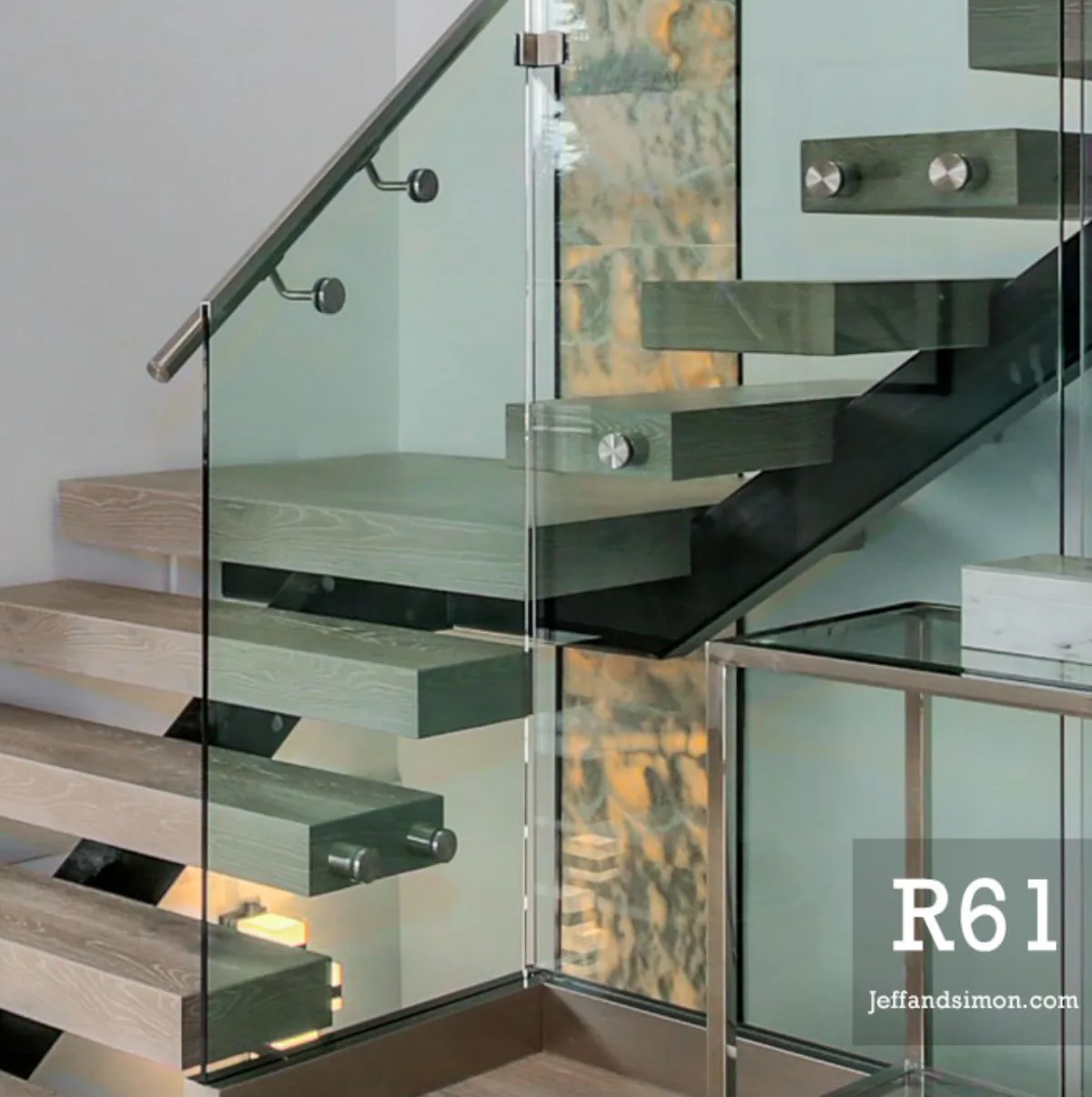
Floating stairs trip over the same code provisions every time: open risers, sphere-passage at the guard, handrail continuity, and where the stair sits in the building. The rules are workable if you read them before fabrication. Confirm everything with your local authority having jurisdiction (AHJ), every municipality interprets the code package slightly differently, and the BC Building Code is updated by the Province of British Columbia.
Two code packages, one stair
Most floating stairs in Metro Vancouver fall under the BC Building Code (BCBC), Part 9 for houses and small buildings, Part 3 for larger buildings. The City of Vancouver uses the Vancouver Building By-law (VBBL), which mirrors but does not duplicate the BCBC. The first question on any floating stair is which code package applies, then which edition.
- BCBC Part 9: most single-family houses, duplexes, small townhouses.
- BCBC Part 3: larger residential, commercial, assembly, and institutional projects.
- VBBL: anything inside the City of Vancouver, with its own enforcement framework.
- Always confirm the current edition with the AHJ, provincial code editions are updated periodically.
Open risers are usually fine in housing
In most Part 9 houses in BC, open risers are permitted on stairs serving a single dwelling unit. Where open risers are used, the opening between treads must restrict the passage of a sphere of a specified diameter. In assembly and many commercial occupancies under Part 3, open risers are restricted or not permitted on required exit stairs. Confirm the exact provisions and sphere dimension that apply to your project edition with your AHJ before committing to an open-riser design.
Guards are about sphere-passage, not aesthetics
The guard is what stops a person, or a child, or a pet, from falling off the side of the stair. The BC Building Code specifies a minimum guard height and limits the size of openings within the guard so a small sphere cannot pass through. Glass, cable, and picket guards all need to satisfy the same opening rule. Cable railings need careful tensioning and intermediate posts to keep horizontal openings within limits as the cable spans grow.
Handrails must be continuous and graspable
Most floating stairs are required to have a graspable handrail on at least one side. The handrail profile, projection, and termination are all defined by code. A glass guard does not satisfy the handrail requirement on its own, there is usually a separate top cap or wall-mounted handrail. We almost always plan handrail position and projection at the shop-drawing stage so the railing trade does not need to improvise.
Where to read the code yourself
The BC Building Code is administered by the Province of British Columbia through the Building and Safety Standards Branch. Project teams can review the official BC Codes information at the Province of BC building codes page, and Vancouver-specific projects can review the Vancouver Building By-law. For tread, riser, and guard sphere specifics, refer to the current edition under your project's permit submission date, and confirm with your AHJ.
Related questions
Are open-riser floating stairs allowed in Vancouver?
In single-family houses and small residential buildings under BCBC Part 9 or the equivalent VBBL provisions, open risers are commonly permitted, subject to the sphere-passage limit between treads. Larger buildings, assembly occupancies, and required exit stairs often have stricter rules. Confirm the exact provisions for your project with your AHJ before committing to an open-riser design.
Can a glass railing be the only handrail?
Almost never. The code requires a graspable handrail with a defined profile, projection, and continuity. A glass panel does not meet that definition on its own. Most projects add a wall-mounted handrail or a top-mounted handrail attached to the glass.
What sphere size applies between treads and within guards?
The exact sphere dimension is set by the BC Building Code edition that applies to your project. Sphere-passage rules between treads on open-riser stairs and within guards both exist, and they are sometimes different from each other. Always read the current BCBC or VBBL clause for your project, and confirm with your AHJ, do not rely on a remembered number.
Do floating stairs need a permit?
Replacing a structural staircase, changing a stair opening, or building a new floating stair almost always requires a building permit in Metro Vancouver. Decorative railing replacements are sometimes permit-exempt. Confirm the scope with your municipality before fabrication starts.
Continue planning
- Floating stairs hub overview
- All four support strategies
- Mono stringer staircase deep dive (Trends)
- Floating stair fabrication guide
Plan floating stairs bc code: open risers, guards & sphere rule for a real Vancouver project
Send drawings, photos, or a rough scope and we will help define the practical next step.