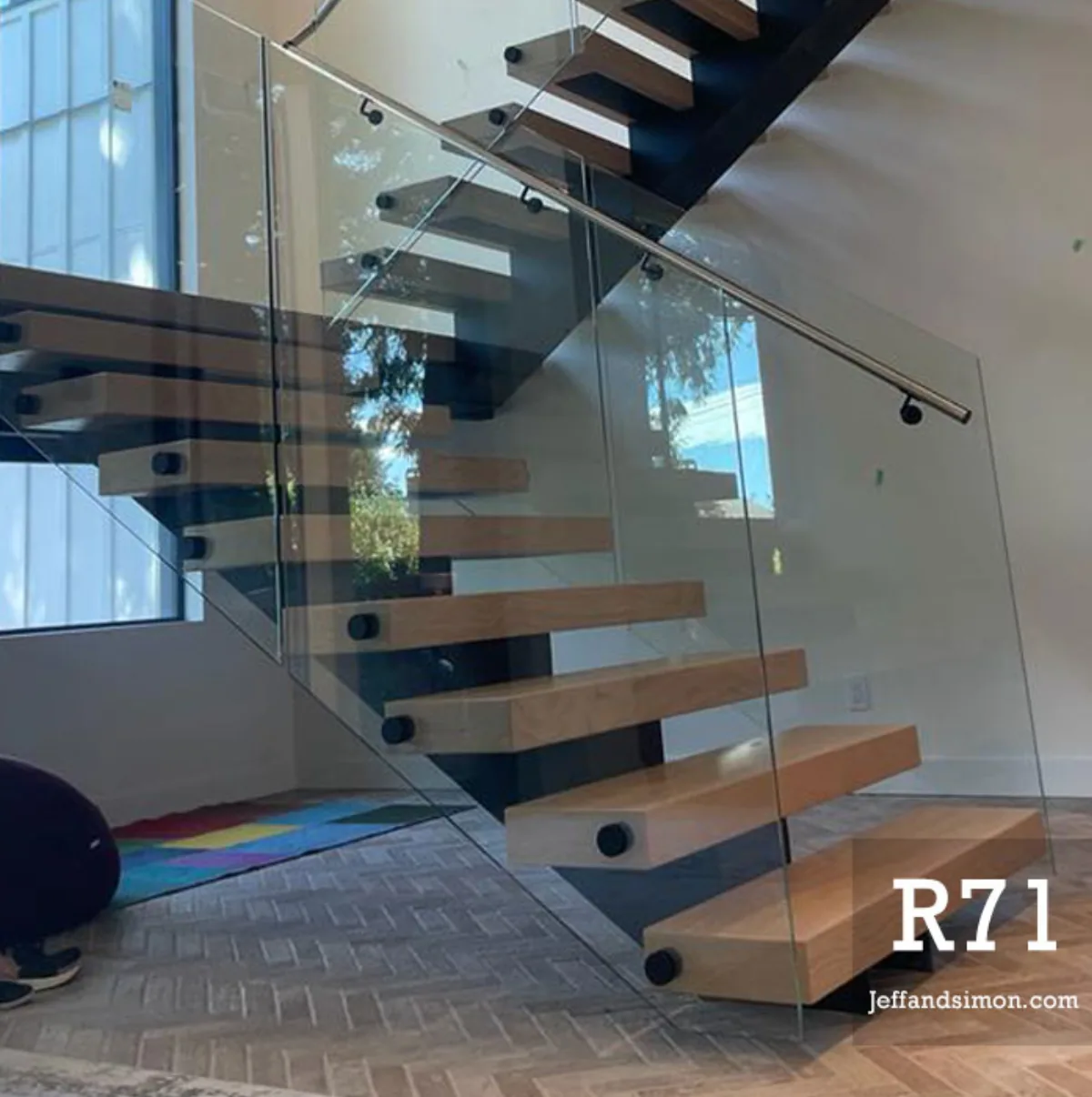
Floating staircase is a visual category, not a structural method. Treads can appear to hang in space using four very different support strategies. The choice you make changes the wall framing, the stair opening, the engineer's load path, the finished schedule, and the price. Pick the strategy first; pick the look second.
Four ways to make a stair look like it floats
Most floating stairs in Metro Vancouver use one of four support methods. Each one demands a different conversation with the framer, the engineer, and the drywall crew.
- Mono stringer: a single central steel beam carries the treads from beneath. Treads cantilever equally on both sides. Visible spine, open risers.
- Cantilevered (wall-anchored): each tread is anchored into a stud-pack or steel knife-plate hidden in the wall. No visible stringer at all. The wall has to be engineered before drywall.
- Hidden double stringer: two side stringers concealed inside the tread profile or behind closed risers. Looks light, but is fundamentally a closed-stringer stair.
- Cable or rod suspended: treads hang from steel cables or threaded rods anchored at the upper landing. Best for tall, narrow openings with strong upper structure.
Mono stringer: most predictable, most popular
A single central beam is the easiest floating stair to draw, fabricate, and inspect. The beam carries the loads, the brackets carry the treads, and the engineer can verify the whole load path from a clean section drawing. Open risers are achieved without depending on the wall behind. Most of the floating stairs we build in custom Vancouver homes are mono stringers, not because they are the prettiest, but because they are the most coordinated.
Cantilevered: cleanest look, biggest framing commitment
A wall-anchored cantilevered stair is the only support method that gives you treads with no visible support whatsoever. The tradeoff is that the wall must be designed to absorb tread loads at every embed location. That means stud-packs, steel back-plates, or a structural masonry wall, all coordinated before drywall. If the framing is wrong, the fix happens behind finished walls.
Hidden double stringer: the compromise option
A hidden double stringer reads as a floating stair but is structurally a closed-stringer stair with the stringers tucked inside the tread thickness. It opens design freedom, risers can stay open, treads can be slimmer than a true cantilever, without committing to a fully engineered wall. The honest version is: the steel is still there, you just stop seeing it.
- Best when the wall behind the stair cannot accept structural embeds.
- Tread thickness becomes a design driver, too thin and the hidden stringer becomes visible.
- Costs sit between mono stringer and true cantilever for most spans.
Cable or rod suspended: a specific architectural answer
Suspended stairs need something strong above them, a roof-anchored steel beam, a structural ridge, or a concrete deck. The stair literally hangs. Beautiful in the right space, expensive to coordinate when the upper structure is wood-framed and was not planned for the load.
Related questions
Which support method is the most cost predictable?
A mono stringer is usually the most predictable to price. The single beam, the brackets, and the connection details all sit in the open and can be reviewed by the engineer from a single section drawing. Cantilevered stairs require coordination with the framing trade and often unlock other costs once the wall is opened up.
Can a floating stair be built without any visible steel?
Yes, a true cantilevered stair has no visible stringer or beam. The structural work moves into the wall, where stud-packs, knife-plates, or back-plates carry the tread loads. The trade-off is that the wall has to be designed and inspected before drywall closes it in.
Are floating stairs allowed in BC?
Floating stairs are allowed when the structural design and guard layout meet the BC Building Code (Division B, Part 9 for housing and Part 3 for larger buildings). Open risers are permitted in many residential settings but are restricted in commercial assembly occupancies. Confirm requirements with your local authority having jurisdiction before fabrication.
Does a floating stair need an engineer?
Most floating stairs require sealed engineering for the tread connections, the stringer or beam, and the wall embeds. Cantilevered and suspended stairs almost always need an engineer of record. We coordinate with the project engineer or define the information an engineer needs to review the stair scope.
Continue planning
- Floating stairs hub overview
- All four support strategies
- Mono stringer staircase deep dive (Trends)
- Floating stair fabrication guide
Plan floating stair support: mono stringer, cantilevered & more for a real Vancouver project
Send drawings, photos, or a rough scope and we will help define the practical next step.