Staircases in Mount Pleasant: Lofts, Character Homes, and the Broadway Densification
What Mount Pleasant homeowners and developers should know about stair design and replacement, from Brewery Creek live-work lofts to pre-1940 character homes being converted under the Broadway Plan.
Mount Pleasant's housing stock spans Brewery Creek warehouse lofts, Edwardian character homes, and a wave of Broadway Plan densification. Each context asks different things of a staircase.
Mount Pleasant covers roughly 1.3 square kilometres between Cambie and Clark, 2nd Avenue and Broadway. Within that area, you find one of the most compressed architectural diversity in Metro Vancouver: Edwardian and Craftsman character homes from the early 1900s alongside Brewery Creek warehouse conversions from the 1980s and 1990s, industrial live-work lofts on Ontario and Quebec Streets, and a growing tier of Broadway Plan mid-rise and mixed-use buildings replacing single-family lots along the main corridors.
Each building type asks something different from a staircase.
Brewery Creek lofts: the industrial staircase context
Brewery Creek, the cluster of converted industrial buildings between 5th and 8th Avenues near the Ontario Street corridor, is where several of Vancouver’s most recognizable loft conversions occurred. The Labatt building, the original Sick’s Brewery structures, and the 1905 Brewery Creek complex were converted beginning in the 1990s, most famously the Brewery Creek Building on 6th Avenue.
These spaces have characteristics that suit a particular staircase approach:
- High ceilings: 4-6 metres in the main living space, sometimes more in original industrial units
- Open floor plates: few or no interior load-bearing walls between the structural grid
- Concrete or heavy timber construction: structural elements are exposed and honest
- Mezzanine layouts: a sleeping or office loft accessed by an interior stair that is fully visible from the main floor
In this context, the stair is a spatial statement. It is not tucked against a wall, it occupies the central or prominent position in the floor plate. The fabrication should match the architecture: industrial-honest rather than decorative, steel that reads as steel rather than steel pretending to be something else.
Typical choices in this context:
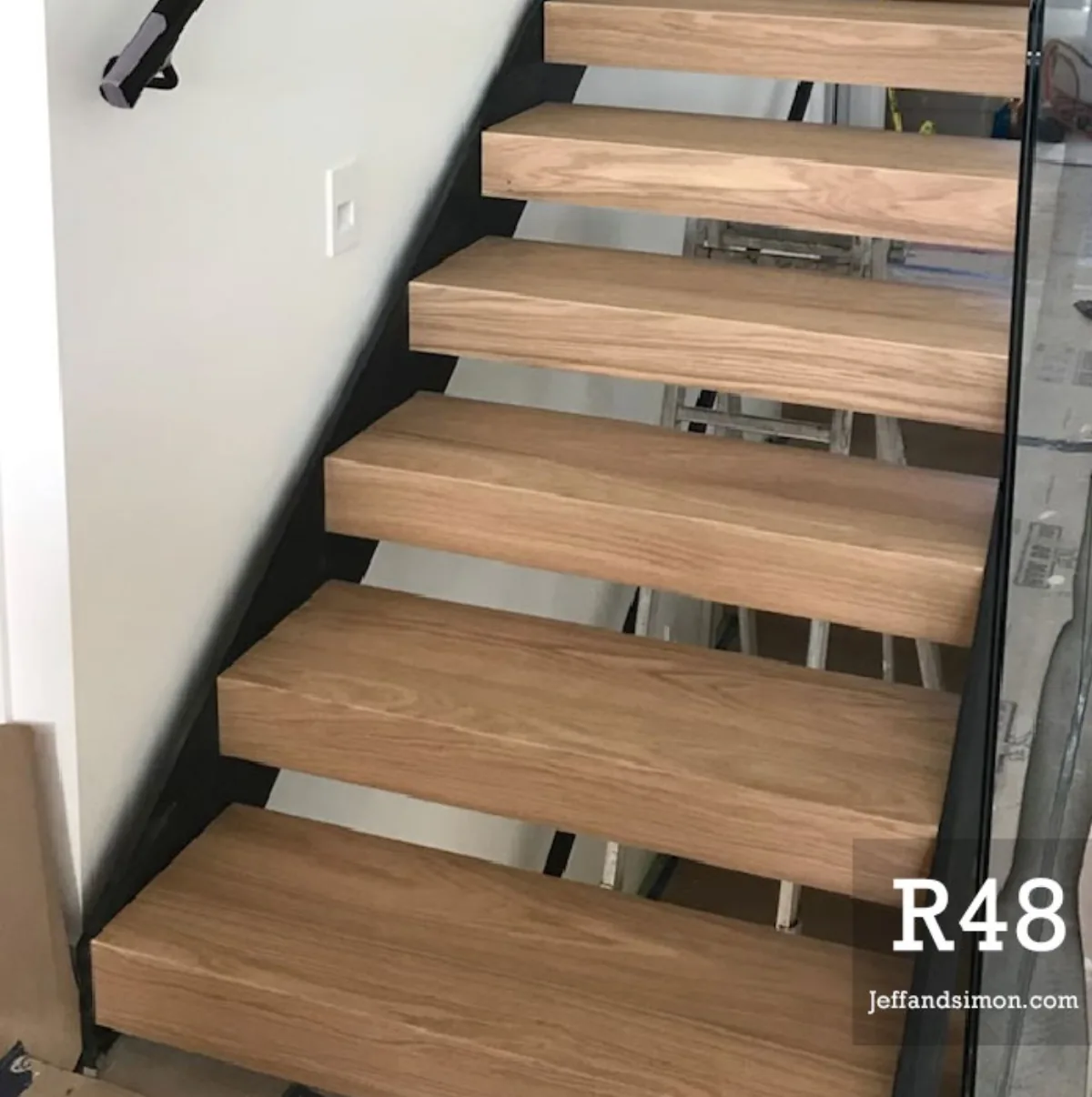
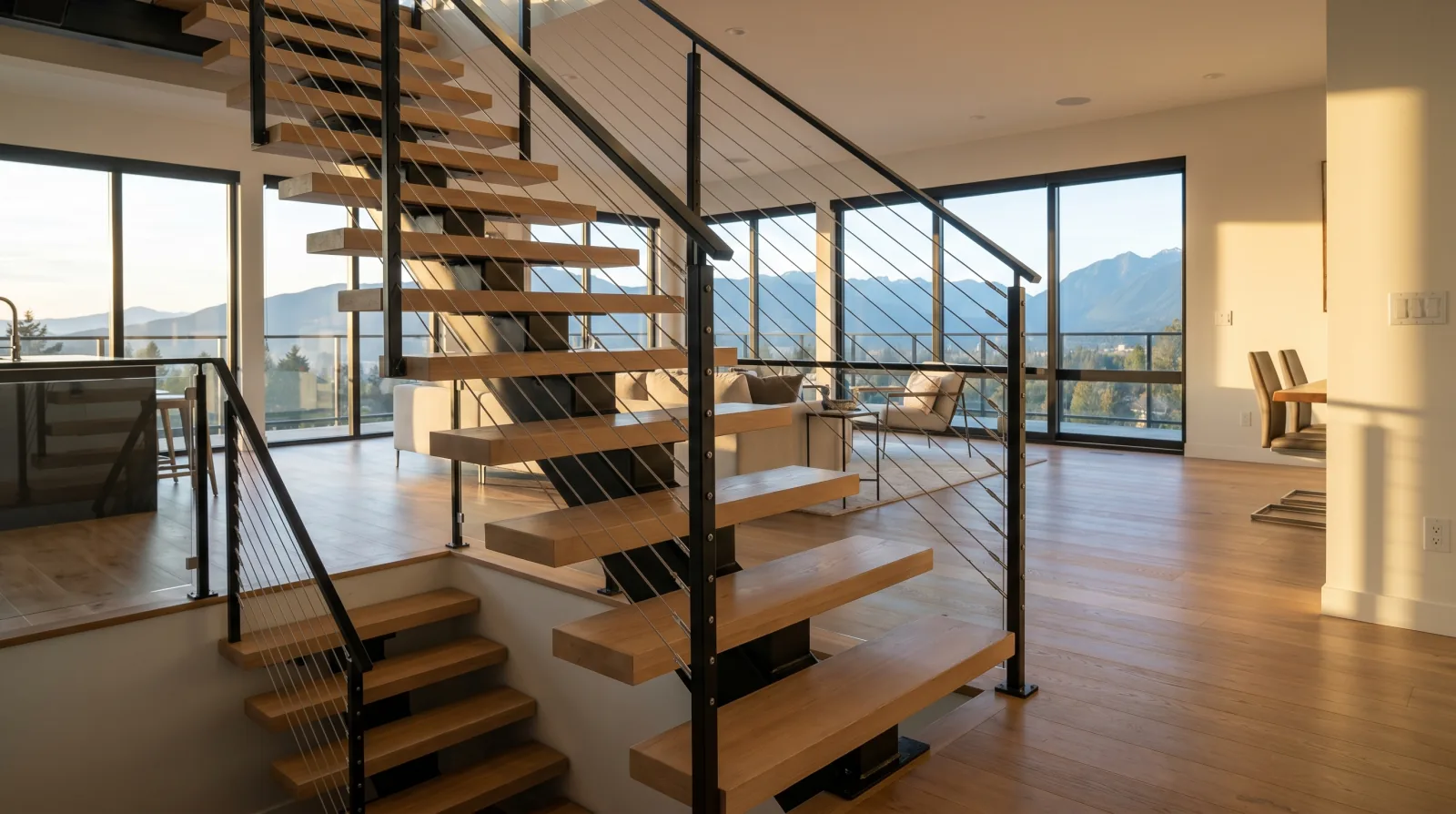
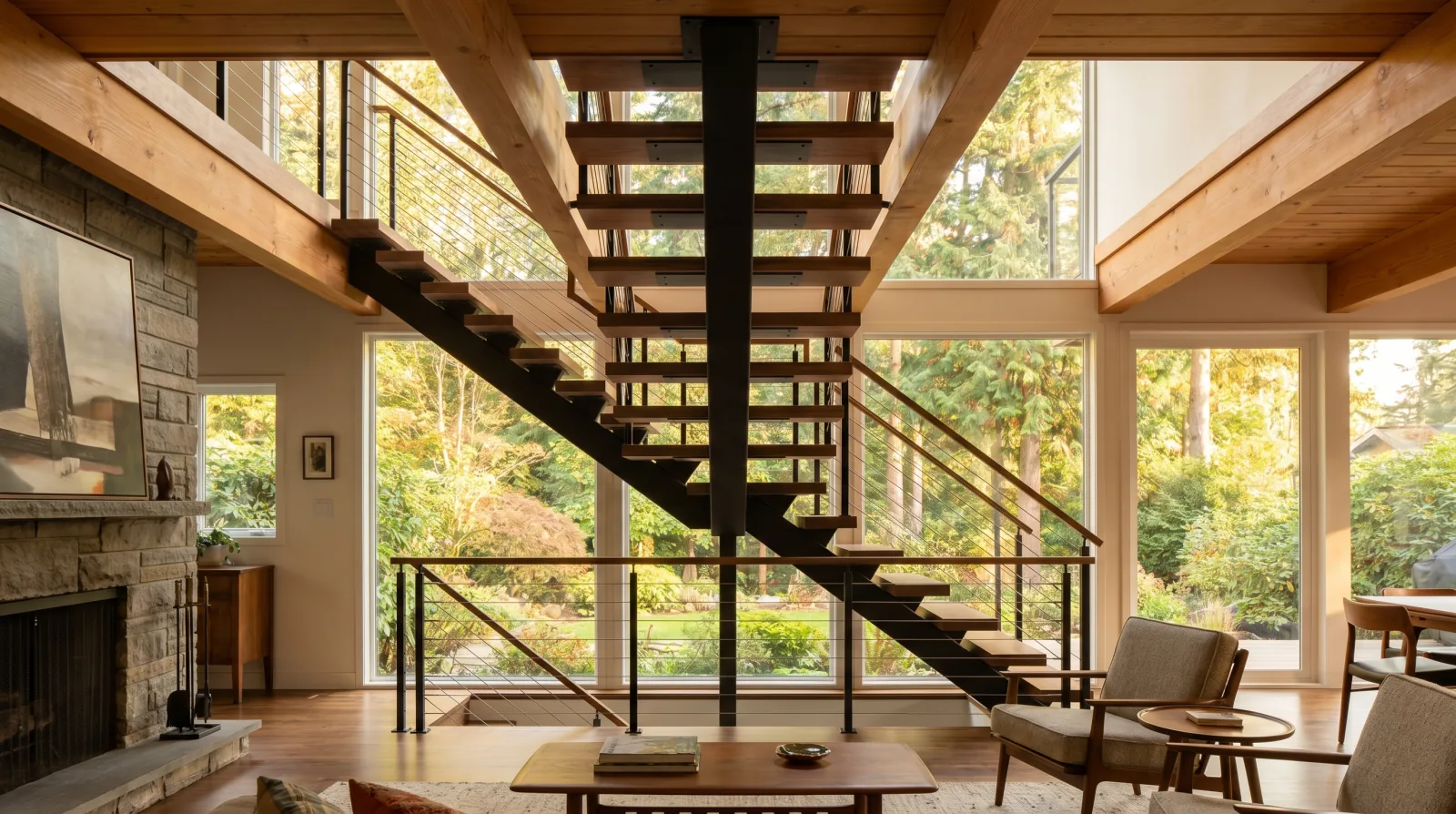
- Mono stringer: a single central beam (the spine) carrying the treads on both sides, no side panels, fully open risers. The spine is fabricated steel, the treads typically white oak or walnut, contrast between warm wood and dark metal reads well against exposed concrete and timber.
- Open-riser switchback: where the space requires a landing and the floor-to-floor height is significant (over 3 metres), a switchback with a mid-landing can be compact in footprint while giving the stair visual weight and structure.
- Cable railing: horizontal cable infill complements the industrial horizontal language, exposed ductwork, beam soffits, band windows, without the visual solidity of a glass panel.
The stair in a loft renovation is often the single most visible fabricated element in the space. It is worth treating the design as architecture, not as code compliance.
Character homes: the Edwardian densification wave
Mount Pleasant’s residential streets, the blocks east of Cambie between 7th and 18th Avenues, have dense concentrations of pre-1940 character homes. These are generally two-storey Edwardian or Craftsman-style houses, built on 33-foot or 50-foot lots, with original stairs that are enclosed, steep by modern standards, and designed for a household without open-plan expectations.
Two forces are changing these properties:
Laneway houses and suite conversions have been active in Mount Pleasant for over a decade. The basement suite or coach house addition often requires separating the stair access from the primary unit, which means either modifying the existing stair or adding a new one.
Broadway Plan densification is accelerating the pace. The Broadway Plan, approved by Vancouver City Council in June 2022, rezones significant portions of Mount Pleasant for increased density, 8 to 20+ storeys along Broadway, 6-12 storeys in mid-block areas, and expanded multiplex permissions on residential streets. Properties within the plan area can be redeveloped for three to six units where a single house previously stood.
For character home owners deciding whether to renovate or stratify, the staircase question is central. A converted character home that becomes three or four units under the multiplex rules may need:
- A separated stair that no longer passes through one unit to reach another
- A stair that meets residential suite code requirements (different from the single-family requirements the original stair was built under)
- Guard heights and handrail specifications consistent with the BC Building Code for multi-unit residential
These are not afterthoughts. They are code requirements that affect the design from the opening dimensions onward.
The structural reality of pre-1940 Mount Pleasant construction
Edwardian houses in Mount Pleasant were built with the platform and balloon framing conventions of their era. The typical characteristics:
- 2x4 or 2x6 framing at 16-inch or 24-inch centres
- Plaster-on-lath interior walls, some of which are structural even where they look like partitions
- Original stair openings that are narrow (often 750-850mm clear width) and steep (risers at 200-210mm)
- Floor-to-floor heights that can be taller than modern expectation, some Edwardian two-storeys measure 2,900-3,100mm floor-to-floor
Replacing the original stair with a modern mono stringer or floating stair means answering the same questions as any character home renovation:
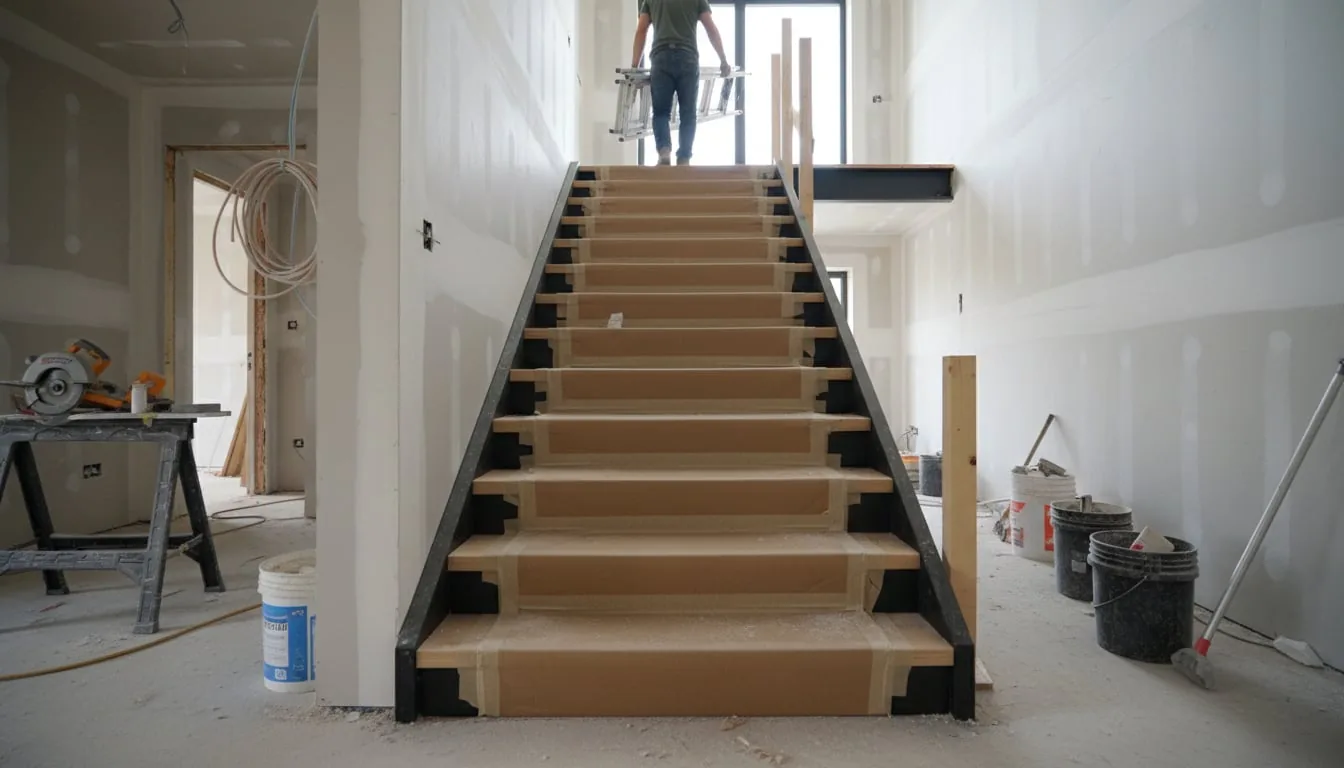
- Does the existing opening need to be enlarged to achieve code-compliant headroom and tread run?
- What is in the wall where the stringer or tread anchors will attach? Is there blocking? A header? A bearing wall?
- Is the floor structure adequate to carry the changed loadpath from the new stair?
The most common issue in Mount Pleasant character home stair replacements is headroom. The original stair rises at a steep pitch, which means relatively little headroom above the lower portion of the stair. A modern code-compliant stair with a gentler pitch (maximum 45 degrees, typically 37-42 degrees in practice) needs more horizontal run to achieve the same rise, and the ceiling above the lower portion of that run may not have the required 1,950mm minimum headroom unless the opening is modified.
This is detectable at the design phase. A thorough site measure before shop drawings are issued should include headroom at the proposed stair soffit, not just the floor-to-floor height.
Material choices for the Mount Pleasant interior
The renovation aesthetic in Mount Pleasant has shifted over the last decade toward something that could be described as industrial-warm: raw-edged materials (concrete, steel, rough-sawn timber) combined with warm tones (oak, walnut, terra cotta, ochre). It is distinct from Kitsilano, which tends toward a lighter, California-contemporary palette, and from the North Shore, which leans on West Coast forest references.
For staircases in this context, the combinations that appear most often:
- Black powder-coated steel with natural white oak treads: the most common pairing in both loft and character home contexts. The contrast between dark metal and warm wood anchors the stair visually.
- Blackened steel (oil-rubbed or chemically darkened rather than powder coated) for a more industrial finish that reads slightly softer than high-gloss powder coat and picks up the patina of the surrounding materials.
- Cable railing on the guard: reads well in both loft and character home contexts; cable tolerates the neighbourhood’s mix of scales and periods better than pickets or flat bar, which can tip toward period or toward contemporary depending on the detail.
Glass guards are used in Mount Pleasant renovations but are less common than in Kitsilano or West Vancouver, the aesthetic tends toward material honesty rather than transparency, and the industrial context does not need the same sightline-opening function that glass provides in a view home.
Working around Broadway Plan uncertainty
For property owners in the Mount Pleasant Broadway Plan area who are planning renovations, the staircase decision needs to account for the property’s likely redevelopment arc. A $40,000 custom stair installed in a house that will be stratified or redeveloped in five years is a different investment calculation than the same stair in a house that will stay in one family for a generation.
This is not a question Vancouver Stairs can answer, it depends on ownership plans, financial assumptions, and development timing that are specific to each property. But it is a question worth raising before committing to a premium stair specification in a Broadway Plan-designated property.
The same fabrication capacity and lead time applies regardless of scope. A simpler stair, straight mono stringer, standard cable railing, no custom tread work, can be executed in the same timeline as a more elaborate design and still produces a code-compliant, well-finished result.
Related reading: the steel staircases hub, the mono stringer staircase deep dive, and the Vancouver service area page.
Related questions
What stair type works best in a Mount Pleasant live-work loft?
Most Brewery Creek and Ontario Street loft conversions have high ceilings and open floor plates, which means a floating mono stringer stair or open-riser switchback reads well spatially. The stair becomes a room divider and a visual centrepiece, not just a code requirement. Cable railing or frameless glass both work in the industrial-modern loft aesthetic.
Can a Vancouver character home under the Broadway Plan add a secondary stair?
If the conversion requires two units, which many now do under provincial and municipal densification rules, a second stair or at minimum a separated access point becomes a building code question. The answer depends on the specific building type and whether the units share a common corridor. An early meeting with a building designer or architect clarifies this before the stair is quoted.
Do stair replacements in Mount Pleasant character homes need a permit?
Yes, for structural changes. The City of Vancouver requires a permit for work that modifies the stair opening, changes the loadpath, or alters the guard system. Heritage-designated properties have additional review requirements. Character homes that are not formally heritage-designated still follow standard structural permit requirements.
What is the typical timeline for a custom stair in a Mount Pleasant renovation?
From first contact to installed stair: 8-12 weeks for a standard residential mono stringer. Add 2-4 weeks if a structural engineer review is needed for wall attachment or opening modification, and 2-4 weeks if a permit is required. Starting the stair conversation at the framing or rough-in stage gives the project the best timeline.