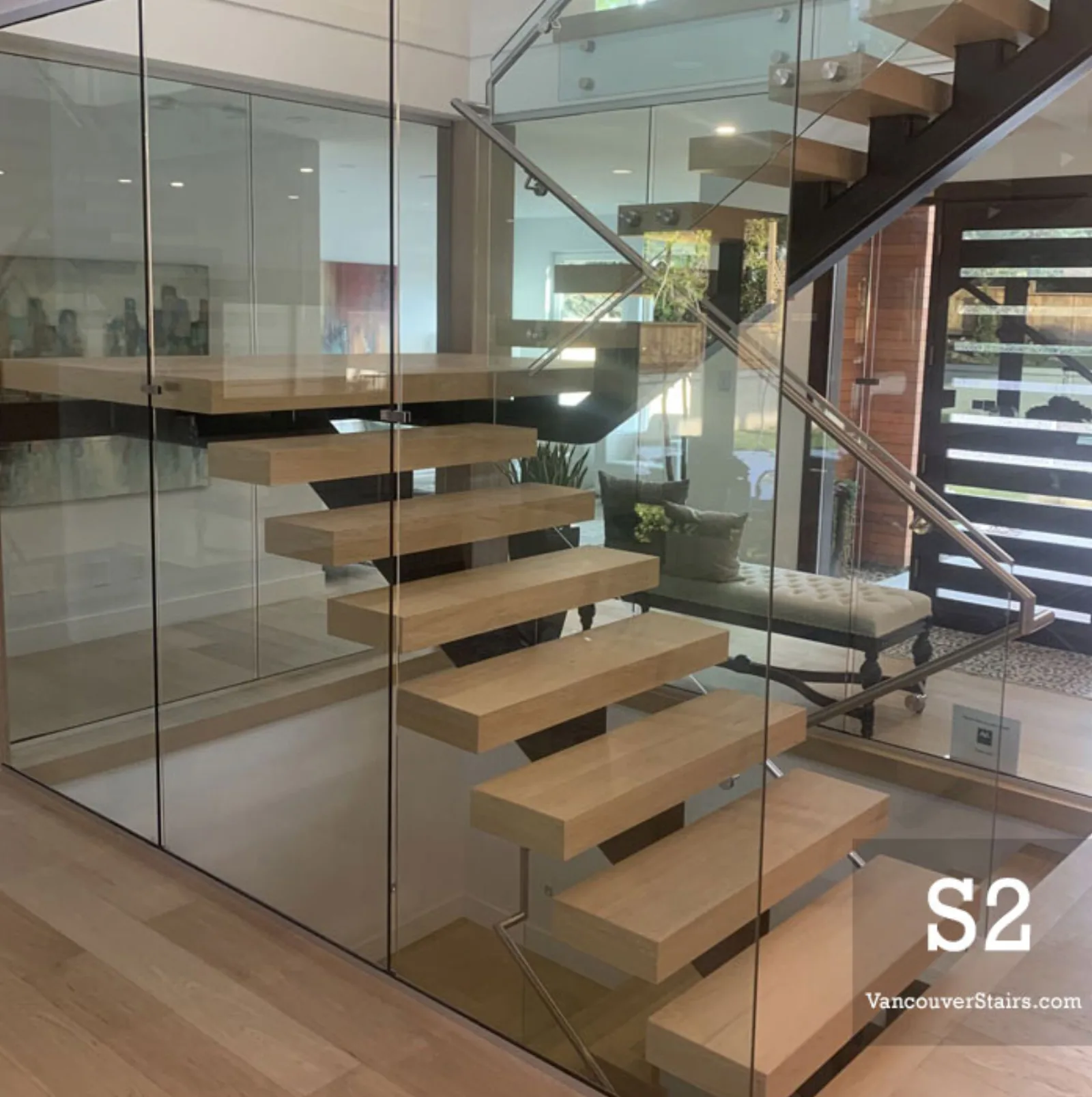
Custom steel staircases in Vancouver.
Residential, artistic, and feature steel stairs, from straight-run replacements to sculptural mono stringers. CWB-certified fabrication in Metro Vancouver.
Steel is the material Vancouver custom homes reach for.
A custom steel staircase does not warp, creak, or need refinishing. It holds its geometry through BC's wet winters and dry summers, takes any finish, and can be designed to be the visual focal point of a renovation or a clean, practical replacement for a tired wood stair.
This hub covers every decision in a steel staircase project: design options, cost drivers, material comparisons, finish systems, and what replacing a wood stair actually involves. The key design question comes before the aesthetics: how does the stair stand? The support strategy, mono stringer, cantilevered wall-anchor, straight-run double stringer, or suspended, determines structural scope, permit requirements, framing coordination, and the bottom-line cost before finish material is discussed.
Vancouver projects add their own layer: older homes with light framing, tight urban lots, heritage review in some neighbourhoods, and BC's seismic requirements for connections. Vancouver Stairs has been fabricating custom steel staircases in Metro Vancouver since 2010, CWB-certified to CSA W47.1 and with an institutional portfolio that includes Surrey Memorial Hospital and BCIT Burnaby.
Guide index
Sculptural Staircase Vancouver
Curved & Helical Staircase Design
Feature Wall Staircase Integration
Working with Architects on Feature Stairs
Replacing Wood Stairs with Steel
Exterior Residential Steel Stairs
Steel Staircase Installation Process
Steel Staircase Design Trends 2026
Which Staircase Type Is Right for You?
Every steel staircase starts with the same question: how does it stand?
The support strategy, mono stringer, cantilevered, straight-run, or suspended, determines the engineering, the framing, and the budget before the finish palette is discussed.
Residential steel staircase
Straight-run and L-shaped steel stairs for homes and renovations. Replaces wood with a durable, low-maintenance alternative.
Learn more →Artistic staircase design
Feature mono stringers, sculptural profiles, and design-led stairs for Vancouver custom homes where the stair is the centrepiece.
Learn more →Steel vs wood stairs
Durability, cost, design range, and maintenance compared. When steel is the better investment and when wood still makes sense.
Learn more →Replacing wood stairs with steel
What a wood-to-steel staircase replacement involves, scope, permit, demolition, framing, fabrication, and installation.
Learn more →Steel staircase FAQ.
Common questions about cost, lifespan, permits, and how steel compares to wood.
How much does a custom steel staircase cost in Vancouver?
A custom steel staircase in Metro Vancouver typically costs $18,000–$55,000 installed. A straight-run mono stringer with wood treads and powder-coat finish runs $18,000–$32,000. Feature floating or artistic stairs with glass railings cost $32,000–$58,000. Curved or helical sculptural stairs start around $60,000. Tread material, railing type, finish system, and site access all affect the final price. Every project is quoted after a site visit.
How long does a steel staircase last?
A properly fabricated and finished steel staircase lasts 50+ years in residential use. Interior stairs with powder coat over phosphate pre-treatment require minimal maintenance, typically a wipe-down and a touch-up on high-contact edges every few years. Exterior stairs with a duplex system (hot-dip galvanized plus powder coat) typically last 30+ years before recoating. Steel does not warp, rot, or creak like wood.
What are the advantages of steel stairs over wood stairs?
Steel staircases offer dimensional stability (no warping or seasonal movement), long service life with minimal maintenance, design flexibility (curves, cantilevers, and thin profiles not achievable in wood), and stronger open-riser options. They hold their geometry through BC's wet winters and take any finish. The trade-off is higher upfront cost than wood and longer lead time due to custom fabrication.
Do steel staircases need a building permit in Vancouver?
Yes. Installing a new steel staircase or replacing a wood stair with steel is a structural change that requires a building permit in Vancouver, Burnaby, Richmond, and most Metro municipalities. A Schedule B engineer's letter is typically required when the stair is floating, mono stringer, cantilevered, or open-riser. Vancouver Stairs provides shop drawings and engineering coordination as part of the project workflow.
How long does steel staircase fabrication take in Metro Vancouver?
Most residential steel staircases take 6–10 weeks from signed contract to installation. The phases are: site measure and drawing approval (1–2 weeks), Schedule B engineer review and permit (2–5 weeks, varies by municipality), shop fabrication (3–5 weeks), and installation (1–2 days for a single flight). Commercial projects or stairs requiring galvanizing run 10–16 weeks. Starting the permit process in parallel with shop drawings compresses the overall schedule.
Does a steel staircase need to be CWB-certified?
CWB certification under CSA W47.1 is mandatory for structural welding on institutional, government, and most multi-family residential projects in BC. For a single-family residential staircase, the building permit engineer will typically require proof of welder qualification, CWB certification satisfies this cleanly. Vancouver Stairs is CWB-certified to CSA W47.1, Division 2, covering the full range of residential and commercial structural steel.
Steel staircase planning resources.
Project guides, cost breakdowns, and technical references for Metro Vancouver staircase projects.
Cost
Custom metal stair cost guide
Full price breakdown, mono stringer, floating, commercial, and spiral stairs in Metro Vancouver.
Permits
Staircase replacement permits in Vancouver
What triggers a permit, which municipalities require one, and how to plan the schedule around approval.
Design
Sculptural statement staircases
When the stair is the feature, design directions and material strategies for Vancouver custom homes.
Maintenance
Metal stair and railing maintenance
What routine maintenance a powder-coated or galvanized steel stair actually requires.
How a custom steel staircase gets built in Metro Vancouver
Every staircase project moves through the same five phases, regardless of style or price point. Understanding the sequence helps homeowners, architects, and GCs coordinate without surprises:
- Site measure and structural assessment. The fabricator visits the site to confirm floor-to-floor height, landing dimensions, existing structural members, and access constraints. This is where support-strategy decisions get locked, a cantilevered stair requires the wall framing to be designed around the tread armature, so the measure has to happen early in the renovation sequence.
- Shop drawings and engineer coordination. Detailed fabrication drawings are produced showing all connections, weld specifications, and dimensions. A BC-licensed structural engineer (P.Eng) reviews the drawings and issues a Schedule B letter of assurance, required by most Metro Vancouver municipalities for any structural stair alteration.
- Building permit. The permit package (drawings plus Schedule B letter) is submitted to the local authority having jurisdiction. Vancouver City typically takes 2–5 weeks for residential stairs. Burnaby and Richmond have similar timelines. Permit review happens in parallel with shop preparation where possible.
- Fabrication and finish. Once permit is approved, the steel is cut, welded, and finished in the shop. CWB-certified welds are the standard for structural connections on permit-required projects. Interior stairs are powder-coated over a phosphate pre-treatment; exterior stairs receive a duplex system (hot-dip galvanized plus powder coat) for corrosion resistance in Metro Vancouver's coastal climate.
- Delivery and installation. The finished stair is delivered in sections and installed on-site. A single residential flight typically installs in one to two days. Treads are set and secured, guards are fitted, and the stair is ready for building inspection before occupancy.
Lead time from signed contract to installation-ready is typically 6–10 weeks for residential, 10–16 weeks for commercial or galvanized exterior work. Starting the permit process in parallel with shop drawings is the most reliable way to compress the schedule.
Home staircases across Metro Vancouver.
Custom steel home staircases, mono stringer, floating, straight-run, and feature stairs, with local planning notes, pricing, and finish guidance for each city we serve.
Vancouver Stairs vs. local competitors.
Choosing a staircase fabricator is a long-lead decision. These comparison pages cover approach, pricing signals, and key differences.
vs. Avangard Steel
Detailed comparison of custom steel stair approach, scope, and differentiators.
vs. Vancouver Fabricators
Scope comparison for mono stringer and residential stair fabrication.
vs. T&F Ironworks
How Vancouver Stairs approaches custom fabrication differently from T&F Ironworks.
All comparisons →
Full list of Vancouver stair fabricator comparison pages.
Other steel stair resources.
Floating Stairs Hub
Support strategies, BC code, structural prep, and cost drivers for open-riser floating staircase projects.
Metal Stair Fabrication
The full fabrication workflow, shop drawings, CWB welding, finish systems, and installation coordination.
Commercial Stairs
BC code compliance, egress design, pan-formed treads, and TI coordination for commercial stair projects.
Plan a custom steel staircase for your Vancouver project.
Send drawings, photos, or a rough scope and we will help define the practical next step.