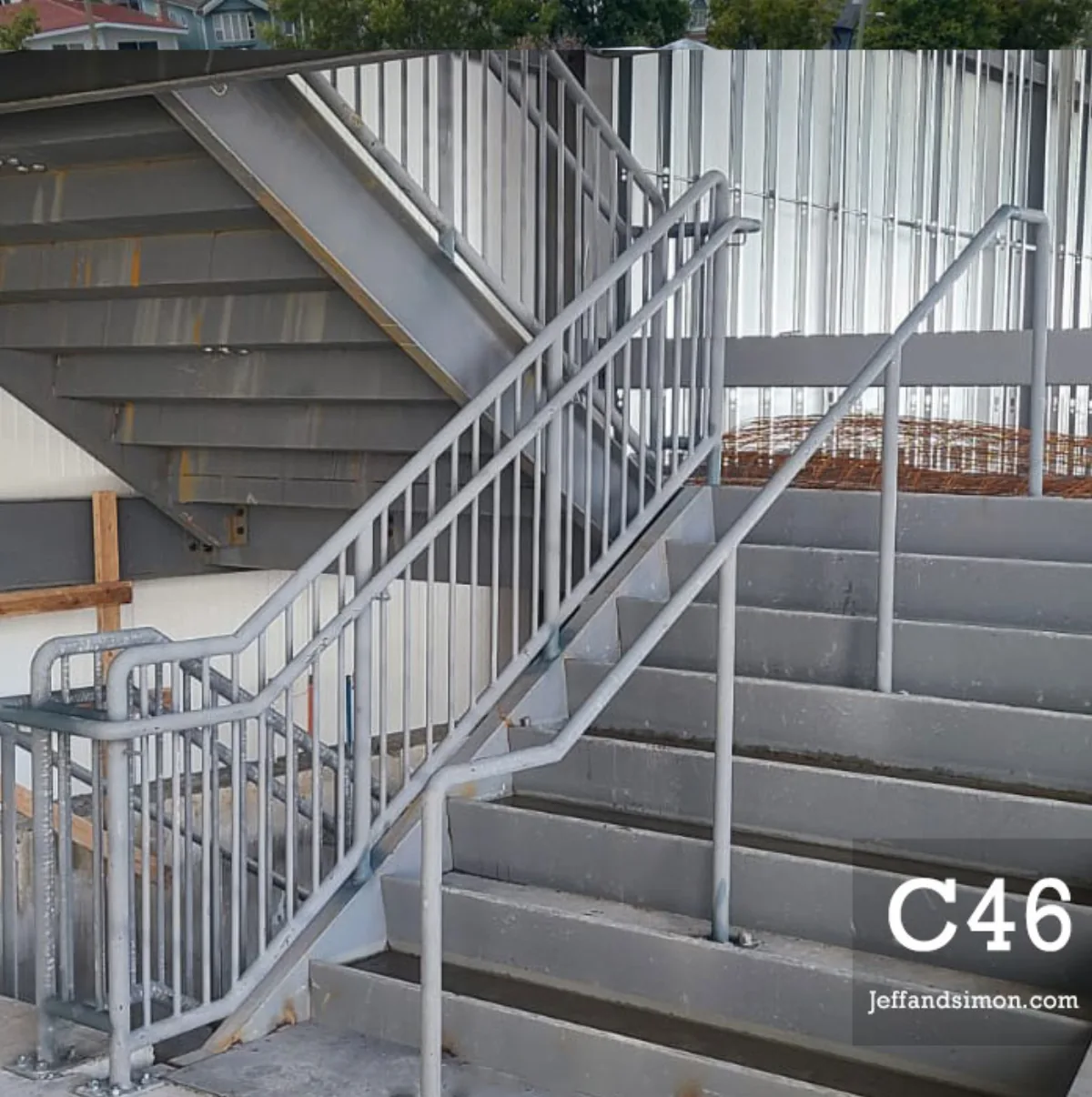
Commercial stairs in Metro Vancouver.
CWB-certified fabrication of egress, switchback, exterior, and feature commercial stairs. Shop drawings, engineer coordination, and full installation across Metro Vancouver.
Commercial stair work is a coordination problem before it is a fabrication problem.
Required exit stairs follow stricter rules than residential stairs. Pan-formed concrete-fill treads need a pour cycle on site. Galvanized exterior stairs need bolted field connections, not welded ones. Tenant improvement stairs install into buildings that are already operating. Each one of those decisions is settled before steel is cut.
Vancouver Stairs is CWB-certified to CSA W47.1 and has fabricated commercial and institutional stairs for projects including Surrey Memorial Hospital, BCIT Burnaby, Collingwood School, Queen Mary School, and Guildford Town Centre. CWB certification is a hard requirement on most institutional and government bids in BC, confirm it on any shop you shortlist before drawings are issued.
This hub keeps the commercial stair decisions in one place so a Vancouver project team, architects, GCs, project managers, building owners, can plan the scope before drawings are issued. None of it replaces the architect of record or the AHJ. All of it shortens the conversation.
Looking for the single-page summary? Read the Commercial Egress Stairs guide in the metal stair hub.
Four common commercial stair layouts.
Layout is set by the building core, not the stair. Pick the layout before tread, guard, or finish decisions.
Switchback
Two flights and an intermediate landing inside a single exit shaft. The default commercial layout because it minimizes floor footprint and uses the shaft efficiently.
Straight-run
A single flight floor-to-floor, with no intermediate landing. Common in atriums and feature lobbies. Demands more linear floor space and more from the stringer.
Scissor
Two independent stairs stacked in one shaft, separated by a fire-rated wall. A building-systems answer to two-exit requirements in some high-rise buildings.
U-return
A switchback variant with a wider mid-landing or a curved return. Reads more architectural than a tight egress switchback. Useful in office lobbies and institutional spaces.
What this hub answers.
A commercial stair lands in a building with a permit, a GC schedule, and an inspection track. The decisions that matter happen long before install day.
Egress Stair Design
Code-driven exit stairs, geometry, guard layout, fire-rated interface, and the coordination that has to happen before fabrication.
Switchback vs Straight-Run
A direct comparison of the four common commercial stair layouts, what each layout asks of the building core, the steel scope, and the schedule.
Pan-Formed vs Grating Treads
Pan-formed concrete-fill, bar grating, perforated steel, and checker-plate, how each tread system changes fabrication scope, install schedule, and maintenance.
BC Code for Commercial Stairs
How the BCBC Part 3, the VBBL, and the AHJ shape commercial stair design, width, riser, guard, handrail, and exit provisions. Confirm the current edition with your AHJ.
Exterior Galvanized Commercial Stairs
Rooftop access, parkade, multi-family exterior, and industrial site stairs, galvanizing, drainage, and bolted field connections that keep them working for decades.
TI Coordination Checklist
What GCs, project managers, and architects need to coordinate before a tenant improvement stair lands on site, drawings, engineer scope, fire-rated interfaces, install access.
What we've learned on commercial stair projects in Metro Vancouver.
Patterns from quoting, fabricating, and installing commercial stairs in BC, the decisions that saved time and the ones that cost it.
TI stair: schedule is the real constraint
On a tenant improvement stair in a Burnaby office building, the steel was ready to ship three weeks before the GC was ready to receive it. The building was occupied, access had to be coordinated with the property manager, and the install window was a single long weekend. We held the stair in the shop and rescheduled without a change order, but that required the GC to confirm the install window at the quote stage, not after fabrication started. Building-occupied TI stairs need a confirmed install window before fabrication goes on the schedule.
Pan-formed treads: the concrete pour is on the GC
A common misunderstanding on institutional egress stairs: we fabricate the pan and the stringer, but the concrete fill goes in on site, typically by the GC or a concrete sub. On a Surrey project, the pour happened three weeks after install, the stair was functional during that window with temporary grating covers. The pour schedule needs to be in the GC's sequence plan before the stair ships. Missing it pushes the building inspection back by the same interval.
Galvanized exterior stairs: bolted connections only
Field-welding galvanized steel burns the zinc and creates a corrosion path at the connection, exactly where you don't want it on a North Shore or coastal site. All of our exterior commercial stairs ship with bolted field connections and galvanized hardware. On a Squamish rooftop access stair, the engineer specified a 600g/m² galvanizing spec (above the standard 460g/m²) because of the site's wind-driven rain exposure. Know the exposure category before you write the finish spec.
Related reading from the Trends journal.
Vancouver-specific commercial and exterior stair posts that pair with this hub:
Related services and fabrication guides.
Common questions before quoting.
What counts as a commercial stair in Metro Vancouver?
Any stair installed in a building governed by the BC Building Code Part 3 or the Vancouver Building By-law, commercial, assembly, institutional, mid-rise residential, parkades, rooftop access, and tenant improvement work. Required exit stairs follow stricter rules than non-required and feature stairs, and the architect of record assigns each stair to its category.
Does every commercial stair need sealed engineering?
Most commercial stairs require sealed structural review of the stringers, the connections, and the anchor points. Some smaller, light-duty service stairs in certain occupancies are exempt. Required exit stairs and feature stairs almost always need sealed review by the structural engineer of record or a stair-specific engineer. Confirm with the project's architect and the AHJ.
Which tread system is right for a commercial stair?
Pan-formed concrete-fill treads are common in interior egress stairs because they read as concrete and damp underfoot noise. Galvanized bar grating is the default for exterior commercial, parkade, and rooftop access stairs because it drains and ships finished. Perforated steel and checker-plate sit between the two. The right answer depends on exposure, traffic, and the building's program.
Can a commercial stair use open risers?
Sometimes, but rarely on required exit stairs in commercial occupancies. Open-riser designs are usually limited to lobby feature stairs, private internal stairs, and non-required stairs. Required exit stairs in assembly, commercial, and institutional occupancies typically need closed risers. Confirm with the AHJ before design intent is locked.
What documentation does a commercial stair install need?
Most commercial projects need sealed shop drawings, the engineer's review letter, mill certs for structural steel, weld documentation where the project requires it, and installation reports. The fabricator's documentation package becomes part of the building's record. Plan the documentation as part of the schedule, not as an afterthought.
Other staircase fabrication resources.
Steel Staircases
Residential and feature steel staircase types, mono stringer, floating, artistic, and straight-run.
Metal Stair Fabrication
The full fabrication workflow, shop drawings, CWB welding, finish systems, and cost guide.
Custom Metal Fabrication
CWB certification, shop drawings, materials guide, and architect-contractor coordination.
Get a quote from Metro Vancouver's CWB-certified commercial stair fabricator.
Send drawings, photos, or a rough scope and we will help define the practical next step.