Custom Staircases in Burnaby Heights and Capitol Hill
What North Burnaby homeowners should know about planning a custom steel staircase, from heritage character home structure to the hillside lot access challenges of Capitol Hill and Burnaby Heights.
Burnaby Heights and Capitol Hill attract buyers who want character, views, and room to renovate. When those renovations include a custom staircase, the North Burnaby context shapes every design and structural decision.
North Burnaby’s premium residential neighbourhoods, Burnaby Heights along Hastings Street, Capitol Hill above Duthie Avenue, and the streets between, have a character that most of Burnaby’s denser areas do not. Detached homes on 33-foot and 50-foot lots, trees that have had sixty or seventy years to grow, views from Capitol Hill’s upper streets that reach across Burrard Inlet to the North Shore mountains. The renovation market here is not spec-build territory. These are properties where owners invest in quality materials and care about whether the result looks like it belongs.
That is the context for a custom steel staircase in North Burnaby: not a volume replacement, but a fabricated element that carries the rest of the renovation.
Burnaby Heights: the character home renovation corridor
Burnaby Heights runs along Hastings Street from Boundary Road east to Willingdon. The residential streets north and south of Hastings, Pandora, Graveley, East, Ormidale, Parker, have dense concentrations of pre-1940 housing: Craftsman bungalows, English cottage styles, two-storey foursquares built in the 1920s and 1930s. These are the properties where a heritage-informed renovation can recover significant value.
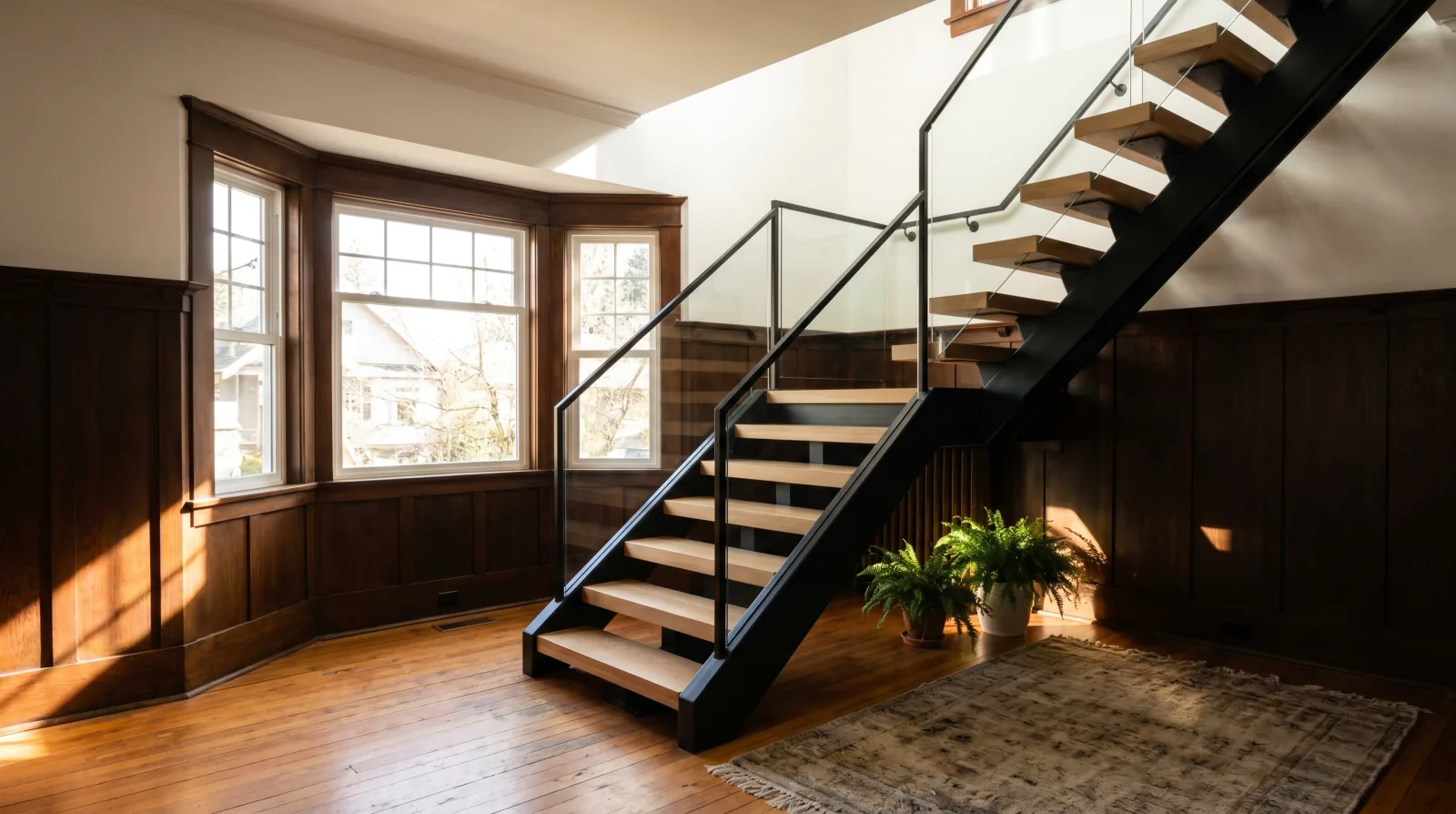
The housing profile here overlaps with East Vancouver and Kitsilano in some respects, but with a key difference: Burnaby Heights lots are more likely to still have the original housing stock intact rather than having been torn down and rebuilt. That means the structural conditions are genuinely older. Balloon framing, original plaster, stair openings designed for steep, enclosed stairs, all the characteristics that require careful structural assessment before a modern open-riser design is introduced.
The renovation economics in Burnaby Heights also differ from Vancouver proper. At $1.6-2.2 million for a detached home in the Heights, a comprehensive renovation that includes a custom steel staircase, typically $25,000-55,000 for a mono stringer or floating stair with glass or cable guard, represents a smaller fraction of asset value than the same investment would represent in a $700,000 Vancouver condo. Owners renovating in this neighbourhood are generally investing to stay, not to flip, and that drives different specification decisions.
Capitol Hill: views and grade
Capitol Hill is the elevated area north of Hastings, roughly between Boundary Road and Duthie Avenue. The streets climb steeply from the Hastings corridor, and homes on the upper blocks, the ones that face north or northwest, have unobstructed views of Burrard Inlet, the North Shore mountains, and on clear days, the peaks of the Tantalus Range above Squamish.
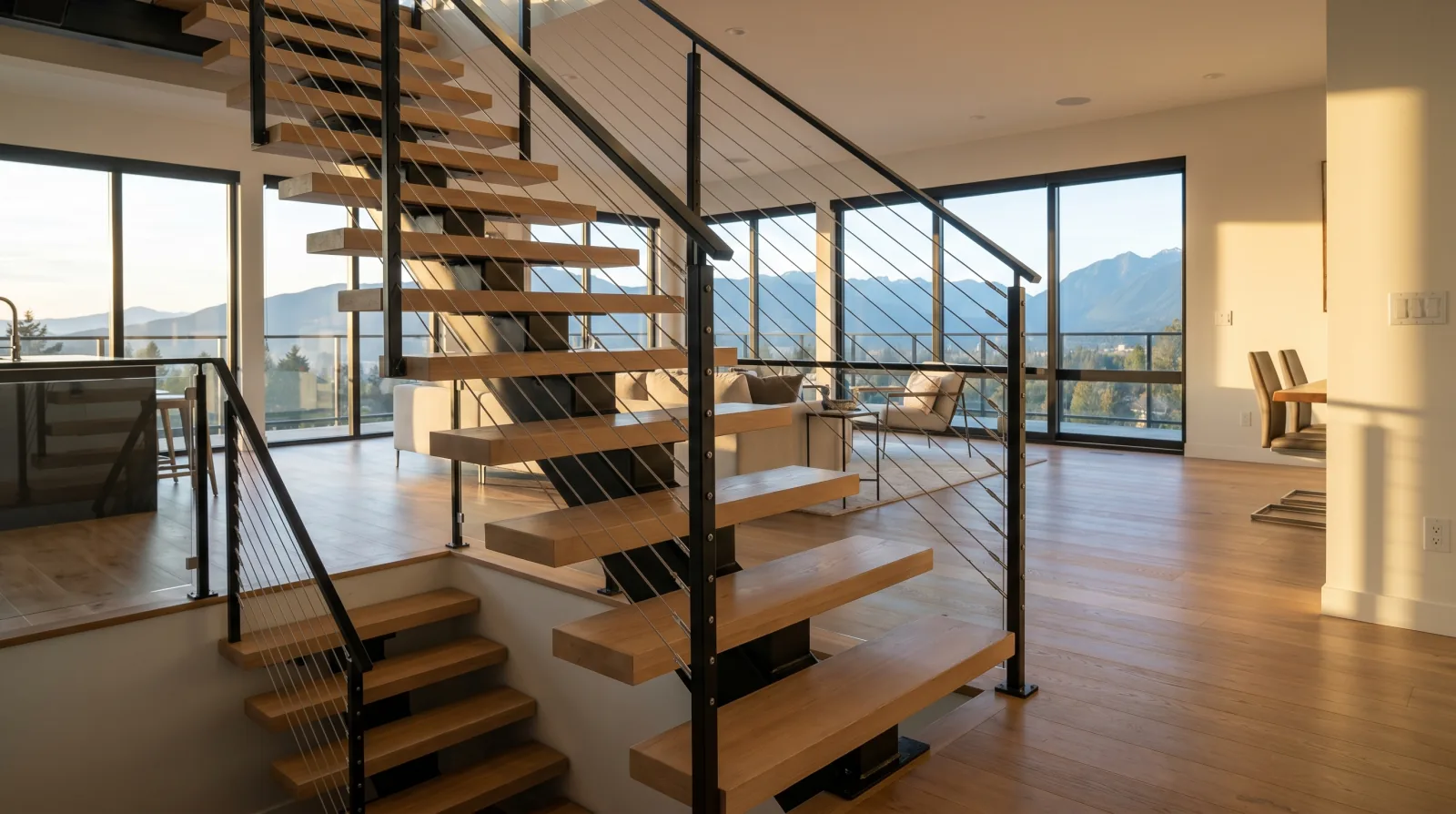
The view changes the stair guard specification. In a home where the stair faces a glazed wall or a view corridor, the guard is part of the view, not just a code requirement. Solid infill panels or close-spaced pickets block the sightline that the house was bought for.
The practical options for guard infill that maintain views:
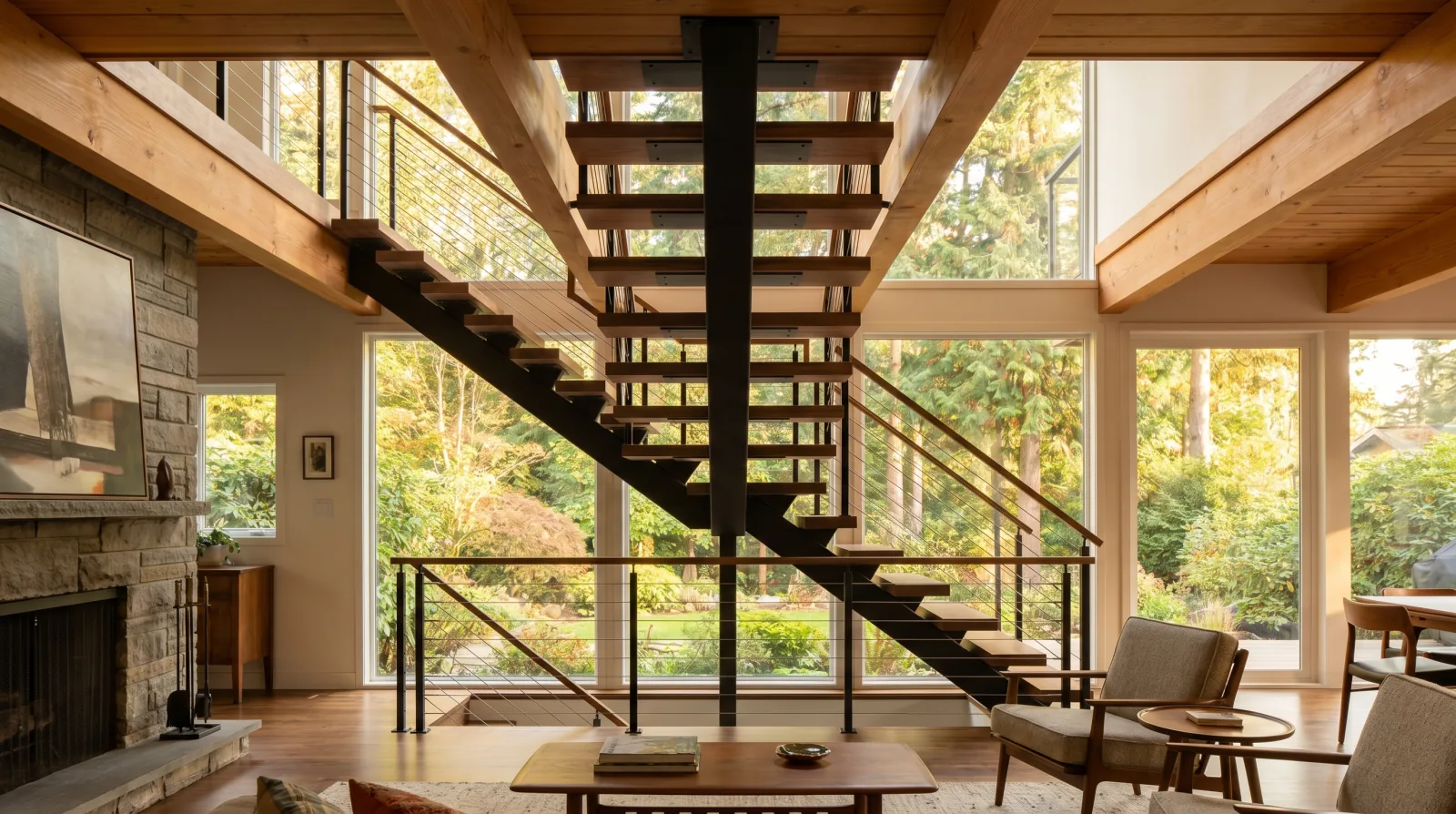
Cable railing, horizontal stainless cable at 100mm maximum clear spacing, with powder-coated or stainless posts. The cables occupy minimal visual space. From a distance, a cable guard reads as nearly transparent. Maintenance requirement: periodic cable tension check every few years; in interior conditions, this is minimal.
Frameless glass guard, tempered or laminated glass panels in a continuous base shoe or spigot-mounted. The glass reads as invisible from a distance. It requires cleaning, fingerprints and condensation show on glass in a way they do not on cable, but the view preservation is superior to any other guard type.
Framed glass with top rail, glass panels in a slotted post or channel post system, with a top rail for graspability. Slightly more hardware visible than frameless but structurally more forgiving where the stair post attachment to the floor structure is imprecise.
For a Capitol Hill home where the stair faces the Burrard Inlet view, frameless glass is the most common recommendation because it fully preserves what the view orientation provides. For homes where the view faces south or east, toward Burnaby Mountain or the Metrotown skyline, cable railing is often the preference because the industrial-modern language of cable suits the urban orientation better than glass.
The Deer Lake context: exterior stairs and driveways
South of Hastings, the Deer Lake area, the streets surrounding Deer Lake Park, including Panorama Ridge and the Buckingham Heights pocket, has a different character from the Heights. Larger lots, 1960s-1970s West Coast-influenced builds alongside newer custom homes, and the topographic complexity of sitting between Burnaby Mountain and the lake basin. Exterior stairs here often connect split-level driveways, rear yards on grade change, or lower patios to main floor entries.
These exterior applications need the same finish thinking as North Shore exterior metalwork:
- Fully exposed stairs should be hot-dip galvanized, or specified with a duplex finish (galvanize plus powder coat)
- Partially sheltered stairs, under a covered entry or eave, can use a quality two-coat powder coating system over steel primer
- Hardware at post bases and stringer ends should be designed to shed water rather than trap it against the steel
Burnaby’s interior climate (no coastal salt exposure) is more forgiving than West Vancouver or North Vancouver, but Burnaby still gets sustained wet periods through the fall and winter. Powder coat alone on a fully exposed exterior stair starts failing at weld points and cut edges within five to ten years in this climate. The galvanized duplex system may cost more upfront but delivers a 25-40 year service life rather than a 10-15 year one.
Coordinating with Burnaby’s new permit fee structure
The City of Burnaby updated its building permit fee structure on January 1, 2026, with increases tied to inflation recovery and staffing costs. For homeowners planning a renovation that includes structural stair changes, the permit fee is calculated against total construction value. A staircase replacement as part of a larger renovation project is typically permitted as part of the whole-project permit rather than as a standalone application.
The practical implication: start the permit application before the stair is quoted, not after. A permit application requires enough design information to assess scope. That means having the basic stair design confirmed, mono stringer vs floating, approximate stair opening dimensions, guard type, before the permit is filed. The detailed shop drawings can follow once the permit is issued.
Burnaby’s inspection process for structural stair work typically requires a framing inspection when the stair is first installed (structure only, before treads and finishes are complete) and a final inspection at project completion. The fabricator and contractor should build these inspection windows into the installation schedule.
What a North Burnaby stair quote should include
A quote for a custom stair in Burnaby Heights or Capitol Hill should itemize:
- Stringer type and material: mono stringer (single central beam) vs double stringer (two side beams) vs wall-supported cantilevered treads
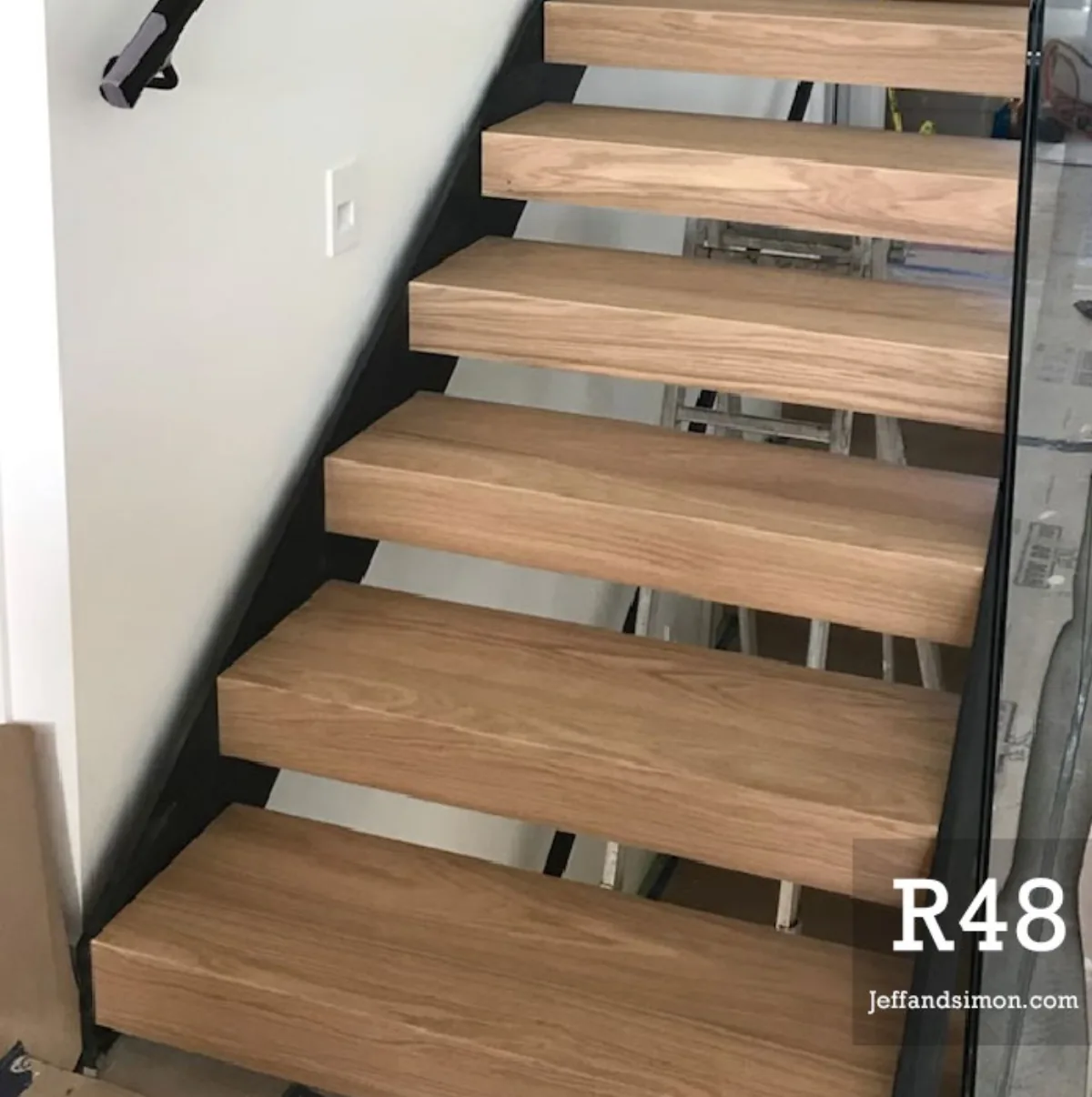
- Tread specification: material (oak, walnut, steel grating, concrete-topped), thickness, nosing detail
- Guard system: type (cable, frameless glass, framed glass, steel picket), post material and finish, top rail if applicable
- Finish: powder coat colour and coat specification, or galvanized duplex if applicable
- Connection detail: how the stringer attaches to the floor structure above and below, including any blocking or header requirements
- Installation: who installs, how many days, whether the fabricator coordinates tread installation if that is a separate trade
A quote that omits the connection detail, one that says “installation” without specifying how the stringer bears on the structure, is one that has not fully thought through the site conditions. In an older Burnaby Heights character home, the connection detail is where the budget risk lives. Getting it specified before the stair is fabricated is the most important part of the pre-fabrication process.
Related reading: the staircase replacement permit guide for Vancouver, the mono stringer staircase deep dive, and the Burnaby service area page.
Related questions
What permit does Burnaby require for staircase replacement?
Burnaby requires a building permit for structural stair changes, including modified openings, changed loadpaths, and new guard systems. The city also requires a minimum Energy Step Code Step 3 for residential work starting January 2025, though this applies to the overall renovation scope rather than the stair specifically. Confirm current requirements with the City of Burnaby before finalizing shop drawings.
Are Burnaby Heights character homes harder to work with structurally?
They have the same challenges as any pre-1940 home: balloon framing, narrow original stair openings, plaster walls that may be structural, and floor-to-floor heights that don't always match modern assumptions. The key is measuring the actual opening and confirming the wall structure at the stringer attachment points before shop drawings are issued.
How long does a custom stair take from first contact to installation?
Typically 8-14 weeks from first site visit to installed stair. This includes design development (2-3 weeks), shop drawing approval (1-2 weeks), fabrication (3-6 weeks), and finishing (1-2 weeks). Permit review adds 2-4 weeks to the beginning of the process if required. Starting early relative to the overall renovation schedule avoids the stair becoming the critical path.
Do Capitol Hill views affect the stair design?
Yes, where a Capitol Hill home has a view of Burrard Inlet, the North Shore mountains, or Vancouver city lights, the stair guard becomes a visibility decision. Glass guards maintain sightlines from a landing or intermediate floor. Cable railing does the same with a more open feel. Solid picket guards or panel infill interrupt the view and are worth reconsidering in these situations.