Glass Railing Cost in Vancouver: 2026 Price Guide
What glass railing systems cost in Metro Vancouver, price per linear foot, frameless vs semi-frameless, and what drives the budget up or down.
Vancouver Stairs installs glass railing across Metro Vancouver for $350–$700 per linear foot, depending on glass type, post system, and whether the installation is frameless or semi-frameless.
Glass railing is the premium railing choice for Vancouver homes, decks, and staircases where unobstructed views and a contemporary look are the priority. It costs more than cable or steel picket railings, and the price range is wide, from a mid-range semi-frameless deck system to a full frameless interior staircase with custom standoffs.
What glass railing costs in Vancouver
Glass railing in Metro Vancouver typically runs $350–$700 per linear foot installed for residential projects. The range reflects the spread between a practical semi-frameless exterior deck system and a high-end frameless interior staircase with custom hardware.
A semi-frameless exterior deck railing with aluminum posts and standard tempered glass panels lands in the $350–$450 range. A frameless system with stainless standoffs or a base shoe channel, custom post spacing, and a top-mounted handrail lands in the $500–$650 range. Full custom frameless interior railings with premium hardware and laminated glass sit at the upper end.
Frameless vs semi-frameless: what the terms mean
Semi-frameless glass railing uses posts, typically aluminum or steel, at regular intervals. The glass panels slot between or into the posts, with the posts carrying most of the lateral load. This is the more common and more cost-effective approach for decks and exterior applications.
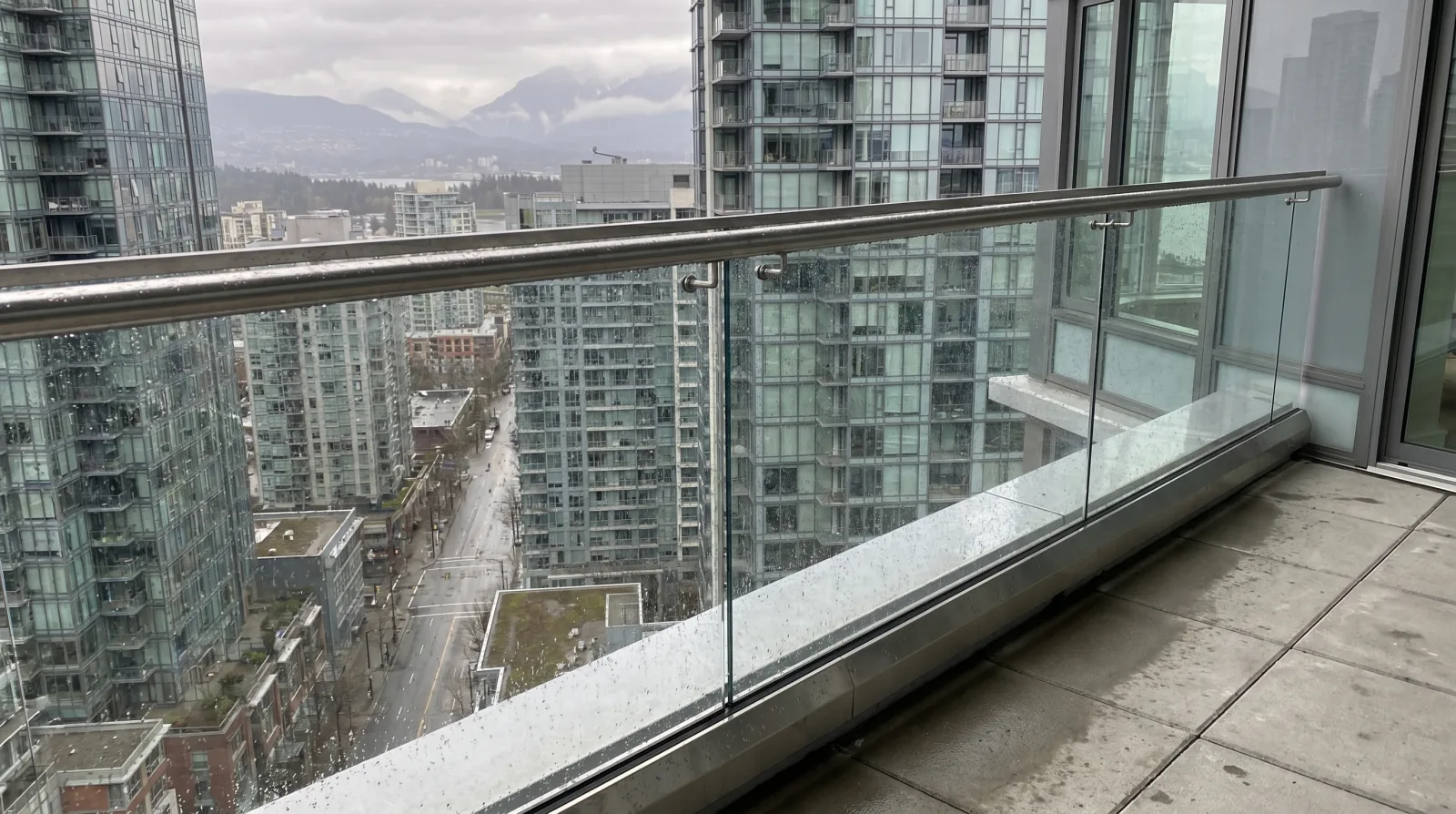
Frameless glass railing eliminates visible posts. Glass panels are held by a continuous base channel (a U-channel or “shoe”) set at the bottom, or by individual standoff fittings on the face of the deck or wall. All of the lateral load transfers through the hardware at the base. The result is a cleaner look with an unobstructed view through the glass, and a higher hardware and installation cost.
What drives the cost up
Glass specification is the first factor. Standard tempered glass (typically 10–12 mm) is the baseline. Low-iron (clearer) glass costs more. Laminated glass, two layers of tempered glass bonded with an interlayer, costs more and is required in some overhead or sloped applications. Tinted glass adds a premium.
Post or hardware system is the second factor. Aluminum semi-frameless posts are the most affordable. Stainless steel posts and standoffs are mid to high range. Custom-fabricated steel frames, powder-coated to match a staircase, are at the upper end.
Handrail material and profile adds cost. A standard aluminum top-rail over a semi-frameless system is mid-range. A custom round-profile stainless top-rail over a frameless system adds fabrication and polishing cost.
Glass panel size affects installation labour. Large panels are heavier, harder to handle on a site, and sometimes require a crane or panel-lifter for upper-level installs. Sites with limited access pay more for installation.
Glass railing on stairs vs decks
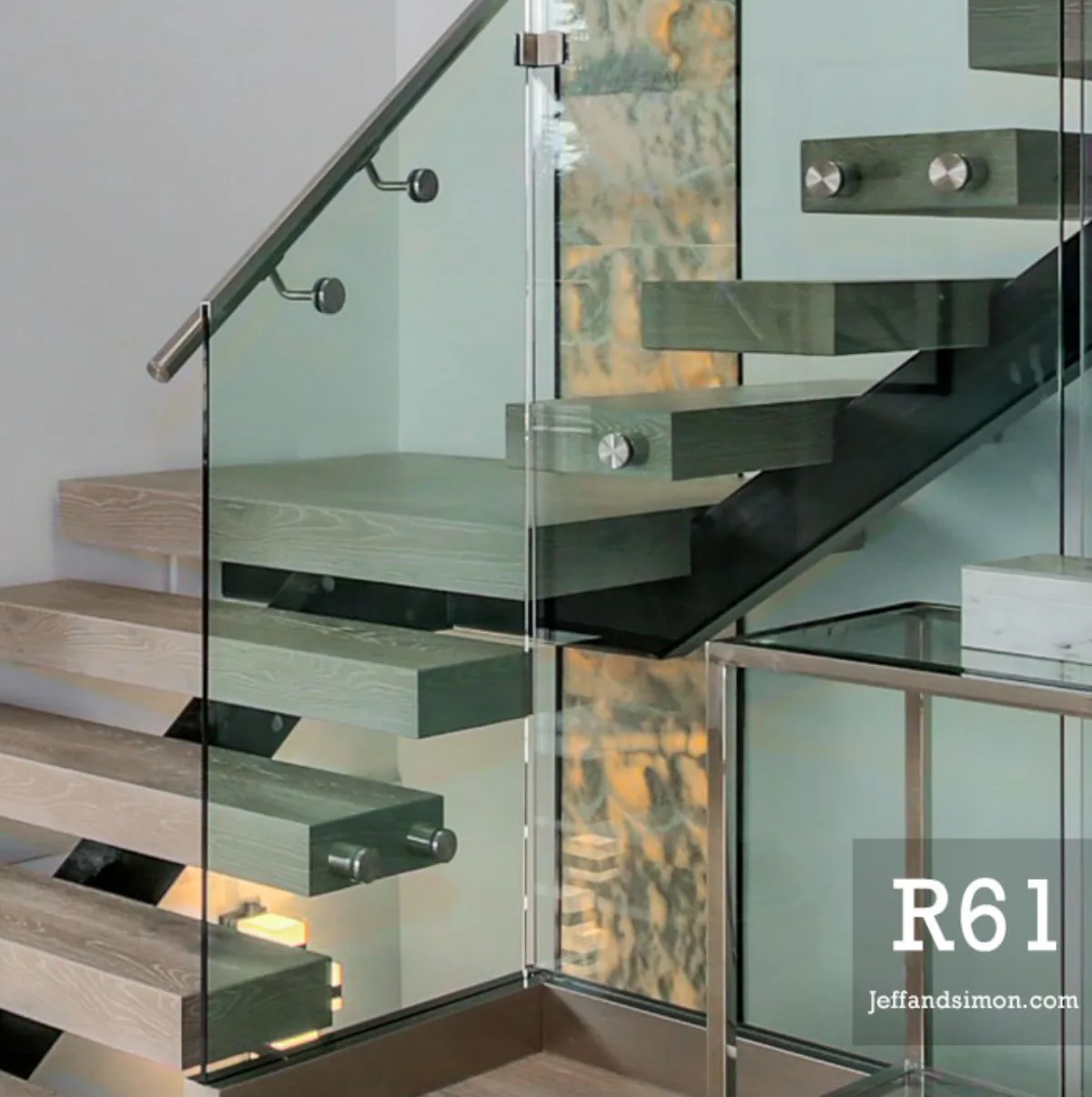
Stair glass railing is typically more expensive per linear foot than deck glass railing because the panel geometry is angled, post connections are more complex, and the handrail continuity requirements under BC code add hardware at the top and bottom of the stair run.
Glass panels on a staircase must be cut to the stair pitch angle, they are not rectangular. Each panel is custom-cut and tempered, which adds lead time and cost compared to the rectangular panels used on flat decks.
The handrail requirement
Under the BC Building Code, a glass railing panel does not satisfy the graspable handrail requirement. A separate handrail, with a defined profile that can be gripped by a hand, must be provided. On semi-frameless systems, the top aluminum rail is sometimes shaped to meet this requirement. On frameless systems, a separate wall-mounted or post-mounted handrail is almost always required. Confirm the handrail detail against the applicable code edition and your AHJ’s interpretation before fabrication.
Typical total project costs
A typical residential glass railing project in Metro Vancouver, a single deck railing or staircase, ranges from $8,000 to $30,000 total installed. A 25-linear-foot semi-frameless deck railing sits at the lower end. A 50-linear-foot frameless staircase railing with custom stainless hardware and a continuous handrail sits at the upper end.
Most homeowners in Metro Vancouver spend $10,000–$20,000 for a complete deck or interior stair glass railing, including installation. Projects with difficult site access, upper-floor balconies, hillside properties, or renovation sequences with other trades in the way, add installation cost regardless of the system type.
Coastal and site-specific pricing factors
Vancouver’s geography adds variables that don’t apply everywhere:
Proximity to salt water is the most significant local factor. Properties within 1.5 km of tidal water, Coal Harbour, Kitsilano Beach, West Vancouver waterfront, Richmond waterfront, Steveston, require stainless hardware and marine-grade fixings throughout. Mild steel or aluminum fittings corrode within two to five years in these environments. Stainless hardware adds 10–20% to the installed cost versus an inland residential installation.
Hillside access on the North Shore (North Vancouver, West Vancouver) affects crane use, panel handling, and installation time. Properties on steeply sloped lots often require extra labour to lift and position large glass panels safely.
High-rise and elevator access in strata buildings adds scheduling complexity, particularly for multi-floor replacement programs. A 10-unit building with balcony glass guards is a different logistics problem than a single-family home.
Glass specification: what to ask about
Not all tempered glass is the same. On a standard project, the glass specification drives both cost and appearance:
- Standard tempered glass (10 mm): baseline cost; a slight blue or green tint visible on the edge
- 12 mm tempered: heavier, slightly higher cost, often preferred for frameless systems where stiffness matters
- Low-iron glass: crystal-clear appearance with no green tint; noticeable difference on large panels; adds 15–25% to the glass cost
- Laminated safety glass: two tempered layers bonded with an interlayer; required for some overhead and sloped applications; premium pricing
For staircase railings, 12 mm tempered or laminated glass is the most common specification. For deck railings, 10 mm standard is often sufficient.
How to compare glass railing quotes in Vancouver
Glass railing quotes vary more than most railing quotes because the line items are less visible. When comparing, ask contractors to break out:
- Glass specification: thickness, type, number of panels, custom cuts
- Hardware system: post type, base shoe or standoff system, finish
- Handrail: included or quoted separately, material and profile
- Installation: number of days, crew size, access requirements
- Permit: included or excluded
A quote that bundles everything into one number is harder to compare and usually harder to adjust if the scope changes.
Related reading: the cable railing cost guide for Metro Vancouver, the custom metal stair cost guide, and the strata railing cost guide for multi-family projects.
Sources
Related questions
How much does glass railing cost per linear foot in Vancouver?
Glass railing in Metro Vancouver typically runs $350–$700 per linear foot installed for standard residential projects, with frameless systems and specialty glass at the upper end. Tenmar, a BC-based specialist, cites frameless systems at $300–$400 per linear foot for their region, with premium stainless hardware and low-iron glass pushing past $700.
Is frameless glass railing more expensive than semi-frameless?
Yes. Frameless glass systems using standoff hardware or a continuous base channel cost more than semi-frameless systems with visible top or side rails because the hardware must carry the full load of the glass panel without support posts. Semi-frameless systems in Metro Vancouver typically run $250–$350 per linear foot installed.
Does glass railing need a separate handrail?
In almost all BC residential and commercial applications, yes. The BC Building Code requires a graspable handrail with a specific profile and continuity. A glass panel on its own does not meet this requirement, a separate wall-mounted or post-mounted handrail is almost always required on frameless systems.
How much does a full glass railing project cost in Metro Vancouver?
A typical residential glass railing project, a single deck or staircase run, ranges from $8,000 to $30,000 total installed in Metro Vancouver. A 25-linear-foot semi-frameless deck railing sits at the lower end; a 50-linear-foot frameless staircase railing with premium stainless hardware sits at the upper end.
Does coastal location affect glass railing pricing in Vancouver?
Yes. Properties within 1.5 km of salt water, Coal Harbour, Kitsilano waterfront, North Shore, Richmond waterfront, require stainless fittings and corrosion-resistant hardware, adding 10–20% to the installed cost versus comparable interior installations.