How to Read a Metal Fabrication Quote: A Homeowner's Guide
What a custom staircase or railing quote should include, which line items to question, and how to compare two quotes that look very different on paper.
A Vancouver Stairs metal fabrication quote itemizes materials, labour, finish, hardware, engineering, and installation separately. Here's what to look for and what the gaps mean.
Getting multiple quotes on a custom metal staircase is sensible. Knowing what to compare is harder. Two quotes for the “same stair” can differ by $15,000 and both be correct, because they are quoting different scopes.
Here is what to look for.
The line items a complete quote should include
A full custom staircase quote in Metro Vancouver should break down roughly as follows.
Design and drawings covers the shop drawings that translate site dimensions, design intent, and engineering requirements into a fabrication plan. Some fabricators include basic drawings in the fabrication price; others charge separately. For complex stairs or projects where the design is still evolving, this is a real line item.
Materials should list structural steel, tread material, railing hardware, and fasteners. A quality quote specifies the steel spec, tube size, wall thickness, or standard section, the tread substrate (hardwood species, gauge of steel pan), and the hardware grade. Generic “materials” with no specification is a warning sign.
Fabrication labour is the cost of cutting, fitting, welding, grinding, and assembling in the shop. This is the core of the fabrication price and reflects the shop’s hourly rate, the geometry, and the custom detail work involved.
Finish covers powder coat colour and application, galvanizing (if exterior), patination, or clear coat. Some contractors include a standard powder coat; others quote it separately. If the quote says “paint” without naming a powder coat applicator, ask what is actually included.
Hardware is sometimes buried in the materials line. On cable railing, it means the cable, swage fittings, tensioners, and end hardware. On glass railing, it means standoffs, base shoes, glass clips, and top rail. Confirm hardware is in scope before accepting any number.
Delivery is a real cost. Getting a fabricated stair from a shop in Burnaby or Surrey to a site in West Vancouver or Kitsilano often requires a flatbed and sometimes a crane or pipe-hoist for upper-floor access. Ask whether delivery is included.
Installation, labour to set the stair, connect to the building, install the railing, tension the cable, and set the handrail, is separate from fabrication. On a complex project, installation can represent 15–30% of total project cost.
Engineering means sealed structural drawings and an engineer’s review letter confirming the stair design meets code. Most permitted stairs require this. Some fabricators bundle it with a preferred engineer; others leave it to the homeowner to arrange separately.
Permit coordination is helping the homeowner or GC submit the application, respond to AHJ questions, and attend inspections. Some fabricators handle this. Others leave it to the owner entirely.
How two quotes can differ by $15,000
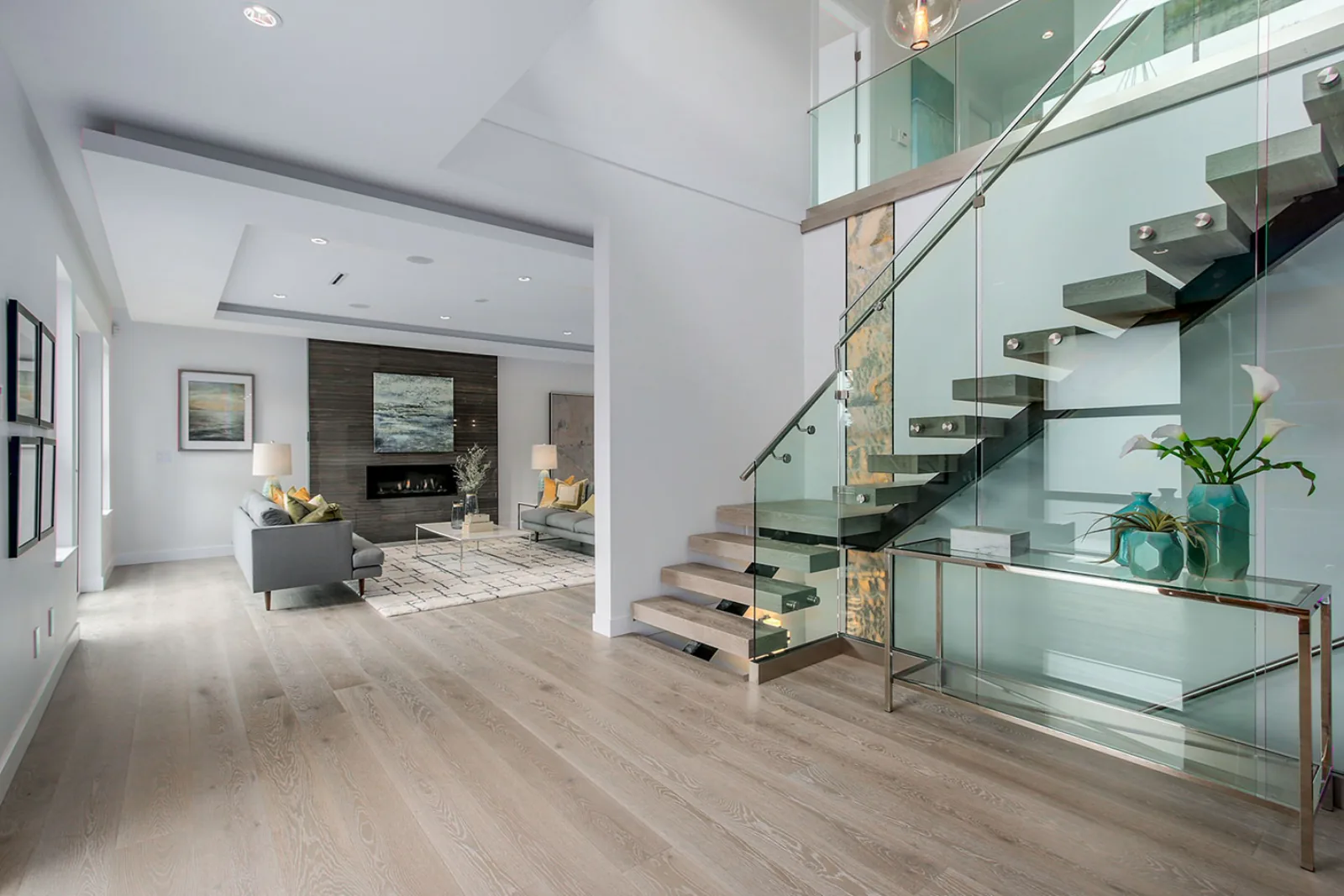
Consider two fabricators quoting a mono stringer stair with glass railing. One comes in at $32,000. The other is $47,000.
The lower quote is fabrication-only. Engineering, glass hardware and panels, installation, and permit coordination are each excluded. Add those back and the true delivered-and-installed cost often lands close to, or above, the higher quote.
The higher quote includes all of those items under one contractor. The gap is real, but the higher number may be the more accurate picture of what the project actually costs.
This is the most common comparison trap on custom staircase quotes. Ask both contractors directly: is engineering included? Is glass or cable hardware included? Is installation included? Is permit coordination included?
Questions worth asking before you accept any quote
Before signing a custom staircase contract, ask these questions. A fabricator who cannot answer them clearly has not fully priced the project.
Ask what steel specification, tube size and wall thickness, is being used for the stringer. Ask what tread species or substrate is included, and what thickness. Ask whether hardware (cable fittings, standoffs, glass panels, base shoes) is in the price. Confirm whether the finish is a shop-applied powder coat from a certified applicator, and which applicator.
Ask directly whether engineering and an engineer’s letter are included, or whether that is the homeowner’s arrangement. Ask whether delivery is included, and whether installation covers all hardware tensioning and handrail attachment. Ask who is responsible for permit application and AHJ coordination, and what the payment schedule looks like, deposit, milestone, and holdback.
Finally, ask for the current lead time from deposit to scheduled installation date, and ask how firm that estimate is.
The questions are not adversarial. They are the same questions the fabricator should have asked themselves when pricing the job.
Lead time is part of the quote
The price is not the only number that matters. A quote with a 4-week lead time and a quote with a 12-week lead time are different products if the project has a fixed move-in date. Ask each contractor for a current lead time estimate from deposit to scheduled installation date, and confirm how firm that estimate is.
In our shop, a standard residential staircase typically runs 8–12 weeks from approved drawings to scheduled installation, though stairs with complex geometry, specialty finishes, or required engineering review can run longer. Confirm current lead time directly with each fabricator when getting quotes.
What a payment schedule should look like
Most metal fabrication projects in Metro Vancouver follow a deposit-milestone-holdback structure. A typical breakdown for a custom staircase:
- Deposit (25–35%): Paid on contract signing. Covers design and drawing development, material procurement lead time, and scheduling the project into the shop’s production queue.
- Shop milestone (30–35%): Paid when fabrication is complete and the stair is ready to leave the shop. Confirms the client has approved shop drawings and is ready to receive the installation.
- Installation complete (25–30%): Paid at completion of installation, including railing, hardware, and final connections.
- Holdback (5–10%): Released after a walkthrough at a defined interval (typically 30 days after installation), confirming no deficiencies and confirming the stair has been used and inspected.
Some fabricators use a two-stage structure (deposit + balance at installation) without a shop milestone. This is more common for smaller projects. For complex or high-value projects, a three-stage structure gives both parties clear checkpoints.
Avoid paying more than 50% before fabrication begins. A deposit over 50% gives the fabricator your funding before they have committed significant production to your project.
Red flags in a custom staircase quote
Not every variation in a quote is benign. Here are the ones worth pausing on.
A quote that says “steel stringer” without specifying the section, RHS 100×100×6, HSS 4×4×1/4, or equivalent, gives the fabricator room to use whatever steel is on hand or cheapest at time of purchase. The stringer section affects stiffness, deflection, and visual weight. It should be named.
“Painting” without specifying powder coat is a different issue. Spray paint and powder coat have different durability and appearance characteristics. If the quote says paint, ask whether that is shop-applied powder coat from a certified applicator or something applied on site.
No mention of CWB certification should prompt a direct question. Structural welding for stairs in British Columbia requires CWB certification, or an equivalent accepted by the AHJ. Ask whether the shop is CWB certified and whether that certification applies to this project’s scope.
“Permit if required” without clarification is a phrase that defers the question without answering it. Ask directly: does this project require a permit? If yes, who is pulling it, and what is included in the quote?
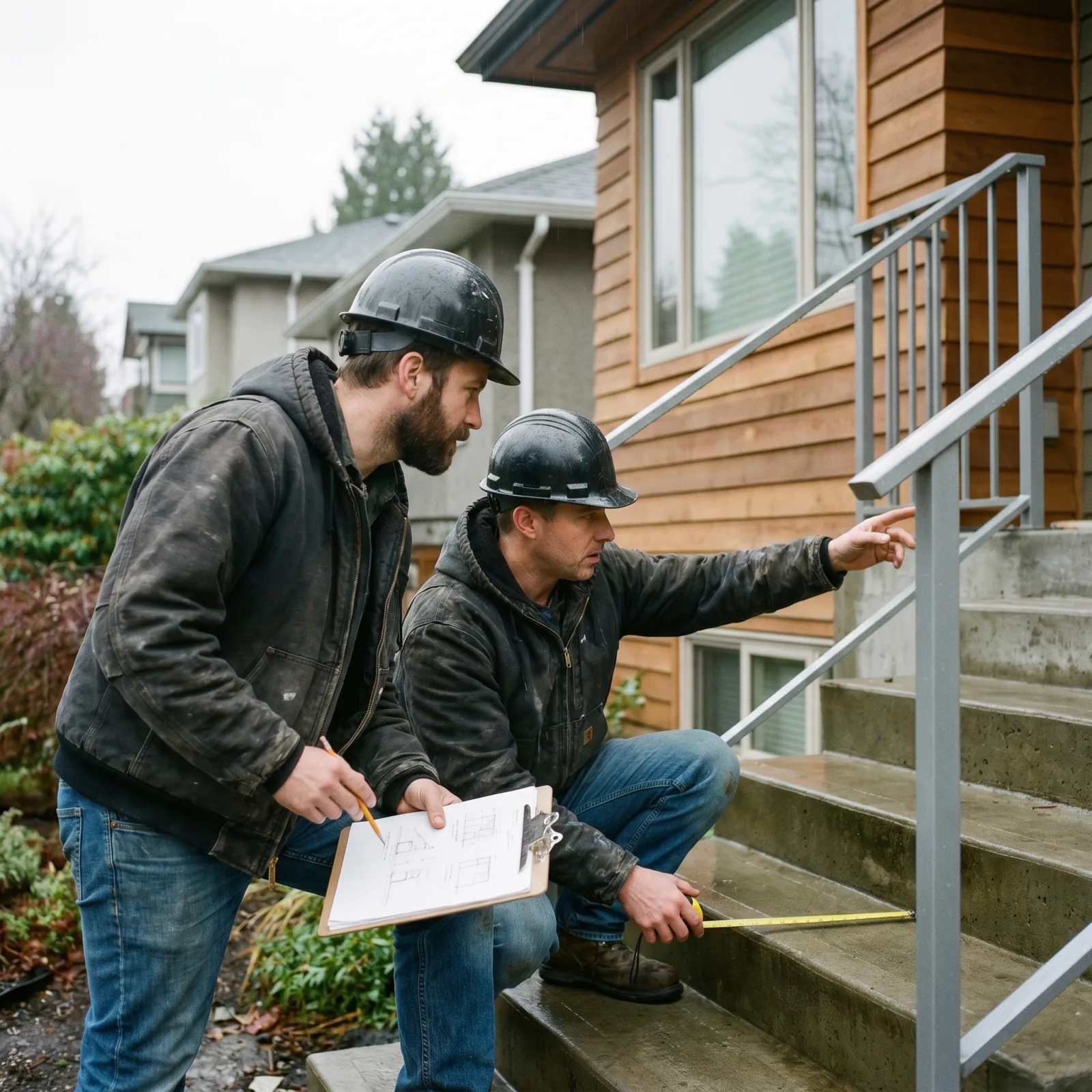
No site visit planned on a renovation project is a real risk. Custom staircases almost always require a field measurement visit before fabrication. A quote issued with “based on drawings only” language carries the assumption that site conditions match the drawings. They often do not.
A sample quote comparison checklist
Use this side-by-side when comparing two quotes for the same project:
| Line item | Quote A | Quote B |
|---|---|---|
| Design and shop drawings | Included / Separate / Not included | |
| Steel specification (section size) | Specified / Generic | |
| Tread material and thickness | Specified / TBD | |
| Hardware (cable/glass/standoffs) | Included / Separate / Not included | |
| Finish (type and applicator) | Specified / Generic | |
| Engineering (sealed letter) | Included / Separate / Not included | |
| Delivery | Included / Separate | |
| Installation | Included / Separate / Not included | |
| Permit coordination | Included / Not included | |
| Payment schedule | Deposit / Milestone / Balance | |
| Lead time from deposit | Weeks | |
| CWB certified | Yes / Ask |
Fill in both columns, then compare true total cost rather than the base fabrication number.
Related reading: the custom metal stair cost guide, the floating staircase cost guide for Vancouver 2026, and the custom metal fabrication process overview.
Related questions
Why is one fabricator's quote so much lower than another's?
Large differences in quotes usually mean one of three things: different scope assumptions, different material specifications, or different engineering and permit inclusions. Ask both contractors to itemize the same line items and compare the numbers side by side.
What should a custom staircase quote include?
A complete custom staircase quote should cover design and drawings, material supply, fabrication, finish, hardware, delivery, installation, engineering (if required), and permit coordination (if included). Ask for each line item separately.
Should I choose the lowest quote?
Not automatically. The lowest quote often excludes engineering, permit, or hardware line items that are included in a higher quote. Compare total delivered-and-installed costs, not the base fabrication number.