Staircase Replacement in Lynn Valley: Planning for West Coast Modern Homes
What Lynn Valley homeowners need to know about replacing stairs in post-and-beam and West Coast Modern homes, structure, headroom, finish, and scheduling around North Shore conditions.
Lynn Valley's housing stock, post-and-beam builds from the 1960s and 1970s, renovated mid-century homes on forested lots, creates a specific set of staircase replacement challenges that differ from Vancouver proper.
Lynn Valley’s housing stock is unlike most of Metro Vancouver. The neighbourhood runs from the valley floor north toward the mountains, forested lots, steep approaches, properties where the garage sits at grade and the main living floor is one storey above the driveway. The architecture that defined Lynn Valley’s growth from the 1950s through the 1980s draws heavily on West Coast Modernism: post-and-beam construction, exposed timber, large glazing toward the trees, open floor plans before open floor plans were a selling point.
That architectural context shapes every staircase replacement project in the neighbourhood.
Post-and-beam structure is not the same as platform framing
Most Vancouver proper homes, Kitsilano bungalows, East Van character houses, Dunbar two-storeys, use platform framing. Studs sit on top of a platform, joists run across spans, and the structure is predictable once you understand the era.
West Coast Modern homes in Lynn Valley often use post-and-beam construction instead. Large timber posts carry the roof and floor loads. The walls between posts are infill, they can be non-structural, or lightly structural, depending on the specific design. Joists span between beams rather than bearing on a ledger at every stud.
This matters for staircase replacement because the loadpath for the new stair needs to connect to structure, not just to framing. A mono stringer stair attached to a wall needs to know what is in that wall. If the wall is infill, the attachment point may need to find a post or add blocking between posts at the height where the stringer bears.
None of this is a reason to avoid a modern stair in a Lynn Valley home, it is a reason to do a proper structural review before shop drawings are issued.
Floor-to-floor height affects every calculation
Lynn Valley lots are not flat. Many homes are built into hillsides, with the main floor at tree-canopy level and the ground floor or basement accessing the slope below. Split-level layouts, two or three half-storey changes within the same house, are common.
An unusual floor-to-floor height changes the stair calculation. BC Building Code allows a riser height range of 125mm to 200mm for residential stairs. The number of risers is the floor-to-floor height divided by the riser height. If the total rise does not divide evenly into the code range, the stair design needs to accommodate a non-standard configuration, or the opening needs to be extended.
This is not theoretical. A Lynn Valley split-level with 2,650mm between finished floors needs 14 risers at 189mm, or 15 risers at 177mm. Neither is unusual, but the tread run for 15 risers at 280mm per tread is 4,200mm of horizontal travel, and that needs to fit within the opening, accounting for any landings. In a compact 1960s floor plan, that can be tight.
The stair fabricator should be provided with the actual finished floor-to-floor measurement, not a rough estimate, before shop drawings begin. A 30mm discrepancy in the stated floor height translates to a riser height change that can only be corrected by remaking the stair.
The interior character of West Coast Modern homes
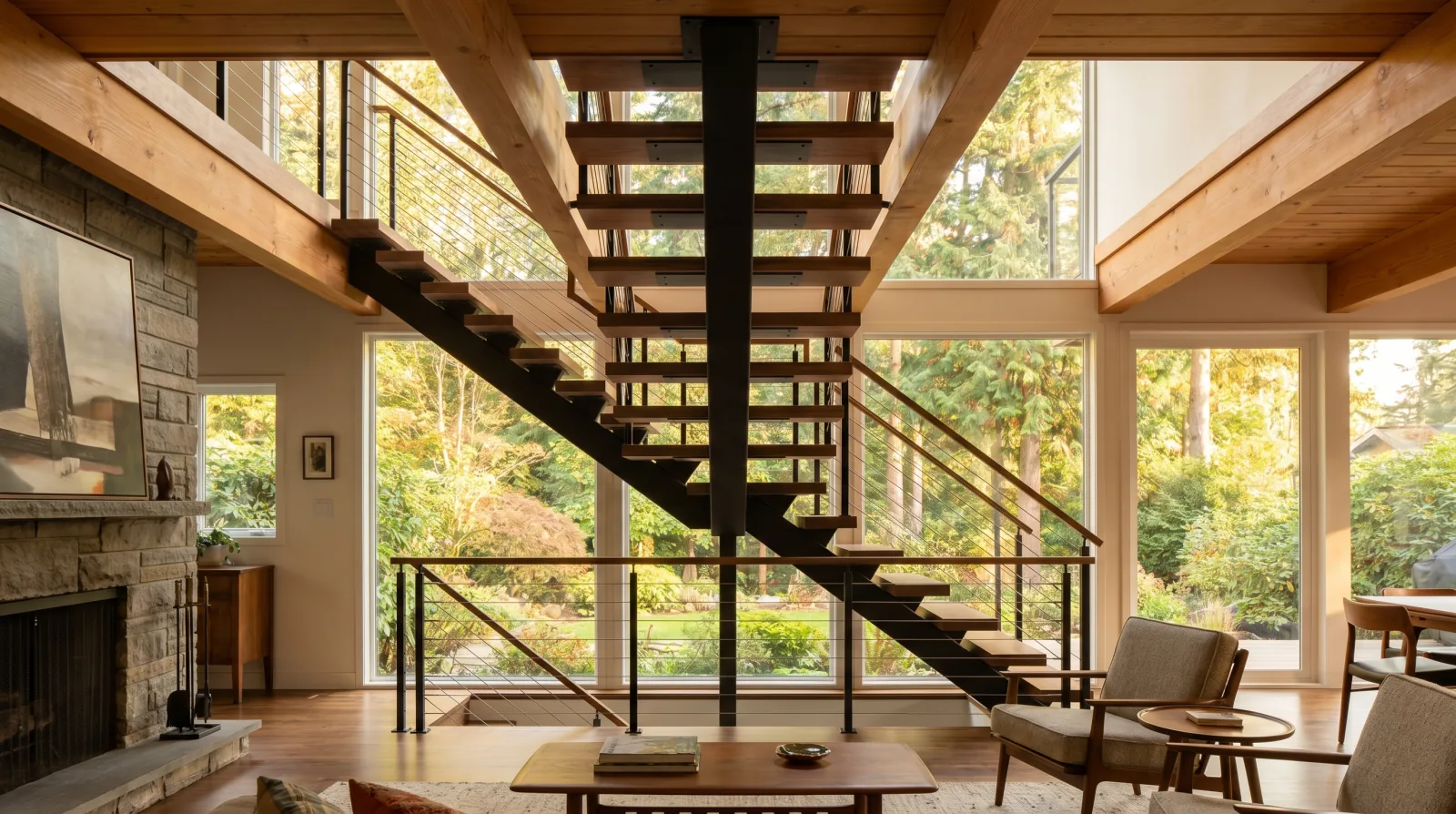
Lynn Valley homes from the 1960s and 1970s have a distinct interior palette: Douglas fir beams, fir or cedar tongue-and-groove ceilings, stone fireplace surrounds, large windows framing tree views. Newer custom builds in the neighbourhood, many of which are built on the lots of demolished mid-century homes, continue the visual language with engineered timber, exposed structure, and generous glazing.
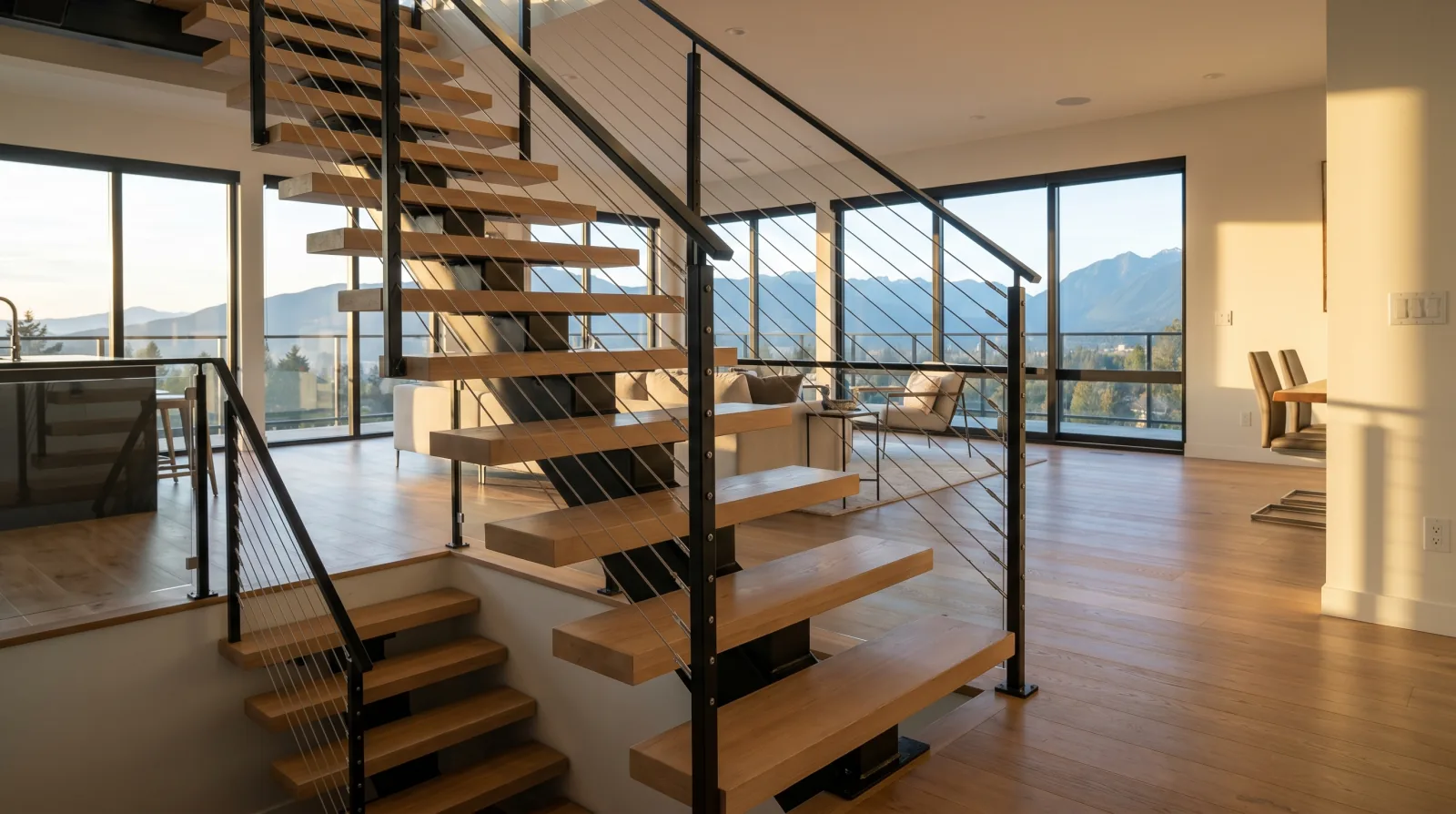
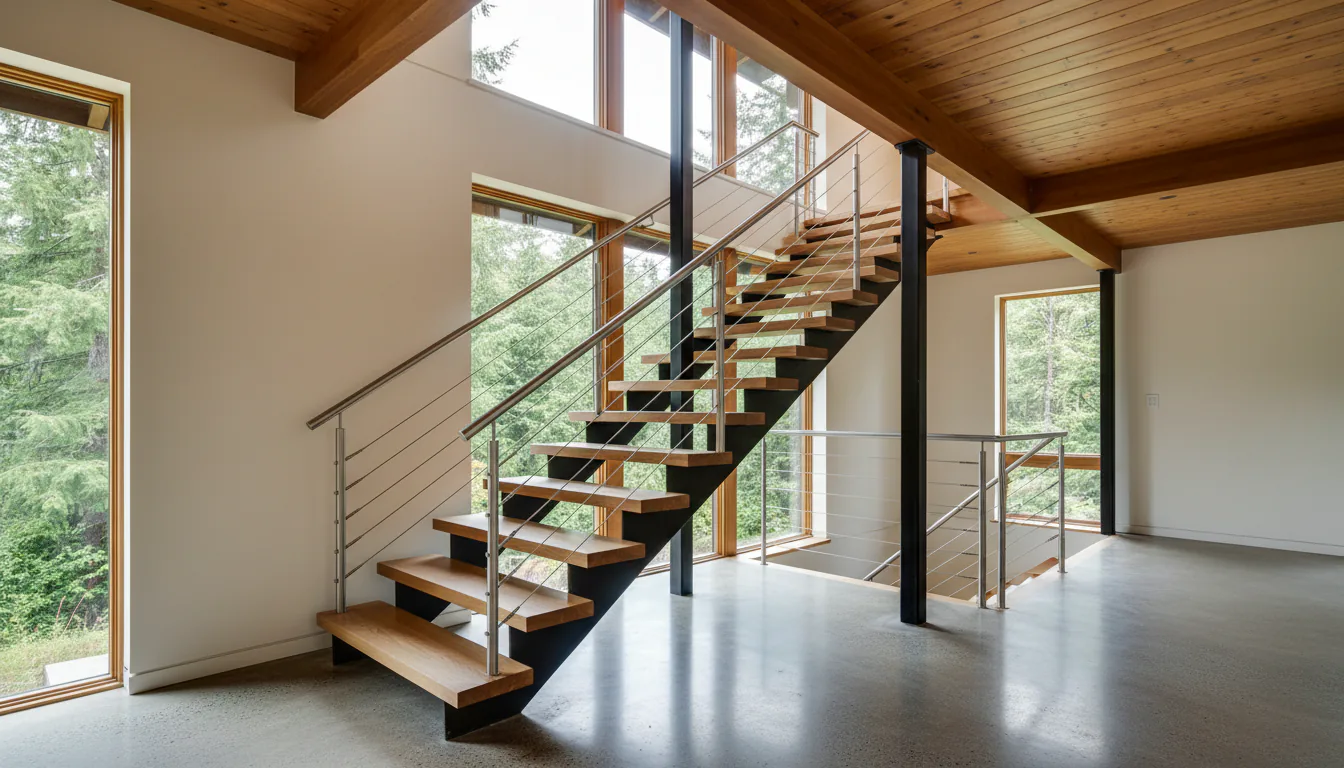
A modern staircase reads well in both contexts when the material palette is considered. The most common combination for Lynn Valley interiors is:
- Stringer and structure: matte black powder-coated steel
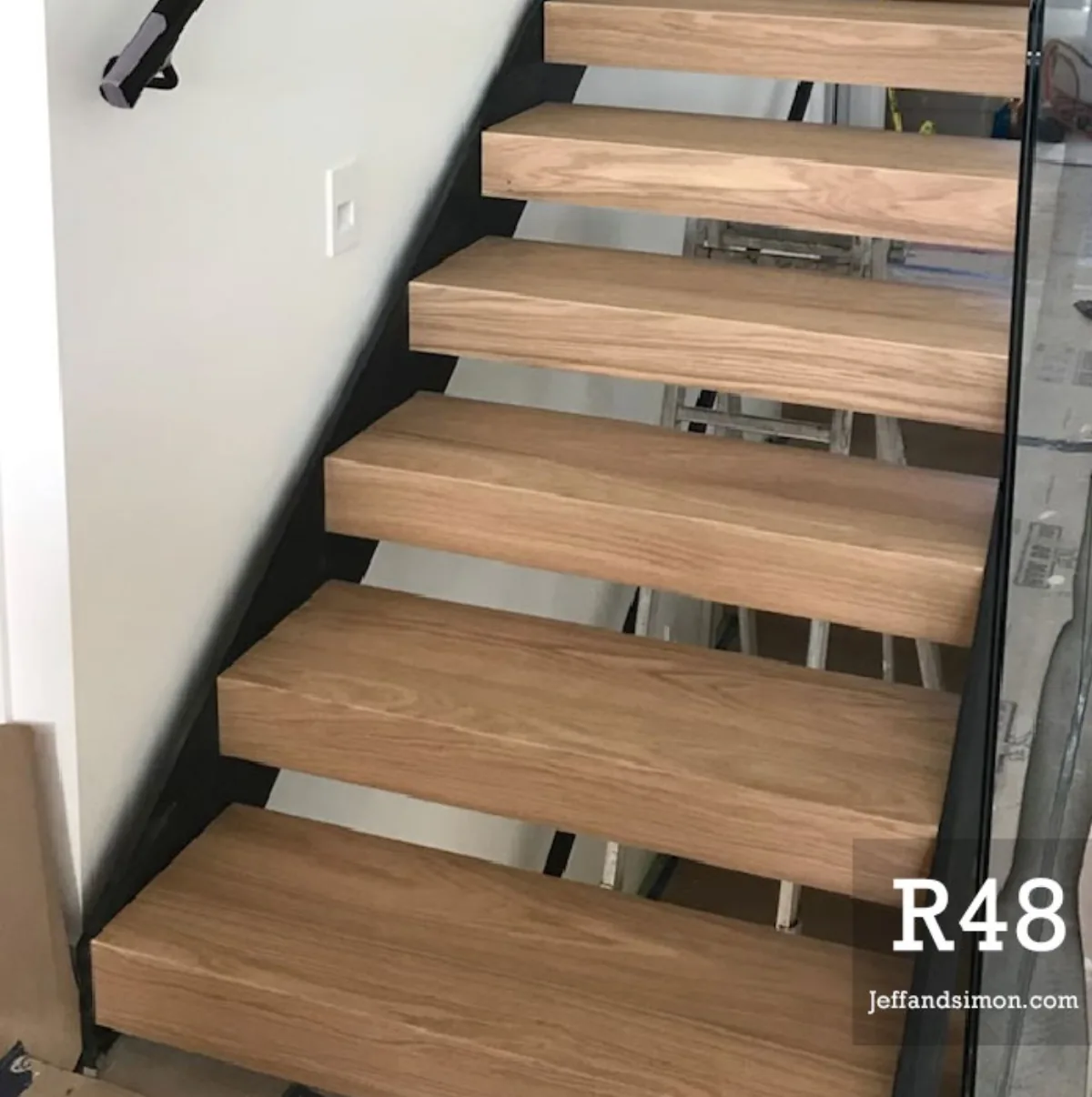
- Treads: white oak, natural walnut, or Douglas fir, either matching the floor material or providing deliberate contrast
- Guard system: cable railing with powder-coated posts, or frameless glass for better sightlines
Cable railing pairs naturally with the horizontal emphasis of West Coast Modern architecture. Horizontal lines, the beams, the wide roof overhangs, the band windows, are a recurring motif. A horizontal cable guard continues that language instead of interrupting it with vertical pickets.
Frameless glass guards are the alternative for sightline-critical situations, where the stair faces a view window and any infill in the guard would block light. Both options are appropriate for the architectural context. The choice comes down to the specific view, the budget, and how much maintenance the homeowner wants to accept over time.
Edgemont and upper North Vancouver considerations
Edgemont Village sits higher on the hillside than Lynn Valley, with more of the premium custom home stock built in the last two decades. Homes here are more likely to have been designed by architects with contemporary stair expectations already built in, larger openings, structural walls designated for stair attachment, floor heights confirmed in the drawings.
Even in these newer builds, a fabricator should verify field dimensions. Framing moves during construction. Finished floor thicknesses are often added after framing was dimensioned. A 15mm difference in a confirmed floor height is common and changes the riser calculation.
For the older homes in Lynn Valley and Dollarton, the original 1960s-1970s builds or their renovated successors, an independent site measurement before issuing shop drawings is not optional. It is how problems are caught before they become costly.
Coordinating with the renovation sequence
Most Lynn Valley staircase replacements happen in the context of a larger renovation: open-concept conversion, new kitchen, primary bedroom rework, or whole-house update. The stair is often the last major structural item to be confirmed but the first that needs to be fabricated because of lead times.
The sequence that works:
- Confirm structural approach with the engineer, wall attachment points, header requirements, any opening modifications needed
- Get a permit if required (District of North Vancouver for structural changes)
- Finalize shop drawings and sign off on riser height, tread dimensions, and guard design
- Fabrication: typically 4-6 weeks from shop drawing approval for a residential mono stringer
- Finish: 1-2 weeks for powder coating; longer if galvanizing is specified for an exterior landing
- Install: after flooring is confirmed but before trim and paint are complete
The stair should not be the last trade to confirm and the last to quote. It is a structural item with the longest lead time and the most coordination dependencies. Starting the conversation at framing rather than at finishing saves schedule.
Getting to the site in Lynn Valley
One detail that affects scoping: Lynn Valley driveways are often steep and the staging area at grade is limited. A steel staircase delivered on a flatbed is practical on a flat Burnaby street. On a hillside lot in Lynn Valley, the crew may need to hand-carry sections, use a boom truck from the street, or plan delivery around a specific access window.
This is not a reason to hesitate on a custom steel stair, it is a reason to confirm site access early and include it in the installation plan. Fabricators experienced on the North Shore build access considerations into the installation quote by default. A quote that does not mention it may not have accounted for the actual site.
Related reading: the North Shore exterior stair and deck considerations guide, the mono stringer staircase deep dive, and the North Vancouver service area page.
Related questions
Are West Coast Modern post-and-beam homes harder to replace stairs in?
Often yes. Post-and-beam construction distributes loads differently from platform framing. Existing stair openings are frequently sized to fit the original stair, not a modern open-riser design. The floor-to-floor height, which in a mid-century split level can be unusual, affects riser count and run length. An early site visit is essential.
Can I get a floating stair in a Lynn Valley home built in the 1970s?
Yes, but wall attachment is the constraint. Floating and cantilevered stairs require walls or a structural spine capable of carrying tread loads. Older framing often needs reinforcement, specifically headers and ledger connections, before those loads are introduced. This should be confirmed with an engineer before committing to a cantilevered design.
Does the District of North Vancouver require a permit to replace stairs?
For structural stair replacement, including changes to the stair opening, loadpath, or guard system, yes. The District of North Vancouver building department reviews structural and guard changes under the BC Building Code. A like-for-like stair replacement of the same type may qualify as maintenance in some cases, but confirm before starting.
What finish holds up best in a Lynn Valley interior?
Powder coating holds well in interior applications. Black powder coat over steel is the most common choice for West Coast Modern interiors in Lynn Valley, it reads as period-appropriate against exposed beam ceilings and Douglas fir finishes. For any exterior landing or stair that connects to the interior, the finish transition needs care.