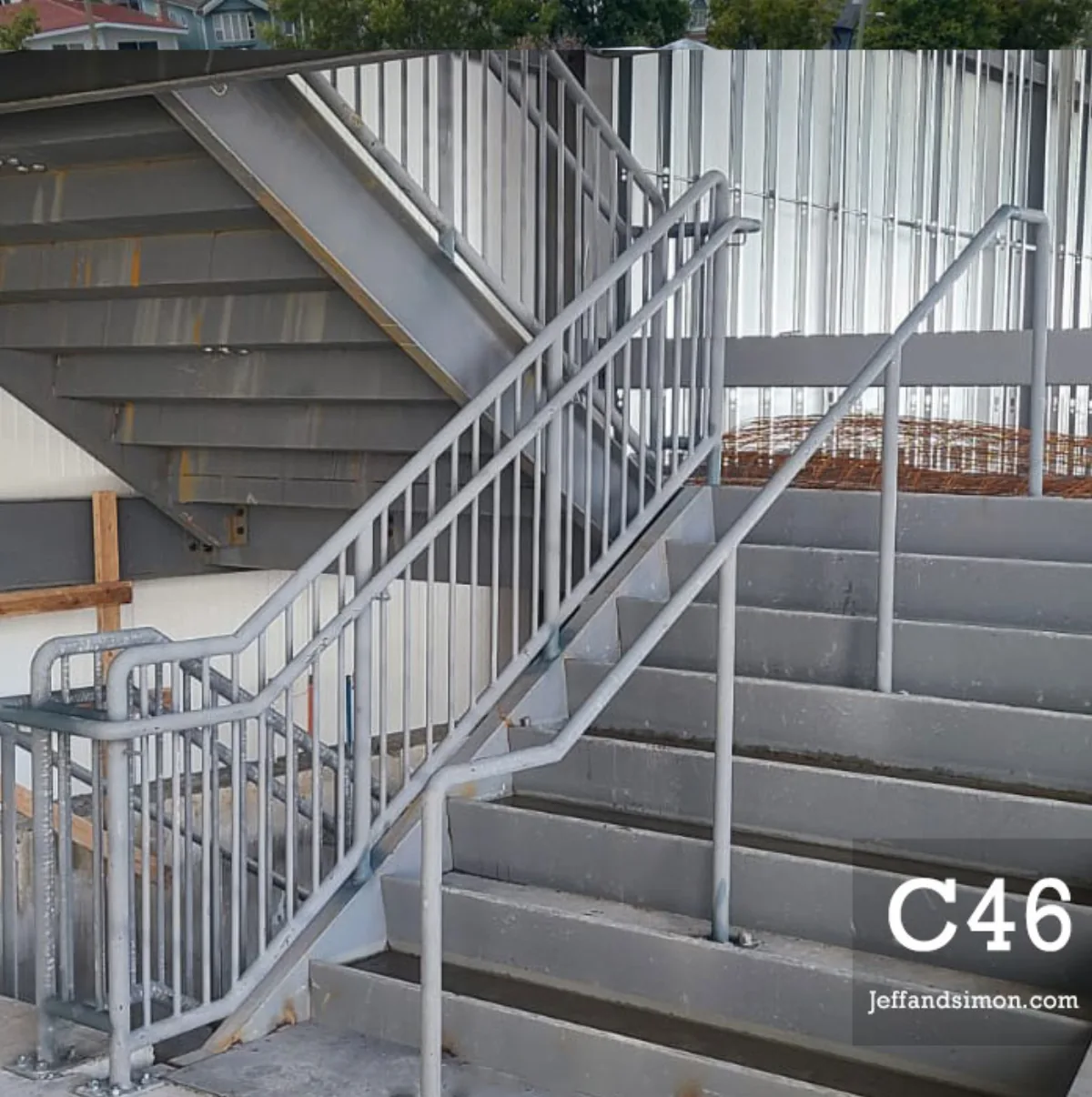
An egress stair is the stair the building depends on when something goes wrong. Geometry, guard layout, handrail continuity, fire-rated wall interfaces, finish, and inspection access all have to be settled before the steel is fabricated. Done well, the egress stair is a quiet utility. Done badly, it is the line item that delays occupancy.
Egress is a system, not a stair
An egress stair is part of the building's exit system. The treads, the landings, the guards, the handrails, the doors, and the surrounding fire-rated assembly all have to work together. The fabricator's scope usually covers the steel, stringers, treads, landings, guards, handrails, anchor connections, but the design has to anticipate the door swing, the fire-rated enclosure, and the floor-to-floor heights. Confirm those constraints with the project's architect of record and the authority having jurisdiction (AHJ) before drawings are finalized.
Code package decides almost everything
Most commercial buildings in Metro Vancouver fall under the BC Building Code (BCBC) Part 3, with the Vancouver Building By-law (VBBL) governing inside the City of Vancouver. Required exit stairs in those occupancies have stricter rules than residential stairs, minimum widths, restricted open risers, specified handrail continuity, and graspability requirements. Confirm the current edition with the AHJ before design assumptions are locked.
- Required exit stairs almost always need closed risers in commercial assembly and institutional occupancies.
- Minimum stair widths, landing dimensions, and headroom are set by occupancy and occupant load.
- Handrail continuity and graspability rules apply on both sides of most commercial stairs.
- Open-tread or open-riser designs are usually limited to non-required stairs, lobbies, and feature scopes.
Geometry comes from the building, not the stair
Commercial stair geometry is set by floor-to-floor height, the available run length, and the required landing dimensions. Switchback stairs are the most common solution in tight cores. Straight-run stairs are common in atriums and feature lobbies. Scissor stairs appear in higher-rise residential and commercial buildings as paired exits. Pick the layout that fits the core before drawing tread and riser dimensions.
Guards and handrails carry the legal load
Commercial guards and handrails have to satisfy two things at once: the BCBC sphere-passage rules within the guard, and the graspable handrail rules along the run. Glass guards, picket guards, perforated steel guards, and woven mesh all have valid commercial applications, but each one resolves the handrail question differently. The cleanest builds settle the handrail strategy at shop-drawing review.
Fire-rated interface is part of fabrication
When a stair sits inside a fire-rated shaft, the steel has to interface with the rated wall assembly, the rated landing structure, and the fire-rated door at each level. The fabricator delivers the steel; the rated assemblies are built by other trades. Confirm interface dimensions, door swing clearances, and inspection windows in writing before fabrication.
Finish is decided by exposure and traffic
Interior egress stairs in heated, conditioned cores can usually be powder-coated steel. Exterior egress stairs, parkade stairs, and rooftop access stairs almost always specify hot-dip galvanizing, often with a topcoat. High-traffic public stairs benefit from durable coatings and slip-resistant tread surfaces. Discuss the finish package with the design team before fabrication so coating lead times do not stretch the install date.
Related questions
Do all commercial stairs need to be code-compliant exit stairs?
No. Many commercial projects include feature stairs, lobby stairs, and non-required stairs that supplement the building's required exits. Required exit stairs follow stricter geometry, riser, guard, and handrail rules than non-required stairs. The architect of record assigns each stair to its category based on the BCBC or VBBL provisions for the occupancy.
Who specifies the stair dimensions on a commercial project?
The architect of record sets the layout and the major dimensions based on the occupancy, the occupant load, and the floor-to-floor heights. The structural engineer reviews the load path and the connections. The fabricator then delivers shop drawings that resolve the steel details, the tread and guard interfaces, and the connection geometry.
Can a commercial stair use open risers?
Sometimes, but rarely on required exit stairs. Open-riser designs are usually limited to lobby feature stairs, private internal stairs, and non-required stairs. Required exit stairs in assembly, commercial, and institutional occupancies typically need closed risers to satisfy the BCBC. Confirm with your AHJ before design intent is locked.
How long does commercial stair fabrication take?
Lead time depends on shop drawing turnaround, engineer review, finish system, and shop load. Galvanized exterior stairs add coating lead time; pan-formed concrete-fill treads add a separate concrete pour cycle on site. Confirm the schedule with a current quote that lists each step from drawings to install.
Continue planning
- Commercial stairs hub overview
- Commercial egress stairs (single page)
- Commercial stair services
- Commercial staircase design (Trends)
Plan commercial egress stair design for a real Vancouver project
Send drawings, photos, or a rough scope and we will help define the practical next step.