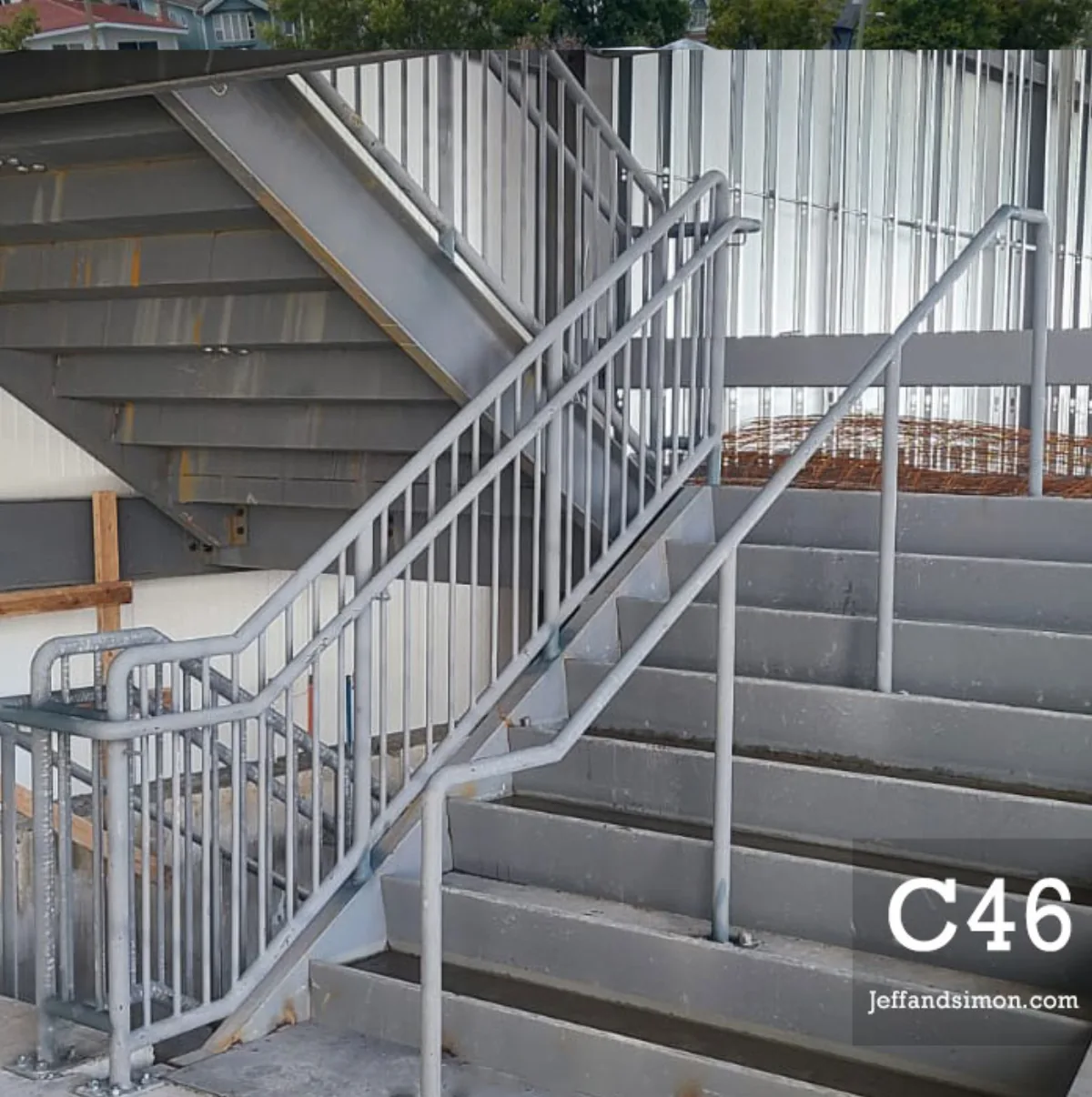
Commercial egress stairs are code-driven from the first line of drawings. Guard heights, handrail profiles, landing dimensions, riser uniformity, tread systems, and fire-rating interfaces are not design choices, they are BC Building Code Part 3 requirements. Getting them right in the shop drawing stage is what keeps the stair approvable at inspection. The complete commercial stairs planning hub is at /commercial-stairs/.
BC Building Code Part 3: what applies to commercial stairs
Commercial and multi-family buildings in BC are governed by Part 3 of the BC Building Code. Part 3 stair requirements differ from Part 9 (residential houses) on guard height (42" minimum for most commercial applications vs. 36" for residential), minimum stair width, required landing dimensions, and the maximum riser-to-tread ratio. All Part 3 stairs require sealed structural drawings from a Designated Structural Engineer.
- Guard height: typically 42" (1067 mm) minimum for commercial occupancies.
- Stair width: varies by occupant load, confirm with AHJ.
- Landing dimension: minimum 900 mm in the direction of travel, or stair width, whichever is larger.
- Riser uniformity: maximum 9.5 mm variation between the tallest and shortest riser in a run.
Tread systems: pan-formed vs grating
Commercial egress stairs typically use one of two tread systems: pan-formed steel treads (a pressed steel pan filled with concrete or fitted with a rubber nosing) or open-bar grating treads (galvanized bar grating welded to angles for exterior and industrial applications). Pan-formed treads are standard for enclosed commercial egress stairs. Grating treads dominate exterior applications where drainage is the priority.
Guard and handrail requirements
Commercial stair guards and handrails are heavily specified by code. Guards must meet the 42" height requirement in most commercial occupancies and satisfy sphere-passage rules. Handrails must be graspable, continuous, and within a specific height range (typically 865–965 mm above the stair nosing). Handrails must terminate in a return at the top and bottom. All of these are fabrication details, not finish decisions.
Coordination with the project engineer
On Part 3 projects, a Designated Structural Engineer seals the stair drawings. The fabricator's shop drawings are submitted to that engineer for review before fabrication starts. The engineer confirms that the stringer section, the tread connection details, the landing support, and the anchor details meet the structural design intent. CWB certification from the shop is required for structural welding on Part 3 projects.
Related questions
Do you provide commercial stair drawings?
We prepare fabrication shop drawings and coordinate with the project's structural engineer and architectural drawings for the steel scope. The structural engineer of record for the project seals the design drawings; we prepare the fabrication shop drawings for the engineer's review.
What is the minimum guard height for a commercial stair?
Under the BC Building Code Part 3, guard height requirements depend on occupancy type, height of fall, and specific code provisions. A 42" (1067 mm) guard height is the common minimum for most commercial occupancies. Confirm the applicable provision for the specific occupancy and height of fall with the project engineer and the AHJ.
What tread system is standard for commercial egress stairs?
Pan-formed steel treads (filled with concrete or fitted with a rubber stair nosing) are the standard for enclosed commercial egress. Open-bar grating is standard for exterior stairs, mechanical mezzanines, and industrial platforms. The choice depends on occupancy, exposure, and acoustic requirements.
Can a commercial stair also serve as a feature stair?
Yes. Many lobby feature stairs and commercial egress stairs are the same physical stair, designed to meet both code requirements and the architectural design intent. The code requirements set the floor; the design intent fills the room above that floor. We have fabricated lobby feature stairs for commercial buildings including BCIT Burnaby and Guildford Town Centre.
Discuss commercial egress stairs for a real project
Send drawings, photos, or a rough scope and we will help define the practical next step.