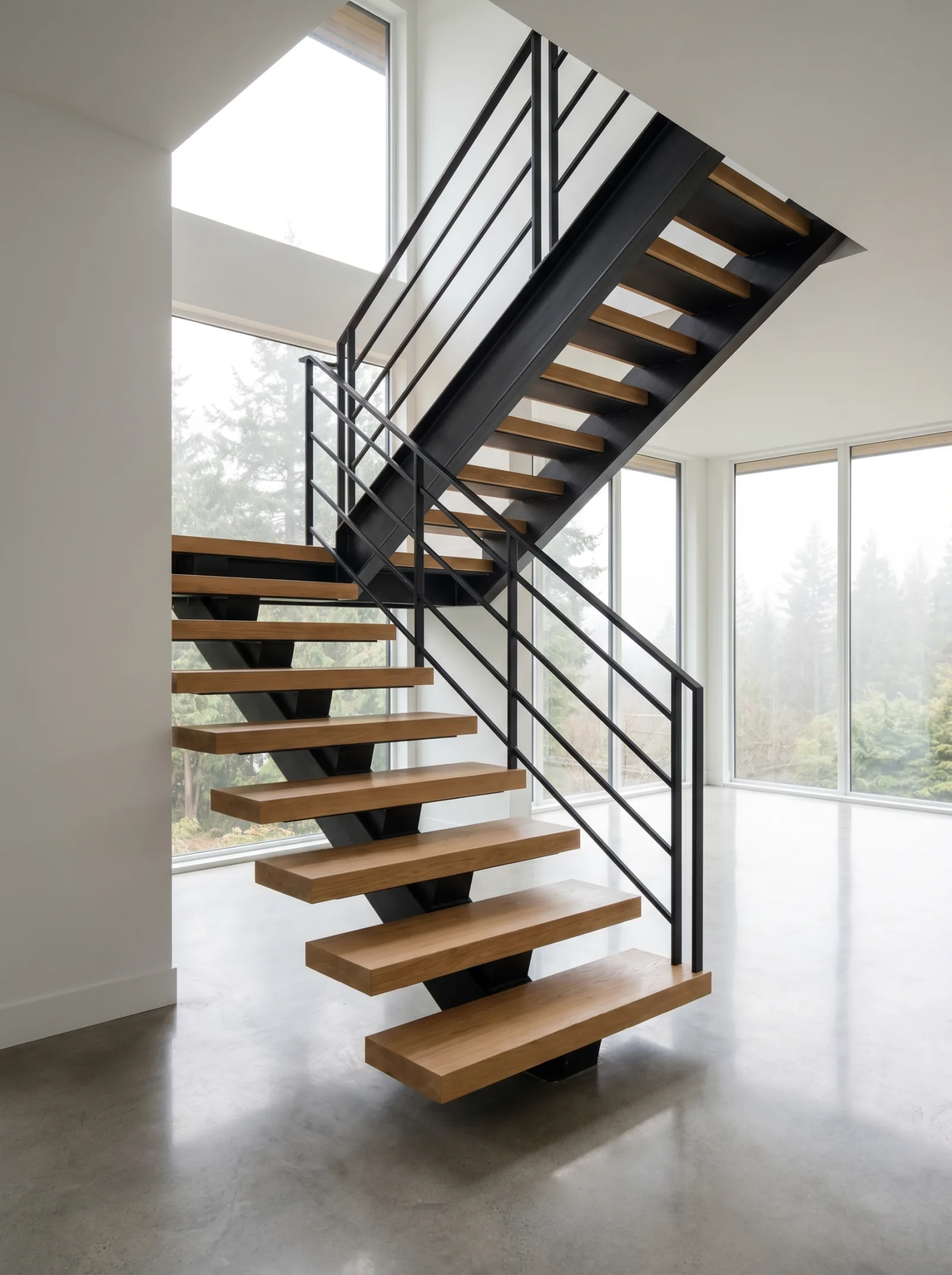
Custom metal staircase questions answered.
Cost, permits, engineering, timeline, and finish, plain answers to what Metro Vancouver homeowners and contractors ask at the start of every stair project.
Vancouver Stairs fabricates custom metal staircases in Metro Vancouver, mono stringer, floating, cantilevered, commercial egress, and exterior galvanized stairs. Below are plain answers to the cost, permit, engineering, timeline, and finish questions that come up at the start of every project. Numbers are 2026 Metro Vancouver figures. Where the answer depends on the authority having jurisdiction, we say so.
If a question below is not the one you have, the fastest path is a short note on the contact page.
Do you design and install custom metal stairs?
Yes. Vancouver Stairs is a CWB-certified shop (CSA W47.1, Division 2) that runs the full custom-stair workflow: site measurement, feasibility review, shop drawings, structural coordination with a Schedule B engineer where required, fabrication, finishing, and install. We do not stamp our own structural drawings, that letter comes from the project engineer, but we provide the connection details, weld procedures, and field-measured geometry that the stamp is based on.
How much does a custom metal staircase cost in Vancouver?
In Metro Vancouver, a residential custom metal staircase typically costs $18,000–$55,000 installed, depending on type. Mono stringer stairs run $18,000–$32,000 for a standard flight. Feature floating or cantilevered stairs with glass or cable railings run $32,000–$58,000. Curved or helical sculptural stairs start around $60,000. Railing type, tread material, finish, and site access all move the number. Every project is quoted after a site visit.
What is a mono stringer staircase?
A mono stringer staircase uses a single central structural beam, typically an HSS rectangular tube, to carry the treads from beneath. Treads cantilever equally to either side of the spine, creating open risers and a light visual profile. It is distinct from a double stringer (two side beams), a closed stringer (treads pocketed into a panel), and a cantilevered stair (treads anchored into a wall with no stringer visible).
What is the difference between a floating staircase and a mono stringer staircase?
Floating is a visual category, not a structural method. Any open-riser stair where treads appear unsupported reads as floating. A mono stringer is one structural strategy that produces that look, a single central beam beneath the treads. Other floating strategies include cantilevered (treads anchored into a wall), suspended (treads hung from rods above), and hidden double-stringer. Each has different framing, engineering, and budget implications.
Do I need a building permit for a new staircase in Vancouver?
Usually yes. Vancouver, Burnaby, Richmond, and North Vancouver treat a new or altered staircase as a structural change requiring a building permit whenever the opening, framing, or load path is modified. A like-for-like replacement inside an existing single-family home may be exempt, but interpretations vary by AHJ. Confirm with the building department before committing to a fabrication schedule. Vancouver Stairs provides drawings and certifications for the permit package; the homeowner or GC pulls the permit.
Do metal stair projects need engineering in BC?
Almost always for custom geometry. Most Metro Vancouver municipalities will require a Schedule B engineer's letter if the stair is cantilevered, floating, mono-stringer, or open-riser, or if it changes a structural opening. Part 3 commercial buildings always require engineering. Vancouver Stairs coordinates with your structural engineer, providing field-measured geometry, connection details, and CWB weld procedures, so the stamp can be issued before fabrication starts.
How long does a custom steel staircase take to build?
A residential custom steel staircase takes 8–14 weeks from signed contract to installation. The phases are: site measurement and shop drawings (1–2 weeks), engineer review (1–2 weeks), shop fabrication (3–5 weeks), finish (1 week), and installation (2–4 days). Galvanizing or duplex coating adds time because parts leave the shop for the coater. A railing-only replacement on existing structure is typically 3–5 weeks. Commercial stairs run 12–20 weeks.
What is a cantilevered staircase?
A cantilevered staircase has treads anchored directly into a structural wall through embedded steel plates or welded brackets, with no visible stringer below. The wall carries all tread loads. Because the armature must be built into the framing before drywall, cantilevered stairs require early coordination, the steel design and engineering must be resolved while the building is still being framed. They are the most visually minimal floating stair option.
What is duplex coating for exterior steel stairs?
Duplex coating is a two-stage finish system, hot-dip galvanizing to ASTM A123, then powder coat applied over a sweep-blast and phosphate pre-treatment. For coastal Metro Vancouver, a duplex system gives the longest service life (typically 30+ years before recoat) by combining the sacrificial protection of zinc with the colour and UV resistance of powder coat. Powder coat alone on bare steel fails at welds and joints within 5–8 years in coastal exposure.
What are the BC Building Code requirements for open-riser stairs?
The BC Building Code requires that open risers on residential stairs pass the 100 mm sphere rule, no opening can allow a 100 mm sphere to pass through. Nosing projections must be consistent and within BCBC 9.8.4.5 limits. Guards must meet height requirements (900 mm for most residential, 1070 mm for commercial) with infill that blocks a 100 mm sphere at any point. Part 3 buildings have additional requirements including fire-rating and handrail specifications.
What areas do you serve?
Metro Vancouver and the surrounding region, including Vancouver, Burnaby, Richmond, North Vancouver, West Vancouver, Coquitlam, Port Moody, Port Coquitlam, New Westminster, Surrey, Delta, Langley, White Rock, Maple Ridge, and Pitt Meadows, plus the Fraser Valley to Abbotsford and Chilliwack, and the Sea-to-Sky corridor to Squamish, Whistler, and Pemberton. The shop is in Burnaby; trucking costs for sites past Squamish or Chilliwack are quoted separately.
Are you CWB certified, and why does it matter?
Yes, Vancouver Stairs is certified by the Canadian Welding Bureau to CSA W47.1, Division 2 for structural welding of steel. The certification governs which welders can touch a load-bearing connection, what weld procedures are used, and what a structural engineer's stamp will recognize. Without CWB certification, a structural engineer cannot rely on the welds for a Schedule B letter on Part 3 commercial work, and many AHJs require a CWB shop for custom residential stair geometry.
What finish should an exterior steel stair use in Vancouver?
For coastal Metro Vancouver, a duplex system, hot-dip galvanizing to ASTM A123, then powder coat over a sweep-blast pre-treatment, gives the longest service life (30+ years before recoat). Galvanizing alone works for industrial and back-of-house stairs. Powder coat alone on bare steel fails at welds and stringer joints within 5–8 years in coastal exposure. Interior steel uses powder coat over phosphate pre-treatment as the standard.
Can you match a finish, for example, the same matte black on every railing in a strata building?
Yes. We work to specified RAL numbers, custom colour-matched powder samples, and Sherwin-Williams or Benjamin Moore equivalents. For strata or multi-unit projects we run a sample mock-up, a 600 mm section of guard in the proposed finish, for council or design approval before production starts. Consistency across runs is one of the reasons we use shop powder coat over field paint: a controlled spray booth and cure oven produce the same colour every time.
What do you need from us to give a real quote?
For a residential custom stair: a floor plan or rough sketch of the opening, ceiling height, finished-floor-to-finished-floor dimension, photos of the space (especially adjacent wall framing), and a sense of the design direction (mono stringer, floating, cantilevered, conventional). For a commercial or strata project: the Issued for Construction architectural and structural drawings, the specification section for metals, and the project schedule. We follow up with a site visit before the quote is binding.
Do you take a deposit, and how is payment structured?
Standard residential terms are 40% on signed contract (covers steel, material, and engineering coordination), 40% on delivery to site or shop completion, and 20% on substantial install completion. Commercial work follows the GC's progress-draw schedule against the issued contract. We do not ask for full payment up front and we do not start shop drawings until the contract and deposit are in place, that protects both sides.
What warranty comes with a Vancouver Stairs project?
Two-year warranty on workmanship, welds, fasteners, finish adhesion under normal use, from the date of substantial completion. Hot-dip galvanizing carries the manufacturer's coating warranty (typically 20+ years against red rust under ASTM A123). Powder coat carries the coater's warranty, generally 5–10 years on interior and 3–7 years on exterior. Wear from foot traffic, salt damage from un-rinsed winter use, and finish damage from third-party trades on site are not covered, we are honest about that up front.
Ready to plan a stair or metalwork package?
Send drawings, photos, or a rough scope and we will help define the practical next step.