Staircase Replacement Vancouver
When the existing stair fails, rotting wood, code violations, structural problems, we fabricate and install the replacement from our Metro Vancouver shop.
When a staircase fails, rotting stringers, treads that flex underfoot, a railing that no longer meets guard height, or an opening that was built without a permit, replacement is the decision that ends the problem. Working with a fabricator who also installs means the same company is responsible for the shop drawings, the permit package, the steel, and the finished stair. There is no gap between what was designed and what was built.
Vancouver Stairs is a CWB-certified metal stair fabrication shop in Metro Vancouver. We fabricate custom steel staircases to replace wood or outdated steel stairs in residential and commercial buildings across the Lower Mainland.
When replacement makes more sense than repair
Most staircase problems look like a repair job until a fabricator looks at the structure. These four conditions almost always point toward replacement over patching:
- Rot and structural failure. Wood stringers that have absorbed moisture rot from the inside out. A tread that feels soft usually means the stringer below it is compromised. Sistering a new stringer beside a rotted one in a confined stair opening is rarely a lasting fix, the source of moisture is usually still present.
- Code non-compliance. Staircases permitted before current BC Building Code editions may have risers that are too tall, treads that are too short, a stair width that no longer meets the requirement, or a guard that is below the minimum height. A non-compliant stair cannot be brought to code by cosmetic work alone, the geometry has to change, which means replacement.
- Undersized stair opening. If the existing opening is too narrow or too short for a code-compliant run, a new stair requires framing work to widen or lengthen the opening. That structural change triggers a permit regardless. At that point, replacing the full stair is typically more cost-effective than trying to salvage a structure that was undersized to begin with.
- Style and design intent. A renovation that changes the feel of a home often reaches a point where an existing wood stair looks out of place. Replacing wood stairs with steel is a common renovation decision in Metro Vancouver, the steel stair does not creak, warp, or need refinishing, and the visual change is significant.
What staircase replacement involves
A staircase replacement is a multi-phase project with a defined sequence. The order of operations matters, decisions made in the drawing phase determine what the permit covers, and the permit determines what the shop can build.
- Site measurement. We visit the site to measure the floor-to-floor height, the stair opening dimensions, the existing connection points, and any constraints on access or headroom. This visit also identifies framing that may need modification before the steel stair can land.
- Shop drawings and engineering. We produce fabrication drawings showing the stair geometry, connections, and railing system. A BC-licensed structural engineer reviews and stamps the drawings. The stamped package is submitted to the local authority having jurisdiction (AHJ) with the permit application.
- Permit approval. The permit review adds 4–6 weeks to the schedule in most Metro Vancouver municipalities. Some municipalities are faster; heritage districts and older buildings take longer. Starting the permit application as early as the drawings allow is the single most reliable way to compress the overall project timeline.
- Demolition of the existing stair. Once the permit is approved and the fabrication schedule is confirmed, the existing stair is removed. We coordinate the demolition timing with the installation date so the building's vertical access is interrupted for the shortest possible period.
- Shop fabrication. The steel stair is fabricated in our Metro Vancouver shop over 4–6 weeks. This includes cutting, welding, grinding, and finishing the stringer, treads (if steel), and railing components. Shop powder coat is applied before delivery for interior stairs. Exterior stairs with galvanized finish require additional lead time for the hot-dip galvanizing process.
- Installation. A single-run residential stair installs in one to two days once the site is ready. Multi-storey or complex landing configurations extend that to two to four days. After the steel is in, finishing trades patch walls and floors around the stair opening.
- Inspection. The completed stair is inspected by the building department as part of the permit close-out. We provide the engineer's Schedule B letter confirming the stair was built to the approved drawings.
Total timeline for a custom steel staircase replacement in Metro Vancouver: 12–16 weeks from the first site visit to installation, with 4–6 of those weeks waiting on permit approval. Projects that start the permit process before finalizing every finish detail move faster.
Steel replacement options
Custom steel staircases come in several structural configurations. The right one depends on the opening, the budget, and the architectural intent of the space.
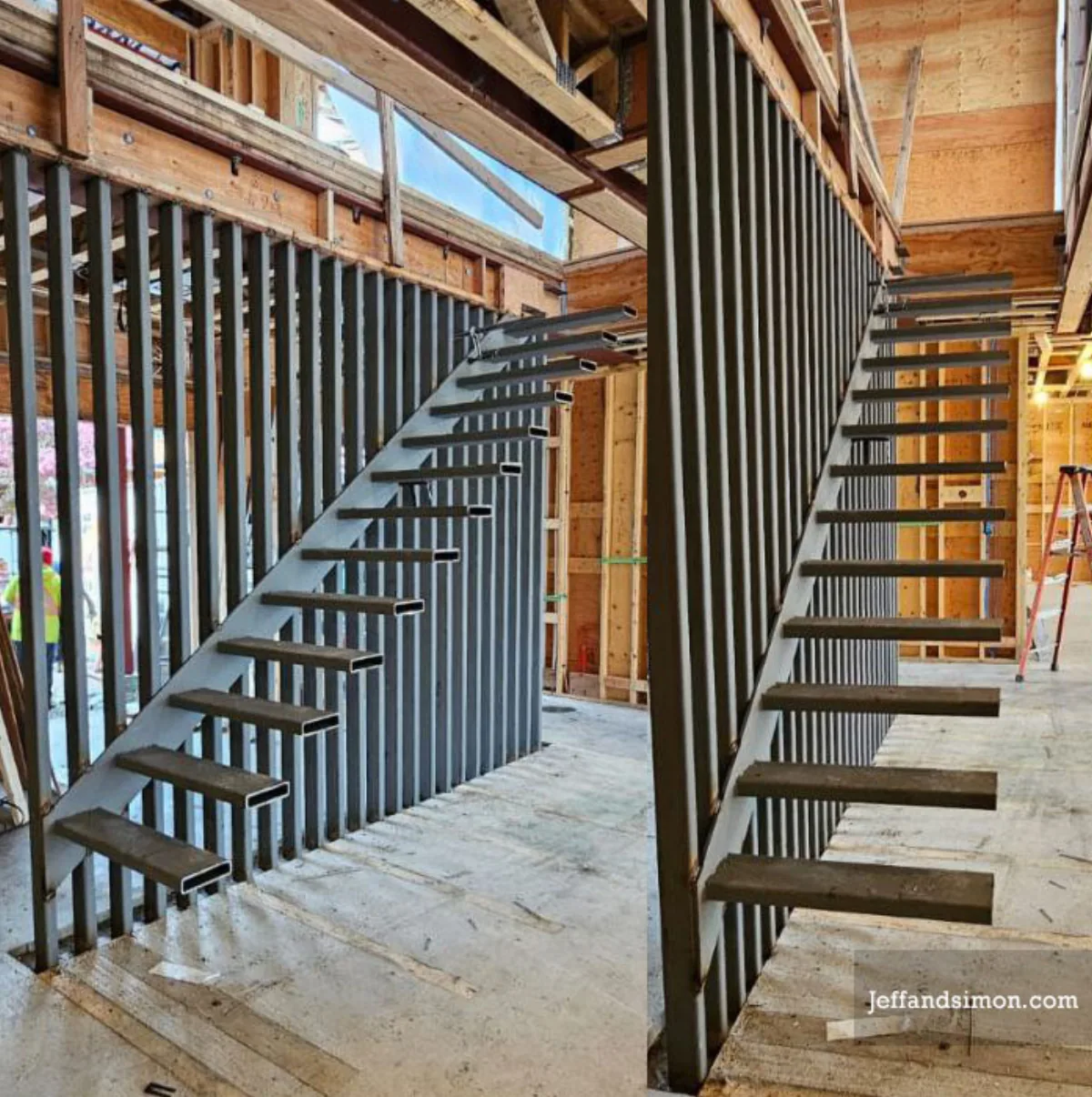
- Mono stringer staircase. A single central HSS steel beam carries the treads, with open risers on both sides. The most requested residential upgrade, the beam is visible and sculptural, and the open riser gives the space more light and sight lines. Requires a properly detailed base plate connection and a structural slab or engineered footing at the base.
- Floating staircase upgrade. Open-riser stairs where the support strategy may be a mono stringer, a cantilevered wall-anchored system, or a combination. The visual effect is treads with no visible structure beneath or beside them. The specific support method depends on the wall framing, the opening, and how early the structural decision is made.
- Straight-run double stringer. The workhorse configuration: two steel stringers (side or under-tread) carry the treads. More economical than a mono stringer, and the right choice when the space does not require a sculptural effect. Can be built with open or closed risers, and with any tread material, steel, wood, stone on pan.
- Exterior galvanized staircase. For decks, secondary exits, and exterior applications in Metro Vancouver's coastal climate, the finish system is hot-dip galvanizing to ASTM A123, not primer and paint. A duplex system (galvanized plus powder coat over sweep-blast) extends service life further and adds colour. Exterior stair details differ from interior stairs: drain holes, vent holes for the galvanizing bath, and connection hardware rated for the exposure condition.
The stair cost guide ranges each configuration in Metro Vancouver numbers.
Cost context for staircase replacement in Vancouver
Custom steel staircase replacement in Metro Vancouver runs $18,000–$65,000 for a residential project, installed. That range covers the scope from a straightforward straight-run double-stringer replacement to a complex mono stringer or floating stair with premium treads and a frameless glass guard.
The main factors that move the number:
- Stair type. A double-stringer straight run is the lowest-cost fabrication scope. A mono stringer or cantilevered floating stair adds engineering complexity and fabrication hours. Curved or helical configurations are at the top of the range.
- Floor-to-floor height and tread count. More risers mean more linear steel, more tread material, and more railing. A low-rise residential stair (8–10 risers) costs less than a full-storey run (13–16 risers) in the same configuration.
- Tread material. Steel pan treads are included in the base fabrication. White oak, walnut, or stone-on-pan treads add cost depending on the material and thickness. Premium wood species and large-format porcelain tiles increase the tread budget meaningfully.
- Railing system. Steel picket or rod infill is the most cost-efficient guard system. Cable railing adds stainless hardware and tension fittings. Frameless glass is the most expensive per linear foot, posts, glass panels, and a separate handrail are all required. Glass guard on a mono stringer stair with oak treads is typically the highest residential budget scenario.
- Structural opening modifications. If the existing stair opening needs to be widened, reinforced, or relocated, a framing contractor handles that scope before the steel stair arrives. Those costs are separate from the stair fabrication and installation.
- Finish system. Interior powder coat is included in the base price. Exterior duplex (galvanize plus powder coat) adds cost. Custom RAL colours are available on all powder-coat work.
The permit, engineering drawings, and Schedule B letter are included in the project scope, not billed separately. Every project is quoted after a site review.
Replacement questions answered
Do I need a permit to replace my staircase in Vancouver?
Yes. Any structural alteration to a staircase in Metro Vancouver requires a building permit. Replacing the full stair, even in the same footprint, is a structural change. The permit covers the new stair's engineering, the guard and handrail system, and any modifications to the floor opening. The permit process typically adds 4–6 weeks to the schedule; starting the application early is the most reliable way to keep the project on track.
How long does staircase replacement take in Metro Vancouver?
A custom steel staircase replacement runs 12–16 weeks from initial site visit to installation. That timeline includes site measurement and drawing review (1–2 weeks), engineering and permit approval (4–6 weeks depending on the municipality), shop fabrication (4–6 weeks), and installation (1–2 days on-site). Projects with structural opening modifications, heritage review, or complex railing systems take longer.
Can you replace just the railing and keep the existing stair structure?
Yes, railing replacement is a separate scope from stair structure replacement. If the existing stair frame and treads are sound and code-compliant, we can fabricate and install a new steel railing system while leaving the stair itself in place. This is a faster and less disruptive project than a full replacement. A site review confirms whether the existing structure meets current BC Building Code requirements before railing work begins.
What is the difference between a fabricator and a staircase contractor?
A staircase contractor typically sources prefabricated components and assembles them on-site. A fabricator like Vancouver Stairs designs, engineers, and builds the stair from raw steel in our own shop, then installs it. Full fabrication means every dimension, connection, finish, and detail is built specifically for your opening, not adapted from a catalogue component. It also means the same team handles shop drawings, engineering coordination, fabrication, and installation without subcontracting any of that scope.
Ready to replace your staircase in Metro Vancouver?
Send site photos, rough dimensions, or a sketch of what you have in mind. We'll define the scope and give you a real number.