Warehouse Staircase Safety and BC Code in Vancouver
Why warehouse and exterior commercial stairs in Vancouver are failing inspection or collapsing, landlord and WorkSafeBC obligations, the deicing-salt problem with pan treads, and why bar grating and dimple treads outlast painted concrete-fill stairs in our climate.
Most exterior warehouse stairs in Vancouver fail for two reasons: rust through pan treads accelerated by ice melt, or geometry that never met code. Both put workers at risk and both put the landlord on the hook under the Occupiers Liability Act.
Calls about warehouse staircases have come in waves this year. Two problems show up over and over: a stair that has rusted through faster than anyone expected, or a stair that never met code and now reads as a hazard the moment WorkSafeBC walks the property. Both are fixable. Neither should be ignored, because the people climbing the stair every day did not sign up for the risk.
This article is not a substitute for code review by the authority having jurisdiction or a site visit from a WorkSafeBC officer. It is a fabrication-focused walk through what fails on exterior warehouse stairs in our climate, what BC and WorkSafeBC require, who carries the liability when something gives way, and what we build instead.
Why exterior warehouse stairs in Vancouver fail before they should
Vancouver’s exterior stair stock is mostly painted carbon steel with concrete-filled pan treads. That detail worked well enough in drier climates and worked acceptably here when the original paint system was intact. Once the paint loses film integrity, usually at welds, fastener heads, and the back edge of each pan, water finds the steel and corrosion compounds.
Two patterns drive the failures we see most often:
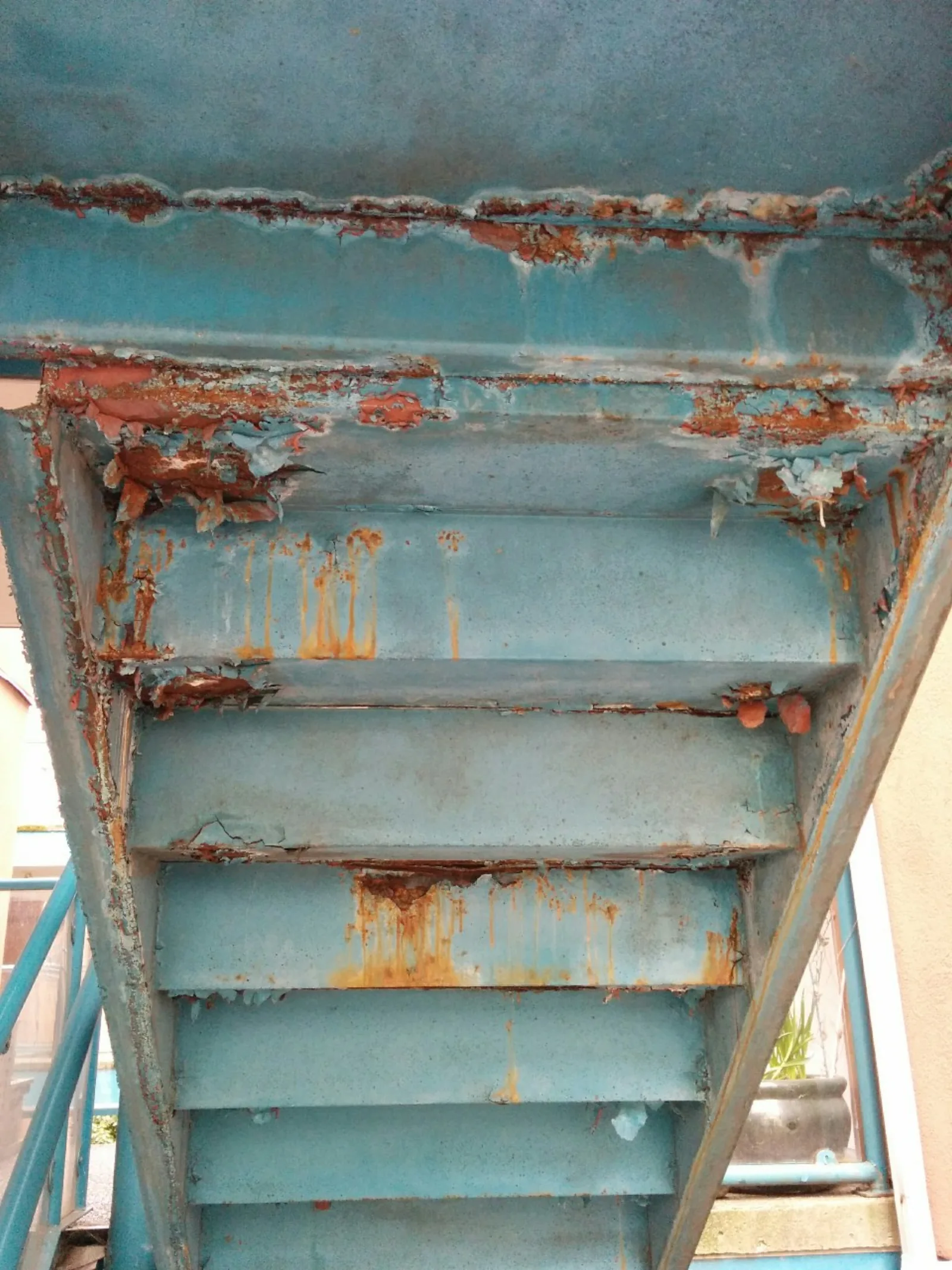
The first is pan corrosion from underneath. Each concrete-filled tread is a shallow steel tray with concrete poured into it. Water that lands on the tread surface migrates through hairline cracks, sits between the concrete and the pan, and corrodes the steel from the inside out. The bottom of the pan rusts long before the top looks bad, so the failure is invisible from the walking surface until a section punches through.
The second is stringer corrosion at the tread-to-stringer weld. Pan treads are welded to the stringer face. Those welds collect water draining off each tread, hold it against the connection, and rust through the most heavily loaded joint on the stair. The stringers themselves can look fine while the load path is failing.
Add in ice melt or rock salt, which most building managers apply each winter, and the timeline compresses. Chloride ions accelerate steel corrosion by orders of magnitude, Engineer Fix’s overview of deicing chemistry walks through how chlorides destroy the steel’s passive layer and let oxidation run unchecked. The salt is doing exactly what it advertises on concrete, while quietly eating the steel underneath.
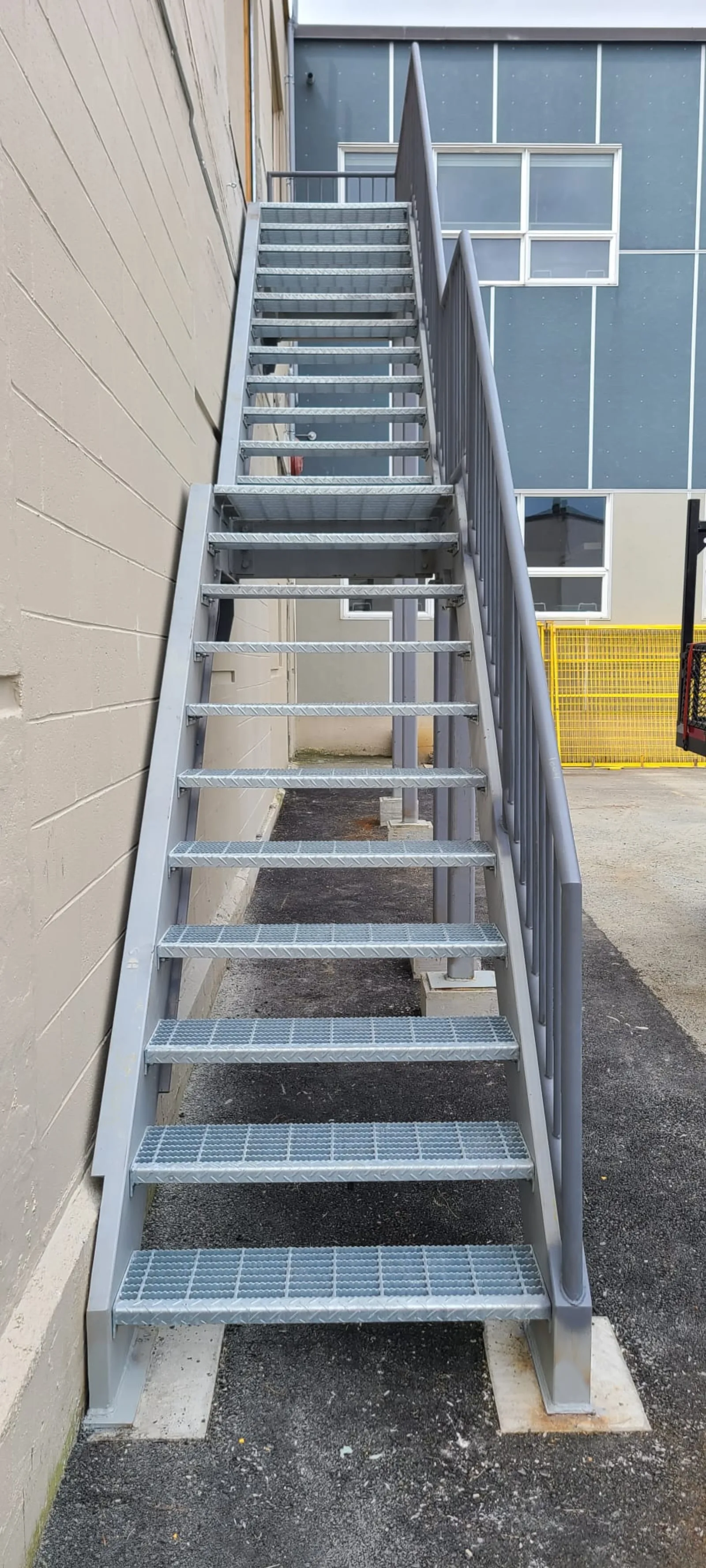
What BC Code and WorkSafeBC require for warehouse stair access
Warehouse stairs sit at the intersection of two regulatory frames. The BC Building Code covers geometry and the as-built compliance at permit issuance. WorkSafeBC covers condition and access in the active workplace, on an ongoing basis. A stair can be code-compliant at construction and still be cited by WorkSafeBC five years later if it has degraded.
On the BCBC side, light-industrial and warehouse occupancies are usually Part 3 buildings, with stair geometry, guards, and handrails reviewed against Section 3.4 (Exits) and Section 9.8 (Stairs, Ramps, Handrails and Guards) depending on the occupancy and storey count. The minimums commonly missed on older exterior stairs are guard height (1,070 mm for guards above grade in most commercial cases), handrail extensions at the top and bottom of a flight, and opening limits in the guard infill.
On the WorkSafeBC side, OHS Regulation Part 4 is the operative document for active workplaces. The clauses most often cited on warehouse stair inspections:
- §4.1, the workplace must be planned, constructed, used, and maintained to protect any person from danger. This is the catch-all that covers a stair that has corroded since installation.
- §4.32, a safe way of entering and leaving every place where work is performed. Block a worn-out stair without providing an alternative and the access requirement is now in play.
- §4.55, guardrails required where a raised floor, platform, or walkway is 122 cm (4 ft) or more above the adjacent floor or grade. Most warehouse landings hit this trigger.
- §4.61, walkways at least 50 cm (20 in) wide with safe access via stairs, ramps, or fixed ladders.
- §4.62, handrails on any stair with more than four risers, 76–92 cm above the tread, capable of withstanding 1.3 kN applied vertically or horizontally.
Employers also carry an ongoing inspection duty under WorkSafeBC’s workplace inspection guidance, regular inspections at intervals that prevent the development of unsafe conditions. A landlord or property manager who has not walked the exterior stairs in years cannot say later that the corrosion was unknowable.
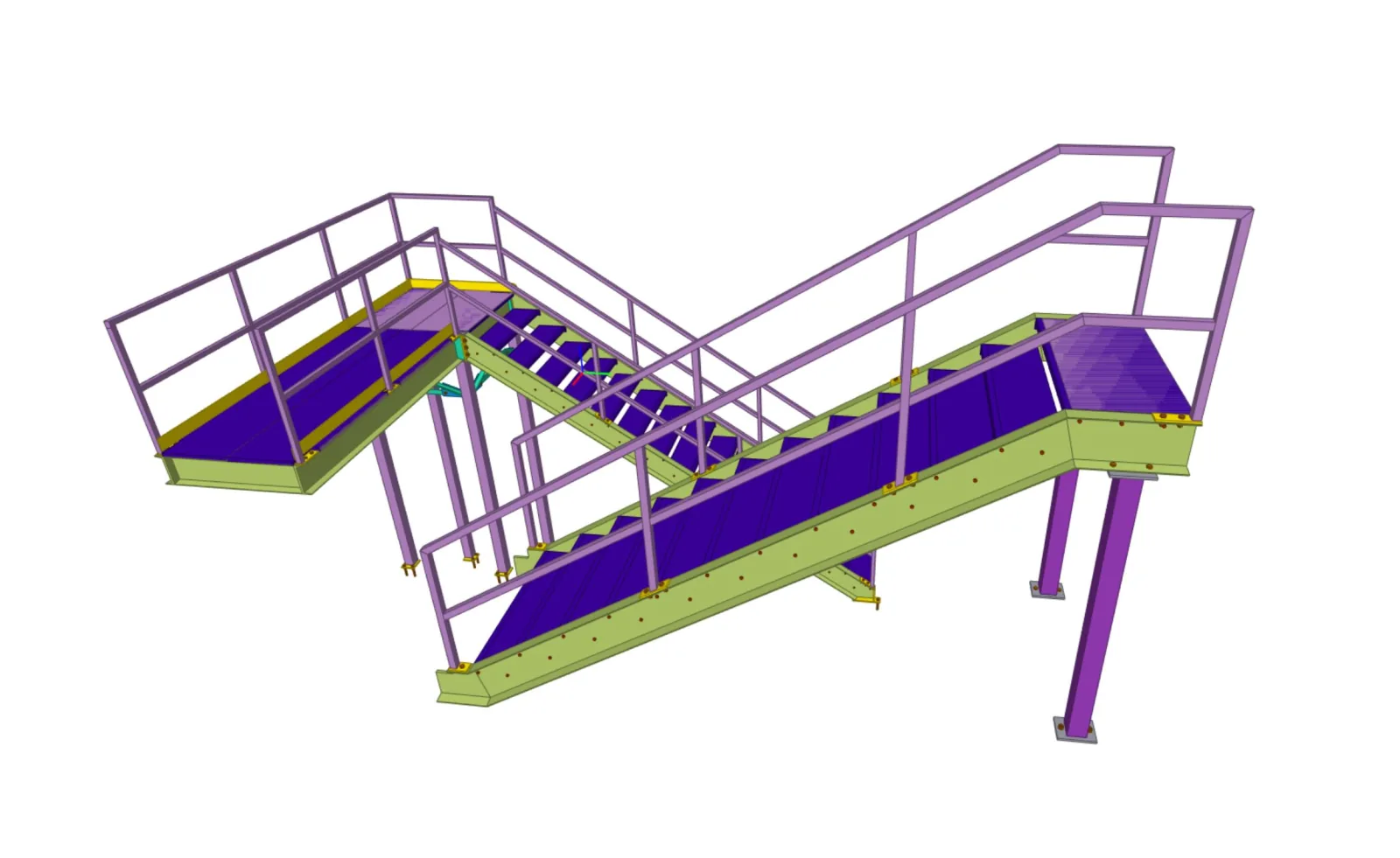
Who is on the hook when a warehouse stair fails
Liability for a failed stair lands in two distinct places: a civil claim by an injured worker or visitor under the BC Occupiers Liability Act, and enforcement by WorkSafeBC against the employer.
The Occupiers Liability Act sets a reasonable-care standard. The occupier of premises owes a duty to take the care that is reasonable in the circumstances to see that any person on the premises is reasonably safe. The duty applies to the condition of the premises, which is where stairs sit, and to activities on the premises. In a leased warehouse, who counts as the “occupier” depends on the lease, on who controls the area, and on who has been doing the maintenance. It can be the landlord, the tenant, or both. Putting the responsibility into the lease in writing does not necessarily move it; the courts look at actual control.
WorkSafeBC enforcement against the employer is separate. A WorkSafeBC officer can issue orders requiring repair or replacement, can shut the access down, and can levy penalties if conditions were unsafe. The employer is the one cited; the building owner who is not the employer may still face a civil claim from the injured worker on top of that.
The practical read for landlords and tenants alike: do not assume the other party is handling it. Walk the stair, document its condition, and decide together when replacement is needed. Photographs of the underside of pan treads are the single most useful artefact in those conversations.
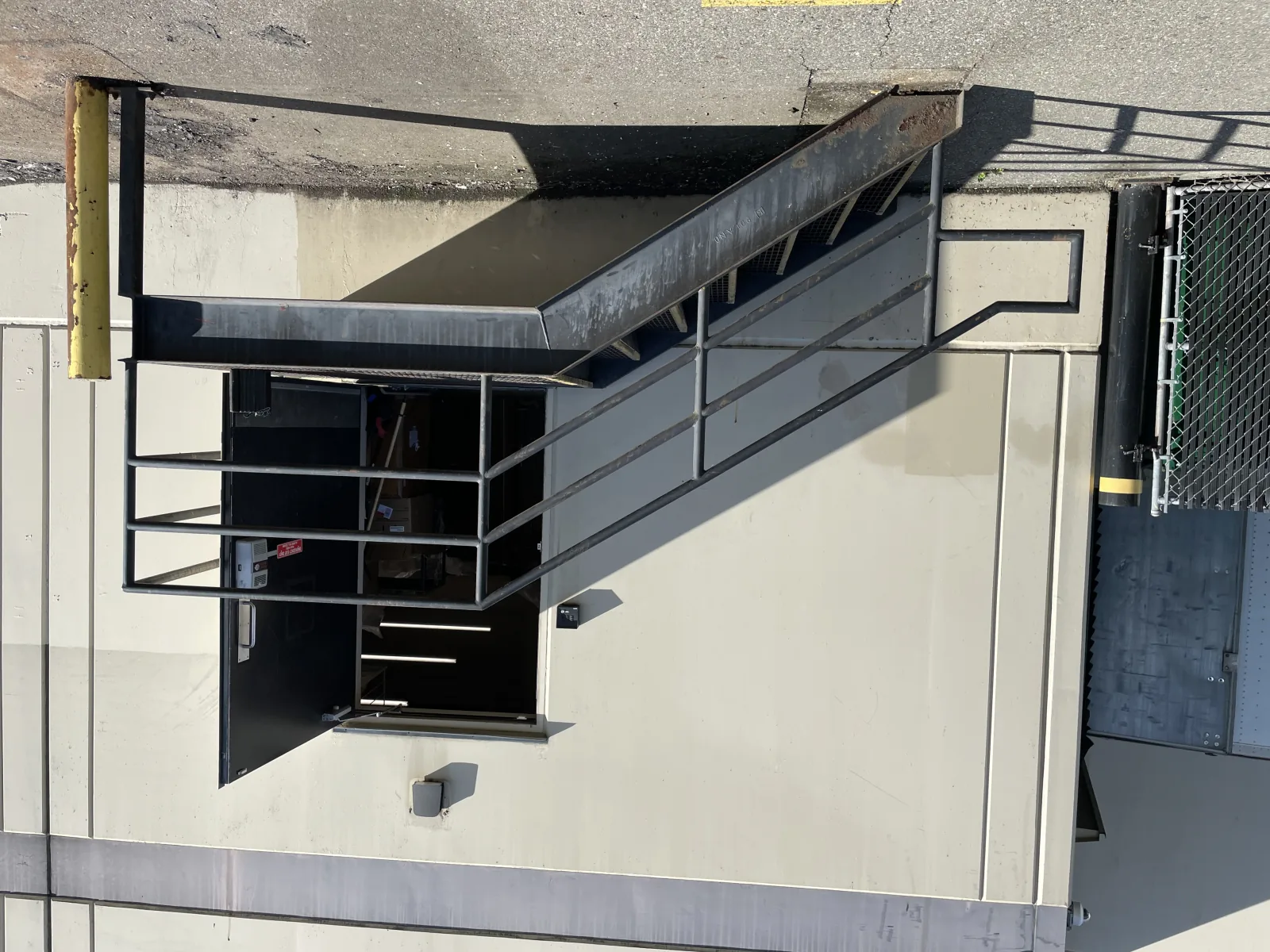
The pan-tread and ice-melt problem
A concrete-filled pan tread is a maintenance trap in a wet, freezing climate. Three things go wrong at once:
First, water never fully drains off the tread. It pools at the back edge against the riser, or at the stringer connection. Even with weep holes the surface holds enough moisture to keep the steel-concrete interface wet for days at a time.
Second, the concrete cracks under thermal cycling and foot traffic. Once cracked, chloride-laden meltwater migrates through and reaches the steel pan and the rebar (if any). The American Galvanizers Association and broader corrosion literature both treat chloride exposure in coastal climates as one of the most aggressive service categories, the AGA’s coastal-climate guide sets out how proximity to salt water shifts service life by exposure zone.
Third, ice melt makes the problem worse on a daily basis through winter. Sodium chloride and calcium chloride are both effective at lowering the freezing point of water and effective at accelerating steel corrosion. There is no version of “use the right ice melt” that solves the steel problem on a painted pan-tread stair, the chemistry that melts the ice is the chemistry that attacks the steel.
The result is a stair whose underside looks like the rusted blue example below. Once a pan-tread stair reaches that state, repair is usually deferred replacement.
Why we build bar grating and dimple treads instead
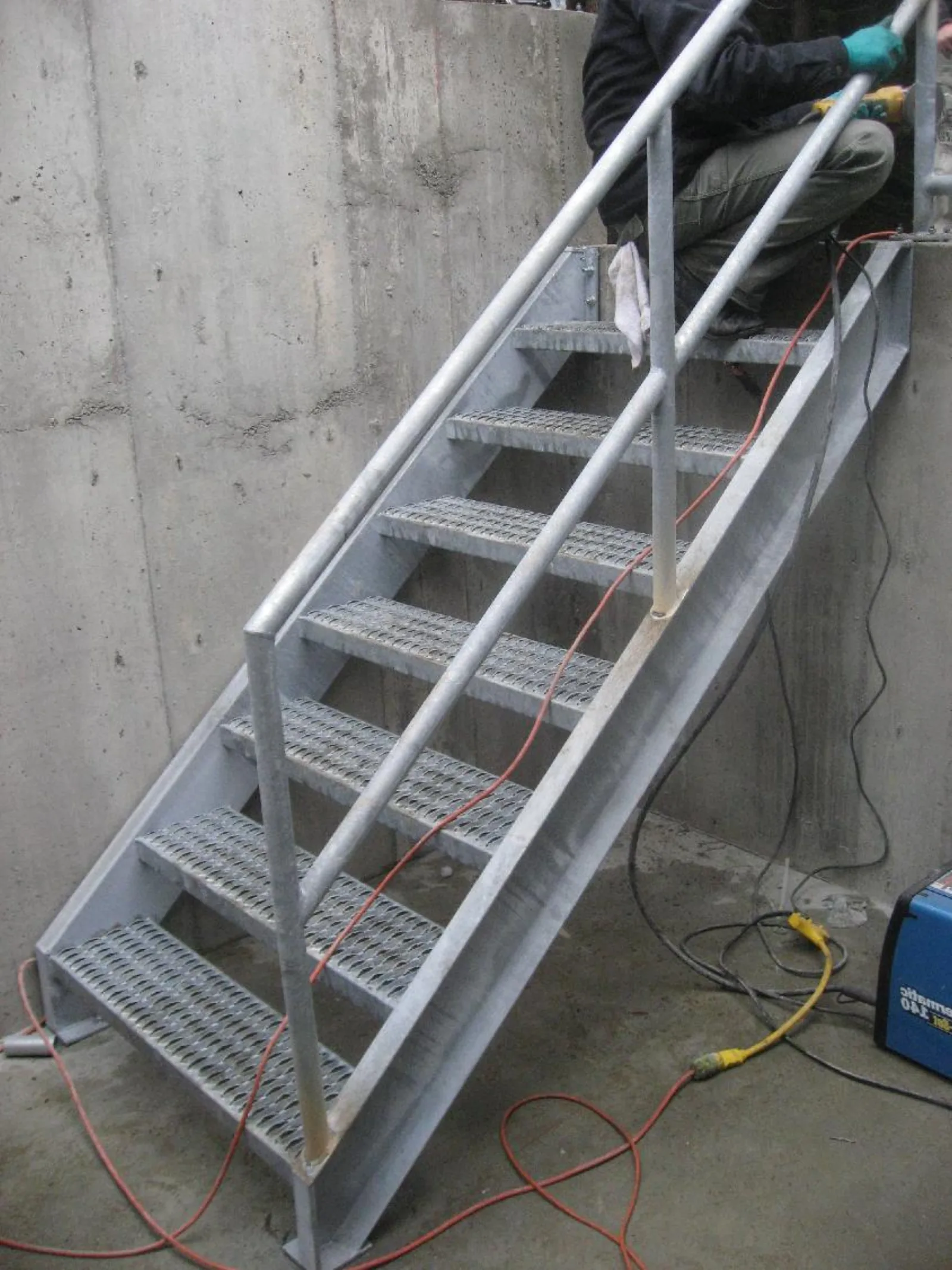
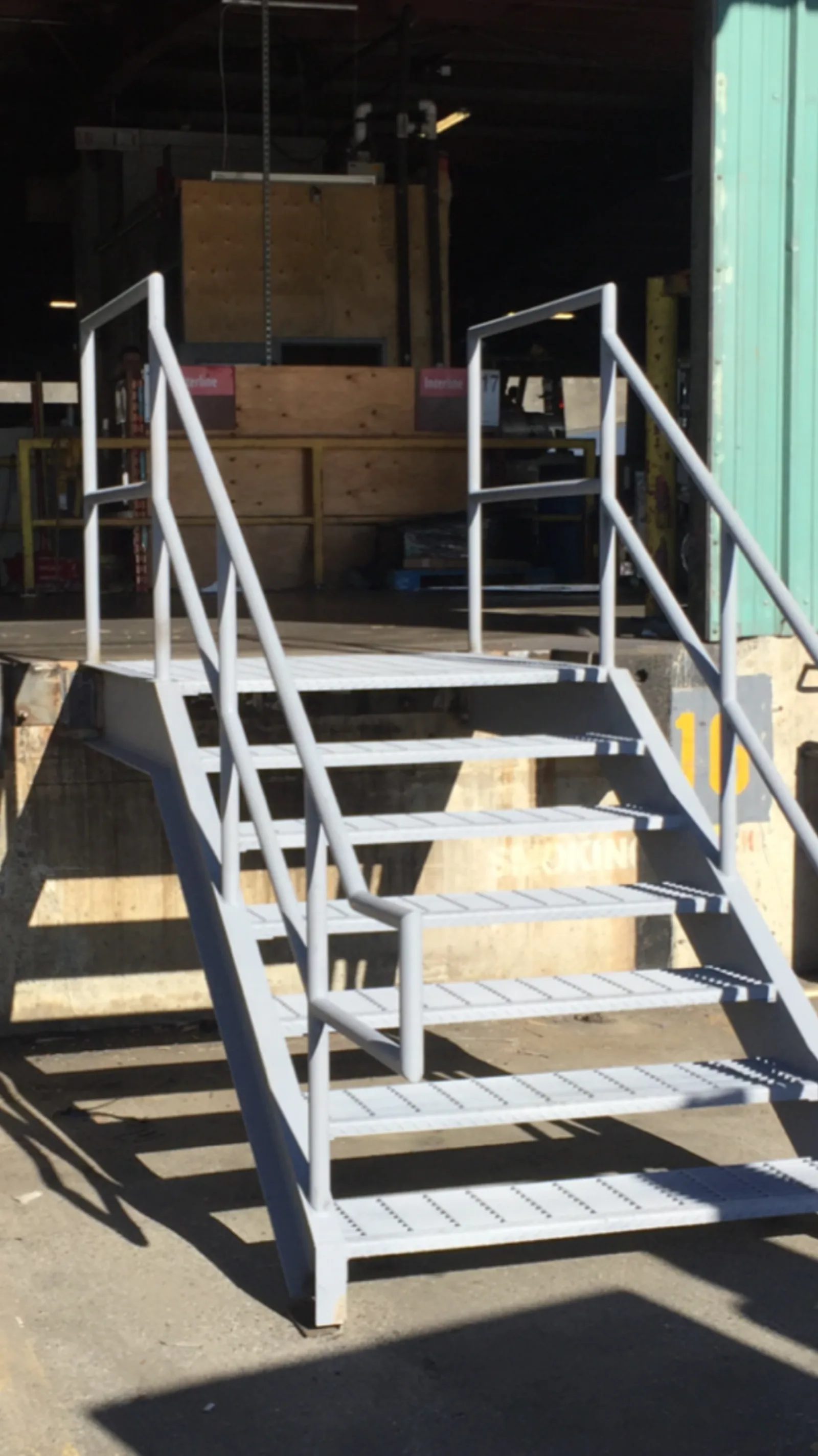
Our standard exterior and warehouse tread is bar grating or dimple-pattern serrated plate. Both detail choices are about drainage and slip resistance, not aesthetics, though the look is honest and the maintenance picture is simpler.
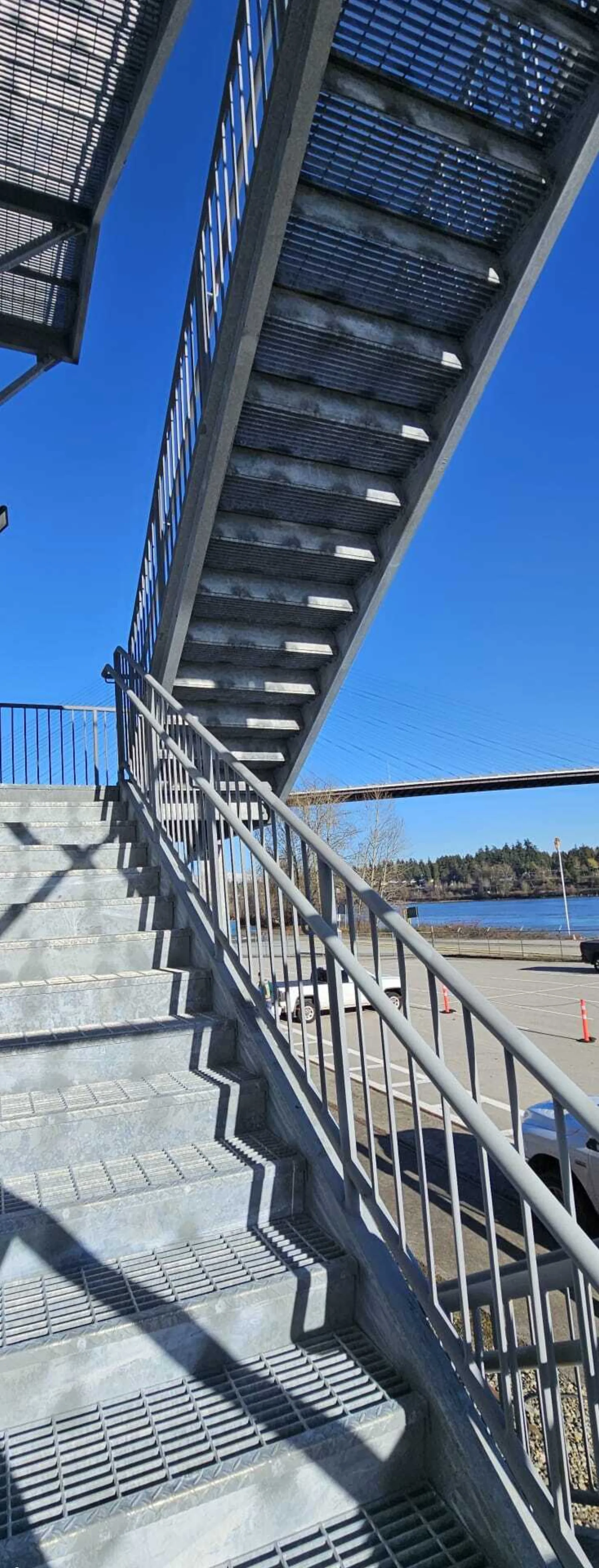
Bar grating is exactly what it sounds like, load-bearing flat bars on edge, welded into a panel with cross bars and a serrated top edge. Water, snow, and meltwater pass straight through. The steel does not sit in standing water. In normal use, the grating sheds rain off the building, off the tread, and onto the ground without holding any of it.
Dimple (raised-button or pebble-pattern) plate is heavier serrated steel plate with a high-friction surface pattern. It works where a solid tread is preferred, a landing under a roof overhang, a stair that has to be swept of small debris, a step adjacent to a doorway where snow is tracked in. Drainage is less aggressive than grating but better than smooth pan-tread by a wide margin, and the surface pattern gives traction even when wet.
Both treads can run galvanized for outdoor use, painted for indoor and protected exposures, or duplex finished where the budget supports it. Galvanizing is the default for exterior because the zinc layer is sacrificial against the chloride attack the paint cannot resist. The American Galvanizers Association notes that hot-dip galvanizing performs well in coastal exposures when specified correctly, with duplex systems extending life further.
The maintenance behaviour changes too. Most of our grating-tread customers stop using ice melt altogether after the first winter on the new stair. The grating is non-slip wet, ice cannot build up on a tread that drains, and snow is removed with a broom or a leaf blower instead of chemicals. The salt budget goes to zero and the corrosion rate drops to whatever the galvanizing can handle.
Field signs your warehouse stair needs replacement
A few patterns we look for during site assessments. Any one of these is worth a closer look. Two or more usually mean the stair has moved past spot repair.
- Underside rust on pan treads that has bubbled the paint, drips at the stringer connection, or shows visible loss of steel. Take a flashlight and look up from below, the top surface is the last thing to fail.
- Loose or missing fasteners at the base plate, the door threshold, or the landing connection. Bolts that wiggle by hand are no longer carrying their share of the load.
- Stringers that move when a worker walks the stair. Lateral or vertical movement under foot traffic is a sign that connections have lost capacity.
- Cracking or spalling in the concrete fill of pan treads. The crack lets in water; the water rusts the pan; the pan loses section; the concrete loses backing.
- Guards short of code. Guards measured at less than 1,070 mm above the walking surface at any elevated landing or stair flight serving a commercial occupancy. Many warehouses built in earlier decades have 36-inch pipe rails that no longer meet the current minimum at exterior heights.
- Handrails missing on the open side, or terminated short of the top and bottom of the flight.
- Treads with surface paint worn through to bare steel that has then rusted. The corrosion has compromised section thickness whether or not it looks structural at a glance.
What a replacement project looks like
The strongest projects start with photos, drawings if any exist, a site measure of the door threshold heights, and a conversation about who is paying, the landlord, the tenant, or both under a cost-sharing clause. From there a typical exterior warehouse stair replacement in the Lower Mainland runs in this order:
Measure and design, we work from a field measure and a sketch of the door access point. Geometry follows BCBC for the occupancy. If a structural engineer’s seal is required for the occupancy or for a deck/landing tied into the building, we coordinate that early so the drawing set carries through permit.
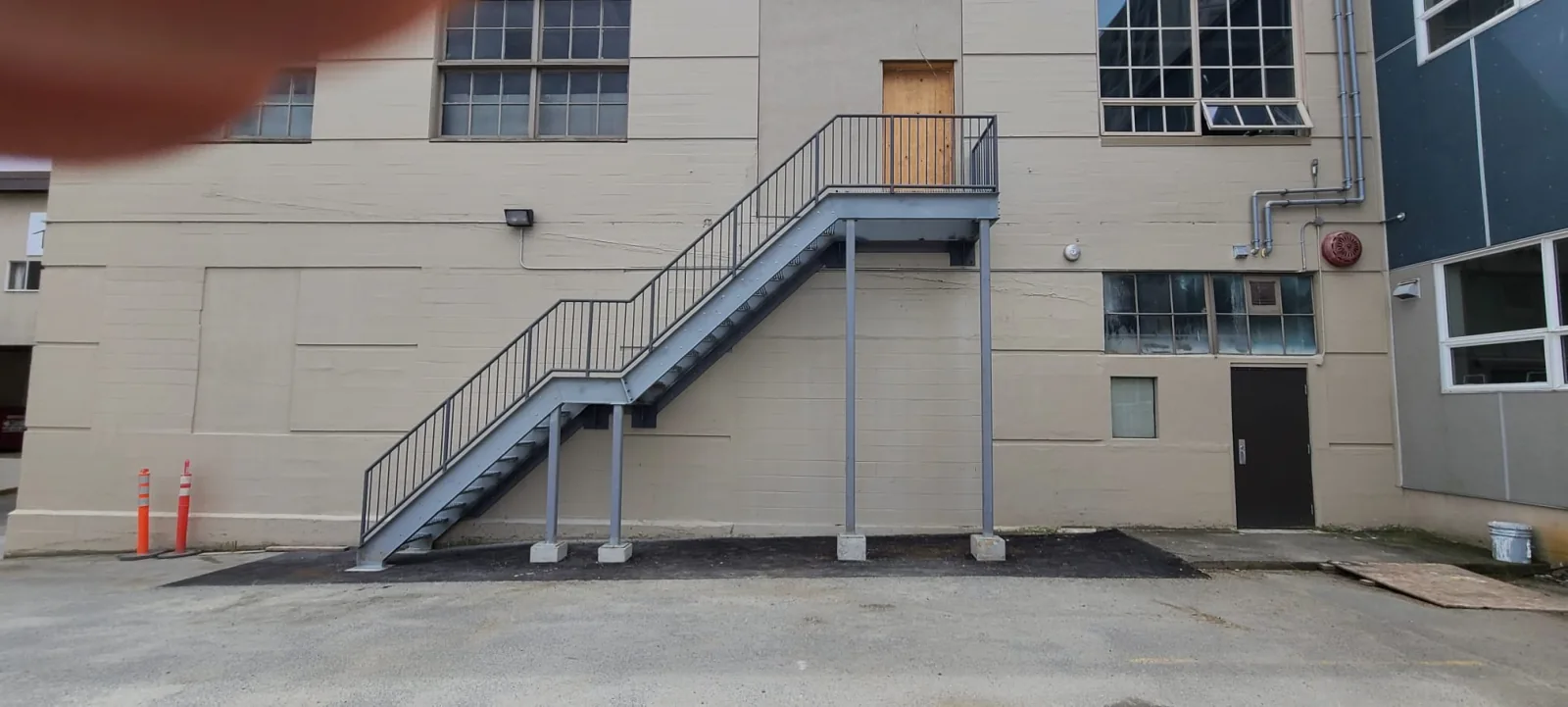
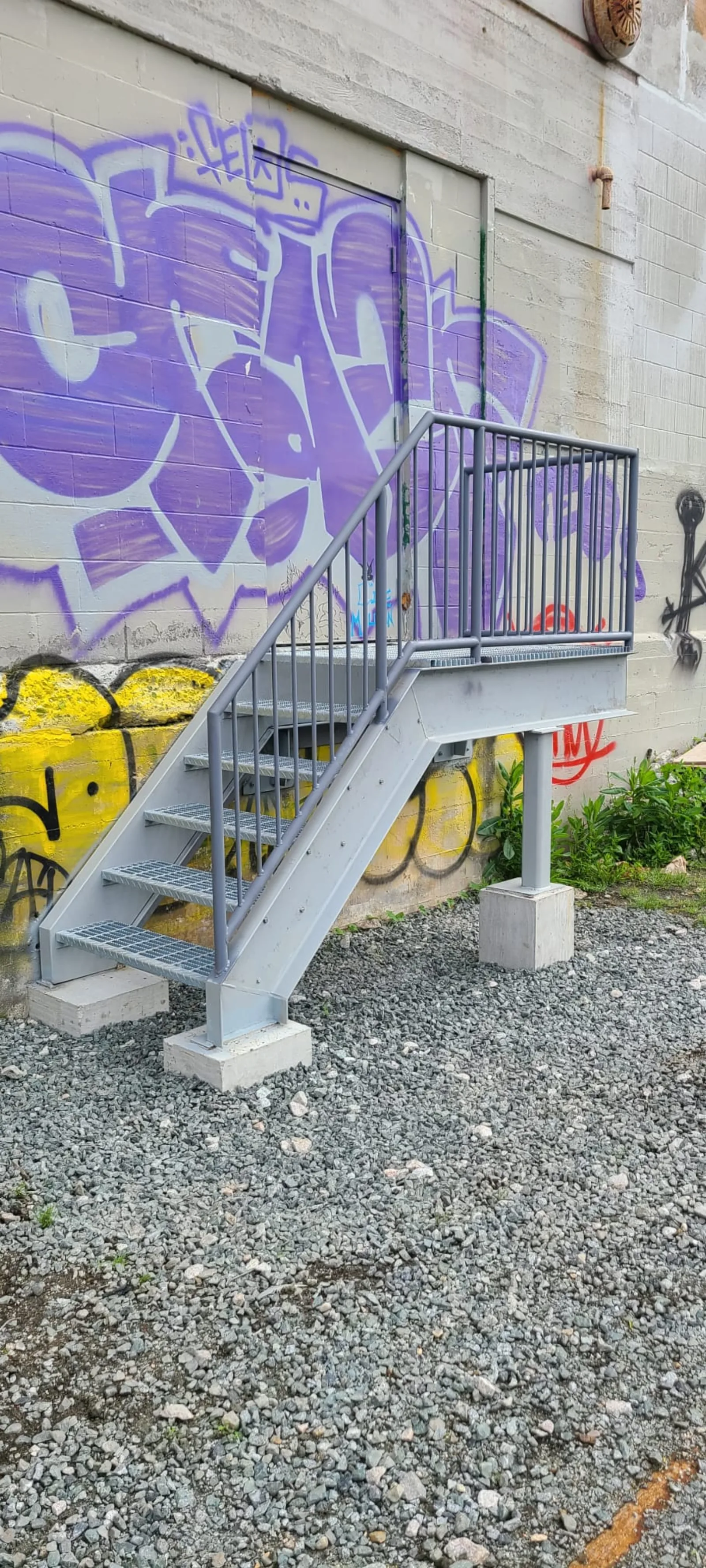
Shop fabricate, stringers, treads (grating or dimple), pipe-rail guards, landing structure. Most warehouse stairs ship as two or three weldments that bolt together on site. Finish is hot-dip galvanized for exterior; powder coat or duplex on request.
Site install, demolition of the old stair, base preparation if foundations are being replaced, and bolted assembly. A clean replacement on existing footings usually runs one day on site. New foundations add concrete cure time and an extra mobilization.
Send photos, drawings if any exist, dimensions of the door threshold height to grade, and a note on which side the door swings. That is enough for us to estimate and to flag whether the project needs an engineer before it can move forward.
For how warehouse access stairs fit alongside egress, landings, and guard detailing, see our overview of commercial stairs.
Sources
- WorkSafeBC OHS Regulation Part 4, General Conditions, handrails (§4.62), guardrails (§4.55), safe access (§4.32), walkways (§4.61), and the §4.1 catch-all.
- WorkSafeBC, Workplace Inspections, employer’s ongoing duty to inspect at intervals that prevent unsafe conditions.
- BC Building Code, Stairs, Ramps, Handrails and Guards (Section 9.8), geometry, guards, and handrail minimums.
- Occupiers Liability Act, RSBC 1996, c. 337, duty of reasonable care owed by the occupier of premises.
- American Galvanizers Association, Hot-Dip Galvanizing in Coastal Climates, service-life expectations for galvanized steel in chloride exposure.
- Engineer Fix, The Science and Consequences of Deicing Salts, chloride attack on steel and concrete reinforcement.
A warehouse stair that you would not want your own crew to use first thing on a January morning is one to replace, not patch. Send photos and a door-threshold measurement and we will tell you what the path forward looks like.
Related questions
What BC rules cover warehouse staircase safety?
Warehouse and light-industrial stairs are governed by the BC Building Code (typically Part 3 for non-residential occupancies) for geometry, guards, and handrails, and by the WorkSafeBC Occupational Health and Safety Regulation Part 4 for safe access and the condition of stairs in active workplaces. Code interpretation belongs with the authority having jurisdiction; WorkSafeBC inspectors enforce condition and access separately.
Who is liable if a warehouse stair collapses?
Under the BC Occupiers Liability Act, the occupier of premises owes a duty of reasonable care to anyone using the property. For a leased warehouse that can fall on the landlord, the tenant, or both depending on the lease and who controlled maintenance. WorkSafeBC enforcement against the employer is separate from any civil claim a worker may bring.
Why do exterior pan-tread stairs rust faster than grating stairs?
Concrete-filled pan treads trap water against the steel pan and along the stringer-to-pan welds. When tenants pour ice melt or rock salt on the treads, chloride ions migrate into the concrete, attack the steel passive layer, and accelerate corrosion from inside out. Grating and dimple treads drain freely, so water and chloride never sit on the steel.
Do I have to use ice melt on bar grating stairs?
In most cases no. Open bar grating sheds snow and meltwater through the tread itself rather than holding it on the surface, and the serrated bar edges or dimple pattern give a high-friction walking surface even when wet. Tenants who reflexively apply rock salt to a grating stair are usually solving a problem the tread already solves.
What does WorkSafeBC require for stair handrails at a worksite?
OHS Regulation Part 4 section 4.62 requires continuous handrails on any stair with more than four risers, set 76 cm to 92 cm above the tread nosing, capable of withstanding a 1.3 kN load. On open sides, a midrail is required between the handrail and the tread. These are minimums, the BC Building Code may require additional handrails on wider commercial stairs.
When does a warehouse stair need to be replaced rather than repaired?
When the stringer or pan has lost section thickness to corrosion, when welds at the stringer-to-pan connection are no longer intact, when the geometry was never to code, or when prior repairs have stacked up to the point that the load path is unclear. Spot repairs to a stair that is structurally compromised are not a long-term answer.
How long does an exterior steel stair last in coastal Vancouver?
Service life depends on the finish system. A painted carbon-steel stair on the open coast can show rust within five to ten years if drainage is poor or ice melt is used. A properly hot-dip galvanized stair typically lasts longer, and a duplex system, galvanized then top-coated, extends life further. The American Galvanizers Association publishes service-life tables for various exposure categories.
Does the BC Building Code allow open-riser stairs at a warehouse?
Open-riser stairs are common at industrial and light-industrial buildings, but the opening between treads must comply with the BCBC sphere test and any accessibility requirements that apply to the occupancy. The detail is reviewable by the authority having jurisdiction, and the load path for grating tread connections has to be shown.
What slip resistance do bar grating and dimple treads provide?
Serrated bar grating and dimple-pattern plate (sometimes called raised-button or pebble-pattern) both create a high-friction walking surface that performs well wet or icy. The exact coefficient depends on the manufacturer's pattern, but both outperform painted smooth-pan treads in wet conditions, which is the typical Vancouver case.
Can you replace a warehouse stair without shutting down the loading bay?
Often yes. We measure the existing footprint, fabricate the new stair offsite to match the door threshold and landing connection, and swap the units in a single staged install. The shutdown window is usually a day for the demo and bolt-up, sometimes less for a clean bolted-base case. Welded connections to existing steel take longer because they need preheat and inspection.