BC Single-Exit Staircase 2026: What the New Code Means for Your Building
BC's January 2026 building code change now allows six-storey residential buildings with a single staircase. Here's what architects, developers, and GCs need to know about the structural and fabrication implications.
BC's January 2026 code amendment allows mid-rise residential buildings to use a single staircase, with wider specs, sprinklers, and smoke management required. Vancouver Stairs explains what the change means for stair fabrication scope.
This article is fabrication context, not engineering or permit advice. Code interpretation and permit scope belong with the authority having jurisdiction (AHJ) and the project’s licensed professionals. Confirm applicability with the local building department before proceeding with design or permit submissions.
On January 20, 2026, the City of Vancouver adopted an amendment to the Vancouver Building By-Law (VBBL) that aligns with the BC Building Code (BCBC) 2024 amendment, and it changes how mid-rise residential buildings can be designed. Six-storey residential buildings can now be permitted with a single staircase as the sole means of egress, a configuration previously prohibited for any building over two or three storeys. For architects designing wood-frame mid-rise, developers planning floor-efficient residential projects, and GCs pricing out stair cores in early SD, this amendment reshapes the options on the table in 2026.
What the old code required
Under the previous BCBC, most residential buildings above three storeys required two separate means of egress, meaning two stairwells. The requirement applied to Group C residential occupancies beyond the thresholds covered by Part 9’s small-building provisions, which pushed most four- to six-storey wood-frame buildings into a two-core layout.
In practical terms, two stair cores in a mid-rise wood-frame building consume significant plan area. A typical code-minimum egress stair at 860 mm clear width plus the enclosing shaft walls, fire separations, and corridors connecting to each core could claim 15 to 25 square metres of floor area per floor, sometimes more depending on shaft geometry and the building’s structural layout. Multiplied over six storeys, that is floor area the project cannot sell or lease. For smaller infill sites in Vancouver, Burnaby, or New Westminster, that math sometimes killed viability outright.
What the new code allows
The 2024 BCBC amendment, adopted by Vancouver on January 20, 2026, permits residential buildings up to six storeys to be designed with a single staircase, subject to a package of co-requirements that compensate for the reduced redundancy. The four conditions that must be present for a single-exit stair (SES) building to be compliant are:
The first condition is a full building sprinkler system. The entire building must be sprinklered to NFPA 13 or equivalent, not limited to the stair shaft, but applied to all occupied spaces, corridors, and storage areas throughout the building.
The second is mechanical smoke management. A compliant system must be designed and commissioned, typically meaning stair shaft pressurization: positive pressure maintained in the shaft relative to adjacent floors so smoke does not enter the egress path during evacuation.
The third condition is a wider stairwell clear width. The single-exit stair must exceed the standard residential minimum of 860 mm to allow simultaneous two-way movement through one shaft. The exact required width varies with occupant load and building classification, confirm with the authority having jurisdiction (AHJ, the local building official responsible for code interpretation and permit issuance) before finalizing the stair core footprint.
The fourth condition is enhanced alarm and communication systems. Detection, alarm, and voice communication systems are required in SES buildings to compensate for the single-exit configuration. These coordinate with the smoke-management system and are reviewed together as a life-safety package.
The amendment cites the BCBC 2024 revision; Vancouver’s January 20, 2026 VBBL adoption is the local trigger that makes it buildable under City permits. Other Metro Vancouver municipalities are expected to follow as they update their own by-laws, but as of May 2026, the adoption status varies by municipality (see section below).
Why this matters for stair fabrication
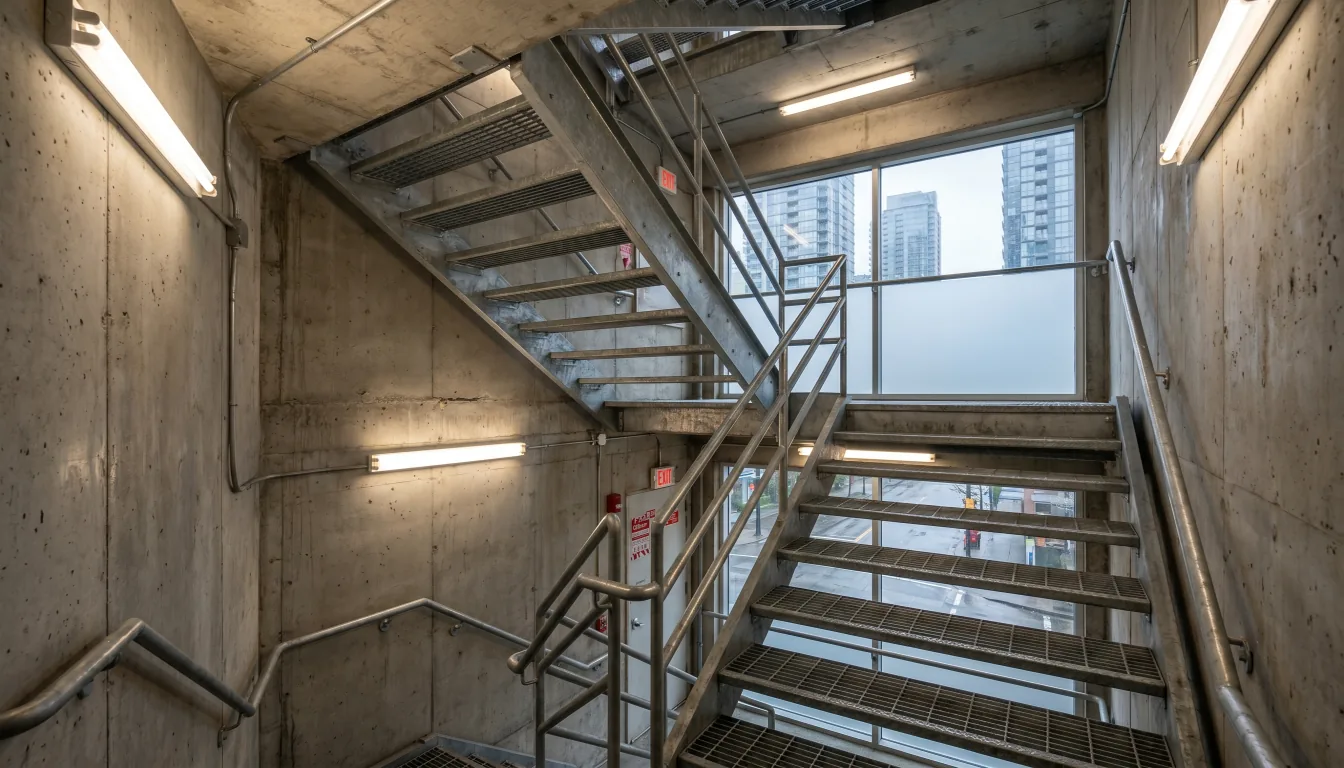
The wider-stairwell requirement is where the code change translates directly into steel scope. A standard Part 9 residential stair in a multi-family building runs 860–900 mm clear between handrails. A single-exit stair in a six-storey building will need to be wider, meaning wider stringers, longer treads or pan forms, and heavier connections at each landing.
The fabrication implications are specific:
Wider stringers are the first fabrication consequence. A standard switchback egress stair at 860 mm clear might run C-channel or light HSS stringers. Moving to the wider clear width required for SES increases the span and steps the stringer section up, from C-channel to HSS, or from lighter to heavier HSS. The shop drawing and engineer’s calculations drive the exact section, but cost and weight move up with width.
Pan-formed treads get heavier too. Steel-pan treads formed for a wider stair are heavier per unit and need more concrete fill volume. Lead time for custom-formed wider pans is longer than for standard residential treads.
Earlier fabricator involvement becomes necessary because of the shaft pressurization system. The mechanical system that maintains positive pressure in the stair during a fire requires penetrations through the shaft walls, typically at each landing level. Where those dampers or supply openings land affects the landing plate details, the anchor locations, and sometimes the stringer geometry. If the mechanical and structural drawings are not coordinated before the shop set is issued, the landing plates may need to be cut or repositioned on site, which is expensive.
Plan for 14 to 18 weeks lead time on an engineered mid-rise stair system. A CWB-certified shop fabricating a compliant SES staircase for a six-storey building, with stamped shop drawings, P.Eng review, and coordination with mechanical, typically works on a 14 to 18 week lead time from design-freeze to delivery. Projects that engage a fabricator during schematic design rather than after permit issuance get ahead of that schedule.
What designers and GCs should ask their fabricator
The SES amendment creates a new set of early coordination points that were not as critical when two stair cores were the default. Before issuing for tender or locking in the stair core layout, confirm the following with a prospective fabricator:
- What is the required clear stair width for your SES design? The AHJ determines this, but the fabricator needs to know it before sizing stringers and pan forms. A 150 mm increase in clear width changes the steel package materially.
- Does the smoke-management system include stair pressurization, and where do the penetrations land? Mechanical damper openings through the shaft at landing level need to be coordinated with landing plate details. Get the mechanical layout in front of the fabricator at the shop drawing stage, not the site visit stage.
- What is the stair core footprint, and is it coordinated with the structural layout? The wider stair shaft required for SES buildings needs to fit within the building’s structural grid. Stringer connections to the concrete core or wood-frame shaft walls need to be coordinated with the engineer of record and the fabricator together.
- What is the fabrication lead time for a compliant SES staircase? Plan for 14 to 18 weeks for an engineered stair system in a mid-rise scope. If that puts steel delivery inside a compressed schedule, discuss it at SD, not after permit issuance.
For egress stair design on typical commercial projects, similar coordination questions apply, but the SES configuration adds the smoke-management and width questions that were previously resolved by the presence of a second stair.
Vancouver vs. rest of Metro Vancouver
The City of Vancouver formally adopted the amendment on January 20, 2026. As of the publication date of this article, other Metro Vancouver municipalities are at different stages of by-law adoption:
- Burnaby, Richmond, Surrey, Coquitlam, and North Vancouver City, expected to follow as part of regular by-law update cycles; adoption status as of May 2026 should be confirmed directly with each municipality’s building department.
- District of North Vancouver, West Vancouver, New Westminster, and Port Moody, same position: anticipated adoption, but not confirmed as of this writing.
The AHJ (authority having jurisdiction, the building official for the municipality where the project is located) is the authoritative source on whether the amendment has been adopted and what specific requirements apply in that jurisdiction. Do not proceed with a single-exit stair design in a municipality outside Vancouver without confirming adoption status with the local building department.
For background on how BC code for commercial stairs interacts with the broader code framework, see the commercial stair hub, the SES amendment sits within the same Part 3 framework that governs commercial egress requirements.
Sources
- BC Building Code 2024 Amendment, single-exit stair provisions for Group C residential buildings up to six storeys
- City of Vancouver Building By-Law (VBBL) Amendment, adopted January 20, 2026
- Vancouver Building By-Law, City of Vancouver Development, Buildings and Licensing
- BC Building Code, Province of British Columbia
For mid-rise residential projects in Metro Vancouver, the SES configuration changes the fabrication scope early. Vancouver Stairs works with architects and GCs from schematic design through installation, sizing the stair core, coordinating with mechanical, and delivering stamped shop drawings on schedule. Send drawings, stair opening dimensions, and the target permit date to begin the conversation.
Related questions
What is a single-exit stair (SES) building?
A single-exit stair (SES) building is a residential building up to six storeys with one staircase serving as the means of egress, now permitted under the amended BC Building Code and Vancouver Building By-Law (adopted January 20, 2026), provided the building includes a full sprinkler system, mechanical smoke management, widened stairwell, and compliant alarm and communication systems.
Does the single-exit staircase code change apply to commercial buildings?
No, the amendment is primarily for residential mid-rise buildings up to six storeys. Commercial and mixed-use buildings still require a separate code assessment and typically a second means of egress. Confirm scope and applicability with the authority having jurisdiction (AHJ) for your specific project.
How wide does the staircase need to be in a single-exit building?
The 2026 amendment requires a clear stair width greater than the standard residential minimum of 860–900 mm, to allow simultaneous egress flow through a single shaft. The exact required width depends on occupant load and building classification, confirm the figure with your structural engineer and the authority having jurisdiction (AHJ) before sizing the stair core.