Balcony Railing Replacement Cost Vancouver 2026
What balcony guard replacement actually costs in Vancouver, material options, strata approval process, permit requirements, and access challenges that drive the final number.
Replacing a balcony guard in a Vancouver condo or low-rise involves strata approval, building permits, and engineering sign-off that a backyard deck project does not. Here is what shapes the cost.
Replacing a balcony guard is not the same scope as replacing a deck railing. In a Vancouver condo or low-rise strata building, the guard is usually common property or part of the building envelope, which means strata council approval, a City of Vancouver building permit, and often an engineer’s sign-off are required before fabrication begins. The access challenges alone, swing stages, freight elevators, noise restrictions, add cost that a backyard project never sees. Understanding what drives the number makes it easier to plan and compare quotes.
Balcony guards are governed by strata bylaws, not just building code
The first thing to establish is who controls the balcony guard. In most BC strata corporations, the balcony slab, the guard, and the balcony enclosure are common property or limited common property, meaning the strata corporation owns or controls them even though an individual unit has exclusive use. This is confirmed in the strata plan and the strata bylaws, which are registered at the BC Land Title and Survey Authority. Before engaging a fabricator, pull the current strata bylaws and confirm whether the guard is designated as common property or limited common property.
The practical implication: an owner cannot replace the guard unilaterally, even if the existing guard is clearly deteriorating. A written proposal must go to strata council, with drawings, proposed materials, and a scope description. Council votes. If the project cost exceeds the council’s approved spending limit (set in the annual budget and typically capped at a few thousand dollars for day-to-day repairs), a special general meeting or annual general meeting vote may be required. That process adds two to six months to the project timeline before a fabricator is engaged.
When the strata corporation initiates a building-wide guard replacement, common in buildings reaching fifteen to twenty years of age where the original aluminum or tempered-only glass guards are aging, the process moves through the strata management company and the strata council collectively. Costs are typically funded from the contingency reserve or through a special levy. For building-wide scopes on towers in Coal Harbour, Yaletown, and the West End, the contract may involve dozens of balconies and run into the hundreds of thousands of dollars.
What building permits require for balcony guard replacement
The City of Vancouver Development and Building Services Centre requires a building permit for balcony guard replacement in most multi-family and commercial buildings. These buildings are Part 3 occupancies under the BC Building Code, and any work affecting the building envelope or structural connections requires a permit application with drawings.
A standard permit application for a balcony guard replacement includes: architectural drawings showing the guard profile, panel layout, and dimensions; structural details for the base shoe or post anchor connection to the slab; the product specification for the glass panels and hardware; and a Schedule B Letter of Assurance signed by a professional engineer, confirming the structural design complies with the BC Building Code. The Province of BC’s guide to Letters of Assurance explains what each schedule covers and when each is required.
Permit review timelines at the City of Vancouver vary by workload and application completeness. A well-prepared application for a straightforward guard replacement can move through in three to six weeks. Incomplete submissions bounce back and restart the clock. For buildings in Burnaby or Surrey, the respective municipal permit desks have their own timelines and fee structures, confirm with the local authority before assuming Vancouver’s process applies.
BC Building Code guard height and glazing requirements
BC Building Code 2018 Section 9.8.8 sets the minimum guard height at 1,070 mm for balconies in most multi-family and commercial buildings, measured from the walking surface, the finished balcony slab, not the subfloor. The 1,070 mm standard applies on all upper floors and on ground-level exterior walking surfaces where a fall hazard exists.
The sphere test under BCBC 9.8.8.5 requires that no opening in the guard allow passage of a 100 mm sphere. For glass guards, this means panel gaps at joints and at the base shoe must be controlled. For cable guards, the 100 mm sphere test must be satisfied under realistic cable deflection under load, not just at rest.
Glass used in balcony guards in Part 3 buildings must be safety glazing. In practice, this means laminated tempered glass, two tempered panels bonded with a polyvinyl butyral (PVB) interlayer. If a laminated panel cracks, the interlayer holds the fragments in the frame rather than allowing glass to fall from height. Standard tempered-only glass, which shatters into small pieces, is not accepted for balcony guards on elevated buildings. Panel thickness for most residential balcony applications runs 12 mm or 13.5 mm depending on the engineer’s design and the panel spans involved.
BCBC 9.8.8 also requires a toeboard at the base of balcony guards where objects could fall and injure people below. The common standard is 100 mm minimum height. Some AHJs require more on high-rise balconies over occupied pedestrian areas, confirm the requirement with the permit reviewer before finalizing drawings.
This article is not a substitute for code review by the authority having jurisdiction, an architect, or a professional engineer.
Material options and cost ranges
The material choice is the largest single variable in balcony guard cost, after access. These ranges reflect the installed cost per linear foot including fabrication, hardware, and standard installation, but before engineering, permit fees, and access equipment:
| Material | Installed cost per linear foot |
|---|---|
| Aluminum tube guard (painted) | $180–$320 |
| Steel tube guard (powder coated) | $220–$380 |
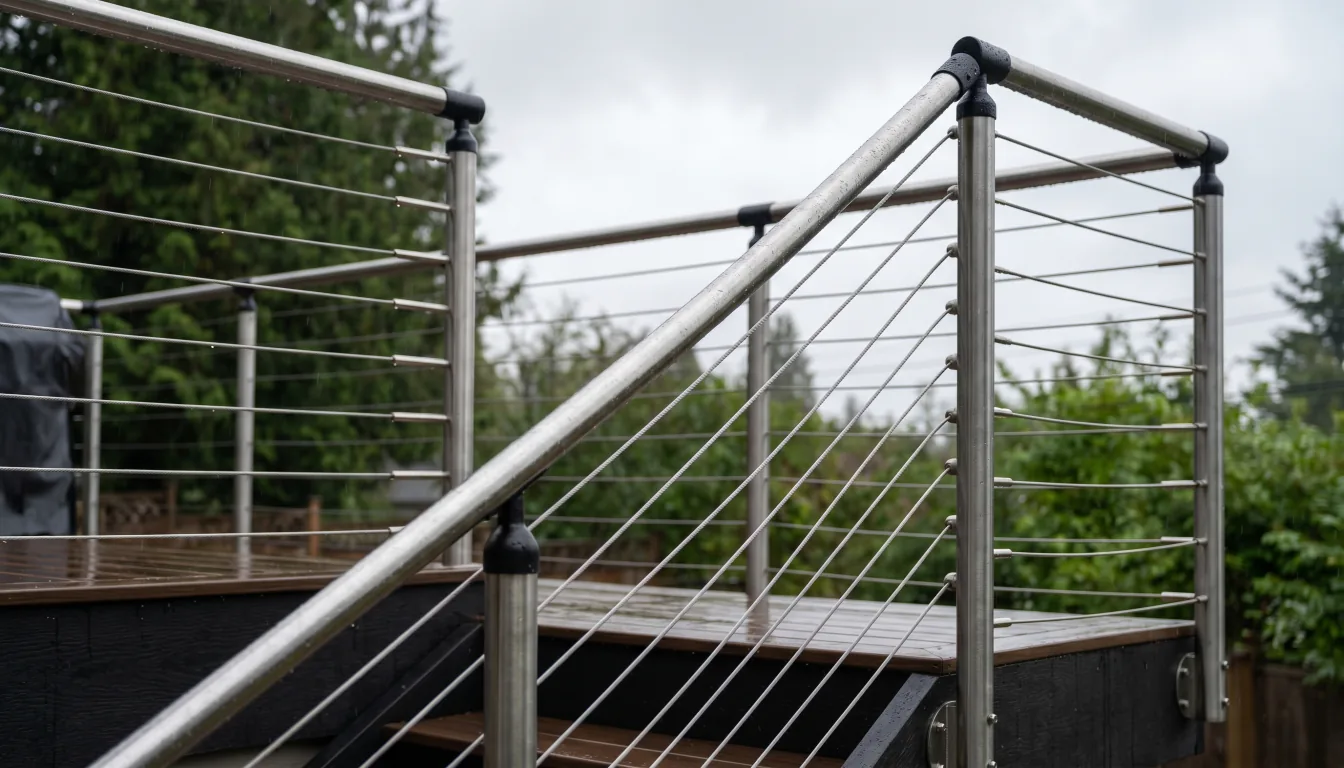
| Cable railing (stainless, engineered posts) | $280–$480 |
| Semi-frameless glass guard | $420–$680 |
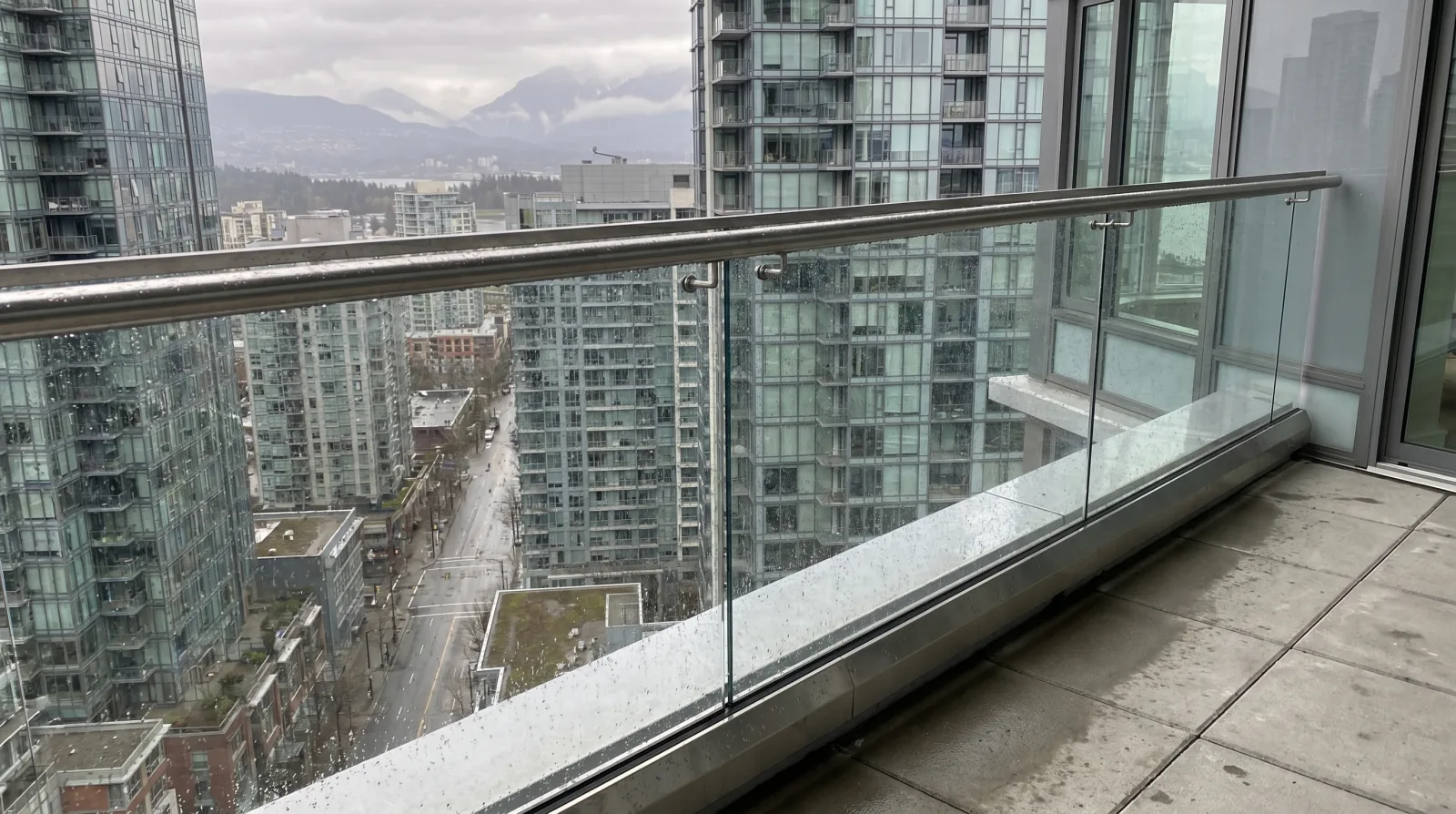
| Frameless glass guard (base shoe) | $580–$950 |
A typical condo balcony guard runs eight to fourteen linear feet. A straightforward aluminum or cable replacement on a low-rise building with good access might land in the $4,500–$8,000 range all-in. A frameless glass guard replacement on a high-rise balcony with scaffolding access and engineering can reach $18,000–$28,000 for a single balcony, and higher in buildings where access equipment must be brought in separately for each unit.
Glass is the dominant choice in Vancouver’s condo market. Coal Harbour, Yaletown, and the West End have a concentration of buildings where the original tempered-only glass guards from the 1990s and early 2000s are being replaced with modern laminated systems. The view is the reason. A solid aluminum guard or steel tube guard cuts the sightline to the water and mountains. Glass preserves it. For buildings where the view drives the unit price, the cost premium for glass is a straightforward decision.
Cable railing is more common on low-rise wood-frame buildings in Burnaby and Surrey where the unit values are lower and strata councils are more cost-sensitive. Cable systems are less expensive than glass, more view-preserving than solid metal, and easier to install in buildings without freight elevator access. The engineering requirement, cable tension, post sizing, and anchor capacity into wood framing, is no less rigorous than for glass, but the system weight is lower and the panel logistics are simpler.
Steel tube guards are common on rental and commercial buildings where maintenance durability and cost are the primary concerns. They are also the right answer for exterior stair guards and parking structure railings where aesthetics matter less than load capacity and lifecycle cost. For more on glass railing options and costs, the glass railing cost Vancouver guide covers panel sizing, hardware specifications, and what drives the price range.
Access challenges that add cost
Access is where balcony railing replacement diverges most sharply from a ground-level deck project. The cost of getting people and material to the work is often as large as the fabrication cost itself.
High-rise scaffolding and swing stages. For balconies above the reach of ladders or ground-level scaffolding, a certified swing stage, a suspended platform system hung from the roof, is the primary access method. Swing stages must be engineered, inspected, and operated by certified workers under WorkSafe BC regulations. The mobilization cost for a swing stage on a downtown Vancouver high-rise can run several thousand dollars per day, and installation of a single balcony guard may require two or three days of access. Multi-floor contracts that allow the swing stage to serve several balconies in one mobilization reduce the per-unit cost significantly.
Freight elevator scheduling. Residential buildings have freight elevator policies that limit the hours, days, and duration of commercial use. A fabricator delivering glass panels, which are heavy, fragile, and awkward to manoeuvre, must book well in advance and may be limited to early morning or weekend windows. If the freight elevator is unavailable or undersized for the glass panel dimensions, panels must be broken into smaller sections or accessed by other means, which increases cost.
Noise restrictions. Many strata buildings restrict noise-generating work to specific hours, typically 8 a.m. to 5 p.m. weekdays. Grinding, drilling into concrete, and impact work fall within those restrictions, but they still limit the working window on a job that must be completed before the swing stage is released. A fabricator who plans realistically for the available working hours will give a more accurate schedule than one who assumes unrestricted access.
Suite access coordination. Glass panel removal and installation typically requires access through the suite as well as from the exterior. The balcony door and interior slab edge must be clear. In occupied suites, coordinating access adds scheduling complexity. In buildings doing a multi-unit replacement, sequencing suite access across dozens of owners is a project management task in itself.
For strata-wide balcony guard replacements across multiple towers in Burnaby and Surrey, the strata railing replacement Burnaby guide covers how building-wide scopes are structured, tendered, and funded.
The strata approval process in practice
The approval sequence for a balcony guard replacement in a BC strata typically runs in this order:
First, the strata owner (or strata council for a building-wide scope) prepares a written alteration request with a scope description, proposed materials, and a rough estimate. For individual owner-initiated projects, this goes to strata council at the next monthly meeting. Council may approve, reject, or ask for more information. For projects above the council’s spending authority, a vote at an SGM or AGM is required.
Second, once council approval is in hand, the strata or owner engages a professional engineer and a fabricator to produce permit-ready drawings. The engineer reviews the anchor design, specifies the glass and hardware, and signs the Schedule B Letter of Assurance required by the building permit application.
Third, the permit application goes to the relevant municipal authority. For City of Vancouver projects, this is the Development and Building Services Centre. For Burnaby, it is Burnaby’s Building and Licensing department. Permit issuance takes three to ten weeks depending on completeness and workload.
Fourth, fabrication and installation follow once the permit is issued and access equipment is scheduled.
The full sequence, strata approval, engineering, permit, fabrication, access booking, installation, takes four to nine months on a well-run project. Projects where the strata approval is delayed, or where the permit application is incomplete, run longer. Engaging a fabricator who has done strata guard replacement work in Vancouver before, and who understands the documentation requirements, reduces the risk of delays at each stage.
For a detailed look at glass guard options and specifications, the glass railings Vancouver page and the strata railings Vancouver page cover the product options and what to expect from the specification process.
Getting a useful assessment
The most useful starting point for a balcony guard replacement is a site assessment with field measurements, access observations, and a review of the strata plan and bylaws. Drawings cannot be started until the slab edge connection detail is confirmed, which requires looking at the existing guard anchor, the slab thickness, and what the anchor connects to. An assessment based on photos alone will miss details that change the engineering and the cost.
For a balcony railing assessment in Metro Vancouver, send the building address, the existing guard type, photos of the current guard and slab edge, and the relevant strata bylaw sections on common property alterations. Even preliminary information helps distinguish a straightforward cable or aluminum replacement from a project that needs swing stage access, laminated glass engineering, and a multi-month strata approval process.
Related questions
Do I need a building permit to replace a balcony railing in Vancouver?
Usually yes. The City of Vancouver requires a building permit for guard replacement when the work involves structural attachments to the slab edge or envelope, or when the building is a Part 3 occupancy (most condos and low-rise apartments qualify). Confirm the scope with a permit technician at the Development and Building Services Centre before engaging a fabricator.
Who approves balcony railing replacement in a strata building?
The strata council approves work affecting common property or the building envelope, balcony guards typically fall into one or both categories. The owner or strata corporation must submit a written request with drawings, proposed materials, and often an engineer's review. Council approval can take two to six months depending on the AGM schedule and whether a special general meeting is needed.
What glass is used for balcony guards in Vancouver condos?
Most replacement balcony guards in Metro Vancouver use 12 mm or 13.5 mm laminated tempered glass panels. The laminate layer (two panes bonded with a PVB interlayer) means that if the panel cracks, it stays in the frame rather than falling from height. Standard annealed glass is not acceptable for balcony guards in Part 3 buildings.
What guard height is required for a balcony in BC?
For most balconies in multi-family and commercial buildings, BC Building Code Section 9.8.8 requires a minimum guard height of 1,070 mm measured from the walking surface. Within a single dwelling unit where the walking surface is no more than 1,800 mm above grade, 900 mm is the minimum. Balconies on upper floors of condos and low-rise apartments use the 1,070 mm standard.
Is cable railing allowed on a Vancouver condo balcony?
Cable railing is code-compliant for balcony guards when the post spacing, cable diameter, and tensioning are engineered to prevent a 100 mm sphere from passing through under realistic cable deflection. Strata councils may have aesthetic restrictions that limit cable systems to certain buildings or exposures. Confirm with strata before specifying.
What is a toeboard and is it required on balconies?
A toeboard (also called a curb or kickplate) is a low barrier at the base of a guard that prevents objects from being kicked or rolling off a balcony. BC Building Code requires a toeboard or equivalent protection on balconies and elevated platforms where objects could fall and injure people below. The common standard is 100 mm minimum height. For high-rise balconies over occupied areas, the AHJ may require more.
Why does balcony railing replacement cost more than deck railing?
Access drives most of the premium. High-rise buildings require scaffold or swing-stage access at hundreds of dollars per day per swing stage. Low-rise buildings often need scaffolding erected around the perimeter. Material delivery must travel through a residential lobby, into a freight elevator, and through a finished suite. Noise restrictions limit working hours. None of these apply to a backyard deck.
How long does strata approval take for railing replacement?
Two to six months is typical. Strata councils meet monthly at most. A proposal submitted just after a meeting waits until the next one. If the project value exceeds the strata council's spending authority, a special general meeting or AGM vote is required. Engineering drawings and permit applications run in parallel but cannot be filed until strata approval is in hand.
Can a strata owner replace their own balcony railing?
Only if the strata bylaws allow limited common property alterations with council consent. In most BC stratas, the balcony guard is either common property or part of the building envelope, meaning the strata corporation controls it. An owner who replaces a guard without council approval may be required to restore the original condition at their own cost.
What is the difference between a frameless and semi-frameless glass guard?
Frameless glass guard systems use a base shoe channel embedded in or bolted to the slab, with no vertical posts between panels. Semi-frameless systems use posts between panels with the glass seated in a channel or clamped by spigots. Frameless systems are cleaner visually and more expensive to fabricate and install. Both are used on Vancouver condo balconies; frameless is more common in Coal Harbour and Yaletown buildings.
Does engineering always cost extra for a balcony railing replacement?
For Part 3 buildings in BC, an engineer's review and Schedule B sign-off are typically required as part of the permit application. This is not optional, the City of Vancouver's building permit for envelope work in a multi-family building requires a Certified Professional or engineer of record. Engineering fees for a standard balcony guard replacement run in the range of one to two thousand dollars for a straightforward scope; complex multi-floor replacements run higher.