Banister Replacement in Vancouver: When to Refresh the Railing and Leave the Stair Alone
A practical guide to banister replacement in Vancouver, how to assess whether the stair structure can stay, what gets replaced, material choices with cost context, and BC Building Code requirements.
Most older homes in Vancouver have perfectly sound stair structures underneath dated or failing railings. Replacing only the banister, newel posts, top rail, infill, bottom rail, takes 2–3 days on-site and costs a fraction of rebuilding the whole stair.
This article is a fabrication-focused overview; code interpretation and permit requirements belong with the authority having jurisdiction (AHJ) and, where structural work is involved, a licensed professional.
Most Vancouver homes have stair structures that are fundamentally sound, Douglas fir stringers, solid treads, good connection to the floor framing, and railings that are not. The original wood picket banister from 1968 has been painted four times, the newel post rocks, and two spindles are missing. Or it is a 1990s brass-and-oak combination that the current owners reasonably want removed.
In those situations, the question is not whether to renovate the stair. The question is whether you need to rebuild anything beyond the railing itself. The answer, more often than not, is no.
When railing-only replacement makes sense
A banister replacement without touching the structure makes sense when:
- The treads are solid and do not deflect more than a few millimetres underfoot when you bounce on them.
- The stringers are not cracked, checking badly, or visibly rotted at the base where they meet the floor.
- The newel post connections to the floor or landing are failing (this is almost always fixable without replacing the stair).
- The current railing does not meet BC Building Code for guard height, sphere passage, or handrail graspability, and the structure underneath is otherwise fine.
- The homeowner wants a visual and material refresh: from wood pickets to steel, cable, or glass, or from brass hardware to something current.
If any of those conditions describe your situation, a railing-only job is the right scope. The fabrication cost stays contained, the disruption to the house is minimal, and you are not paying to rebuild work that does not need to be rebuilt.
Assessing whether the structure can stay
Before committing to railing-only scope, the fabricator or a contractor needs to look at three things on-site.
Tread deflection. Stand on the leading edge of several treads and push down firmly. Any deflection more than 4–5 mm is worth investigating. It usually means the tread is not bearing properly on the stringer below, or the stringer itself is moving. A railing job on a bouncy stair will always feel wrong, and the new post connections will work loose faster.
Rot at the base. The bottom newel post sits on the floor or on a landing, and the stringer toe-nails or bolts into the same floor framing. In older Vancouver homes, particularly pre-1980 houses in East Van, Hastings-Sunrise, and Mount Pleasant, the basement landing area and the ground-floor stringer heel are the first places to check for moisture damage. Push an awl into the wood. If it sinks easily, the stringer needs attention before a new railing is installed.
Connection to the floor. In open-plan houses where the stair lands on a second floor with no wall on one or both sides, the stringer-to-floor connection carries a lot of lateral load every time someone grabs the top rail to stop a trip. If that connection is only a few toenails and the stringer visibly rocks when you push laterally on the handrail, the railing job needs to include fixing that connection, which is still much cheaper than a full stair rebuild.
If all three check out, proceed with railing-only scope.
What actually gets replaced in a banister renovation
A complete banister replacement typically includes four components:
Newel posts. The main structural posts at the bottom, top, and any landing. On a railing replacement, the old newel posts are cut off or removed entirely and new posts are anchored to the floor framing, usually with a surface-mount base plate that bolts through the subfloor into blocking below, or by a through-bolt that pulls the post tight against the stringer. This is where the structural connection is actually improved relative to the original.
Top rail (handrail). The graspable element that runs the length of the stair. BC Building Code has specific grip requirements, more on that below. Steel tube is common for metal builds. Wood cap rails over steel or cable systems are popular in West Vancouver houses where homeowners want warmth at the top rail. Integrated LED strip channels are an option in newer builds.
Infill. Pickets, cable, or glass, the elements between top and bottom rail that form the guard. This is the biggest visual and cost variable.
Bottom rail. Some infill systems (cable, glass) need a continuous bottom rail to tension against. Steel picket jobs often do not, pickets can tie directly to the stringer or a floor plate. The need for a bottom rail affects how the stringer interface is handled and adds material and labour cost.
Three design directions: materials, regional fit, and cost
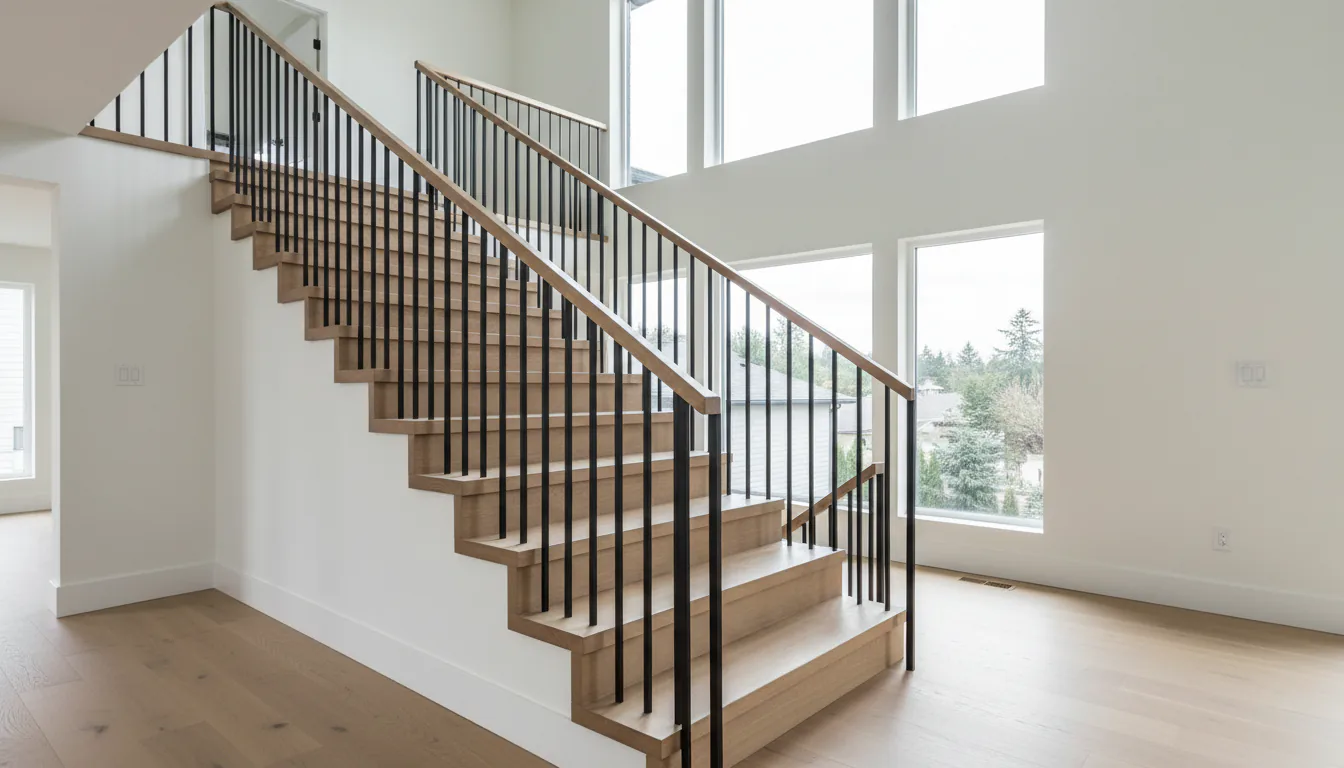
Steel pickets, East Van, Burnaby, New Westminster
Steel square or round pickets welded to a steel top and bottom rail is the most common material combination we fabricate for residential banister replacements. It is also the most code-straightforward: picket spacing is easy to verify (sphere passage requires a 100 mm maximum gap), and the guard height is set by the post-and-rail frame.
In East Vancouver, Burnaby, and New Westminster, steel pickets are the default choice for renovation jobs. They read as industrial-modern in character with the neighbourhood housing stock, semi-detached 1940s houses, 1960s ranchers that have been updated, newer infill. Powder coat finish in matte black or dark charcoal is the most requested finish.
Cost context: Fabricated and installed steel picket railing runs approximately $180–$280 per linear foot for a residential staircase, depending on the picket profile, rail size, and connection complexity. A typical 12-foot stair with two landings is roughly $3,000–$4,500 installed.
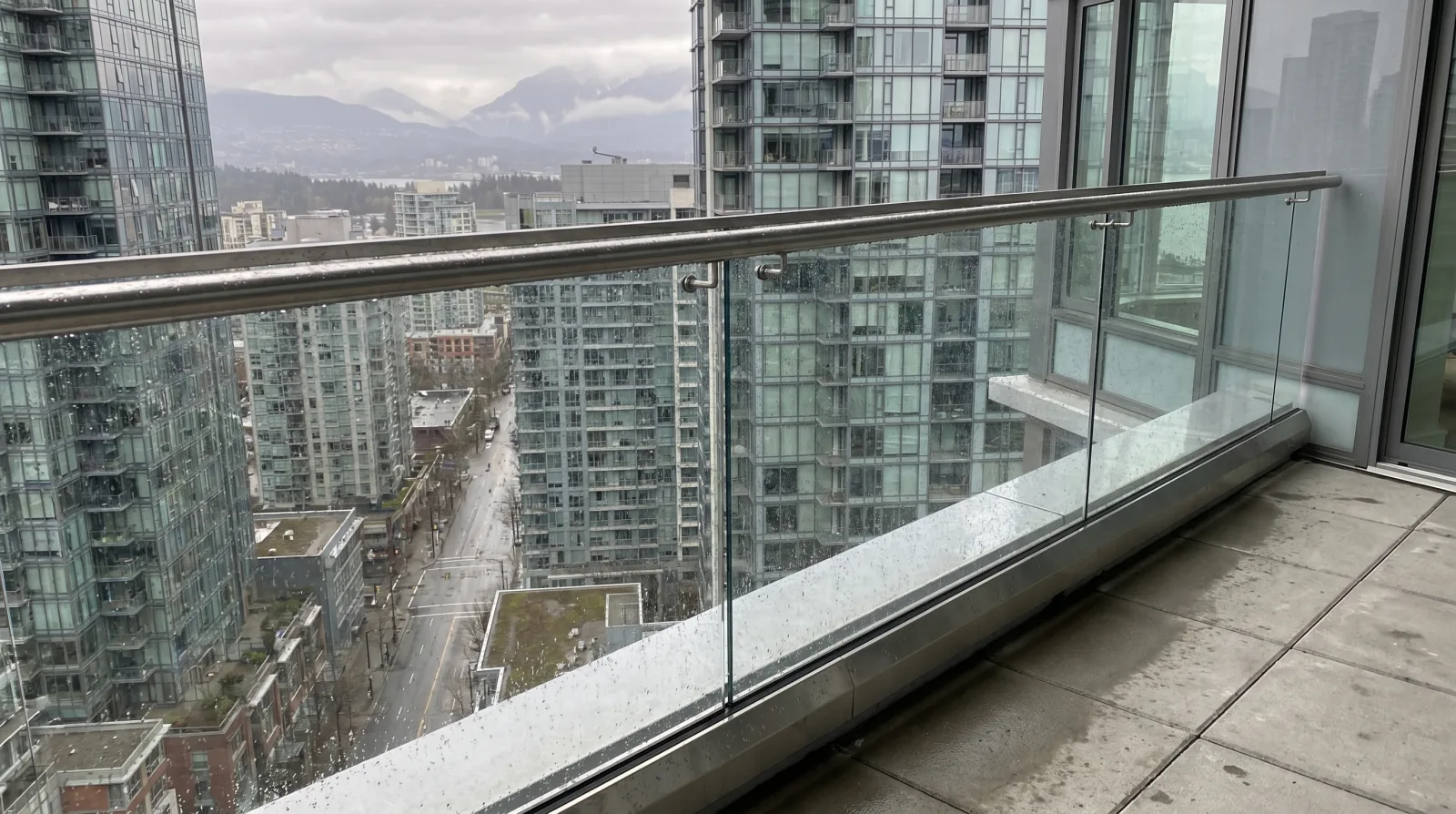
Glass panels, West Vancouver, Yaletown, Coal Harbour
Tempered or laminated glass panels in a steel or aluminum frame are the preferred choice in West and North Vancouver and in high-rise renovation work in Yaletown and Coal Harbour. Glass opens the sightline, makes narrow stairs read as wider, and shows off the stair structure, a selling point when the stringer and treads are already attractive.
The trade-off is that glass panels cannot be cut on-site. Every panel is custom-sized to the fabricator’s measurements, so a measurement error means waiting for a re-cut. Lead times for tempered glass are typically 10–14 days after the shop order goes in.
Glass railings Vancouver are also the most involved to specify to code: the glass must meet structural requirements for infill panels, typically using 12 mm or 19 mm tempered glass depending on panel span, with appropriate edge treatment and frame engagement.
Cost context: Glass infill railing runs approximately $350–$550 per linear foot installed, depending on panel thickness, frame material, and whether the top rail is glass-to-glass channel or a conventional capped rail.
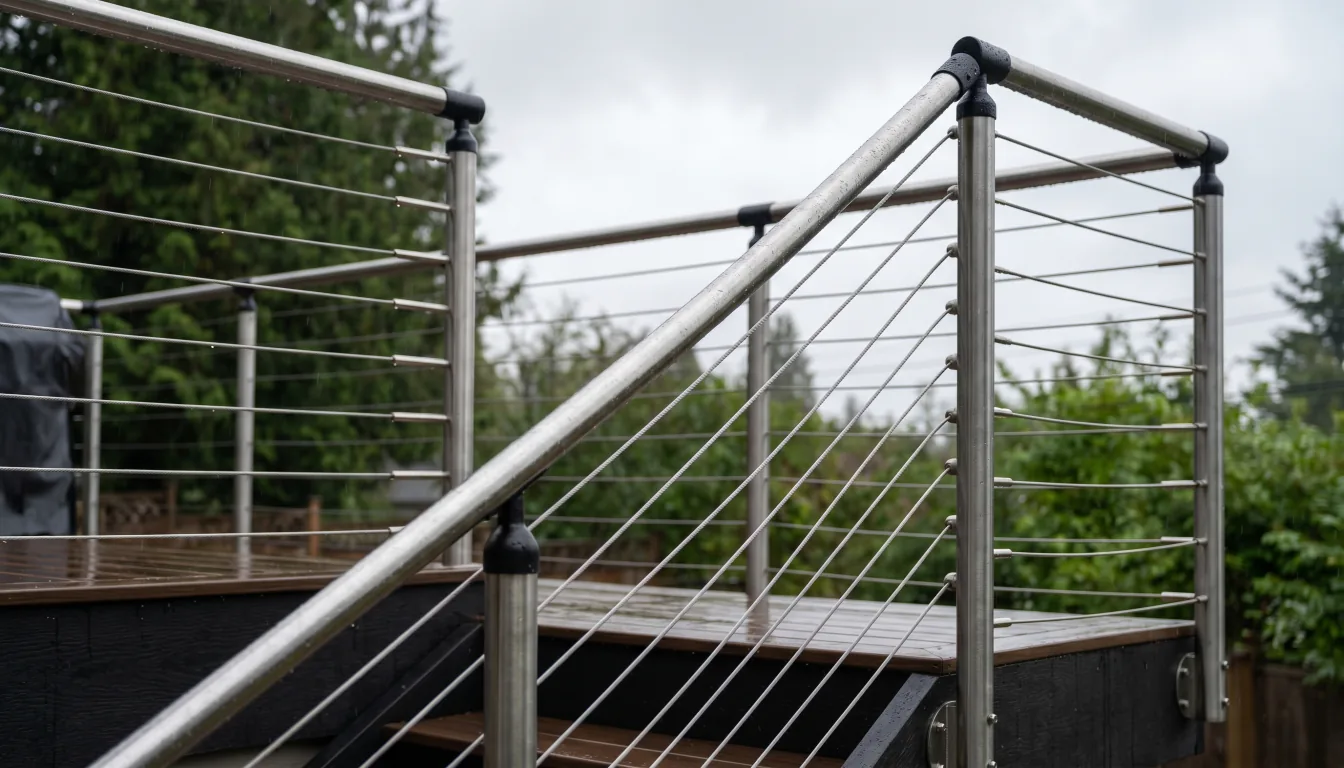
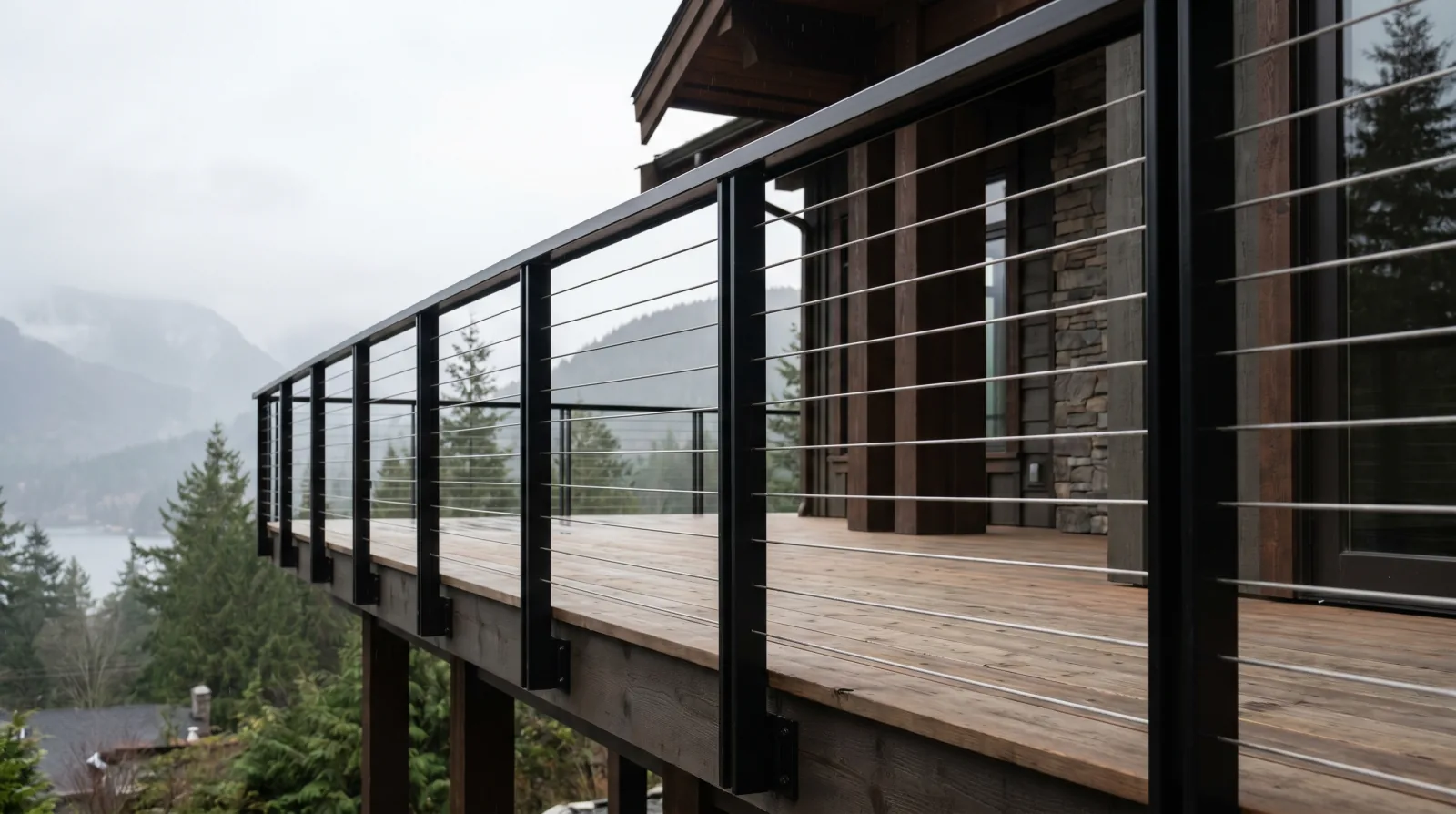
Cable railing, coastal properties, decks, open staircases
Horizontal stainless cable through steel or wood posts is the predominant choice for exterior decks and staircases on North Shore properties and in coastal areas. It preserves the view, handles wet exposure well when stainless cable and swaged fittings are specified correctly, and requires less maintenance than painted steel.
For interior applications, cable works well on open-tread floating stairs where the horizontal lines complement the visual language of the stair. It is less common on enclosed staircases because the horizontal cable runs run counter to most building code sphere-passage rules unless the stair pitch and cable spacing are carefully coordinated, something worth reviewing with the fabricator before committing to the design.
Cable railings Vancouver have specific code nuances: horizontal cables must be tensioned to prevent a 100 mm sphere from passing through, and they must resist lateral loads without deflecting enough to create a climbable element, a particular concern on stairs used by young children.
Cost context: Cable railing with steel posts and swaged stainless cable runs approximately $250–$400 per linear foot installed. The post spacing and cable run length drive cost more than material quantity.
BC Building Code requirements that apply
When a guard or handrail is replaced, the work must conform to the current BC Building Code, not the code that was in effect when the house was originally built. That matters in Vancouver, where a lot of housing stock predates current guardrail requirements.
Guard height. For residential stairs where the adjacent floor is between 600 mm and 1800 mm below: minimum 900 mm. Where the drop exceeds 1800 mm (most interior staircases between floors): minimum 1070 mm. Measure from the leading edge of the tread nosing to the top of the guard.
Sphere passage. Guards must prevent a 100 mm sphere from passing through any opening. For picket railings this sets the maximum clear gap between pickets. For cable railings this means cable spacing must be verified at the steepest point of the stair where the diagonal of the stair pitch can open the gap further than it appears on a flat section.
Handrail height and graspability. The graspable handrail must be between 865 mm and 965 mm above the stair nosing, measured vertically. The handrail profile must be graspable, BC Building Code specifies a circular cross-section of 30–43 mm diameter, or an equivalent graspable profile. Flat-top rails do not satisfy this requirement on their own; a separate graspable element must be attached or the profile must meet the equivalent test.
Climbability. Guards must not have a configuration that makes them readily climbable by children. Horizontal rails and cables at mid-height are the most common climbability concern. Verify with the building department if you are specifying horizontal infill on a stair accessible to young children.
For full detail on how these requirements apply to metal staircase systems in BC, see our breakdown of BC stair code.
Permits: when is one required for railing replacement in Vancouver?
In the City of Vancouver, replacing a guard or handrail on a stair that serves as a required means of egress is classified as an alteration, and an alteration that affects a guard or handrail requires a building permit under the Vancouver Building By-law.
For most homeowners, this means a permit is required for an interior staircase banister replacement. The permit process for a straightforward residential railing job is a minor permit, typically reviewed over the counter or online within a few business days. The permit lets the city inspect the installation, which for a railing job usually means a final inspection once the guard is in.
The cost of the permit is modest relative to the project (typically a few hundred dollars for a minor residential alteration). The cost of not pulling a permit can be significant if the house is sold: a railing installed without a permit in a later-code house can become a deficiency item on a home inspection report, and insurance claims related to a fall on an unpermitted railing are complicated.
Municipalities outside Vancouver, Burnaby, North Vancouver, West Vancouver, Richmond, have similar permit requirements. The strata railing replacement Burnaby context is different (common property, strata authority), but the underlying code and permit requirements are consistent across Metro Vancouver.
Timeline: what to expect from first call to finished railing
A typical residential banister replacement runs on this schedule:
- Week 1: Site visit, measure, and design confirmation. The fabricator photographs the existing stair, verifies the structure, takes dimensions of every run and landing, and confirms material and finish.
- Weeks 2–4: Fabrication. Steel picket and rail systems typically take 2–3 weeks in the shop. Glass panel jobs run 3–4 weeks because of glass lead time. Cable jobs fall in the middle.
- Installation: 2–3 days on-site. Day one is usually demolition of the old railing and setting the new newel posts. Day two is rail and infill. Day three is final fixes, hardware, and cleanup.
The house is usable throughout, the stair is always accessible at the end of each day, even if the railing is temporarily secured with temporary blocking.
Get a quote on your banister replacement
If your stair structure is sound but the railing is not working, either visually, structurally, or for code compliance, a railing-only replacement is a contained, high-impact renovation. We work across Vancouver, Burnaby, North Shore, and the broader Metro Vancouver area, and we can assess whether your existing stair qualifies for railing-only scope on the first site visit.
Get a quote and we will schedule a site visit, walk you through material options suited to your house and neighbourhood, and give you a fixed price before any fabrication starts.
Related questions
Do I need a permit to replace a railing in Vancouver?
Usually yes, if the guard or handrail is on a stair or landing that serves as a required means of egress. The City of Vancouver classifies railing replacement as an alteration, and any alteration that affects a guard or handrail in a residential building requires a building permit. A small deck railing on a ground-level deck that is less than 600 mm above grade may not trigger a permit, but interior staircase guards almost always do.
What is the minimum guard height for a residential staircase in BC?
BC Building Code requires guards to be at least 900 mm (35.4 inches) high where the adjacent floor or ground is between 600 mm and 1800 mm below. Where the drop exceeds 1800 mm, which includes most two-storey interior stairs, the minimum is 1070 mm (42 inches). Some Vancouver heritage properties have original railings that fall short of this and must be brought to code when the guard is replaced.
How long does a banister replacement take from first call to finished railing?
Plan on 3–5 weeks total. The site measure takes about an hour. Steel fabrication lead time is typically 2–3 weeks. On-site installation runs 2–3 days depending on the number of newel posts and the complexity of the connection details. Glass panel jobs can add a week if the panels are custom-cut tempered glass, which cannot be adjusted on-site.