Basement Suite Stair Egress in Vancouver: Code, Geometry, and the Permit Pathway
Basement suite stair egress in Vancouver: BCBC Sections 9.36 and 9.37 requirements, separate-entrance geometry, and common structural surprises.
A basement suite stair is a code stair first, an architectural stair second. The geometry is set by the BCBC before the design moodboard.
Adding a basement suite is one of the most common renovation paths on Vancouver houses built before 1990. The City of Vancouver, the District of North Vancouver, and most surrounding municipalities recognize secondary suites in their zoning and building codes, and the demand from owners looking to add a mortgage-helper or accommodate a family member has been steady for two decades. The renovation almost always includes a new external entry stair connecting grade to the basement suite door, and that stair has to satisfy a specific set of code provisions that the rest of the home does not.
This post walks through how basement suite entry stairs are designed and fabricated in Vancouver, what the BC Building Code and the municipal secondary suite rules ask for, and the structural surprises that come up on most projects.
The code premise, a secondary suite is a separate dwelling unit
A secondary suite under BC Building Code is treated as a separate dwelling unit for the purposes of egress, fire separation, and life safety. This is what triggers the requirement for a separate means of egress from the suite, usually an external door directly to grade, and the related requirement for the access stair that serves it.
The exact provisions are detailed in BC Building Code Section 9.36 and related Part 9 chapters, and the City of Vancouver’s secondary suite regulations layer additional requirements on top. The architect or the permit consultant typically interprets the applicable clauses for the specific project, but the fabricator needs to understand the geometry implications to detail the stair correctly.
This article is not a substitute for code review by the authority having jurisdiction, an architect, or an engineer.
Stair geometry, the published minimums
BC Building Code Section 9.8 sets the minimum stair geometry: minimum tread run, maximum rise, minimum headroom, minimum stair width, and the relationships between these dimensions. The dimensions are published and the AHJ uses them as the test.
On a basement entry stair, the most common geometry shortfalls are:
- Headroom below the minimum. Original 1950s and 1960s Vancouver houses were framed with floor systems whose lower edge sat at an elevation that produces headroom below the current minimum on an external basement entry stair. The fix is to lower the stair landing relative to the door, raise the door head height by reframing the floor edge above, or both.
- Stair width below the minimum. Original concrete steps to a basement door were often built narrower than the current minimum stair width for an egress stair. The fix is to widen the stair, which usually requires excavating a wider opening at the top of the stair and rebuilding the structure.
- Rise per tread exceeding the maximum. Original stairs were often built with a steeper rise to fit a tight space. The fix is to add steps and reduce the rise per step, which requires more horizontal room at the top of the stair.
Each of these can be resolved, but the fix has structural implications that need to be coordinated with the broader renovation.
The guard at the top of the stair
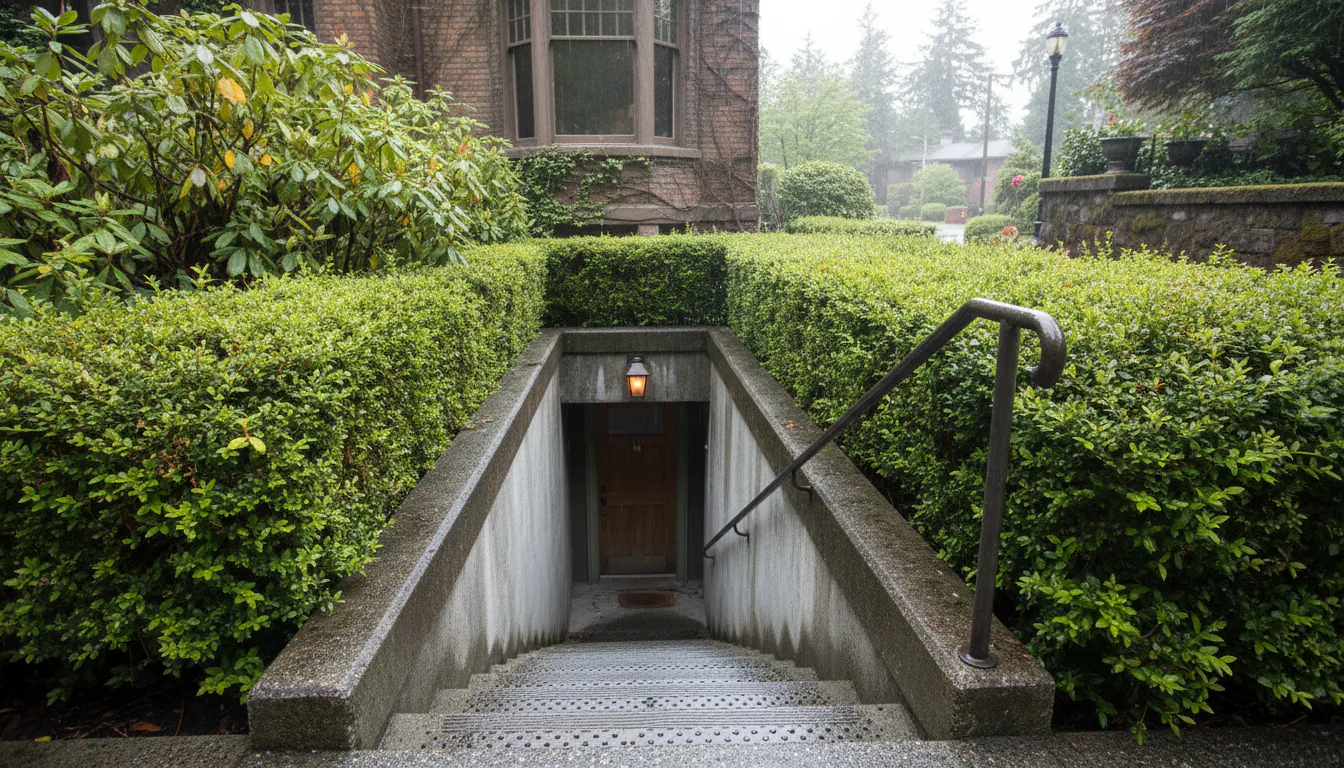
A basement entry stair below grade typically requires a guard at the top of the stair on the property side, where the user could fall into the stair well from the surrounding ground level. The guard height has to meet the BC Building Code 9.8 requirements, 900 mm minimum for guards on residential properties, with the opening rule applied throughout.
Many original basement entry stairs simply do not have a guard at the top. The original construction predates the current code, and the absence is one of the most common items flagged at inspection on a secondary suite permit. The fix is fabrication of a new guard, usually steel pickets or a panel infill on top of the existing stair retaining wall, that satisfies the height, opening, and continuity provisions.
We work the guard into the stair shop drawings as a single coordinated piece so the visible result reads as one fabrication rather than as a stair with a guard added later.
The handrail, continuity and graspability apply
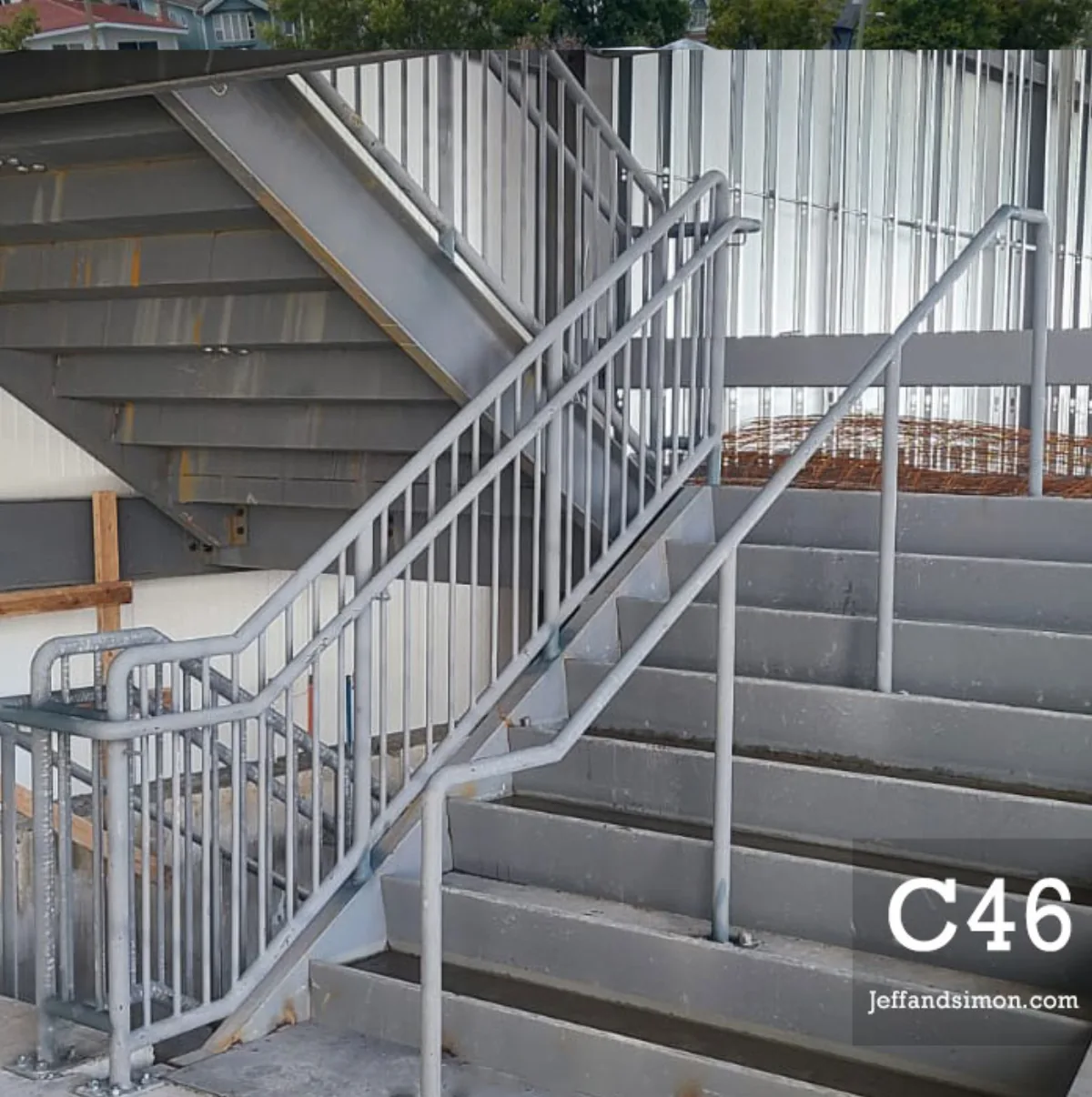
The handrail provisions of BC Building Code 9.8 apply to a basement entry stair as they do to any other stair in the home. The handrail has to be continuous over the run of the stair, has to be graspable, has to have returns at the top and bottom, and has to be at the prescribed height above the tread nosing.
The most common failures on basement entry stairs are missing returns and incorrect height. We address both at fabrication and confirm the heights at install. Our piece on handrail continuity under BC code covers the rule in detail.
Drainage at the base of the stair
A basement entry stair is below grade, which means rainwater and groundwater both can collect at the base. The drainage detail at the bottom of the stair is critical, both for the comfort of the suite occupant who has to use the stair every day, and for the building envelope of the basement wall the door sits in.
The right detail is a drainage well at the base of the stair connected to the building’s drainage system or to an external drain. Water that enters the stair from above drains down through the well and away from the building. The stair landing at the bottom is at an elevation slightly above the door threshold so the threshold is not a trip edge in service.
The waterproofing of the adjacent foundation wall has to be coordinated with the stair structure. A stair that anchors to the foundation wall has to penetrate the waterproofing, and the penetration has to be flashed and sealed so water cannot enter the building.
Material and finish, the basement entry environment
The basement entry stair is fully exterior and exposed to all the weather a Vancouver winter delivers. The finish system has to match the exposure.
We default to hot-dip galvanized carbon steel on the structural members and grade 316 stainless on any hardware or fittings that see direct salt exposure (less common on a basement entry stair than on a beachfront railing, but still relevant for some hardware). The galvanizing provides the corrosion protection and the topcoat (powder coat or industrial wet paint) provides the visible finish.
The tread material is typically a grating, perforated metal, or a steel pan with a drainage detail. Solid plate treads accumulate water and debris and freeze in winter, which is both a slip hazard and a structural concern. The grating tread allows water and debris to fall through to the drainage well below.
For broader context on related exterior finish work, see our pieces on the hot-dip galvanizing for exterior stairs and the exterior steel stairs coastal Vancouver finish piece.
The City of Vancouver permit pathway for a secondary suite
The City of Vancouver requires a building permit for adding or renovating a secondary suite, and the permit includes review of the stair geometry, the egress configuration, the fire separation between the suite and the primary dwelling, and the general life safety provisions.
Engineered drawings are typically required for the stair structural work if it involves modification to the foundation wall, excavation, or significant load changes. The permit consultant or the architect packages the drawings for submission, and the structural engineer stamps the relevant sheets.
The permit review timeline at the City of Vancouver varies by project complexity. We coordinate the fabrication timeline with the permit submission so the shop drawings are ready when the permit is issued.
The structural surprises in older homes
The most common structural surprises on basement entry stair renovations are:
- Inadequate foundation wall structure for the opening. Cutting a new opening in an existing concrete foundation wall for a basement door requires the wall to be evaluated for the load redistribution. A structural engineer often specifies an embedded steel lintel or a reinforced concrete header above the opening.
- Moisture issues at the existing wall. Many original basements were built without modern waterproofing, and cutting a new opening exposes the wall to inspection. Found waterproofing issues have to be resolved as part of the project, often by re-waterproofing the affected section from outside.
- Existing utilities at the stair location. Original homes often had drain tile, electrical conduit, or gas lines running through the area where the new stair will be. The contractor locates and reroutes these before the stair structure is built.
We work the stair shop drawings around these as they are discovered, and we flag them at the first site visit so the GC can plan the remediation in the broader renovation.
Timeline and budget
A typical Vancouver basement suite renovation including a new external entry stair runs three to six months from first design conversation to occupancy. The stair fabrication itself is a small fraction of the timeline, usually four to six weeks once shop drawings are approved.
The budget for the stair is similarly a small fraction of the total renovation budget. The suite itself, the kitchen and bathroom work, the fire separation, and the permit and inspection process together usually run substantially more than the stair. The stair is the smallest discrete element on the permit but one of the most visible to inspection.
Sources
- City of Vancouver, Secondary Suites and Laneway Houses
- BC Building Code Section 9.8, Stairs, Ramps, Landings, Handrails and Guards
- BC Building Code Part 9, Housing and Small Buildings
Related reading: the handrail continuity under BC code piece, the hot-dip galvanizing for exterior stairs piece, and the staircase replacement permit Vancouver piece.
Related questions
Does a basement suite need a separate entrance stair?
Most BC municipalities require a secondary suite to have a separate means of egress from the primary dwelling. In practice this often means an external basement entry stair leading from grade down to the suite door, separate from the main home entrance. The City of Vancouver and surrounding municipalities have specific secondary suite requirements that the architect and the homeowner confirm at the design stage.
What's the minimum width and headroom for a basement entry stair?
BC Building Code Section 9.8 sets the minimum stair geometry, and the secondary suite provisions impose specific requirements on egress stairs from suites. The minimums are published in the code text. We confirm the applicable dimensions with the architect or permit consultant at the design stage before fabrication.
How long does a basement suite renovation including the stair take?
A typical Vancouver basement suite renovation with a new external entry stair runs three to six months from first design conversation to occupancy, depending on the permit complexity and the structural work required. The stair fabrication itself is a small fraction of the timeline, usually four to six weeks once shop drawings are approved.