Hot-Dip Galvanizing for Exterior Stairs on the North Shore, When It's Worth It
Hot-dip galvanizing for North Shore exterior steel stairs: when it earns its premium in coastal Vancouver conditions, and when paint alone is enough.
Salt-laden air and high rainfall on the North Shore are unkind to painted exterior steel. Hot-dip galvanizing changes the math, but only on the steel that actually faces the weather.
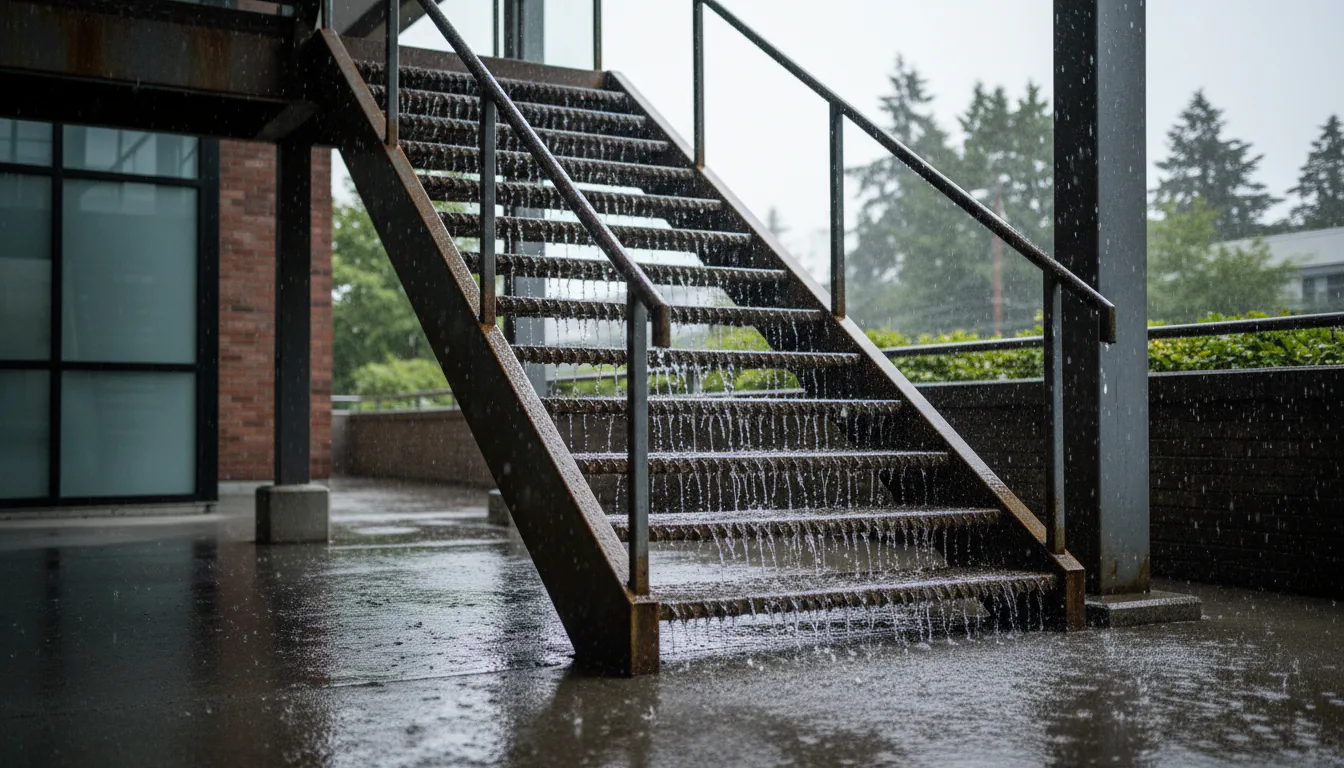
The North Shore is hard on exterior steel. The combination of high annual rainfall, salt-laden air drifting up from Burrard Inlet, and the long shoulder seasons of wet-and-cold sets a level of corrosion exposure that paint alone struggles to handle for two decades. Hot-dip galvanizing changes that math, but only for the parts of the project where the exposure is actually severe.
What hot-dip galvanizing does, structurally
Hot-dip galvanizing is not a coating in the way paint is a coating. The fabricated steel is dipped into molten zinc at approximately 450 °C, and the steel and the zinc react to form a series of zinc-iron alloy layers metallurgically bonded to the base steel, topped by a layer of free zinc. The resulting coating is harder than the steel underneath at the alloy interface, and it self-sacrifices to protect the steel through galvanic action, even at a scratch or a cut edge, the surrounding zinc corrodes preferentially and protects the exposed iron.
The process and its service-life prediction are documented by the American Galvanizers Association’s coating life chart and by their detailed guidance on hot-dip galvanizing in coastal environments. The technical reading is dense but the practical takeaway is short: in marine and coastal categories the zinc consumes itself faster than in dry interior categories, but even at the higher consumption rate, the predicted time to first maintenance on a properly galvanized stair runs into multiple decades.
The North Shore exposure category
ISO 9223 classifies atmospheric corrosivity in categories from C1 (dry interior) through CX (extreme marine, splash zone). The North Shore is broadly C3 to C4 by that classification, high humidity, moderate to significant chloride deposition, frequent wetting cycles. The ISO standard and its application to architectural coatings are summarized in resources like the AGA’s corrosion in coastal environments page and in coating manufacturers’ system selection guides such as Tnemec’s coastal protection systems.
The category matters because it sets the design coating system. A C2 interior dry environment can be served by a single-coat shop paint. A C3 to C4 coastal environment, which describes most exterior steel work facing the Burrard Inlet and Howe Sound, benefits from either hot-dip galvanizing or a heavy-build duplex system, and which one wins on cost over a 25-year horizon depends on the geometry of the project.
When galvanizing earns the premium
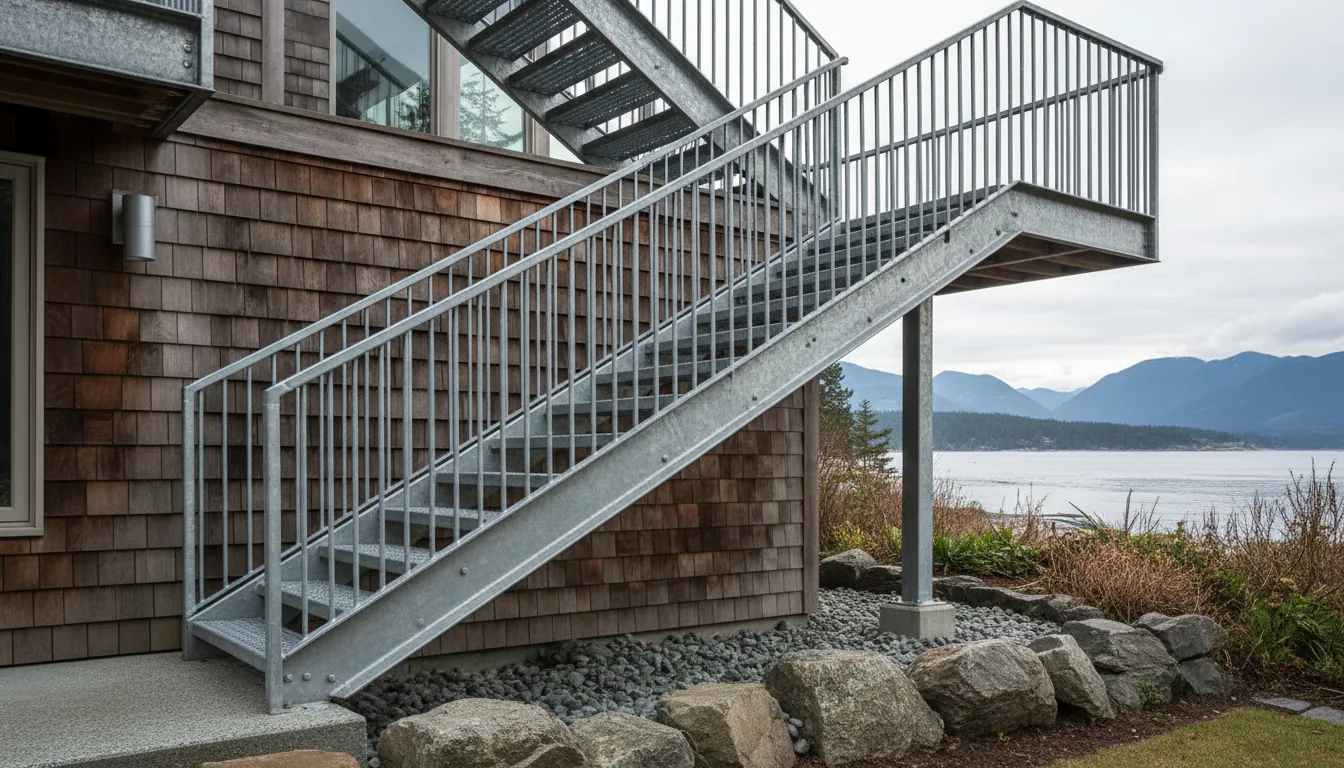
Galvanizing earns its premium on three kinds of project. The first is utility exterior stairs, fire escapes, service stairs, deck access stairs, where the finish matters less than service life and where touch-up access over time will be difficult. The second is multi-family and commercial exterior stairs where the property manager will not be repainting every five years and a 30-year low-maintenance finish has measurable lifecycle value. The third is any project where the homeowner explicitly wants to avoid the repaint cycle that a coastal-painted stair will eventually demand.
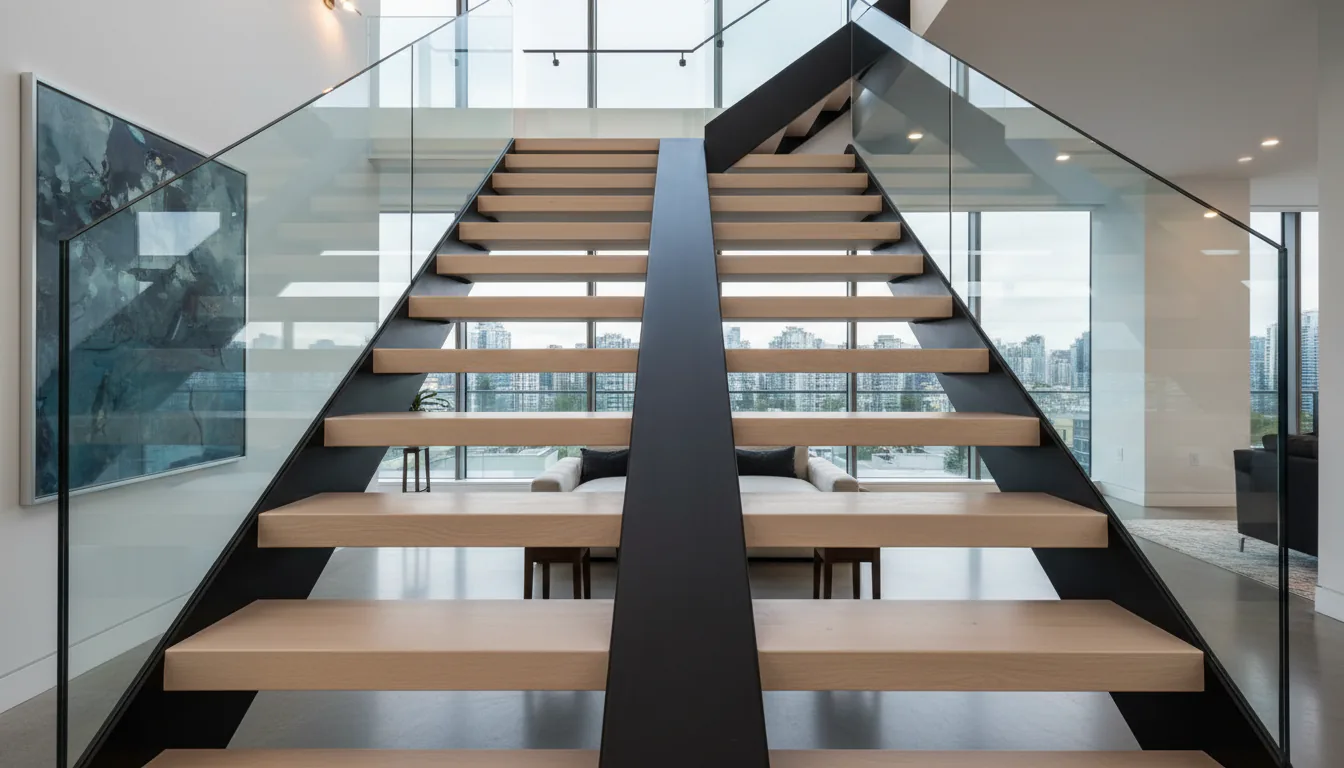
Where galvanizing is harder to justify is on small, low-exposure stairs in moderate locations, or on highly visible feature stairs where colour and finish texture matter more than service life. For a glass-railed entry stair on a downtown Vancouver project that is largely sheltered by the building above, a high-build duplex paint system can deliver excellent service for many years at a lower upfront cost than the galvanize-plus-paint combination.
Duplex systems: galvanize plus paint
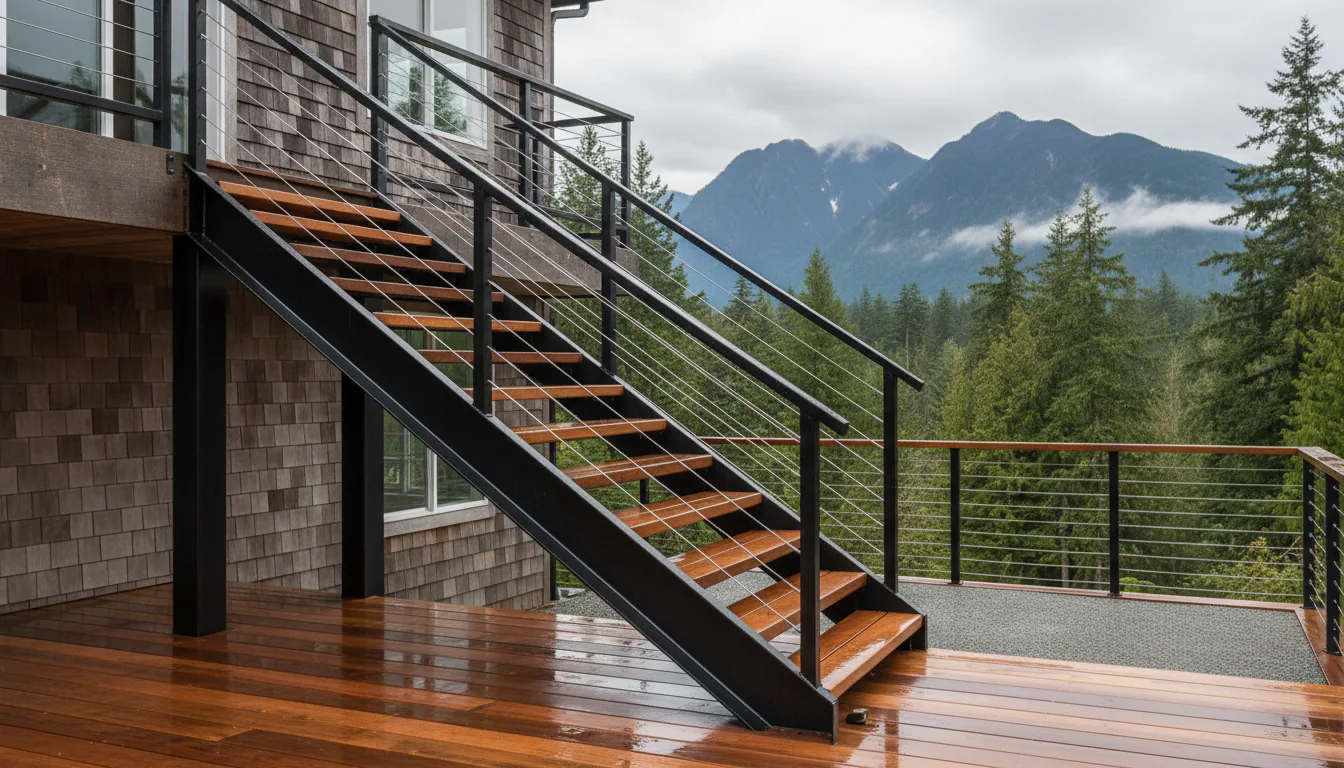
For visible feature stairs, the standard high-performance combination on the North Shore is a duplex system, hot-dip galvanizing followed by a paint or powder coat topcoat. The galvanize provides the corrosion protection, and the paint provides the colour, the finish, and an additional barrier that extends the life of the underlying zinc.
The combined service life of a duplex system is meaningfully longer than the sum of its parts. Both AGA and major coating suppliers, Sherwin-Williams’s duplex coating guidance is a representative reference, describe a synergy where the paint protects the zinc from atmospheric exposure and the zinc protects the steel if the paint fails. For a North Shore exterior stair, a duplex system with a polyurethane topcoat is the most resilient finish we routinely specify.
The preparation step between the galvanize and the paint is where duplex systems succeed or fail. A freshly galvanized surface has to be passivated and lightly sweep-blasted before paint will adhere reliably; coatings applied directly over uncleaned zinc are prone to peeling. The SSPC SP16 standard for surface preparation of non-ferrous metals is the typical specification for that prep step.
Scope the galvanizing to the exposed steel
The most common mistake we see on exterior stair budgets is galvanizing every piece of steel in the project, including the parts that will never face the weather. Galvanizing is priced by weight and by piece count, and including interior brackets, indoor stringers, and concealed steel adds cost for no service-life benefit.
Our standard approach is to scope galvanizing to the steel that will be wet, salty, or visible to the outside environment. The stringers, the treads if they are steel-pan, the guard posts, the railing components, and any exposed brackets all go through the galvanizer. The interior reinforcement, the embed plates inside the building envelope, and the connection hardware behind drywall stay raw or get a shop primer. The package boundary is drawn on the shop drawings before the steel goes to the galvanizer.
Galvanizing changes the fabrication sequence
Hot-dip galvanizing has implications for how the steel is fabricated. The molten zinc has to flow into and out of every cavity, so closed sections need vent and drain holes sized and located to satisfy the galvanizer’s specifications. The galvanize-and-deliver schedule adds a leg to the project timeline, typically a week or two between when the steel leaves the shop and when it arrives on site, depending on the galvanizer’s queue.
Welds made after galvanizing destroy the zinc layer locally, so design intent is to do all welding before the dip and use bolted connections for any field joints. When a site weld is unavoidable, the AGA’s touch-up guidance for damaged galvanized coatings sets out the standard zinc-rich paint or thermal-spray repair procedures.
What the homeowner sees on day one and year fifteen
A freshly galvanized stair has a distinctive bright, spangled zinc surface that dulls to a uniform matte grey over the first year or two. Some homeowners love the spangle and specify a galvanize-only finish to keep the look; many prefer the duplex system because the painted topcoat lets the stair match the building’s exterior colour palette.
The long-term reward of the galvanize decision shows up at year ten and beyond. A North Shore exterior stair finished with a single-coat shop paint will, in our experience, need a significant repaint cycle every five to eight years to stay ahead of rust. A duplex system can run twice that interval, and a bare galvanized utility stair can often go decades before any meaningful maintenance is needed. For the right project, and most exterior stairs on the North Shore are the right project, that maintenance differential is the reason the galvanizer’s invoice is worth paying.
Sources
- American Galvanizers Association, time to first maintenance
- AGA, hot-dip galvanizing in coastal environments
- Tnemec, coastal protective coatings systems
- Sherwin-Williams, specification services and duplex guidance
- SSPC, surface preparation standards
- AGA, touch-up and repair of galvanized coatings
This article is not a substitute for the recommendations of the coating manufacturer, the galvanizer, or the AHJ on any given project. Final finish specification should be confirmed with all three.
Related reading: the exterior steel stairs and coastal finishes guide, the North Shore exterior stair and deck guide, and the metal stair fabrication hub for the full fabrication and finishing process.
Related questions
What is hot-dip galvanizing?
Hot-dip galvanizing is a finishing process where fabricated steel is submerged in molten zinc at roughly 450 °C, forming a metallurgically bonded zinc layer on every surface. The zinc layer corrodes preferentially to the steel underneath, protecting the steel for decades in moderate exposures.
How long does hot-dip galvanizing last on a North Shore stair?
Service life depends on coating thickness and exposure category. The American Galvanizers Association publishes service-life charts that show 50+ years to first maintenance in many coastal categories, though the heavily marine, salt-spray-dominant edge of the North Shore can shorten that. Service life is also longer when the galvanized steel is also painted in a duplex system.
Is galvanizing alone enough, or does it need paint?
For utility stairs in moderately exposed locations, galvanizing alone is often the right answer, durable, low-maintenance, and visually consistent. For visible feature stairs where colour matters, a duplex system (galvanize plus paint or powder coat) is standard. The galvanize gives the corrosion protection; the paint gives the aesthetic and adds service life.
Can a galvanized stair be powder coated?
Yes, but the galvanized surface needs proper preparation, typically a sweep blast and a passivation step, before the powder coat will adhere properly. The coater needs to be familiar with the duplex process. We coordinate the galvanizer and the coater on every project where both are involved.