Powder Coat vs Wet Paint for Interior Steel Stairs in Vancouver
Powder coat or wet paint for an interior steel staircase in Vancouver? Cure, finish quality, repairability, and on-site reality compared by a working fabricator.
Both finishes can land on a beautiful black stair. The difference is what happens on the day of install, the day a tradesperson scratches a stringer, and the day a homeowner asks for a touch-up five years later.
Almost every black or charcoal interior steel staircase in Vancouver gets to its final colour through one of two paths: powder coating or wet paint. The two finishes look similar in a finished room, but the path to get there is different, and so is what happens when the stair gets scratched, modified, or aged.
What each finish is, structurally
Powder coat is a dry electrostatic finish. Charged thermoplastic or thermoset powder is sprayed onto a clean, primed steel substrate and then baked in an oven, typically at 180–200 °C, until it flows into a continuous film. The cured film is mechanically bonded to the steel and tough, many architectural powder coats meet the AAMA 2604 specification for organic coatings on architectural aluminum and steel, the same standard used on commercial curtain wall and storefront framing.
Wet paint is a liquid system applied with a sprayer, roller, or brush at ambient temperature. Modern industrial systems use a zinc-rich primer, an epoxy intermediate, and a polyurethane or polyaspartic topcoat. The Society for Protective Coatings publishes the SSPC surface-preparation standards that the prep step references, most reputable Vancouver finishers spec SP6 or SP10 blast cleaning before a high-build interior system, the same prep grade used on industrial steel.
A well-applied powder coat and a well-applied wet paint system can both look like a smooth matte black plane. What separates them is how they get to that plane and what happens after.
The size constraint is the first question
Powder coating happens inside an oven. The oven size in the coater’s shop sets the maximum assembly size that can be powder coated as one piece. Most commercial powder coating ovens in the Lower Mainland accommodate parts up to roughly 6 m long and 2.4 m tall, but the exact envelope varies, and a staircase fabricated as a single welded assembly often exceeds it.
Wet paint has no oven. A welded stair assembly the size of a small living room can be wet-painted on site or in the shop without size constraints. That is the single biggest reason wet paint stays in the conversation: for very large feature stairs, sculptural helical stairs, or single-piece commercial stringers, wet paint may be the only realistic option.
When we know a project will be powder coated, we break the stair into shop-welded sub-assemblies sized to fit the oven, with site connections at locations where a clean joint can be hidden behind a tread or a wall. The connection design becomes a finish decision, not just a structural one.
Finish quality and consistency
A powder coat finish, applied well, has a uniformity that wet paint does not match easily. The electrostatic process pulls powder evenly onto edges and corners that brush and spray techniques tend to miss, and the oven cure produces a continuous film with no brush marks, no orange peel from spray, and no lap lines. Texture options run from a high-gloss smooth finish to a heavy texture that hides minor surface imperfections in the underlying steel.
Wet paint quality lives or dies on the applicator. A premium polyurethane system applied by an experienced industrial painter can match a powder coat finish visually. The same system applied in a less controlled environment, dusty site, wrong temperature, hurried prep, looks noticeably softer and shows more brush marks or roller texture under raking light. For a homeowner spending serious money on a feature stair, that variability is the risk.
Repairability is wet paint’s quiet advantage
Where wet paint wins is repairability. A scratch on a wet-painted stair can be feathered, primed, and recoated with the same material that produced the original finish, and the repaired area will blend cleanly once cured. A scratch on a powder-coated stair has to be touched up with a different material, usually a colour-matched aerosol or brushable paint, and the repair will be visible under raking light even when the colour is dead on.
This matters because steel stairs get scratched. Movers drop a couch, a tradesperson on a different scope drags a tool across a stringer, a child rides a scooter into a guard post. The first scratch on a powder-coated stair is harder to make invisible than the first scratch on a high-quality wet-paint system. We keep a touch-up kit on the truck for every powder-coated job, but we are clear with homeowners about what the touch-up will and will not look like.
Cure, schedule, and trade coordination
Powder coat is dry-to-handle straight out of the oven. The stair goes from coater to install with no further cure time. Once installed, the finish is ready for traffic, trim, and adjacent finish work the same day.
Wet paint needs a controlled cure. A high-build polyurethane system needs hours to days to reach full hardness, and the SSPC paint application standards call out specific minimum re-coat and full-cure times that vary with humidity and temperature. On a real site, that cure window has to be protected from drywall dust, painter overspray, and trade traffic, or it gets contaminated. Powder coat skips that risk because the cure happens before the stair arrives.
On-site touch-up reality
Site-applied wet paint for the connection joints between powder-coated sub-assemblies is the standard solution and works well, but it has limits. The colour match is good. The sheen match is good if the touch-up product is the right one. The texture match is usually not perfect, powder coat has a consistent flow texture that brushable paint does not replicate. Under direct light at a low angle, a careful eye can see the difference.
We design feature stairs with that reality in mind. Touch-up joints get located where treads, walls, or trim cross the joint, not in the middle of a long visible stringer face. When a joint has to land in a visible location, we accept the visual seam as a design feature and detail it as a deliberate break in the steel.
When to choose which
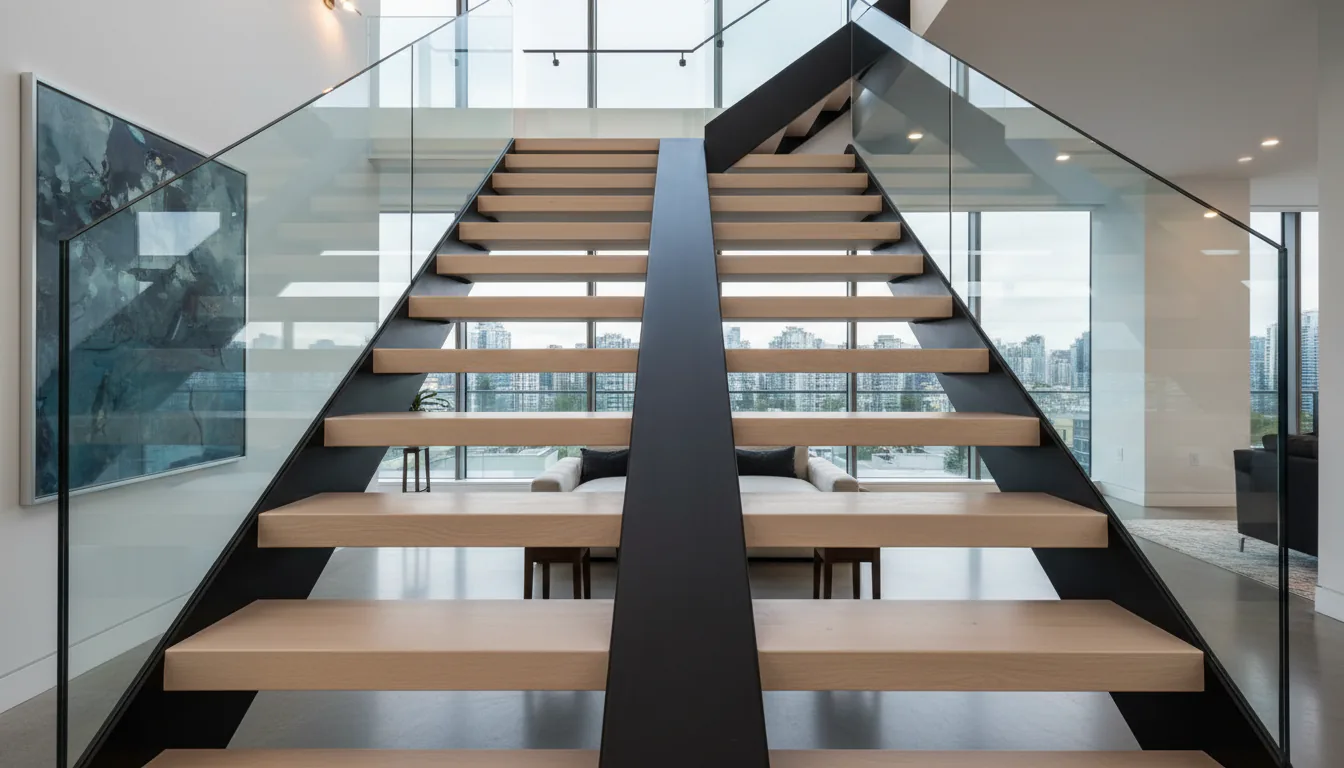
For most interior residential stairs in Vancouver, mono stringer, hidden double stringer, switchback with intermediate landings, we recommend powder coat. The finish quality is more consistent, the cure schedule is cleaner, and the assemblies break down naturally to fit a coater’s oven. Touch-up is a manageable trade-off.
For very large sculptural assemblies, helical stairs that have to be welded as one unit on site, and any feature stair where the homeowner expects to repair scratches invisibly over the life of the stair, we recommend a high-build wet paint system from a reputable industrial applicator. The finish is slightly less crisp but more forgiving long-term.
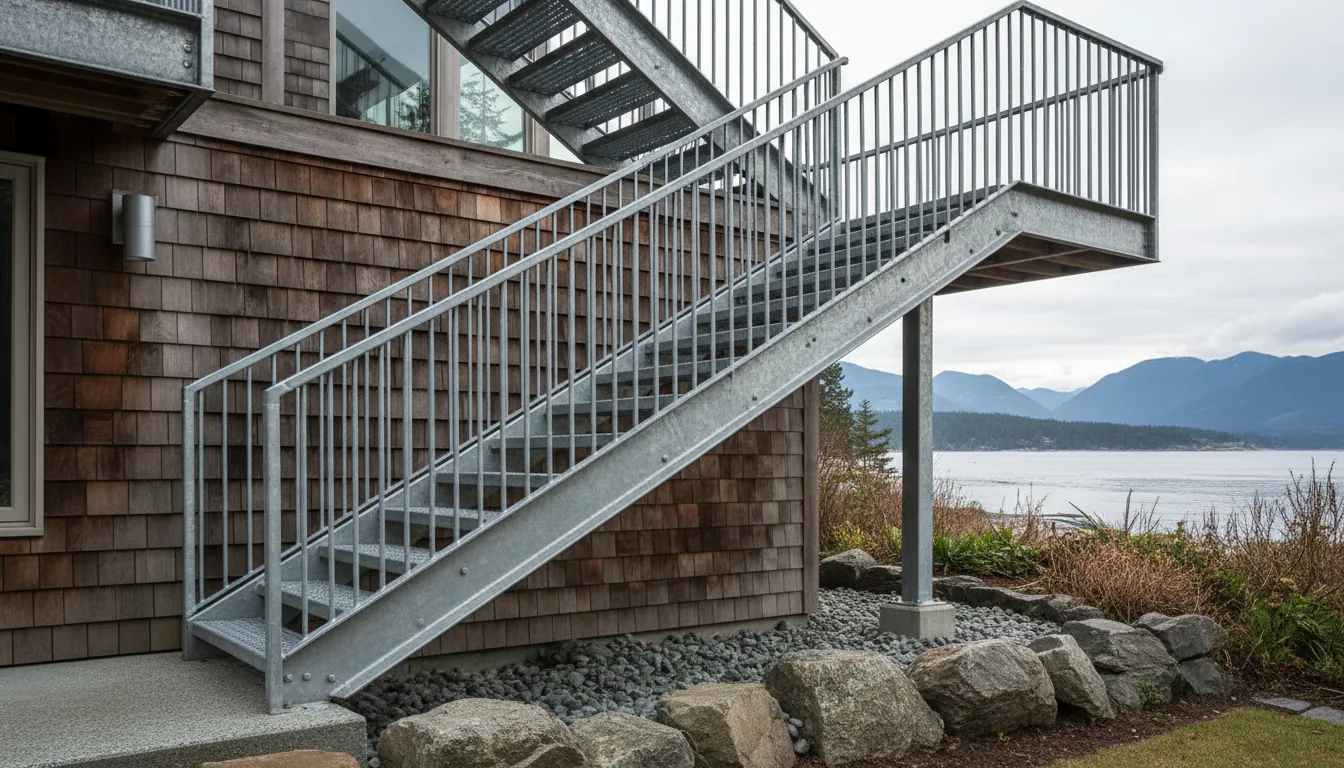
For exterior stairs, the conversation changes again, hot-dip galvanizing under either a powder coat or a duplex paint system handles coastal exposure differently than either finish alone, and our exterior steel stair coastal finish guide covers that decision in more detail.
For the broader range of finishes and support strategies, see our overview of custom steel staircases in Metro Vancouver.
Sources
- AAMA 2604, Voluntary specification for organic coatings
- SSPC surface preparation and paint application standards
Vancouver Stairs does not replace the recommendations of the specifying engineer, the coatings supplier, or the AHJ on any given project. Final finish specification should be confirmed with the coater and the design team.
Related questions
Is powder coat better than wet paint for an interior steel staircase?
Usually yes, on durability and finish quality, but only when the stair can be coated in pieces small enough to fit a powder coater's oven. For very large welded assemblies that ship to site as one unit, a high-build wet paint system is often the only practical option.
Can a powder coated stair be touched up on site?
Touch-up is possible with matched aerosol or brushable paint, but the touched-up area will not match the original powder coat finish exactly under raking light. We size the powder coat assemblies so welded site joints are minimal, and we keep colour-matched touch-up paint on each project.
How long does a powder coat finish last on an interior steel stair?
On a properly prepped and primed interior application, a powder coat finish should outlast the surrounding interior finishes, interior abrasion, not UV or weather, is the dominant wear. Heavy traffic stairs in commercial settings benefit from a tougher topcoat chemistry; the powder coater can specify.
What does powder coating add to the cost of a custom stair?
In our shop, powder coat usually runs as a line item rather than a percentage. It depends on the assembly count, the colour, and the prep specified. Wet paint can be cheaper on a one-piece welded stair simply because there is no oven or transportation cost.