Stainless Steel Railing in Vancouver: 304 vs 316 and When to Upgrade
304 and 316 stainless steel railings look identical but behave differently near saltwater. Here is how to choose the right grade for your Metro Vancouver property.
Both grades look the same when new. The difference shows up a few years later on anything within reach of marine air.
Stainless steel cable railings and stainless post systems are common in Metro Vancouver, on decks, stairs, balconies, and rooftop terraces. Most buyers specify stainless because it is low-maintenance and looks clean. What many do not know going in is that “stainless” covers two meaningfully different grades, and choosing the wrong one for a coastal or waterfront site can mean visible rust within three to five years.
This article is not a substitute for code review by the authority having jurisdiction, an architect, or an engineer. It covers the grade decision, what the difference is, which properties need which grade, and what questions to ask before the stainless is specified.
304 and 316 are both stainless but work differently near salt
Both 304 and 316 are austenitic stainless steels. They share a chromium-nickel base that gives stainless its defining property: when the surface is exposed to oxygen, it forms a passive chromium oxide layer that continuously re-forms if scratched. That is what makes stainless steel “stainless”, not a coating but a surface chemistry.
The difference is that 316 contains molybdenum, an alloying element absent in 304. Molybdenum significantly improves resistance to pitting corrosion, the type of localized attack that chloride ions (salt) trigger when they penetrate the passive layer. In a salt-laden environment, 304 stainless can develop visible pitting and “tea staining” over time. The same environment leaves 316 largely unaffected because the molybdenum stabilizes the passive layer against chloride attack.
The shorthand: 304 handles rain. 316 handles rain plus salt.
Vancouver’s climate creates distinct coastal zones
Metro Vancouver is a wet, mild coastal environment, but not all sites have the same exposure to salt. The distinction matters because the coastal zone, where 316 is worth specifying, is a subset of the Metro area, not the whole region.
Tidal and near-waterfront sites, properties on Burrard Inlet, English Bay, False Creek, the Fraser River estuary, Howe Sound, and the Squamish Estuary waterfront, are in the clearest 316 territory. Spray, mist, and prevailing onshore winds deposit chlorides on exposed surfaces. Anything stainless within reach of that air should be specified in 316. Cable fittings, tensioners, and post hardware are especially at risk because crevices at fittings concentrate salt.
West Vancouver waterfront and the North Shore coast sit in the same zone. The combination of marine air off English Bay and Howe Sound, frequently wet weather, and limited drying time on sheltered faces makes this a demanding environment for 304.
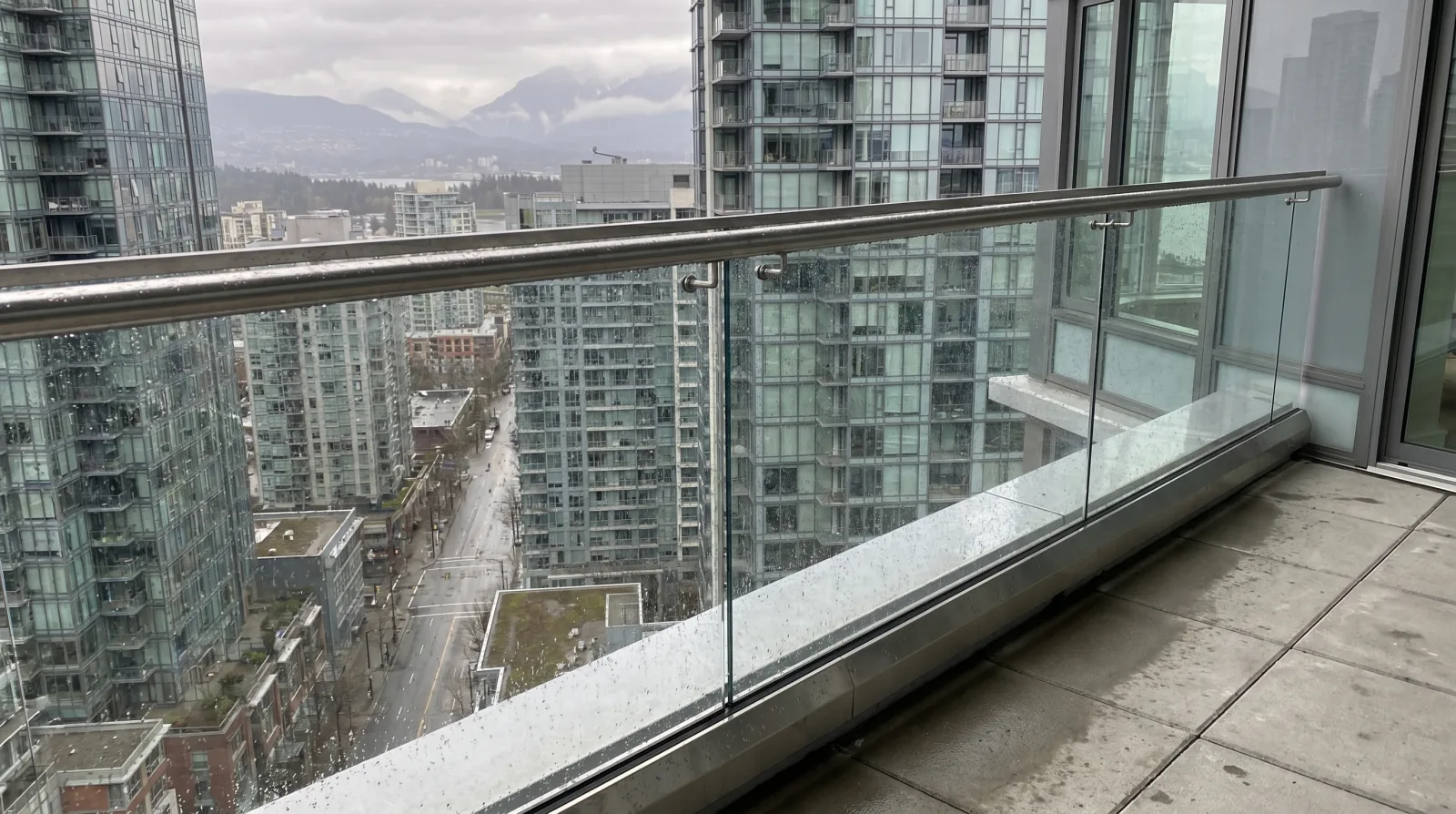
Coal Harbour, False Creek marina-adjacent, and Yaletown waterfront condos, balcony and rooftop railings on these buildings face marine air year-round. Property managers specifying replacement cable or handrail systems for these locations should default to 316 for exposed components.
Inland Metro locations, Burnaby, Coquitlam, Port Moody (except waterfront), Surrey, Langley, Maple Ridge, Richmond away from the river mouth, see wet weather but relatively low chloride exposure. 304 stainless performs reliably in these environments for exterior stairs, deck guards, and interior applications.
North Shore elevation properties present a nuance: the salt exposure is lower than the waterfront, but snow and road salt applied to driveways and paths can splash onto exterior railings over winter. For any railing near a salted surface, a front entry stair alongside a salted walkway, a deck over a garage where road salt is tracked, the case for 316 hardware at least is stronger.
The components that matter most
A cable railing system has multiple components, and not all of them see the same exposure. It helps to think through grade selection component by component.
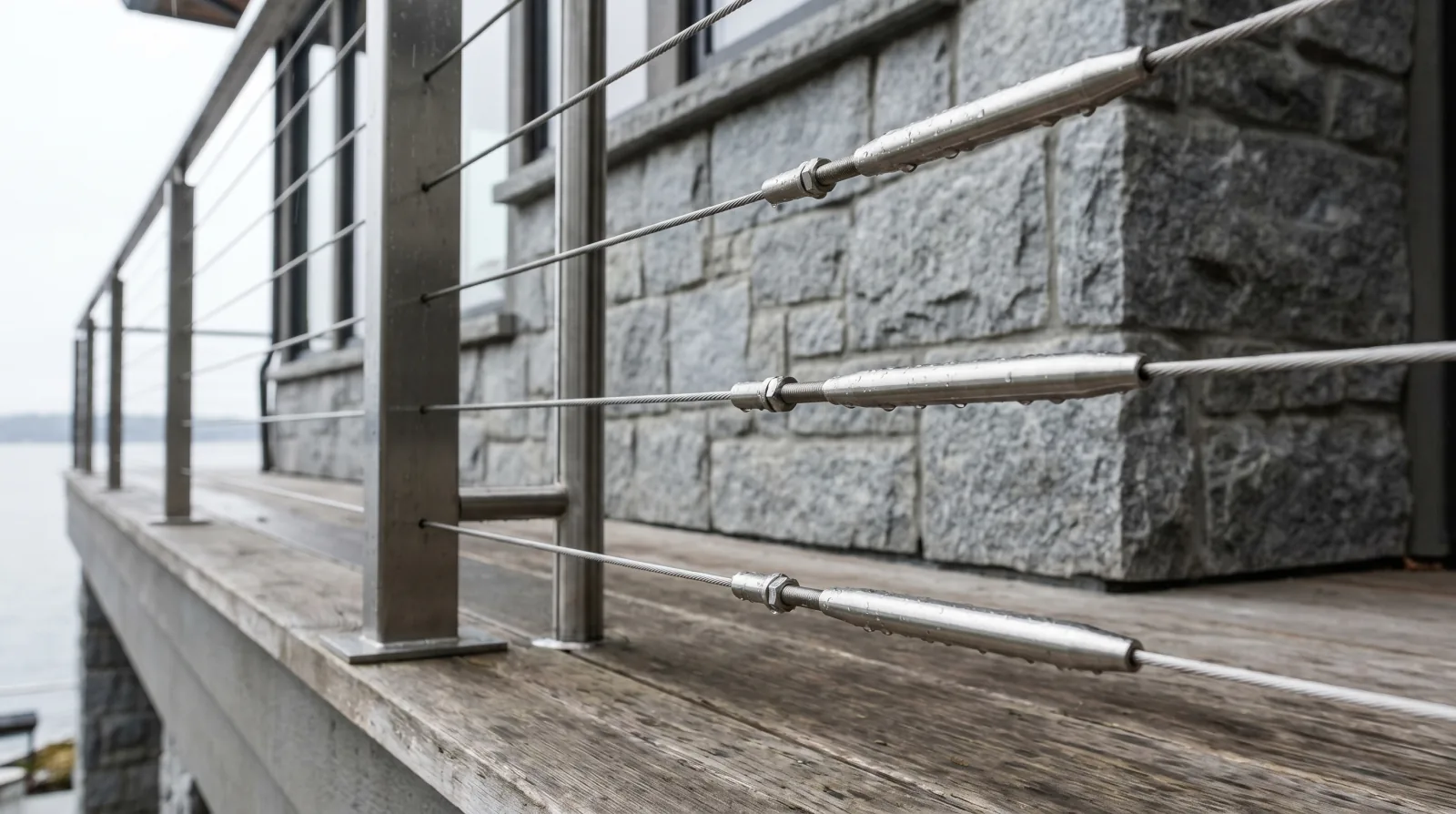
Cables are the most exposed element, continuous outdoor exposure, no shelter, difficult to inspect for internal corrosion. Most cable railing manufacturers specify 1×19 or 7×7 316 stainless cable as their standard for exterior applications. 304 cable is available and sometimes offered at lower cost, but for any exposed coastal application, 316 cable is the defensible spec.
Swage fittings and tensioners are where crevice corrosion is most likely to initiate, because salt and moisture concentrate in the small gaps between the fitting and cable. For coastal sites, 316 fittings are not optional, they are where the grade decision pays off most directly.
Posts and top rails are larger sections with fewer crevices and better self-draining geometry. 304 tube posts in an inland location will perform acceptably. For waterfront, the continuity argument, specifying 316 throughout so there is no weak link, outweighs the incremental cost saving of mixing grades.
Hardware and fasteners, base plate anchor bolts, set screws, surface-mount fittings, are often the last specification detail confirmed, and sometimes not confirmed at all before install. A 316 cable assembly on 304 post hardware in a marine environment will show rust at the hardware before anywhere else. Get confirmation from the fabricator that the hardware grade matches the rest of the system.
When to ask for 316
The decision tree for most Metro Vancouver residential and light commercial projects is relatively simple.
Waterfront, marina-adjacent, or within consistent range of onshore marine air: specify 316 for cables, all fittings, and hardware. 304 for posts and top rail at minimum adds a weak link unless 316 throughout is achievable at reasonable cost.
Inland Metro, Burnaby, Coquitlam, Surrey, Langley, inland Richmond, Port Moody away from the inlet: 304 performs adequately for exterior applications. A well-fabricated and passivated 304 assembly on a covered deck or sheltered balcony in these areas should provide a long service life without the grade premium.
Elevated North Shore sites, West Vancouver above the waterfront, Squamish: look at the specific microclimate. A sheltered rear deck in West Vancouver that never faces the wind off the Sound is a different environment than an open front balcony on a property 200 metres from the inlet.
When in doubt, the cost difference is a reasonable insurance premium. The incremental cost of upgrading to 316 for fittings and hardware is a fraction of the labour and railing cost, and a small fraction of the cost of replacing prematurely corroded hardware.
Cost premium and specification clarity
The grade premium is real but not enormous for the hardware and cable components where it matters most. Where it becomes significant is in large tube post and top rail runs, because the material quantity is much higher and the cost scales with weight.
For most residential cable railing projects, the practical approach is: specify 316 cable, fittings, and hardware throughout, and get a current quote showing the grade breakdown for each line item. Ask the fabricator to confirm in writing which grade they are supplying for each component. This prevents the common situation where “stainless steel railing” is quoted in 304 on the basis that it is stainless.
Price 316 at current market rates, molybdenum and nickel both have significant commodity price variation. A quote from two years ago is not a reliable guide to current pricing.
Passivation and installation matter too
Grade selection is necessary but not sufficient. Two installation practices affect performance regardless of grade.
Passivation after fabrication. Welding, grinding, and cutting create heat-affected zones and contaminate the passive layer. A proper passivation process, acid treatment to restore the chromium oxide layer, should follow all fabrication on stainless components destined for outdoor coastal use. Ask whether the fabricator passivates stainless railings as part of their standard process.
Isolation from mild steel. During installation, contact between stainless and mild steel, tools, temporary fixings, adjacent mild steel structure, can embed iron particles that rust on the stainless surface. This is a cosmetic issue more than structural, but it is a common complaint with new stainless railings showing surface rust that has nothing to do with the grade. Good installation practice avoids this.
For projects that include both mild steel (powder-coated stair stringer) and stainless railing (cable guard), the install sequence and isolation details are worth confirming with the fabricator before the job starts.
The right spec starts before the quote
The grade question should be part of the initial scope conversation, not a substitution that happens after the quote. A well-written railing specification identifies the grade for cables, fittings, hardware, posts, and top rail separately. If the quote says “stainless steel cable railing” without specifying grade, ask for clarification.
For waterfront properties in Horseshoe Bay, Coal Harbour, False Creek, or West Vancouver, bring the 316 requirement into the scope before pricing starts. It avoids the cost of a value-engineering conversation after the quote is in, and it ensures the system is built to the right standard from the first component.
For inland properties, confirm the site exposure with the fabricator and make an informed decision, upgrading to 316 throughout is a defensible choice even where it is not strictly required.
The strongest projects resolve the material specification, including stainless grade, before shop drawings are issued. A grade decision made at that stage is clean. A grade substitution made after fabrication starts is disruptive and sometimes impossible to reverse.
Vancouver Stairs fabricates and installs cable railings, glass guards, and stainless stair systems across Metro Vancouver. For a site-specific discussion, include the property address, approximate linear footage, and whether the site is coastal or inland when reaching out for a quote.
Related reading: the cable railing specification guide for Vancouver decks and stairs, the steel staircase hub for full stair types and finish options, and the custom metal fabrication hub for CWB-certified welding and materials guidance.
Related questions
What is the difference between 304 and 316 stainless steel?
316 contains molybdenum, an alloying element that is not present in 304. Molybdenum improves resistance to pitting and crevice corrosion in chloride-rich environments, specifically salt water and marine air. Both grades contain chromium and nickel, which give stainless its general corrosion resistance.
Is 304 stainless steel good enough for exterior railings in Vancouver?
For most inland Metro Vancouver locations, Burnaby, Coquitlam, Surrey, Langley, inland Richmond, 304 stainless performs reliably outdoors. The coastal climate is wet but not inherently corrosive for 304 unless the site is close to tidal water or exposed to salt air regularly.
How close to the ocean does a property need to be before 316 is required?
There is no fixed code distance. The professional guidance from manufacturers and corrosion engineers is generally 500 metres from tidal water as a threshold, but site-specific factors, prevailing wind, spray exposure, whether the railing is sheltered or fully exposed, matter more than distance alone. Confirm with the fabricator and, if in doubt, with a corrosion consultant.
Does 316 stainless steel rust?
316 is highly resistant to rust in standard coastal conditions but is not immune. Contamination from welding scale, iron particles embedded during installation, or contact with mild steel fasteners can cause surface rust even on 316. Proper passivation after fabrication and regular cleaning matter regardless of grade.
What does stainless cable railing hardware typically come in, 304 or 316?
Most cable railing hardware sold in Canada defaults to 316 stainless for the cables, swage fittings, and tensioners because these are the components most exposed to moisture and most difficult to replace. Posts and top rails are sometimes offered in either grade, confirm with the supplier which grade is specified for each component.
Can 304 and 316 stainless components be mixed in the same railing?
Yes, but mixing grades can create galvanic coupling risks if the environment is aggressive. For a coastal install, it is cleaner to specify 316 throughout rather than mix grades and rely on isolation. For an inland install, mixing is less of a concern.
How much more does 316 cost than 304?
The premium depends on form, tube, plate, cable, sheet, fittings, and market conditions. Molybdenum and higher nickel content both add cost. The premium is real but the magnitude varies; get a current quote from the fabricator that specifies the grade for each component.
Will my railing need a building permit?
New railing installations and guard replacements on exterior decks and stairs typically require a building permit in Metro Vancouver municipalities. The permit confirms guard height, structural attachment, and load compliance with the BC Building Code. Confirm with the municipal building department before work starts. This article is not a substitute for code review by the authority having jurisdiction.
Does grade choice affect the BC Building Code compliance?
No. The BC Building Code specifies structural and dimensional requirements for guards, height, loading, opening limits, not the grade of stainless steel used. Grade selection is a durability and maintenance decision, not a code compliance decision.
What maintenance does stainless railing need in a coastal area?
Regular washing with fresh water and a mild soap removes salt deposits before they concentrate and pit the surface. In practice, the rain in Metro Vancouver does some of this passively, but sheltered sections under soffits or covered decks need active cleaning. For 316 cable hardware, wipe the fittings annually with a stainless-compatible cleaner.