Steel Stair Connection Details: Anchors, Embeds, and Base Plates in Vancouver Builds
How custom steel stairs connect to slabs, framing, and walls in Vancouver, anchors, embeds, base plates, and the field measurements that decide them.
The connection is where a steel staircase succeeds or argues with the rest of the building. Anchors, embeds, and base plates carry the load, the geometry, and the schedule.
A steel staircase reads as one object on a drawing and as a stack of connections in the shop. The brackets, anchors, embeds, and base plates that tie the stair into the slab, the framing, and the wall do most of the structural work and almost all of the coordination work. They are also the part of the stair that GCs and homeowners look at last, which is usually too late.
The connection decides the schedule, not just the load
Stair drawings tend to centre the stringers and the treads, but the connection details are what gate the schedule. Cast-in embed plates have to be set before the slab is poured. Post-installed anchors need a finished slab and a clear edge distance. Wall-anchored details depend on whether the wall is framed yet, drywalled, or already finished.
In our shop we lock the connection strategy before we cut steel, because changing it after fabrication usually means re-cutting the stringer or fabricating a new base plate. The same lock is what lets a residential install land in one day instead of two, the install crew arrives with the right anchors, the right embeds, and a connection drawing that matches what the framers actually built.
Base plates on a concrete slab
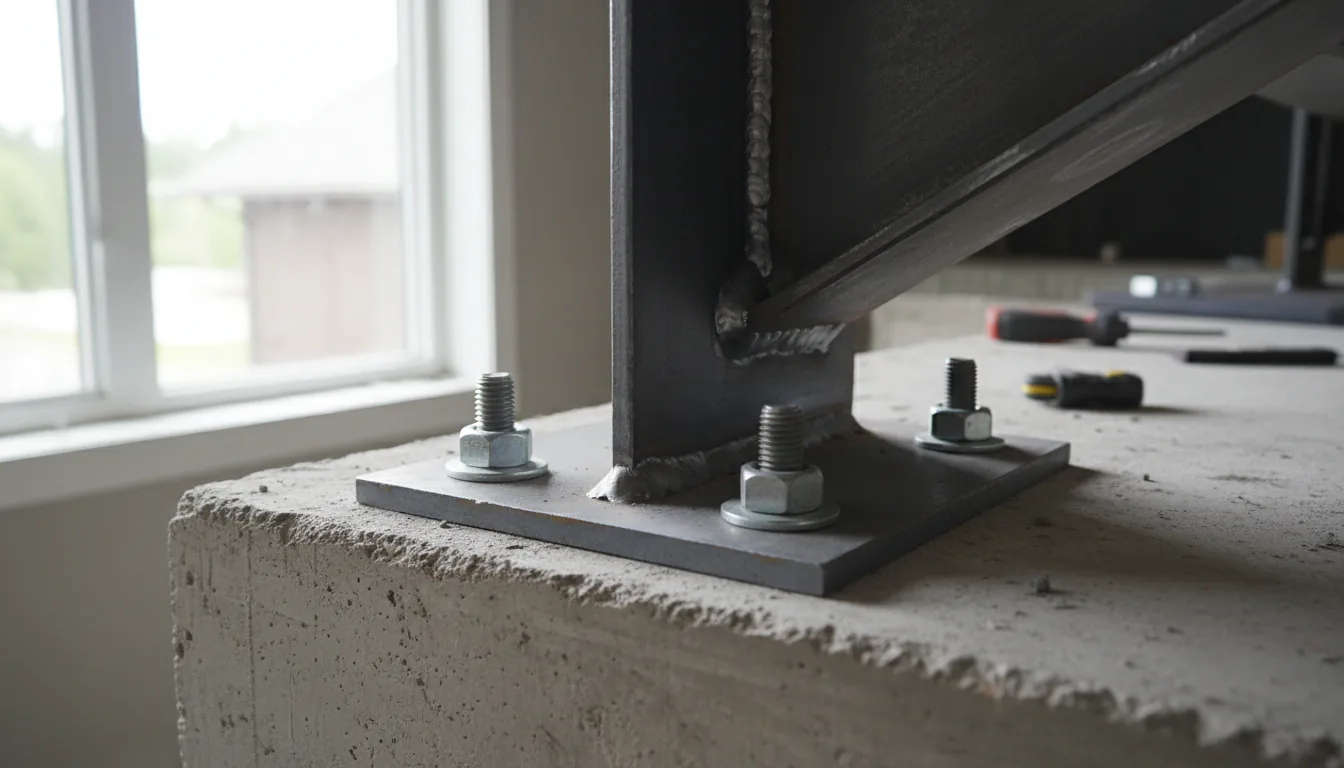
The most common residential connection is a steel base plate welded to the bottom of the stringer and bolted to the slab. The plate spreads the point load from the stringer across the concrete and gives the anchors enough edge distance to develop their full capacity. Plate thickness, bolt count, and bolt diameter all come out of the stair engineering, not a default, a 12 mm plate with four anchors works for many residential mono stringer landings, but a tall guard or a heavy commercial stringer can push the plate to 19 mm or thicker with six or eight anchors.
Post-installed anchor selection is a real decision. Mechanical expansion anchors are quick and good for moderate loads in cured concrete. Adhesive (epoxy) anchors carry higher loads and tolerate closer edge distances, but they require a clean hole, the right temperature window, and a cure time before the stair can be loaded. For exterior or wet locations, Hilti’s guidance on corrosion resistance of post-installed anchors is a useful starting point for choosing between zinc-plated, hot-dip galvanized, and stainless anchors. The wrong finish on an exterior anchor will rust visibly within a few seasons.
Anchor capacity is governed by edge distance, spacing, and concrete strength. The ACI 318 anchorage to concrete provisions are the standard reference for engineered anchor design in North American practice and are the basis most BC engineers work from. A connection that looks fine on a drawing can still fail capacity if the slab edge is too close, the slab is too thin, or the concrete strength is lower than assumed.
Cast-in embed plates
For commercial work and any time a steel stair is sized for repeat loading, cast-in embed plates are the cleaner solution. The embed is a steel plate, typically with shear-stud or rebar legs welded to its back face, that gets set in the formwork before the pour. The plate sits flush with the finished slab surface, and the stair is welded or bolted to the exposed face.
The advantages are real. The connection capacity is set by the embed engineering, not by what a drilled hole happens to find. There is no anchor edge-distance penalty, no drilling dust in a finished space, and no risk of hitting rebar mid-install. The trade-off is coordination: the embed location, orientation, and elevation have to be set before concrete and held tightly during the pour. A 15 mm shift in any direction at the embed stage can cost a day of corrective shop work later.
For Vancouver commercial projects we usually issue embed drawings as a separate package, ahead of the main stair drawings, so the structural sub can place them confidently before the slab is poured. The embed package is short, a plan view, a section, a finish note, but it has to be right.
Wall-anchored details for cantilevered and floating stairs
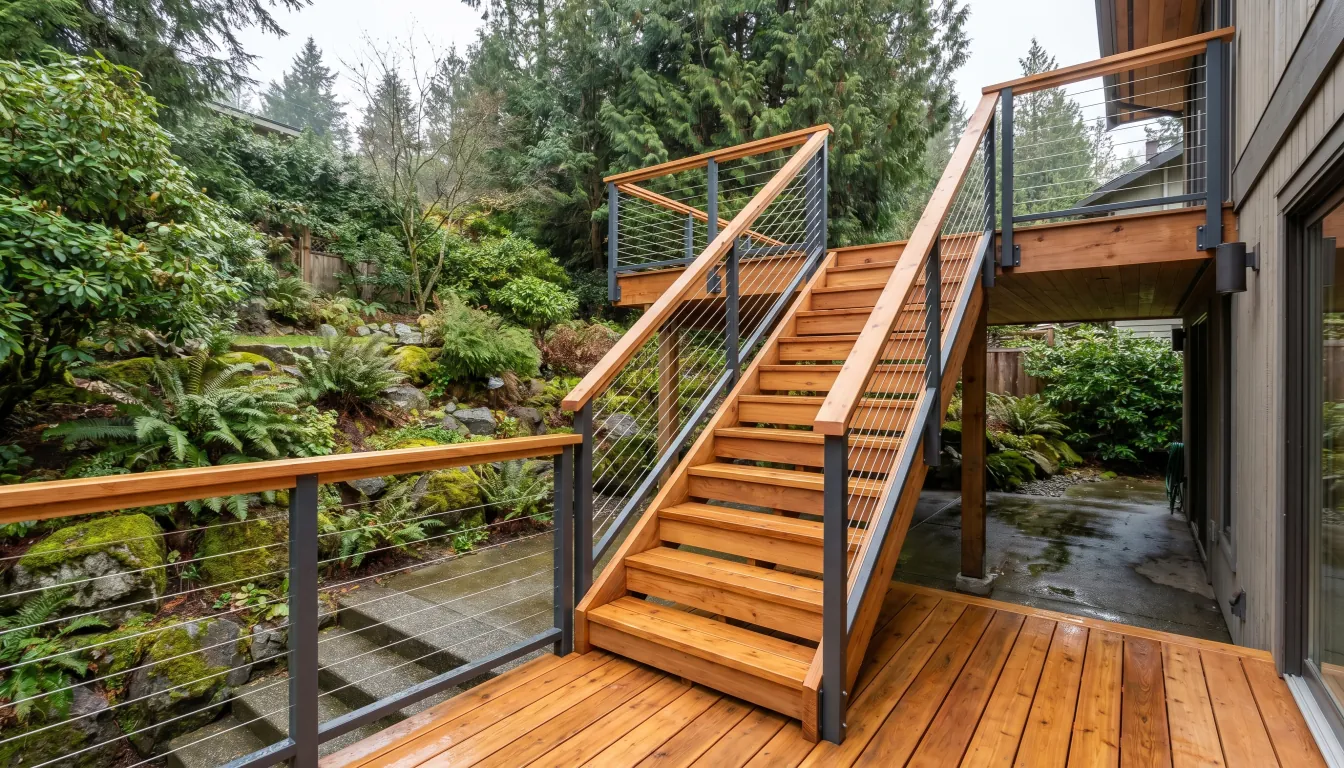
Cantilevered stairs and many wall-anchored floating stairs transfer their tread loads into the wall framing rather than into a slab. The connection becomes a series of steel brackets, sleeves, or threaded studs anchored into a reinforced wall, with the tread carried by a hidden steel arm.
The framing behind that wall is the connection. A standard 2x6 stud wall does not, on its own, carry a cantilevered tread, it usually needs additional steel studs, a steel-plate backer, or a full structural-steel post-and-beam build inside the wall. The reinforcement detail comes out of the stair engineering and has to be coordinated with the framer before drywall closes the wall. We frequently send a framing pack with the cantilevered stair drawings showing exactly where the reinforcement sits relative to the finished tread elevations.
Once the wall is closed, the connection is also closed. Changing a cantilever anchor after drywall is expensive in the best case and impossible in the worst. The same applies to wall-anchored cable railing posts in a glass partition, the backing has to be there before the finish goes on.
Guard anchors carry the loaded post, not just the post
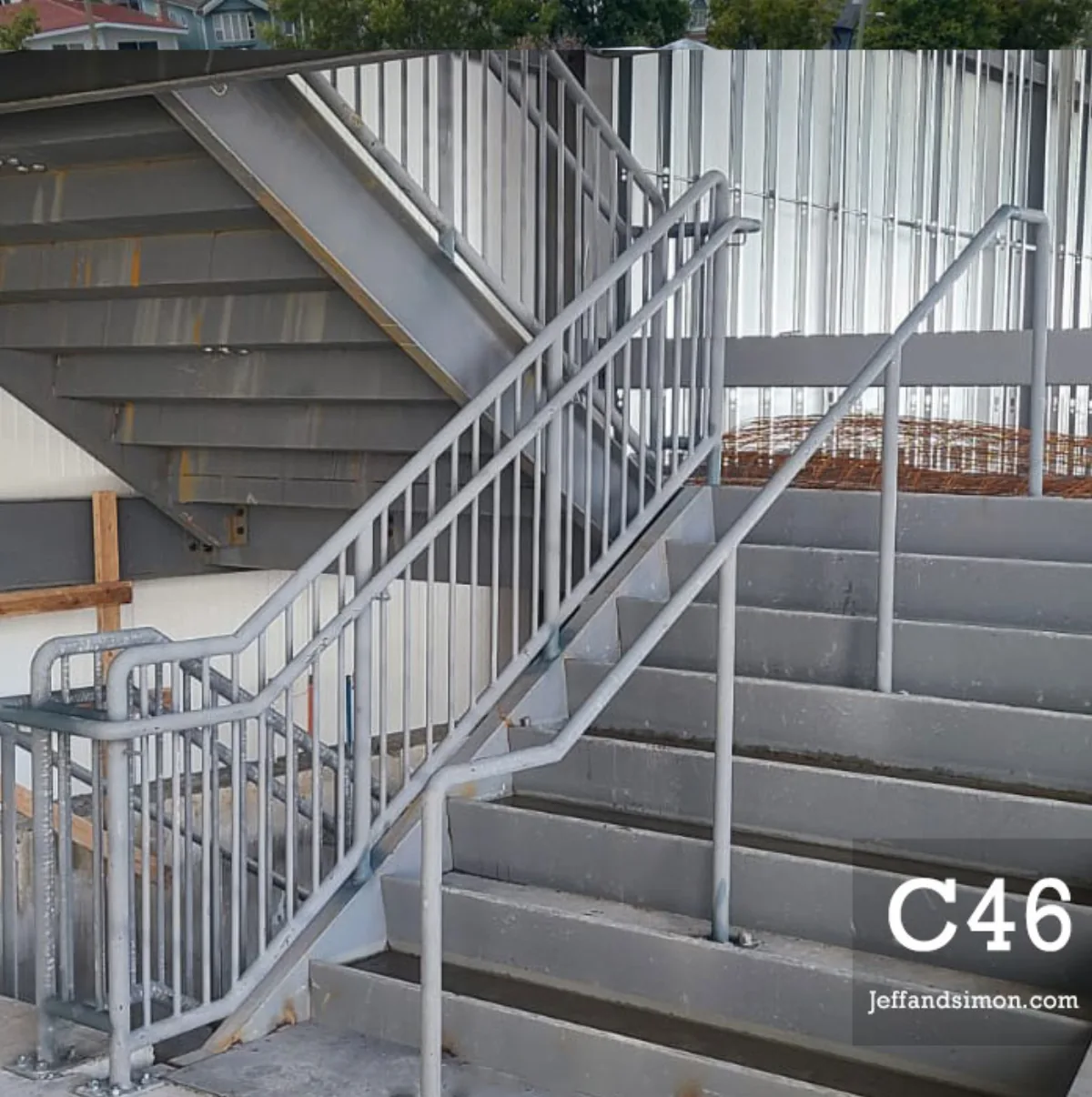
A stair guard or railing is a separate connection problem from the stringer. Each guard post sees a concentrated load at the top, code-driven, applied horizontally, and the connection at the base of the post has to develop that load into the stair or the surrounding structure. The numbers come from the BC Building Code Part 9 guard provisions for residential work and the relevant Part 3 references for assembly and commercial occupancies. For an exact loading number on any given project, the engineer of record sets the value and Vancouver Stairs does not replace AHJ review.
For posts surface-mounted to a wood or steel stair, the base plate and bolt count are sized to that horizontal load. For posts fascia-mounted to a stringer, the connection geometry adds a moment arm that drives the bolts harder than people assume. For posts core-drilled into concrete, the embedment depth and the grout pocket are the structural detail; the Feeney CableRail installation guidance is a good representative of the level of detail residential guard manufacturers publish for their own post anchors. Manufacturer guidance is the floor for design, not the ceiling, engineered projects often go beyond it.
Coordination beats clever detailing
The single biggest cost driver we see on stair connection details is not the bracket or the anchor itself, but late coordination. A slab edge that came in 40 mm shy of the drawing. A floor finish change that moved the slab elevation by 25 mm. A framing wall that landed in a different plane than the architectural drawing. Each one means a redesigned base plate or a new embed pack.
The strongest projects we work on lock connections at the same time as the stringer geometry. Site dimensions are confirmed by a tape measure, not a CAD model. Embed elevations are set by survey before the pour. Wall reinforcement is signed off by the framer before drywall arrives. When that sequence holds, the install is fast and the finish work is clean, which is what the homeowner and the GC notice, even if they never see the anchor schedule that made it possible.
Sources
- Hilti, anchor selection and corrosion guidance
- ACI 318, anchorage to concrete
- BC Building Code (BC Codes portal)
- Feeney CableRail installation guidance
This article is not a substitute for code review by the authority having jurisdiction. Anchor selection, embed design, and guard-post connections should be confirmed by the structural engineer of record on your project.
Related reading: the metal stair fabrication hub for the full design-to-install process, the permit and engineering process guide for BC Building Code coordination, and the steel staircases hub for stringer types and connection strategies.
Related questions
How does a steel staircase connect to a concrete slab?
Most residential steel stairs land on a base plate that is bolted to the slab with post-installed anchors, typically expansion or adhesive anchors sized to the manufacturer's published capacity and edge distances. Commercial work more often uses cast-in embed plates set during the slab pour.
What is a cast-in embed plate?
An embed plate is a steel plate with welded rebar legs set into the concrete before the pour. Once the slab cures, the steel stair is welded or bolted directly to the exposed face of the plate. Embeds give a stronger connection than post-installed anchors and remove drilling work from the install.
Do steel stair anchors need a structural engineer?
For most multi-storey commercial stairs, yes, the connection capacity and the resulting bolt or weld sizing are part of the stamped stair package. Single-storey residential stairs often rely on prescriptive anchor schedules from the manufacturer, but a P.Eng review is required whenever a guard carries an engineered load or the structure is unusual. Vancouver Stairs does not replace AHJ review.
How early in the build should connection details be locked?
Before the slab pour if embeds are involved, and before steel fabrication starts in every other case. Connection geometry changes the stringer length and the brackets, so a late change cascades through the entire stair package.