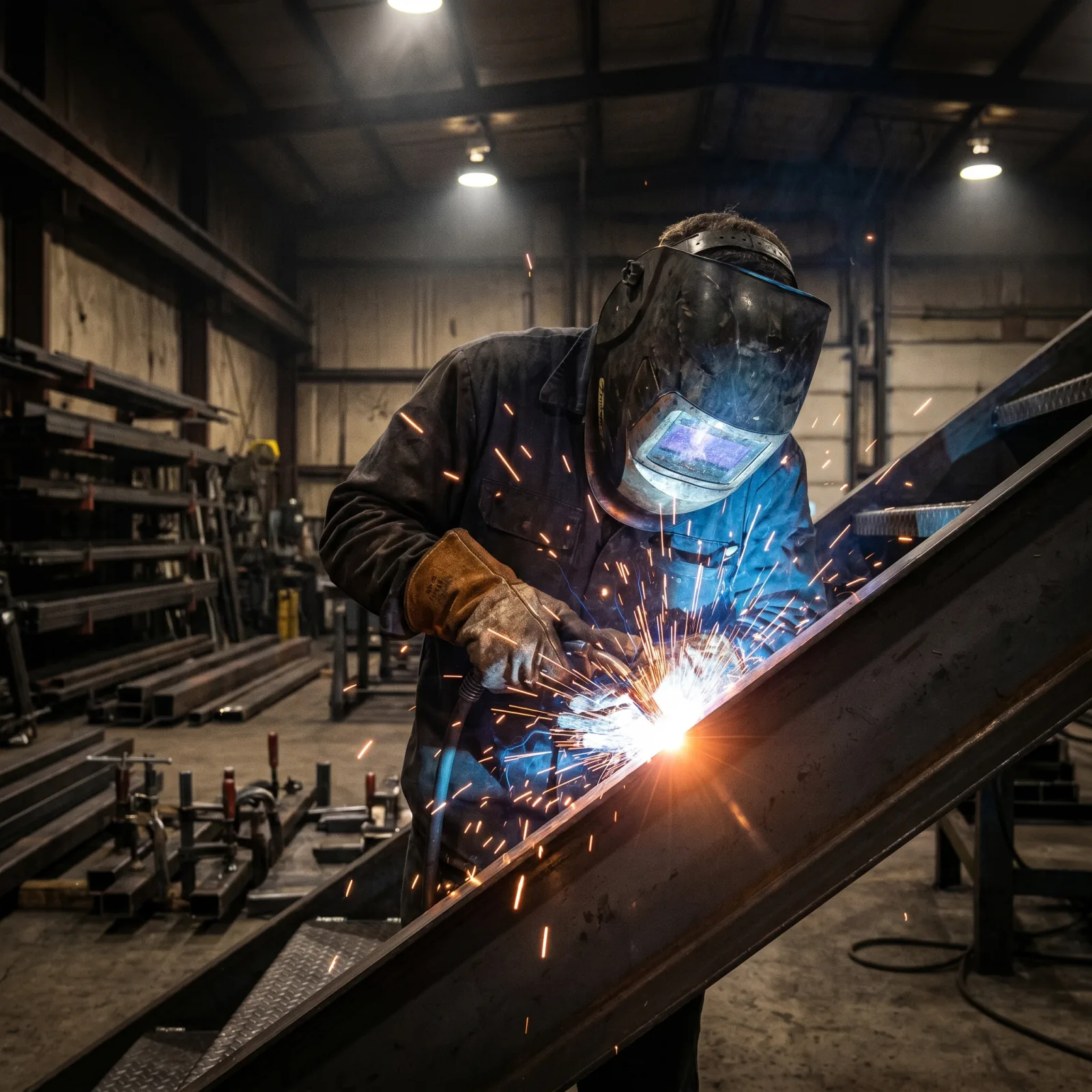
Once shop drawings are approved, the project moves from documents to material. This is the phase clients see least and ask about most, partly because it happens off site and partly because the schedule during it is driven by things that are not obvious from outside, like whether the stair needs to travel to a galvanizer and come back. Understanding what happens between approval and delivery makes the timeline legible, and it explains why certain changes are cheap in week one and impossible in week three.
Material comes first, and it is not always on the shelf
Fabrication starts with buying steel to the approved specification. Common sections in common grades are usually available quickly. Heavier plate, specific structural sections, stainless in particular finishes, and anything unusual can carry real lead time. This is why approval releases purchasing, and why a change after approval that alters a section size can push the schedule by more than the shop time it saves. Where a long-lead item is involved, it gets identified at quoting so the schedule reflects it rather than discovering it later.
- Standard structural sections and plate: typically readily available.
- Stainless, heavy plate, and specific grades: may carry lead time.
- Glass for guards is ordered to size and is not adjustable after fabrication.
- Long-lead items are identified at quote stage so the schedule is honest.
Cutting and fit-up decide the accuracy of everything after
Components are cut to the drawing, then assembled and checked before any final welding. Fit-up is the stage where a stair is held together in position and measured against the drawing, and it is deliberately reversible. A tread bracket that is 3 mm out of position can be adjusted at fit-up in a minute. After final welding it is a cut-and-reweld operation with grinding and refinishing behind it. Good shops spend more time at fit-up than seems necessary, because errors caught here cost minutes and errors caught later cost hours.
- Components cut to drawing dimensions, then dry-assembled and checked.
- Squareness, tread spacing, and connection positions verified against the drawing.
- Adjustments at fit-up are inexpensive and expected.
- Only after fit-up passes does final welding begin.
Welding is where certification stops being paperwork
Structural welds carry the load, and welding to CSA standards under a certified procedure is what makes them predictable rather than hopeful. Under CSA W47.1 a certified company qualifies its welding supervisors and engineers, has its welding procedures reviewed and approved by the Canadian Welding Bureau, and qualifies its welders against those procedures. In practice this means the weld on your stair was made by a qualified person following a procedure that was approved for that joint in that material. Distortion control matters here too, because heat moves steel, and a long stringer welded without managing sequence comes out bowed.
- Welding follows procedures approved for the material and joint type.
- Welders are qualified against those procedures, not generally.
- Weld sequence is planned to control heat distortion on long members.
- Welds that will be visible in the finished stair are dressed to a specified standard.
The finish route decides the calendar
Finishing is where schedules diverge sharply. A powder-coated interior stair is blasted or prepared, coated, and cured in the shop, which is fast and predictable. A hot-dip galvanized stair leaves the shop entirely, travels to a galvanizing plant, gets dipped, and comes back, which adds transit and plant scheduling to the calendar and is largely outside the fabricator’s control. A galvanized-then-powder-coated stair does both in sequence. Blackened steel is hand-applied and sealed in the shop. Choosing the finish is therefore choosing a timeline as much as an appearance. Our finishes and coatings guide compares durability by exposure.
- Powder coat: prepared, coated and cured in shop, fastest predictable route.
- Hot-dip galvanizing: leaves the shop to a plant, adds transit and scheduling time.
- Galvanize then powder coat: both steps in sequence, longest route, best exterior durability.
- Blackened or patina: hand-applied in shop, variation is inherent to the finish.
- Closed sections being galvanized need vent and drain holes designed in at drawing stage.
Treads, glass, and hardware arrive on their own schedules
A stair is rarely only steel. Wood treads are milled and finished separately, often by a joinery shop, and their delivery has to align with the steel. Glass panels for guards are cut to size from the approved drawing and cannot be trimmed on site, so any dimensional error becomes a reorder with its own lead time. Cable, fittings, brackets, and fixings are ordered against the drawing. Coordinating these so everything converges at installation is a large part of what project management on a stair actually involves.
- Wood treads: milled and finished on a separate schedule, aligned to steel delivery.
- Glass: cut to approved dimensions, not adjustable on site, reorders carry lead time.
- Hardware and fixings: ordered to the drawing at the same time as material.
- Everything has to converge at the installation date, which is the coordination task.
Shop inspection before anything leaves
The stair is checked against the drawing before it ships: dimensions, weld quality on visible and structural welds, finish coverage and colour, and that every component and fixing needed on site is packed. Catching a problem in the shop means fixing it with shop tools and shop lighting. Catching the same problem on site means either working around it or taking the stair back, both of which cost days. Where a client wants to see the stair before it ships, that visit happens at this point and is worth doing on a feature stair where finish appearance matters.
Related questions
How long does staircase fabrication take?
Staircase fabrication time depends mainly on the finish route rather than the welding. A powder-coated interior stair is prepared, coated and cured in the shop on a predictable schedule. A hot-dip galvanized stair leaves the shop for a galvanizing plant and returns, adding transit and plant scheduling largely outside the fabricator's control. Material lead time on non-standard sections can extend the start. We confirm the schedule for your specific stair at quoting.
What is fit-up in steel stair fabrication?
Fit-up is the stage where cut stair components are dry-assembled and checked against the shop drawing before final welding. Squareness, tread spacing, and connection positions are verified while everything is still adjustable. A tread bracket 3 mm out of position takes a minute to correct at fit-up and becomes a cut, reweld, grind and refinish operation afterward, which is why shops spend deliberate time here.
Why does hot-dip galvanizing add time to the schedule?
Hot-dip galvanizing adds time because the stair physically leaves the fabrication shop, travels to a galvanizing plant, is dipped, and returns. That transit and the plant's own scheduling sit largely outside the fabricator's control, unlike powder coating which happens in-house. Closed sections also need vent and drain holes designed in at drawing stage so molten zinc can flow and air can escape.
What does CWB certification mean for the welds on my stair?
CWB certification under CSA W47.1 means the welding company has qualified its welding supervisors and engineers, submitted welding procedures to the Canadian Welding Bureau for review and approval, and qualified its welders against those procedures. For your stair it means the structural welds were made by a qualified welder following a procedure approved for that joint and material, rather than to general practice.
Can glass guard panels be adjusted on site?
Glass guard panels cannot be adjusted on site. They are cut to the dimensions on the approved shop drawing, and tempered or laminated glass cannot be trimmed after manufacture. Any dimensional error becomes a reorder carrying its own lead time and delaying handover. This is one reason the site measure and the shop drawing review matter so much on stairs with glass guards.
Does welding distort the steel in a staircase?
Welding does move steel, because heat causes expansion and contraction. On a long stringer, welding without a planned sequence produces a bowed member. Fabrication shops control this by planning weld sequence and managing heat input across the assembly. Distortion control is a normal part of structural fabrication rather than an exception, and it is one reason weld order is not arbitrary.
Are wood treads made by the same shop as the steel?
Wood treads are often milled and finished by a separate joinery shop rather than the metal fabricator, on their own schedule. Coordinating that delivery with the steel, the glass, and the hardware so everything converges at the installation date is a substantial part of stair project management. A delay in any one component affects the installation date for all of them.
Can I visit the shop to see my staircase before it ships?
A shop visit before shipping is worth doing on a feature stair where finish appearance matters, and it happens at the shop inspection stage after fabrication and finishing are complete. Seeing a blackened or patina finish in person is particularly useful, since those are hand-applied with inherent variation that photographs and samples only partly convey.
What is checked before a staircase leaves the shop?
Before a staircase ships, the shop checks overall and component dimensions against the drawing, weld quality on structural and visible welds, finish coverage and colour, and that every component and fixing needed on site is packed. Problems found in the shop are fixed with shop tools and lighting. The same problem found on site costs days, either in workarounds or in returning the stair.
Continue reading
- Previous step: 4. Permits & Engineering
- Next step: 6. Delivery & Installation
- Stair project process overview
- BC Building Code for stairs and guards
Talk through fabrication and finishing: what happens in the shop for a real Vancouver project
Send drawings, photos, or a rough scope and we will help define the practical next step.