Deck Railing Replacement Cost in Vancouver: 2026 Guide
What deck railing replacement costs in Metro Vancouver, price ranges by material, the decisions that move the budget, BC code requirements, and when a permit is needed.
Deck railing replacement in Metro Vancouver runs $3,500–$22,000 depending on material and linear footage. Here is what drives the number and how to plan your budget.
Replacing aging deck railing is one of the more common metalwork scopes Vancouver Stairs handles, rotted wood posts, rusting pickets, or guards that no longer meet the current code height requirement. The cost range is wide: a simple aluminum system on a small rectangular deck can come in under $4,000, while a glass or cable railing on an elevated coastal-exposure deck with a building permit can reach $20,000 or more. What follows is a breakdown of what actually moves that number.
What deck railing replacement costs by material
The table below covers the most common railing systems used on Vancouver residential decks. Prices are installed, posts, infill, top rail, hardware, and labour, and reflect typical Metro Vancouver project pricing. They do not include removal of existing railing, permit fees, or engineering.
| Material | Installed cost per linear foot | Notes |
|---|---|---|
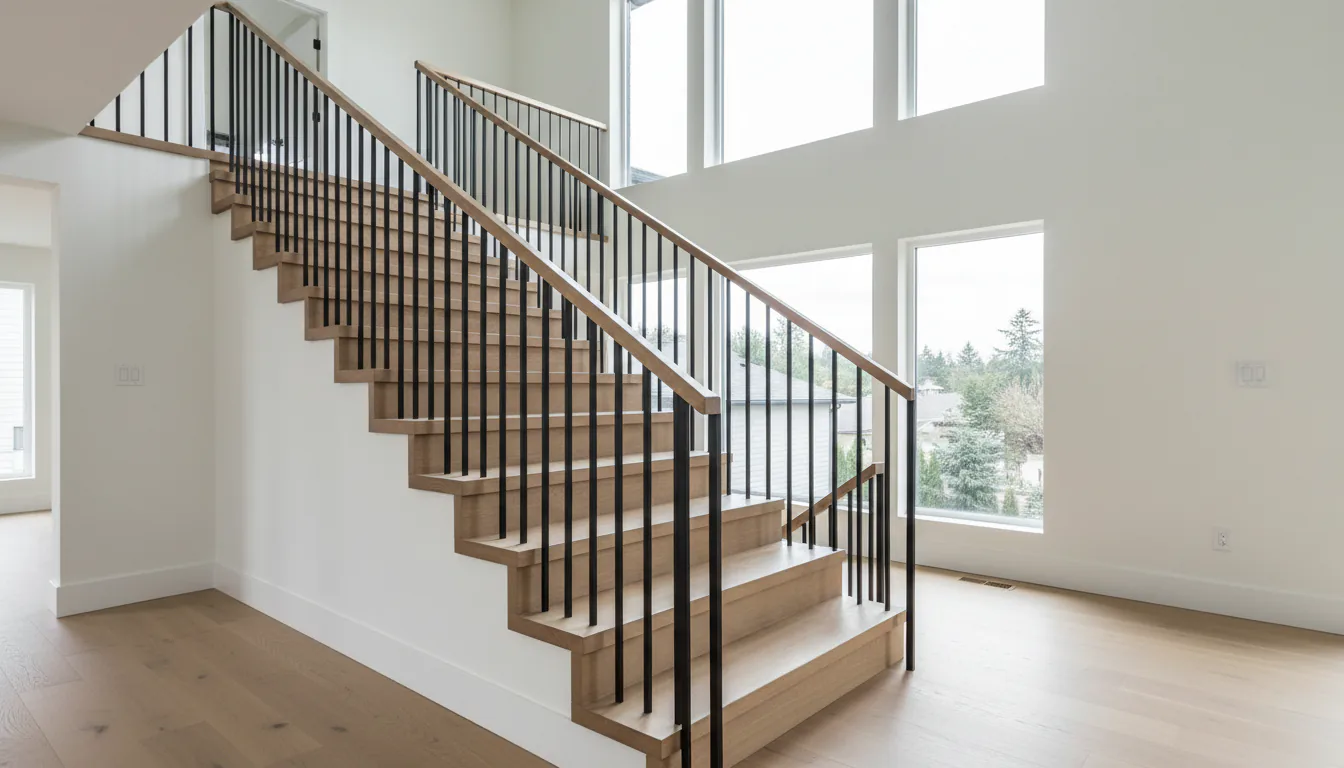
| Pressure-treated wood posts + steel pickets | $90–$160 | Most economical system. Posts require periodic maintenance. Steel pickets powder coated. |
| Aluminum railing (post and picket system) | $110–$185 | Low maintenance, no corrosion, widely available in standard profiles. |
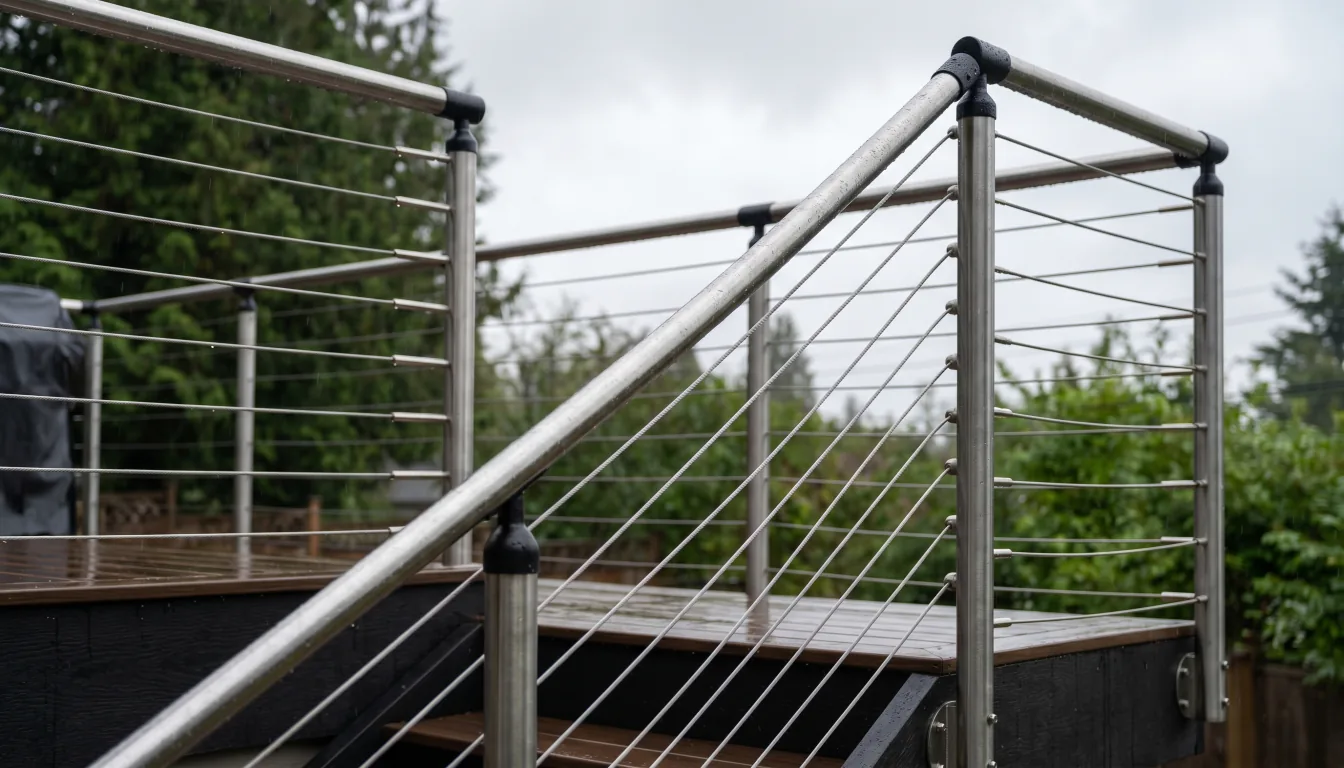
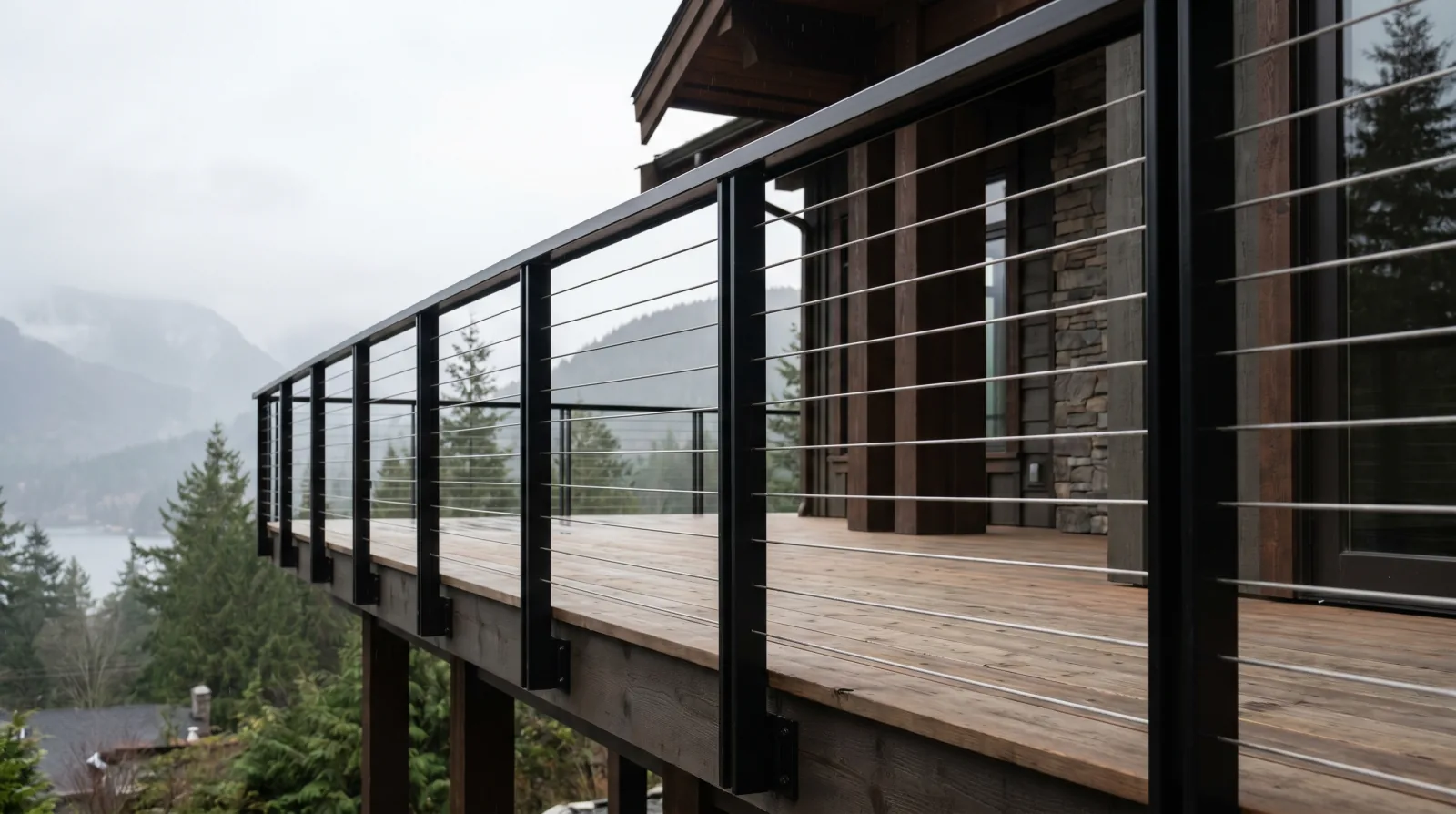
| Cable railing (steel posts, stainless cable) | $175–$425 | Cost scales with post material and hardware spec. See cable railing cost Vancouver for detail. |
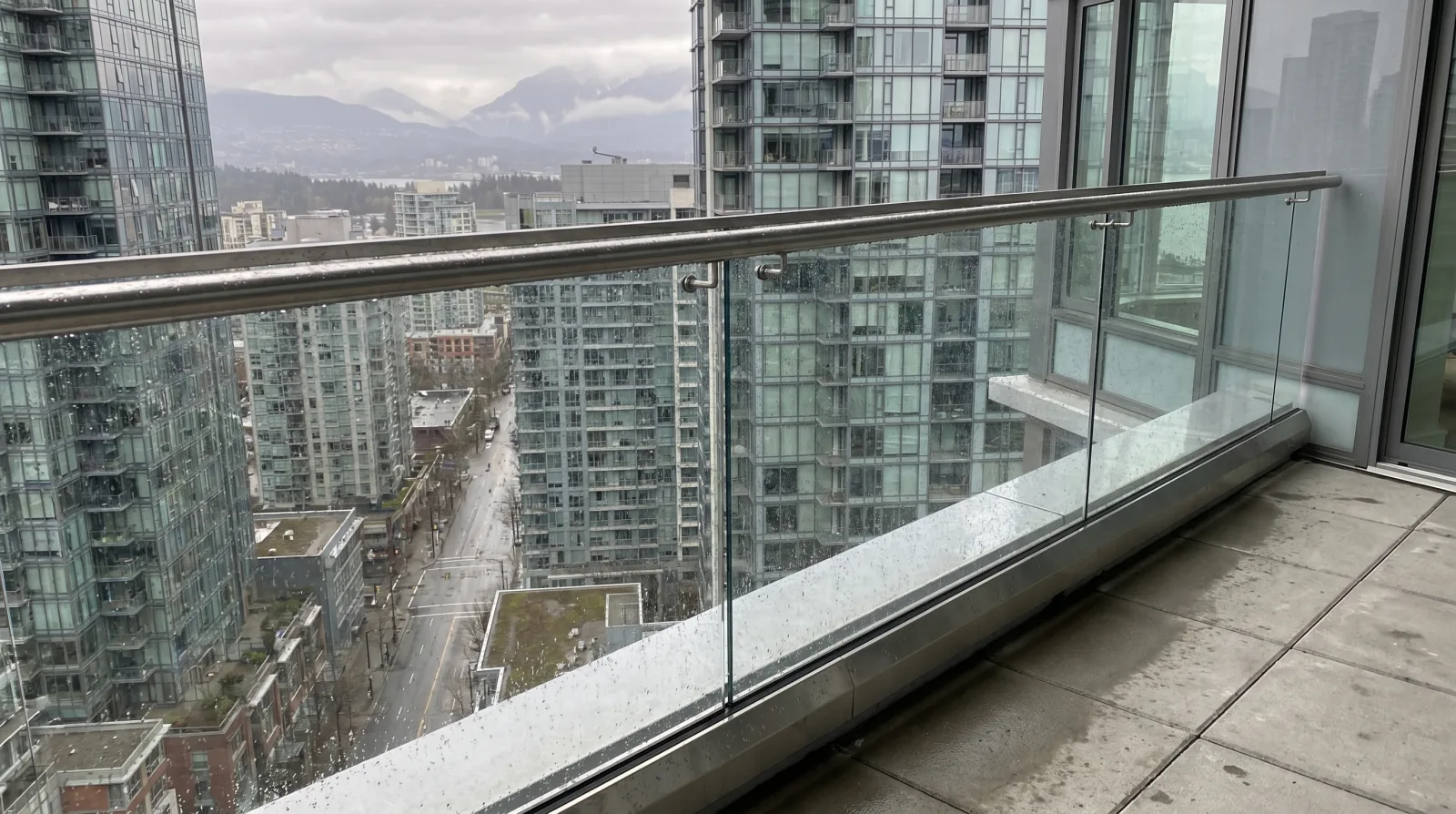
| Glass railing (semi-frameless or frameless) | $350–$700 | Frameless systems at the upper end. Separate graspable handrail required. See glass railing cost Vancouver. |
| Steel tube railing (welded, powder coated) | $180–$340 | Custom-fabricated, durable, minimal moving parts. Good for exposed or industrial-look decks. |
For a 40-linear-foot deck, a common size for a standard Vancouver detached house rear deck, these ranges translate to total material-and-labour costs of roughly $3,600–$6,400 for aluminum, $7,000–$17,000 for cable, and $14,000–$28,000 for glass. Removal of the old system, disposal, and permit fees add to these figures.
What drives the cost up
Several factors push a deck railing replacement well above the midpoint of any material range.
Coastal exposure. Properties within approximately 1.5 km of salt water, Coal Harbour, the False Creek seawall, Kitsilano waterfront, North Shore properties facing the inlet, Richmond’s river-facing lots, require hardware specified for marine environments. For cable railing, that means 316 stainless cable, fittings, and tensioners rather than 304. For glass systems, stainless standoffs and marine-grade aluminum hardware. For steel posts, hot-dip galvanizing or a high-build epoxy system. The hardware cost difference between 304 and 316 specification is typically 10–20% of the railing budget.
Elevated decks. A deck more than one storey above grade requires staging for installation. Working at height adds labour time and may require scaffolding or an aerial lift, particularly on steep North Shore lots where staging below the deck is difficult. Sloped sites complicate post setting and often mean non-standard post heights, which adds fabrication time.
Sloped deck surface. When the deck surface has a cross-slope or the railing transitions from a flat deck section to a stair section, the post heights vary across the run and the top rail must rake or step. This is fabrication work that does not appear on flat decks.
Removal and disposal. Removing and disposing of existing railing is a separate cost that many initial estimates leave out. A full perimeter replacement on a larger deck can mean several hundred kilograms of material to demo, carry off site, and dispose of, particularly when the existing system is a heavy wood-and-steel combination. Budget $400–$1,200 for removal on a typical residential deck.
Custom corner posts. Any deck with a non-standard corner angle, an angled lot, an octagonal deck corner, or a stair landing that changes direction, requires corner posts fabricated or ordered to accommodate the geometry. Standard catalog hardware is sized for 90-degree corners. Custom corner posts add fabrication time and cost.
Permit fees. Where a permit is required (see below), the permit fee is based on construction value and varies by municipality. In the City of Vancouver, permit fees for residential railing work are typically in the $300–$800 range for a standard scope. Burnaby, North Vancouver, and West Vancouver each have their own fee schedules.
What keeps the cost down
A straightforward scope on a simple deck keeps all of those cost drivers out of the equation.
A rectangular deck at or near grade, less than 600 mm above ground, does not legally require a guard under the BC Building Code Part 9, though most homeowners choose to install one regardless. When a guard is still desired on a ground-level deck, an engineer’s review is rarely required and post sizing can be standard.
Standard post spacing, typically 1,500–1,800 mm for most picket and aluminum systems, uses catalog hardware without custom fabrication. Non-standard spacing or unusual deck framing requires field measurement and custom post cuts.
Aluminum over steel saves on lifecycle maintenance cost and eliminates the corrosion concern that drives finish specification on steel or iron systems. Aluminum does not rust and does not need periodic painting, and it resists degradation effectively through Metro Vancouver’s rain and temperature cycling in typical residential use. The installed price per linear foot is lower than cable or glass, and the long-term maintenance cost is low.
Reusing existing post footings, where the existing post bases are anchored into the deck framing and still in good structural condition, can reduce the installation scope if the new system uses the same post spacing. In practice, most railing replacements remove the old posts entirely, but when the existing lag-bolt pattern and post location work for the new system, skipping new footings saves time.
What BC Building Code requires for deck guards
This article is not a substitute for code review by the authority having jurisdiction (AHJ), an architect, or an engineer. The following is a general summary of requirements under the BC Building Code 2018, Part 9, Section 9.8.8.
Guard height. A guard is required on any deck surface, balcony, or landing that is more than 600 mm above the adjacent grade or floor below. The minimum guard height is 1,070 mm measured vertically from the deck surface. This is a common replacement trigger, older railings built to a 36-inch (914 mm) standard no longer meet the 1,070 mm requirement and must be raised when replaced.
Sphere passage. The infill, whether pickets, cables, glass panels, or bars, must not permit a 100 mm sphere to pass through. For cable railing, this means maximum 100 mm clear spacing between cables. For picket systems, maximum 100 mm clear between pickets.
Graspable handrail. Where the guard serves a stair, a graspable handrail with a specific profile is required in addition to the guard. A flat top rail or glass panel does not meet this requirement on its own. This is why glass and cable railings on stairs typically include a separate wall-mounted or post-mounted round-profile handrail.
Load requirements. Guards must resist a concentrated lateral load of 0.9 kN (approximately 90 kg of force) applied at the top rail, and a uniform distributed load as specified by the code. Post base connections are where most residential railing failures occur, the post must transfer that load into the deck framing, not just into the decking boards.
When a building permit is required in Vancouver
In the City of Vancouver, a building permit is required for work that alters the structure of a building or changes a safety system. The City of Vancouver’s Development and Building Services provides permit guidance online, but the general rule for deck railing is:
A like-for-like replacement, same height, same post spacing, same type of railing, on an existing permitted deck typically does not require a new permit. The work is considered maintenance.
A change in guard height, post spacing, railing type, or post connection method may trigger a permit requirement, particularly if the change affects the structural load path into the deck framing.
A new guard on a deck that did not previously have one typically requires a permit, because the post connections become a structural scope.
Requirements vary across Metro Vancouver municipalities. Burnaby, North Vancouver District, West Vancouver, and Richmond each maintain their own permit thresholds. When in doubt, a call to the municipal building department before starting work prevents the cost and delay of a stop-work order.
Cable, glass, or steel pickets: which makes sense for a deck
The right system depends on the deck, the exposure, and what matters most to the homeowner.
Cable railing works well on decks with a view worth preserving. The horizontal cables are visually light, particularly on elevated North Shore or West Vancouver decks looking toward the water or mountains. Cable handles coastal exposure well when the hardware is correctly specified, 316 stainless in marine environments, 304 adequate further inland. The ongoing maintenance is low: periodic cable tensioning and occasional cleaning. Cable railing requires posts engineered for lateral tension, which matters on the end posts where the cable terminates. Vancouver Stairs installs cable railing across Metro Vancouver, see the cable railings Vancouver service page for project examples and specification detail.
Glass railing maximizes the view and creates a contemporary look. It costs more than cable, largely because of the glass panel cost, the hardware cost, and the separate graspable handrail required by code. Semi-frameless systems with aluminum posts are the more practical choice on exterior decks where the glass is exposed to rain, cleaning, and physical contact. Frameless systems with base shoes or standoffs look cleaner but are more sensitive to deck surface levelness and require more precise installation. See the glass railings Vancouver service page for project details.
Steel pickets or tube railing is the right choice when the deck is not about the view, a private rear deck surrounded by landscaping, a commercial or strata application, or a utilitarian exterior stair. Welded steel railing is durable, has no moving parts, and the powder coat finish is easy to touch up. It is the lowest lifecycle cost option when the installation is not coastal-exposed.
Aluminum sits between steel and cable in cost and between wood and steel in maintenance. It is worth considering on any deck where the aesthetic priority is “clean and low-maintenance” rather than “view-maximizing” or “custom.” Standard aluminum systems are available in a range of profiles and colours and install faster than fabricated steel, which helps keep labour cost down.
How to get a useful quote
The more complete the information sent at the outset, the more accurate the first quote will be. For a deck railing replacement, send:
- Total linear footage of railing to be replaced (measure along the top rail, including stair sections separately)
- Deck height above grade at the tallest point
- Photos of the existing post connections and the deck framing visible from below if accessible
- The railing material you are considering
- The site address, for permit jurisdiction and coastal exposure assessment
- Whether there is a stair section, and if so the number of steps and the rise
For most residential deck railing replacements, a fabricator or installer can provide a reliable budget range from photos and dimensions. A site visit is usually required before a final price is confirmed, particularly where the post base conditions are uncertain or the deck surface geometry is complex.
Sources
Related questions
How much does deck railing replacement cost in Vancouver?
Most deck railing replacements in Metro Vancouver run $3,500–$22,000 total installed, depending on the linear footage, material choice, and site conditions. A simple aluminum picket system on a small ground-level deck sits at the low end. A glass railing on an elevated, coastal-exposure deck with a permit sits at the upper end.
Do I need a permit to replace deck railings in Vancouver?
In the City of Vancouver, like-for-like railing replacement on an existing permitted deck typically does not require a new permit if the deck structure is unchanged. Any change to post spacing, height, or railing type may require a permit. Check with Vancouver's Development and Building Services before starting work, requirements vary by municipality across Metro Vancouver.
What guard height is required for a deck in BC?
The BC Building Code requires guards on decks more than 600 mm above grade. The minimum guard height is 1070 mm measured from the deck surface. This applies to residential decks under Part 9 of the code.
Is 316 stainless required for coastal properties in Vancouver?
316 stainless is the recommended specification for properties within approximately 1.5 km of salt water, Coal Harbour, False Creek, the North Shore waterfront, and Richmond's river-facing properties. 304 stainless is adequate further inland. The difference matters for cable hardware, post fittings, and fasteners, not just the cable itself.
How long does deck railing replacement take?
A standard residential replacement, remove old railing, install new posts and infill on an existing deck, typically takes one to three days on site once materials are ready. Cable and glass systems with custom hardware have longer lead times for fabrication and supply, often four to eight weeks from quote approval to installation.
What is the cheapest deck railing material in Vancouver?
Aluminum railing is typically the lowest installed cost for a code-compliant, low-maintenance system. Pressure-treated wood posts with steel pickets are also economical but require periodic staining or painting. Cable railing costs more than aluminum but less than glass.
Can I replace deck railing myself in Vancouver?
Homeowners can replace railing on their own property, but the installation must still meet BC Building Code guard height and sphere passage requirements, and a permit may be required. Post connections into the deck framing are structural, incorrect fastening has caused guard failures. For elevated decks, having the post connections reviewed by a contractor is worth the cost.
Does cable railing meet BC Building Code for decks?
Yes, cable railing meets BC Building Code requirements when the cable spacing does not allow a 100 mm sphere to pass through and the posts and hardware are engineered to handle the lateral load. Horizontal cable railings may face restrictions in some jurisdictions due to climbability concerns, confirm with your AHJ before specifying.
How does coastal exposure affect railing replacement cost?
Properties near salt water require 316 stainless hardware, marine-grade aluminum, or hot-dip galvanized steel, all of which cost more than standard inland specifications. Budget an additional 10–20% on hardware and coating costs for properties within 1.5 km of salt water.
What information should I send for a railing replacement quote?
Send the total linear footage of railing, the deck height above grade, photos of the existing structure and post connections, the railing material you are considering, the site address (for code jurisdiction and coastal exposure), and your target completion date. Photos of the existing post base conditions are especially useful.