Handrail Continuity Under BC Code: The Detail That Fails Inspections
BC Building Code Section 9.8 on handrail continuity: returns, terminations, graspability, and how the detail is built on a Vancouver custom stair.
A handrail that looks right in a render fails inspection if it stops short, sticks out, or wobbles at the wall. The continuity detail is decided in the shop drawings.
Handrail continuity is one of the few stair details that nearly every BC inspector checks the same way every time. The handrail has to run continuously over the flight, has to terminate without catching a sleeve, and has to be graspable along its full length. When any of those three is missed, the stair fails the rough-in or the final without much debate. The inspector is not negotiating; the clause is written down and the as-built either matches or it does not.
This post walks through what the code actually says about handrail continuity in a residential and small commercial stair, where the common failures happen, and how the detail is built on a custom Vancouver stair so it passes the first time.
What “continuous” means in BC 9.8
BC Building Code Section 9.8 governs stairs, ramps, landings, handrails, and guards in the Part 9 small-buildings stream that covers most houses and small multifamily. The continuity language requires a handrail to extend the full length of the stair flight, with limited exceptions where a stair turns at a landing or terminates at a post.
In practice, continuity has three components.
First, the rail does not stop in the middle of a flight. A handrail that ends three treads short of the top because a wall ended early is not compliant. The rail either continues to the top of the flight on its own structure, or it returns into the wall through a detail designed for that purpose.
Second, the rail crosses landings where the geometry allows. On a switchback stair with a 180-degree turn at the landing, the rail typically does not cross, the two rails terminate on either side of the landing, but on a quarter-turn or straight-run landing the rail is expected to continue.
Third, the rail does not have obstructions or gaps that interrupt the grip. A mid-rail bracket that protrudes above the rail surface, a post that interrupts the rail, or a joint that does not present a continuous profile under the hand will all draw an inspector’s attention.
This article is not a substitute for code review by the authority having jurisdiction, an architect, or an engineer.
Handrail returns, the smallest detail that fails the most stairs
A handrail return is the short curl, angle, or scroll at the top and bottom of the rail that brings the free end back into the wall, into a post, or down to the floor. The purpose is to prevent a loose sleeve, a bag strap, or a forearm in a fall from catching the open end and the user from being pulled off the stair.
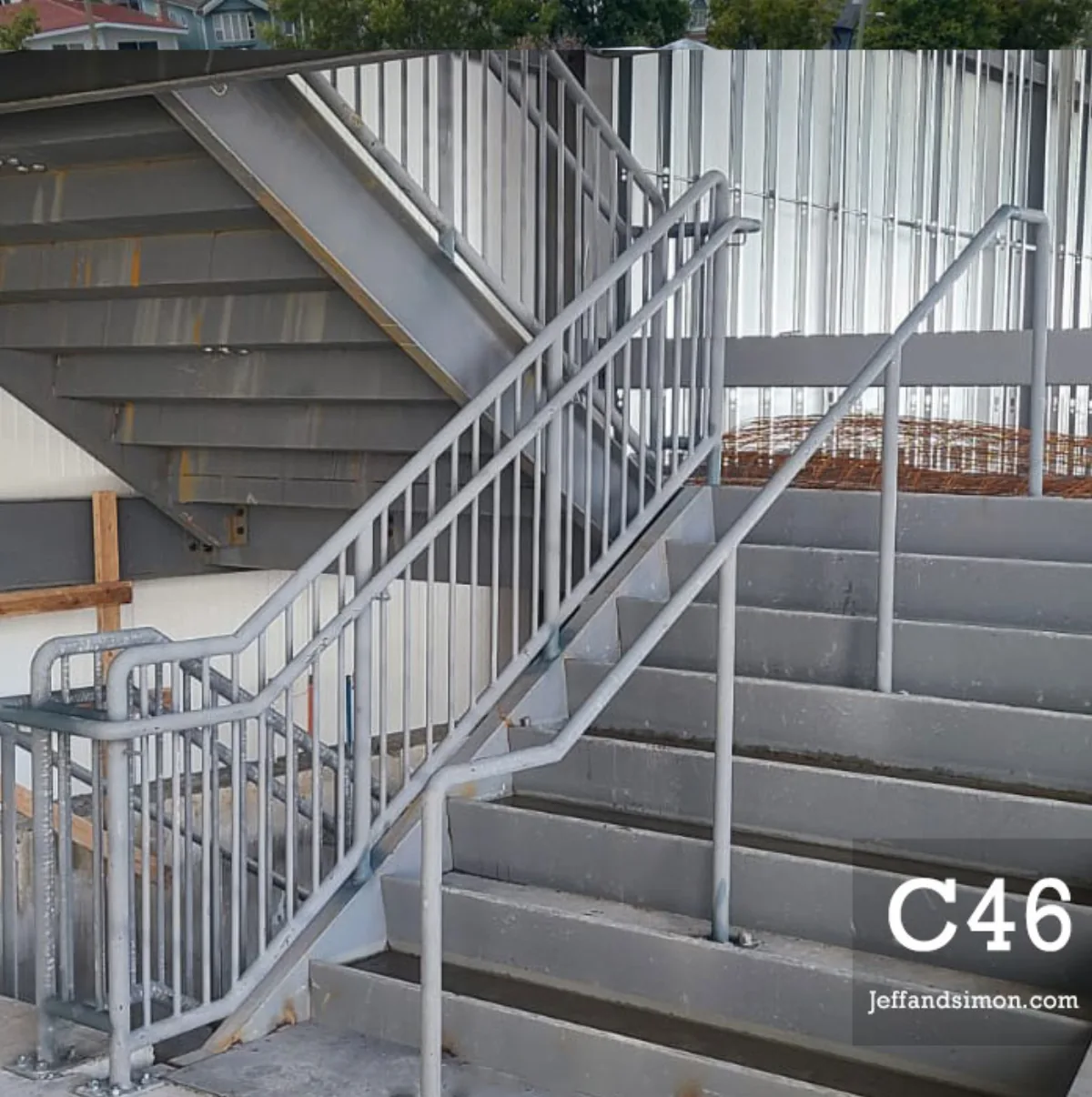
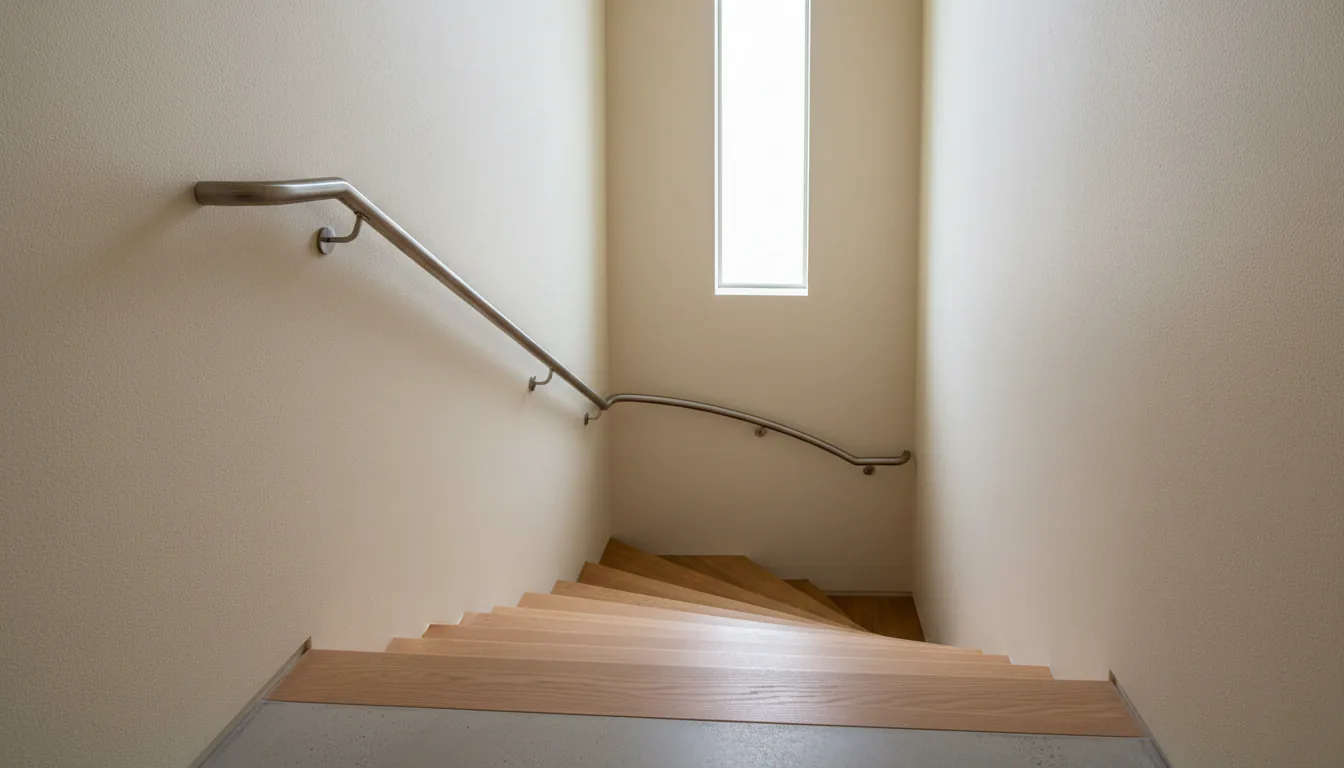
Most BC AHJs flag missing returns at inspection. On a residential stair, the return is usually a short radiused bend in the metal, a quarter-turn down to a post at the bottom newel, and a quarter-turn into the wall at the top. On a wall-mounted rail without a post, both ends return into the wall. The radius is small and the rail does not stick out into the head space.
The detail is decided in the shop drawings. A rail without a return drawn in is a rail without a return installed, and the fix on site is a hot weld on a finished rail in a finished space. That repair never matches the original finish under the kind of inspector light. We draw the returns, fabricate the returns in the shop, and install the rail as a single finished piece with both ends already resolved.
Graspability, diameter, profile, and what the hand can close around
A graspable handrail is one the user can actually close their fingers around in a fall. BCBC 9.8 gives a diameter range for circular handrails and a perimeter and shape range for non-circular profiles. The numeric values are in the published code text and the AHJ uses them as the test.
The most common graspability failures we see on Vancouver custom stairs:
- Oversized architectural rails. A 50 mm or 63 mm round rail looks substantial in a render and is too big to close a hand around in a fall. Some AHJs accept a secondary smaller graspable rail mounted below or alongside the architectural rail; some do not.
- Square or rectangular rails with sharp corners. A 38 mm × 38 mm square rail can pass on perimeter, but the sharp corners reduce the effective grip and most inspectors will look at it carefully. We bevel or radius the corners on a custom square rail to improve graspability and reduce the inspector’s concern.
- Flat-top rails on glass guards. A wide flat top rail on a glass railing, a common architectural detail, is sometimes treated by the AHJ as a guard cap rather than a graspable handrail, and the project ends up needing a separate handrail at the prescribed height. This decision should be confirmed with the AHJ before fabrication, not discovered at inspection.
For railings that use rigid pickets or a vertical infill, we typically resolve the handrail as a separate continuous round profile mounted on top of the structure or alongside it, sized inside the published graspable range. The architectural top rail can remain wide; the graspable rail is the one the inspector tests.
Wall-mounted rails, bracket spacing, clearance, and the return
A wall-mounted handrail has three details that recur on every inspection.
First, the clearance between the rail and the wall has to allow a hand to wrap around the rail without scraping the knuckles. The published clearance is small but specific, typically around 38 to 50 mm. A rail mounted tight to the wall fails the test.
Second, the bracket spacing is set by the structural load. A wall-mounted rail has to resist a horizontal load applied at the top of the rail, and the bracket pattern is what transmits that load into the studs or the backup blocking. We resolve the bracket spacing with the framer at rough-in, not at finish, the blocking has to be in the wall before the drywall closes up, or the brackets have to land on studs whose locations are known.
Third, the rail returns to the wall at both ends. A wall-mounted rail with a flat-cut end pointing into the room is the most common handrail failure on residential renovations. Our piece on banister replacement in Vancouver covers the related detail when an old rail is being replaced on a heritage stair.
Newels, posts, and the question of “where the rail ends”
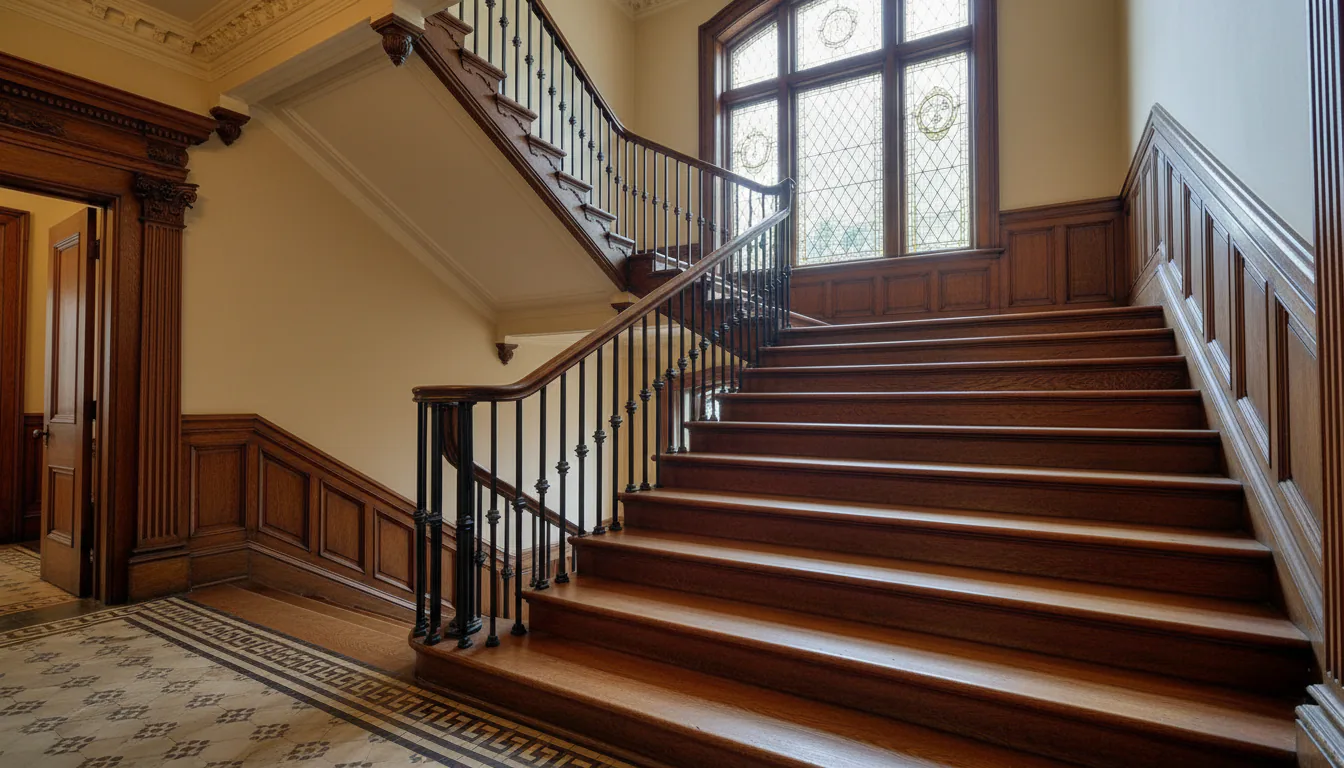
On a stair with a newel post at the bottom, the rail typically terminates at the post. Most AHJs accept the post as the termination, the post is structural, the rail is graspable to the post, and the user does not encounter a free end. A few AHJs prefer to see the rail return down the post to a horizontal segment, or curl down to the floor in a volute, even with a post present. The right answer is the AHJ’s answer.
At the top of the stair, where the rail meets the upper floor, the same question applies. A rail that terminates at a post on the upper landing is usually acceptable. A rail that just ends in space above the landing is not. If there is no post, the rail returns to the wall.
The newel detail also intersects with the guard detail. The guard at the upper landing has to satisfy the height and opening provisions of 9.8 in addition to the rail satisfying continuity. Two requirements that have to be resolved together, not separately. See our BC stair code requirements for metal stairs piece for the broader code overview.
Where the failures concentrate on real projects
After enough Vancouver stair inspections, the failures cluster in five places:
- Missing return at the top of a wall-mounted rail, easy to forget when the wall geometry is irregular.
- Rail too large in diameter, usually a render-driven choice that nobody questioned.
- Rail too tight to the wall, usually a bracket selection error.
- Rail interrupted by a structural post, common on stairs with a guard built in panels.
- Rail not continuous across a landing, usually a design choice that the AHJ overrules.
Each of these is solvable in the shop drawings. None is solvable cheaply in the field. The fix is to draw the rail explicitly, including the returns, the brackets, the diameter, and the landing crossings, and to confirm the drawing with the architect and the AHJ before steel is cut.
Why the detail is worth the time
A handrail is the part of the stair the user touches every day. Its quality is judged at the hand, not the eye. A continuous, well-returned, graspable rail in a deliberate profile reads as fabricated; a discontinuous, mismatched, oversized rail reads as a renovation. The same stair with two different rails feels like two different stairs.
The investment is small relative to the rest of the stair. Drawing the returns, sizing the rail correctly, and coordinating the wall blocking is hours of work; rebuilding a failed inspection is days. We treat the handrail as the first thing the user trusts on a stair, not the last finish detail.
Sources
- BC Building Code Section 9.8, Stairs, Ramps, Landings, Handrails and Guards
- City of Vancouver, Building permits and inspections
Related reading: the BC stair code requirements for metal stairs, the banister replacement guide, and the steel stair connection details piece.
Related questions
Does a handrail have to be continuous from top to bottom on a stair?
On most BC stairs the handrail is required to be continuous over the full run, including across landings on the same flight when the geometry allows. The clauses governing graspability and continuity sit in BC Building Code Section 9.8, and the exact language has been refined in recent code cycles. The AHJ decides at inspection whether the as-built rail satisfies the intent.
What is a handrail return and when is it required?
A handrail return is a short curved or angled piece at the top and bottom of the rail that bends the end back into the wall or down to a post. The return prevents loose clothing, bag straps, and arms from catching on a free end. Most BC AHJs require returns on residential stairs and consistently flag missing returns at inspection.
Can a handrail be larger than 38 mm or smaller than 32 mm in diameter?
BC Building Code 9.8 specifies a graspability range for circular handrails. Outside that range the rail is harder to grip in a fall and the AHJ can require a redesign. Non-circular profiles have their own perimeter and shape rules. We size handrails inside the published range by default and confirm the profile with the architect before fabrication.