Spiral Staircase Cost Vancouver 2026, What Custom Fabrication Actually Costs
How much does a custom spiral staircase cost in Vancouver? 2026 pricing from a Metro Vancouver fabricator, by diameter, material, tread type, and railing system.
Custom spiral staircases in Metro Vancouver range from $14K to $45K depending on diameter, material, and railing. Here's how fabricators price them.
A spiral staircase is one of the most misquoted items in residential construction. Ask five people what one costs and you’ll get answers ranging from $3,000 to $80,000, because they’re talking about completely different products. A bolt-together kit spiral from a flat-pack supplier and a custom-fabricated CWB-welded spiral are not the same object. This post is about the custom fabricated version, what it actually costs in Metro Vancouver in 2026, and what drives the number.
Kit vs. custom, the distinction that matters most
Prefab spiral stair kits from manufacturers like Dolle, Mylen, and Salter are real products. They ship in boxes, bolt together in a day, and cost $1,500–$8,000 depending on size and finish. For a storage loft, a rooftop access hatch, or a secondary escape route in a rural property, they can work. The tradeoff is fixed geometry: kit spirals come in set diameters (typically 1,200–1,370mm inside), fixed tread counts, and limited railing options.
The problem in BC is code. A kit spiral at 1,200mm inside diameter is smaller than what the BC Building Code allows for a primary stair in a dwelling unit. Most kit spirals are also not engineered to BC standards for primary means of egress, and many jurisdictions will not approve them as a building’s main stair regardless of diameter.
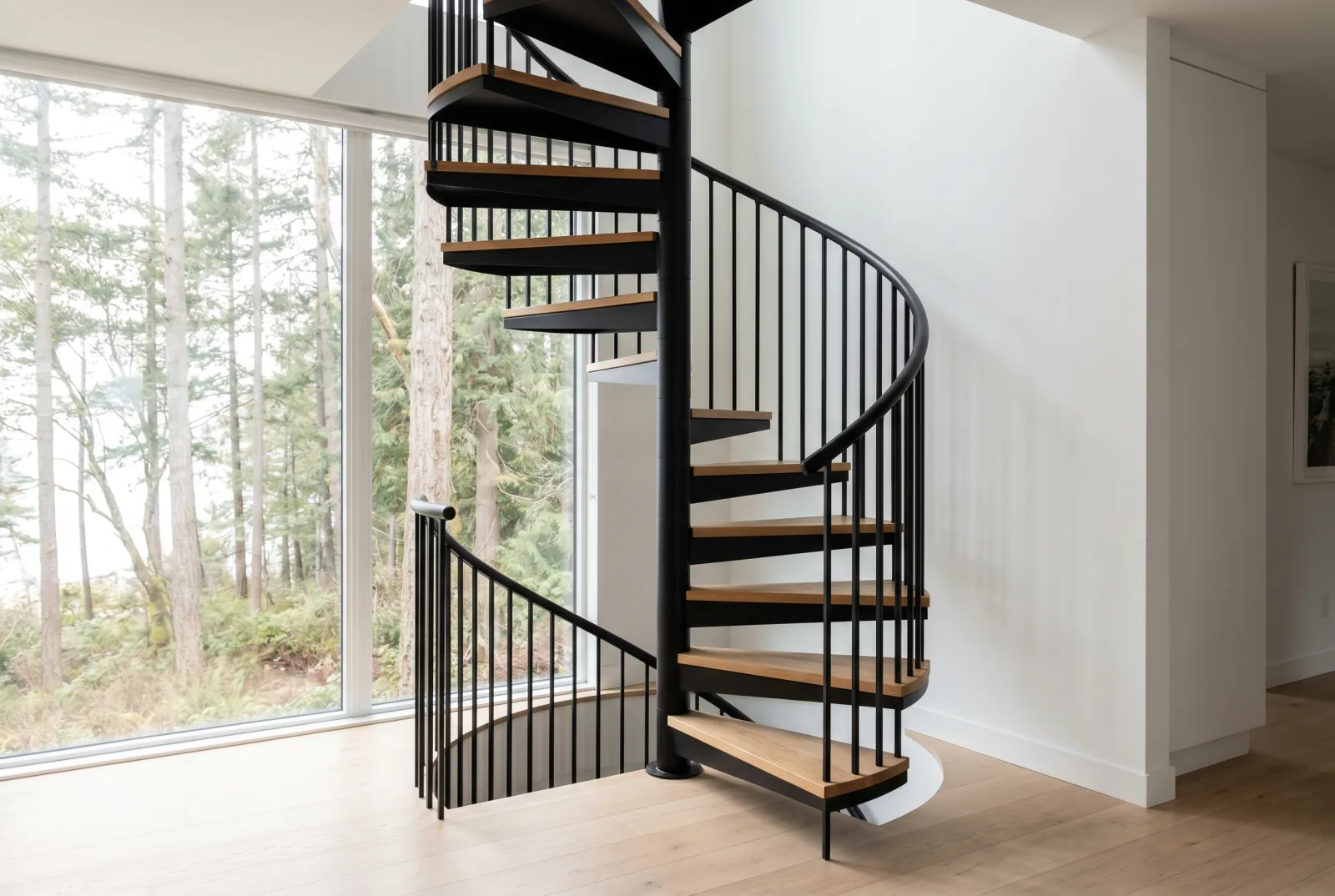
Custom fabricated spirals are a different animal. The structure is designed to your floor-to-floor height, your chosen inside diameter, your tread material, and your railing system. Welding is CWB certified. Shop drawings are stamped by a P.Eng. The finished stair is built for permit, not around it.
BC Building Code requirements for spiral staircases in dwellings
Before pricing anything, confirm what the code actually requires for your project:
Minimum inside diameter: 1,500mm for a spiral staircase used as a primary means of egress in a dwelling unit (BCBC 2018, Section 9.8). Most prefab kit spirals at 1,200–1,370mm do not meet this requirement for a primary stair. If the spiral is the main stair between floors, 1,500mm inside diameter is the starting point.
Tread requirements: Minimum 240mm tread depth measured at 250mm from the narrow end of the tread. Spiral treads are wedge-shaped by geometry; confirming the tread depth at the code measurement point is a shop-drawing exercise, not an estimate.
Handrail requirements: If the spiral is a primary means of egress, a handrail is required on both sides. In practice this means a central column handrail and an outer railing, both to the correct graspable profile and height.
AHJ note: The authority having jurisdiction for your municipality interprets code. Some treat a spiral to a loft or mezzanine, where there is also a primary stair, differently than a standalone primary stair. Confirm with your AHJ early. Getting this wrong resets the permit and the fabrication timeline.
Cost breakdown by variables
Custom spiral staircase pricing in Metro Vancouver is driven by four main variables: diameter, material and finish, tread specification, and railing system.
Diameter is the biggest single cost driver because it controls both the steel package and the tread area. The code minimum is 1,500mm inside; a comfortable everyday spiral is typically 1,800mm inside; a grand statement spiral in a high-ceiling space might be 2,100mm. Each 300mm step up in diameter adds approximately $3,000–$5,000 in steel and tread material. A 2,100mm spiral uses substantially more steel in the column, the arms, and the tread pans than a 1,500mm spiral covering the same floor-to-floor height.
Material and finish set the cost floor for the entire project. Three common paths:
- Mild steel with powder coat: The most common choice for residential interiors. Strong, weldable, and finishable in any RAL colour. This is the entry-level material path for a custom spiral, typically in the $14,000–$25,000 range for a standard residential floor-to-floor height at 1,500–1,800mm diameter.
- Stainless steel 304: Interior premium choice. No paint, no maintenance, and the brushed or polished surface reads as a finished product without additional coatings. Add roughly 40–60% to the mild steel price. Typical range for a residential spiral: $28,000–$40,000.
- Hot-dip galvanized: The right choice for exterior spirals, deck access, rooftop, exterior commercial. Galvanizing saturates the steel rather than coating it, so it performs in coastal and rain conditions where powder coat eventually fails. Typical range: $18,000–$30,000, depending on diameter and the complexity of the tread system.
Treads are the second biggest budget swing after material. The tread is the only part of a spiral the user touches on every use, and the material drives both cost and weight, which feeds back into the structural design:
- Open steel grating or steel pan treads: The budget tread for a custom spiral. Functional, weldable to the arm, and appropriate where appearance is secondary. Included in entry-level pricing.
- Wood or concrete-filled pan treads: Mid-range upgrade. Oak, walnut, or ash floating in a recessed steel pan reads significantly better than bare steel. Add $3,000–$6,000 to the total depending on species and tread count.
- Stone, porcelain, or glass treads: Premium specification. These materials require a different connection to the arm, sometimes a different structural arm depth to control deflection, and longer lead time for fabrication. Add $8,000–$15,000 to the total, sometimes more for full-length stone slabs.
Railing system provides a $2,000–$12,000 range swing on its own. Mild steel pickets welded to the outer rail are the most common and least expensive option. Stainless cable infill read lighter and are increasingly common in modern interiors. A frameless glass outer railing with stainless hardware is the premium option, it dramatically changes the visual weight of the stair but adds real cost and lead time for the glass panels. The centre column handrail is included in all cases; the outer railing specification is where the cost diverges.
Engineering and permit are not optional line items for a custom spiral as a primary stair. P.Eng stamp, shop drawings, and permit application typically add $3,000–$5,000 to the project. This is the cost of having a fabricated steel structure reviewed by an engineer and approved by the municipality, it protects the client and the fabricator.
Typical project ranges, Metro Vancouver 2026
| Scope | Range |
|---|---|
| Entry-level custom spiral, mild steel + powder coat, 1,500mm dia, steel pan treads | $14,000–$20,000 |
| Mid-range spiral, walnut treads, cable railing, 1,800mm dia | $26,000–$35,000 |
| Premium spiral, glass treads, glass railing, 2,100mm dia | $38,000–$55,000+ |
Engineering and permit costs ($3,000–$5,000) are in addition to the fabrication ranges above where not already noted. Treat these figures as illustrative until a fabricator measures the site and confirms the structural and finish assumptions. A custom spiral is not a menu, small geometry changes move the number.
What affects timeline
Spiral staircases are not fast projects. Custom fabrication in Metro Vancouver runs on a realistic timeline that most clients underestimate when planning a renovation or new build:
Fabrication: 10–12 weeks from deposit, once shop drawings are signed off. This includes cutting, welding, grinding, and finish (powder coat adds one to two weeks if it leaves the shop for application).
Engineering and permit: 4–6 weeks for P.Eng review, shop drawing production, and permit application submission. These run concurrently with fabrication if the drawings are ready when deposit is placed, otherwise they add to the front end of the timeline.
Total: 14–18 weeks from signed contract to install is the realistic expectation for a custom spiral in Metro Vancouver in 2026. Projects that start engineering before awarding the contract get the best outcome. Projects that award fabrication first and engineer second add weeks.
If a general contractor is coordinating the renovation, the stair is typically the long-lead item. It should be the first thing ordered and the last thing installed. Finishing floors and painting walls before the stair goes in protects the finished surfaces and simplifies the install.
Getting an accurate quote
The variables above, diameter, material, treads, railing, and engineering, determine whether a spiral staircase project is a $16,000 build or a $50,000 build. The most useful information to bring to a first conversation is: floor-to-floor height, preferred inside diameter (or the constraint that sets it), finish preference, tread material, and railing system. With those five items settled, a fabricator can produce a meaningful estimate rather than a wide range.
A site visit almost always clarifies the install scope. Spiral stairs ship as a partially assembled stack and are rotated into position, the access path from the delivery point to the install location matters for scheduling the crane lift or manual carry. A fabricator who has not seen the site is quoting against assumptions.
For spiral staircase fabrication including design, engineering, and install in Metro Vancouver, contact us for a quote. For broader context on what custom metalwork costs across stair types, the stair cost guide and the metal stair fabrication Vancouver service overview are the right starting points. If you’re comparing spiral to open-riser stair options, the floating staircase cost breakdown covers the competing geometry in detail.
Ready to price a spiral? Use the Quote button above or call us directly, bring your floor-to-floor height and the diameter you’re considering and we can usually give you a ballpark in the first conversation.
Sources
Related questions
How much does a custom spiral staircase cost in Vancouver?
Custom fabricated spiral staircases in Metro Vancouver range from $14,000 to $55,000+ depending on diameter, material, tread type, and railing system. Entry-level custom spirals in powder-coated steel with steel treads start around $14,000–$20,000 for a 1,500mm inside diameter. Mid-range walnut-tread, cable-railing spirals at 1,800mm diameter run $26,000–$35,000. Premium glass-tread, glass-railing spirals at 2,100mm diameter reach $38,000–$55,000+.
Do spiral staircases need a permit in Vancouver?
Yes, any primary stair in a dwelling unit requires a building permit. A spiral staircase fabricated as a custom structure also typically requires a P.Eng stamp for the shop drawings. Confirm requirements with your local authority having jurisdiction; some municipalities treat a spiral to a loft or mezzanine differently than a primary means of egress.
What is the minimum spiral staircase diameter allowed in a BC dwelling?
The BC Building Code requires a minimum 1,500mm inside diameter for a spiral staircase used as a primary means of egress in a dwelling unit. Most prefab kit spirals are 1,200–1,370mm inside diameter and do not meet this requirement for a primary stair.
Is a spiral staircase cheaper than a straight or floating staircase?
For the same floor-to-floor height, a custom spiral staircase is often comparable to or more expensive than a straight mono stringer stair because the geometry is more complex, curved arms, wedge-shaped treads, and a central column assembly all require more fabrication time than a straight stringer with parallel brackets. The cost advantage of a spiral is space efficiency: a 1,500mm diameter spiral needs far less floor area than a straight or floating stair covering the same rise.
Can a spiral staircase be used as the primary stair in a Vancouver home?
Yes, if it meets the BC Building Code requirements for primary egress: 1,500mm minimum inside diameter, minimum 240mm tread depth at 250mm from the narrow end, and handrails on both sides. Most prefab kit spirals do not meet these requirements. A custom-fabricated spiral with P.Eng-stamped drawings can meet code for a primary stair in a BC dwelling, but confirm with your AHJ and your engineer before committing to the design.
How long does it take to fabricate a custom spiral staircase in Vancouver?
Realistic expectation in Metro Vancouver: 14–18 weeks from signed contract to installation. This includes engineering review and shop drawings (four to six weeks), fabrication and finishing (ten to twelve weeks), and permit approval. Projects where engineering is started before the fabrication contract is awarded save time overall. The spiral is typically the longest-lead item in a renovation, order it before locking in other finish trades.
What tread material works best for a spiral staircase?
Steel pan treads are the most economical and are welded directly to the arm, durable and finish-matched to the stringer. Wood-filled pan treads (white oak, walnut) add warmth and are the most common residential upgrade. Stone and glass treads are used in premium applications but add significant weight per step, which affects the structural arm design. For exterior or semi-exterior spirals, hot-dip galvanized steel or stainless treads handle the weather far better than powder coat over mild steel.
What information helps a fabricator quote a spiral staircase accurately?
The most useful starting package: floor-to-floor height, available footprint (which sets the diameter you can accommodate), preferred inside diameter, material and finish preference, tread material, and railing system. A site photo of the landing area above and below is worth more than a description. Fabricators quoting against unknown conditions will price conservatively, a clear brief produces a more accurate first number.