Fire-Rated Steel Stairs in BC Multifamily Buildings: What Fabricators Need to Know
Fire-rated steel egress stairs in BC multifamily buildings: intumescent coatings, enclosed shafts, landing protection, and the coordination that passes.
A fire-rated stair is a steel object inside a fire-rated assembly. The rating belongs to the assembly. The stair has to be detailed so it does not break the rating.
Most of the fire-rating conversation on a multifamily steel stair belongs to the architect and the AHJ, not the fabricator. The shaft, the doors, the landing protection, and the smoke control are decided long before the stair shop receives shop drawings. But the fabricator does need to know enough to detail the stair so the rated assembly stays rated, and to flag the details that will trip an inspection if they are not coordinated.
This post is a working overview of how fire-rated steel stairs come together on BC multifamily projects, where the responsibility splits between disciplines, and where we see the most common coordination failures.
Steel is non-combustible. The shaft carries the rating.
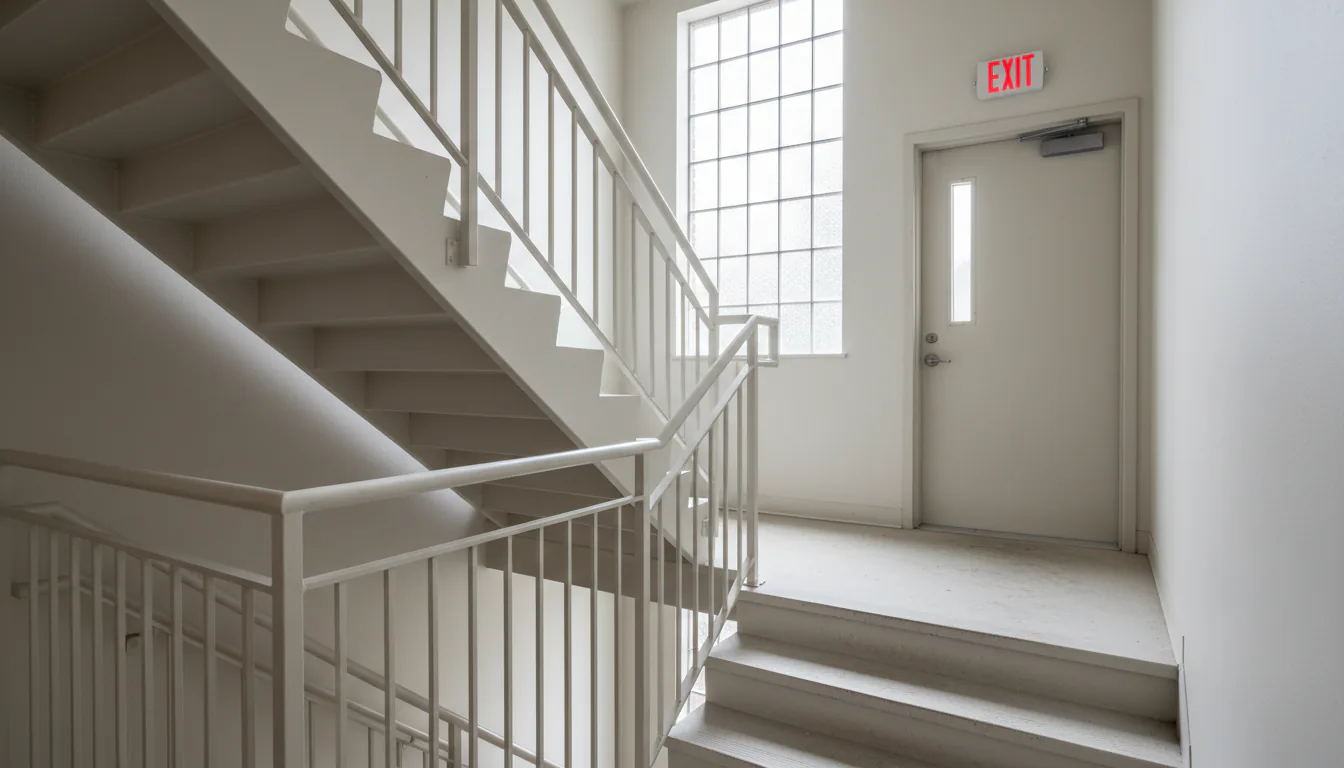
Steel is a non-combustible material under the BC Building Code Part 3 definitions. It does not burn, it does not contribute fuel, and a steel stair in isolation does not need a fire rating in the same way a wood stair does. What carries the rating in a multifamily building is the shaft enclosure, the rated walls, the rated floor-ceiling assemblies at the landings, and the rated doors that open into the shaft on each floor.
The shaft enclosure is typically rated for one or two hours of fire resistance depending on the building’s construction classification under Part 3, combustible, non-combustible, encapsulated mass timber, and the building’s height and area. The architect’s reflected ceiling and the rated assembly listings on the drawings establish which UL or ULC assembly is being used. The stair fabricator is rarely in that decision. The stair is built inside that shaft.
The reason this matters for the fabricator is that the rating only works if the assembly stays intact. Every penetration of the shaft wall by the stair, a header connection, an anchor plate, a guard post welded through to the back side of a stud wall, is potentially a breach. Those connections have to be detailed so the shaft is repaired around them with the same rated assembly the architect specified.
This article is not a substitute for code review by the authority having jurisdiction, an architect, or an engineer.
Intumescent coatings have a narrow but real role
An intumescent coating expands when heated, forming a thick insulating char layer that delays the heating of the steel underneath. On a structural steel column in an open lobby that needs a one-hour rating without being wrapped in drywall, intumescent is one of the standard answers and a published PFP application guide covers the design path.
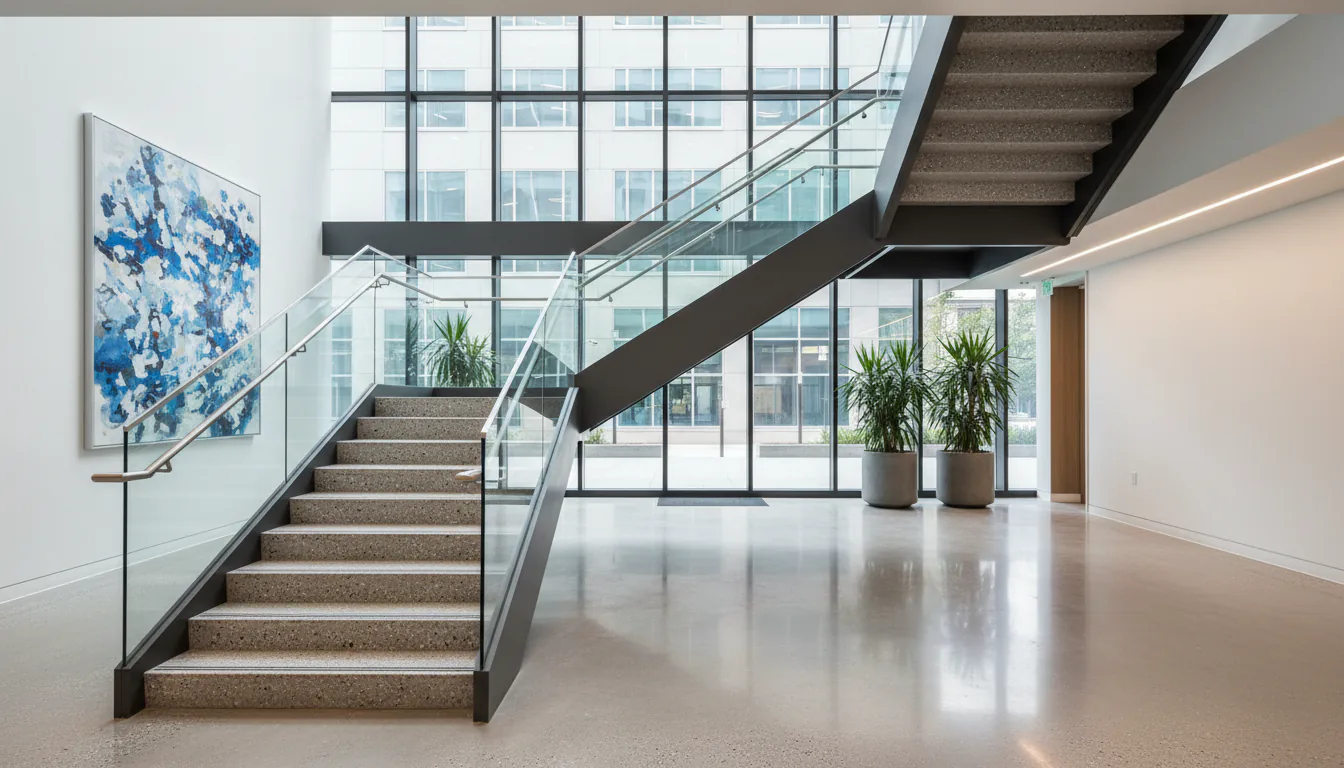
On a multifamily egress stair inside a rated shaft, intumescent is usually not required because the shaft carries the rating. The exception is the mixed-use case, a feature stair in a hotel lobby, a mezzanine stair in a podium retail unit, a stair in an atrium that exits through a rated lobby, where the stair is part of the architectural feature and not enclosed in a shaft. In those cases the structural steel of the stringers, posts, and connections may need to be coated to maintain capacity for the rating period.
The specification matters. Intumescent is a coating system: primer, intumescent, topcoat. The dry film thickness has to be measured. The substrate preparation has to follow the manufacturer’s spec. The topcoat colour can be selected to match the architectural intent. The fire-rated thickness is a separate question from the cosmetic appearance, and both have to be specified together in the finish schedule.
A common coordination failure: the architect specifies a powder coat finish on a feature stair, then a fire consultant later requires intumescent. Powder coat and intumescent are not compatible as a stacked system. The decision has to be made up front, and if the rating is needed, the finish system is intumescent with a topcoat, not powder coat with intumescent over the top.
Doors, hardware, and the landing assembly
The rated stair shaft has doors on every floor. The doors are listed assemblies, a door, frame, and hardware combination tested together and carrying a published rating. They are not the fabricator’s scope, but the stair landings are.
The landing structure is where the stair scope and the door hardware scope meet. The fabricator sets the landing elevation, the landing-to-door threshold dimension, and the clear floor area in front of the door for the occupant load. The architect sets the door swing direction, the hardware schedule, and the closer specification. The clear width through the door at the landing, the clear floor area required for the door to swing without encroaching on the stair run, and the threshold detail are checked at inspection. We coordinate those dimensions with the architect at shop drawing review, and we resist any field change that compresses the landing without the architect signing off, the inspection will fail and the fix is expensive.
Steel detailing notes that come up on rated stairs
A few practical fabrication decisions repeat on rated multifamily stairs:
- Closed risers vs open risers. Most rated egress stairs use closed risers. Open risers in a smoke-control shaft can allow smoke to move vertically through the stair, which most AHJs will not accept. Closed risers also reduce the visual line of sight which can be a wayfinding decision in a panic event.
- Tread surface. Closed riser steel pan treads are typically filled with concrete or a poured tread topping to provide a non-slip surface and reduce noise. The tread material is specified for slip resistance and durability under a code-driven traffic load.
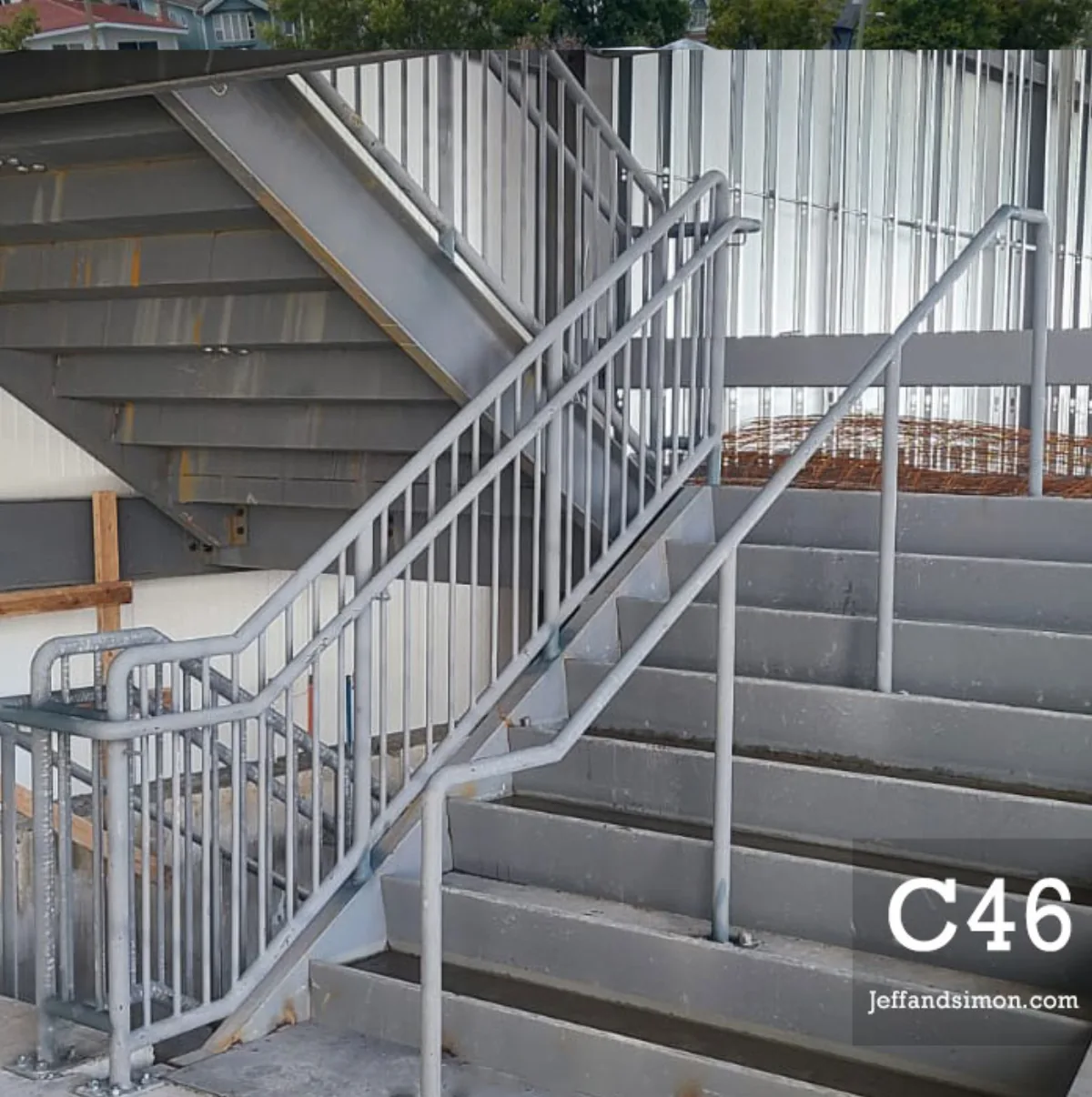
- Guard and handrail geometry. Multifamily egress guards are usually 1070 mm minimum, and handrails are required on both sides for stairs of a certain width and run. The opening between guards has to comply with the climbable-guard provisions of BCBC 9.8 and Part 3. These dimensions are non-negotiable at inspection.
- Connection to the rated assembly. Every weld, bolt, or bracket that lands on the inside face of a rated shaft wall has to be detailed so the wall is patched with rated material around the connection. A field-cut hole through a Type X gypsum assembly is a breach until it is repaired with the same listed assembly.
The coordination that decides whether the stair passes
The fabricator does not control the rating, but the fabricator does control the details that can break it. On a typical Lower Mainland multifamily project, we expect to see three coordination touchpoints before fabrication:
- Shop drawing review with the architect, where the stair geometry, finish, and rated assembly references are confirmed. We pull the architect’s rated assembly numbers (ULC or UL listings) into the stair shop drawings explicitly so the inspector can match them at install.
- Door hardware coordination with the door supplier and the architect, where the threshold dimension, swing clearance, and landing area are confirmed against the stair landing layout.
- Penetration detail confirmation with the framer or drywall sub, where any bracket or anchor that lands in a rated wall has the patch detail specified before fabrication.
When any of these are missed, the inspection finds it. The fabricator’s job is to flag the gap early enough that the architect can resolve it.
For projects where the stair is a feature in a lobby rather than enclosed in a shaft, our piece on commercial staircase design in Vancouver walks through the typical scope split, and the warehouse staircase safety and code guide covers the analogous decisions in industrial occupancies.
The honest version of the cost conversation
A fire-rated egress stair in a Lower Mainland multifamily building is rarely the most expensive stair on the project. The shaft, the doors, the hardware, the smoke control, and the architectural feature stair in the lobby will usually outrun the egress stair by a comfortable margin. What the rated egress stair has is the smallest tolerance for error: the stair has to work at inspection, every time, for the life of the building.
The shop that builds these stairs at scale is not the shop with the lowest unit price. It is the shop that returns shop drawings on time, flags the coordination gaps before they become field issues, and shows up at the inspection prepared to explain what the AHJ is looking at. The cost of a rebuilt landing is more than the cost of an experienced detailer.
Sources
- BC Building Code Part 3, Fire Protection, Occupant Safety and Accessibility
- BC Building Code Section 9.8, Stairs, Ramps, Landings, Handrails and Guards
- AISC, Steel as a Fire-Resistant Material (PFP overview)
Related reading: the commercial staircase design guide, the warehouse staircase safety and code piece, and the BC stair code requirements overview.
Related questions
Do steel egress stairs in BC multifamily buildings need a fire rating?
The stair itself is steel, which is non-combustible. The shaft enclosing the stair is what carries the fire-resistance rating under BC Building Code Part 3. The rating is typically 1 or 2 hours depending on the building's construction classification and the height of the building. The stair is detailed so that openings, landings, and doors do not breach that assembly.
When does a steel stair need intumescent coating?
When the structural steel of the stair itself is exposed inside a rated assembly and the code requires the steel to retain capacity for a defined time during a fire, an intumescent coating is one path. On most enclosed BC multifamily egress stairs the shaft walls carry the rating and the bare painted stair is acceptable. On exposed structural steel in lobbies and mixed-use spaces, intumescent is more common.
What documentation does the AHJ usually ask for?
Shop drawings, stair geometry confirming code dimensions, the door hardware schedule, any fire-rated assembly listings (ULC or UL) used at landings and shafts, and the coating manufacturer's spec sheet if intumescent is applied. The AHJ verifies that the as-built stair matches the drawings reviewed at permit.