Steel vs Aluminum Railings in Vancouver: How to Choose
Steel and aluminum railings look similar in a quote but behave very differently over time. Here is how to compare them for exterior stairs and decks in Metro Vancouver.
Both materials can look clean and hold up outdoors. The difference is in what you can build with each, and what it costs to build it right.
Steel and aluminum railings both cover the same basic function, a guard that keeps people from falling. A quote for an aluminum railing and a quote for a steel railing on the same exterior stair can come from two very different fabricators at very different price points, and the materials behave differently enough that the choice has consequences beyond the initial cost.
This article is not a substitute for code review by the authority having jurisdiction, an architect, or an engineer. It explains how the two materials compare on cost, maintenance, customization, finish, and structural use so that the decision is based on the actual trade-offs, not marketing assumptions in either direction.
The materials are structurally different
Mild steel and aluminum are both metals but are not structural equals. Steel is significantly stronger and stiffer per cross-section, a steel post of a given size carries more load than an aluminum post of the same size. This matters for guards in high-load situations: long cantilever balconies, commercial railings, stairs with unusual geometry, or situations where the structural attachment into a floor or wall is limited.
For standard residential deck guards on wood-framed structures with conventional post spacing, engineered aluminum systems meet BC Building Code load requirements. The structural capacity of aluminum is sufficient for the task. Where aluminum shows a limitation is in non-standard spans, unusual post configurations, and custom structural connections, scenarios where welded steel allows the fabricator to design the connection to the specific load.
The other structural difference is weldability. Steel welds cleanly with consistent quality across a wide range of section sizes. Aluminum welding requires different equipment, different technique, and introduces heat-affected zones that reduce the local strength of the alloy. Welded aluminum fabrication is a specialized capability, not something every shop offers at the same level as steel. For most aluminum residential projects, fabricators work with pre-cut extrusion sections and mechanical connections rather than site-welded aluminum.
The cost comparison is not straightforward
The common assumption is that aluminum is cheaper than steel. For standard residential profiles, colonial balusters, square pickets, conventional post spacing, off-the-shelf top rail, that assumption is often correct. The extrusion process produces standard shapes efficiently and the material cost for the profiles is competitive.
Where the comparison shifts: custom geometry. A straight run of standard aluminum picket railing on a flat deck is typically less expensive than the equivalent in custom-welded steel. A railing with changes in direction, raked sections on a stair, custom picket profiles, or unusual attachment points involves fabrication labour that narrows or eliminates the aluminum cost advantage. At that point, the material cost premium of steel may be comparable to the labour premium of custom aluminum work, and the steel version gives more design flexibility.
The other factor is finish. Standard aluminum profiles come powder coated from the manufacturer in a limited palette of colours. If the project needs a specific finish colour that does not match a standard manufacturer offering, either a custom coat is ordered (adding lead time and cost) or the project moves to custom steel where any powder coat colour is available. For a project where the railing needs to match an existing powder coat on a fence, gate, or stair stringer, steel gives cleaner control over the finish match.
Maintenance differences are real over time
Aluminum’s primary advantage over mild steel is what happens when the finish fails. Mild steel is protected by its powder coat or paint. When that coating breaks down, at a weld, a cut edge, a fastener hole, a scuff during installation, the exposed steel rusts. In Metro Vancouver’s wet climate, a rust breach in a powder coat on an exterior railing can progress noticeably within a season if the breach is not caught and touched up.
Aluminum’s natural oxide layer is stable. If the powder coat on an aluminum railing chips or wears, the exposed aluminum oxidizes but does not spread corrosive damage the way rust does. A neglected aluminum railing looks faded and chalky; a neglected steel railing rusts at its weak points and the rust spreads.
For property managers, strata councils, or owners who cannot guarantee regular inspection and touchup on exterior railings, aluminum’s inherent maintenance tolerance is a real advantage. For owners who can monitor and maintain, powder-coated steel with a good industrial coat performs well in inland Metro Vancouver conditions.
The calculus changes in coastal and waterfront locations. Near tidal water, both materials face chloride exposure. Aluminum’s oxide layer is not immune to chloride attack in aggressive coastal environments, anodized or well-coated aluminum handles it better, but neither material is maintenance-free waterfront. For coastal sites with cable railing hardware, the grade of stainless steel for cables and fittings often matters more than the steel vs aluminum choice for posts.
What custom steel allows that standard aluminum does not
Custom fabrication is where the comparison shifts decisively toward steel for architectural and design-driven projects.
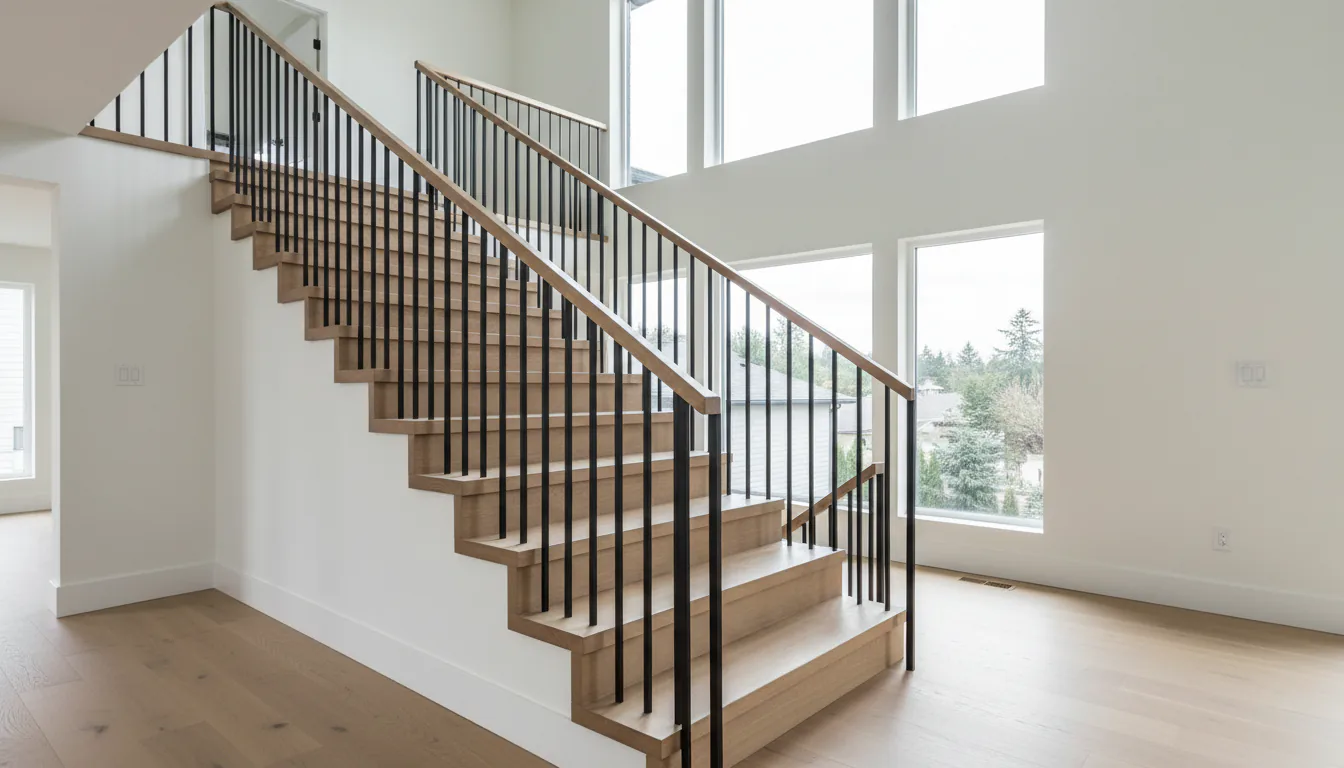
Profile variety. Welded steel can be built from any standard structural section, square tube, round tube, flat bar, angle, channel, in any size. A mono stringer staircase with a steel top rail and horizontal flat bar infill, a cable railing with fabricated steel posts, a guard that transitions from horizontal cable to vertical picket mid-run, all of these require custom fabrication that works cleanly in steel. The equivalent in aluminum would require custom dies or compromises in the profile.
Structural connections. A welded steel post can be designed to attach to a concrete slab edge, a steel beam, a wood joist, or a custom embed plate with a specific weld pattern sized to the load. Aluminum post systems rely on mechanical anchor hardware in standard configurations. When the attachment point is not standard, steel gives the fabricator more tools.
Finish integration. When the railing is one piece of a larger metalwork scope, a stair stringer, a canopy, a gate, a fence, fabricating it in the same material as the rest of the scope means one shop, one powder coat colour, one install. A steel stair with an aluminum guard involves two different material systems that can visually match but structurally behave differently and may come from different suppliers.
Repair and modification. A welded steel railing can be cut, extended, or modified in the field with standard welding equipment. An aluminum extrusion railing is difficult to field-weld and repairs typically involve mechanical replacement of sections.
When aluminum makes more sense
Standard aluminum extrusion railing is a legitimate choice for residential deck guards, front entry stairs, and exterior guards where the geometry is conventional, the finish colour is available in a standard offering, and the owner’s priority is low-cost and low-maintenance over design flexibility.
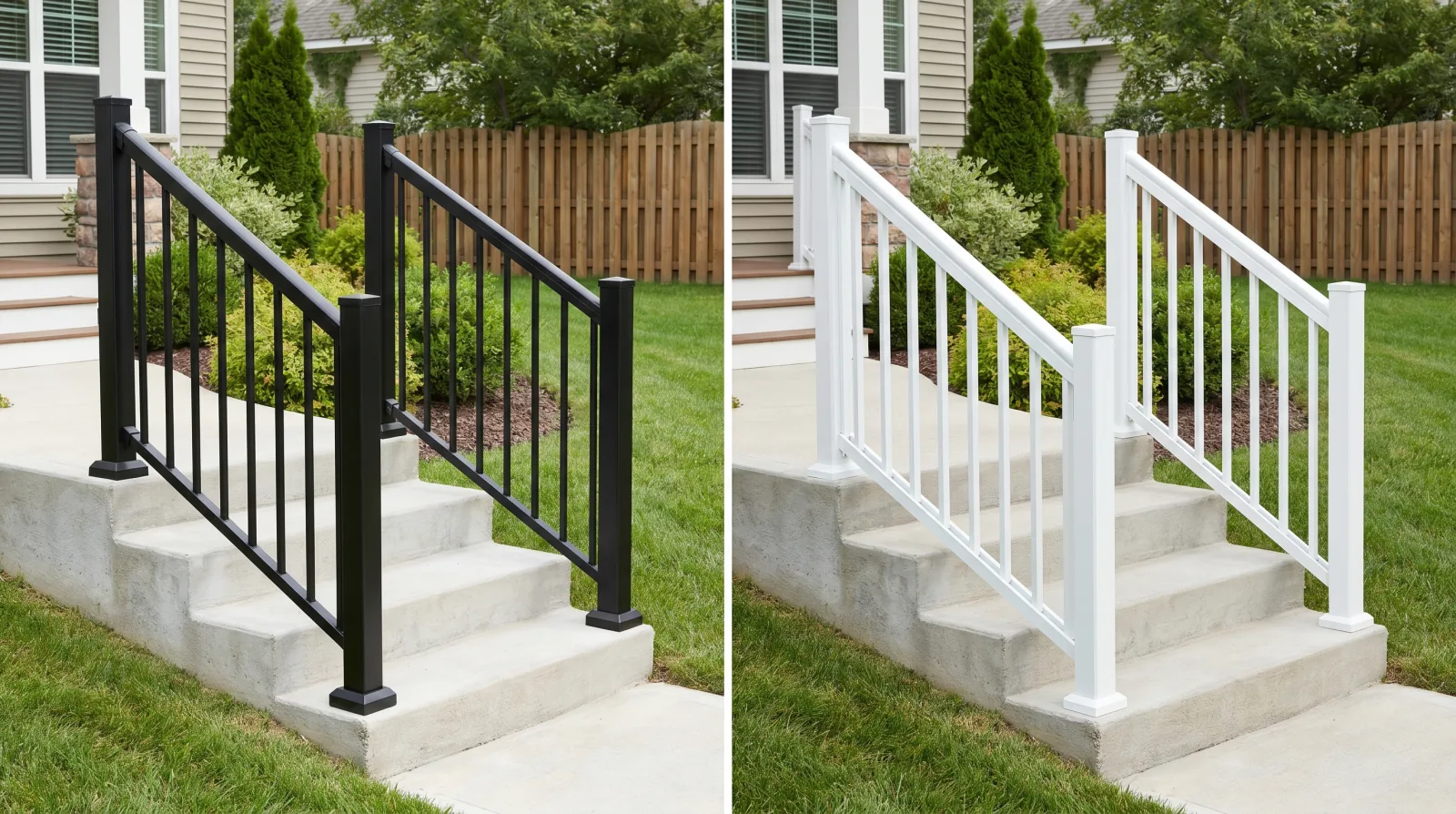
In practice, this describes a significant portion of residential deck and balcony guard replacements in Metro Vancouver, a straight run on a flat deck, a simple stair section with conventional post spacing, a standard black or white finish. Aluminum handles this scope well at competitive cost.
It also describes most strata building common-area guard replacement programs, where the scale of linear footage, the need for consistent standard profile, and the low-maintenance requirement all point toward engineered aluminum systems as a sensible choice.
Getting a comparable quote for both materials
If the decision is still open, ask the fabricator to quote both materials on the same scope. A quote for custom-welded steel and a quote for an engineered aluminum system on the same project will show the actual cost difference for that geometry and finish, not a theoretical comparison.
Ask specifically: what grade and profile of aluminum is specified? What powder coat thickness and brand? What is the post attachment method? These questions reveal whether the aluminum quote is for a light residential system or an engineered one, and whether the steel quote assumes standard mild steel or a more expensive alloy.
The material decision matters more than it looks on a single-line quote. A railing that performs for thirty years and requires occasional touchup is a different outcome than a railing that needs panel replacement in ten, both are “railing,” and both can show up at similar initial cost.
Resolve the material specification before shop drawings are issued. At that stage, switching materials is a scope change. After fabrication starts, it is much more disruptive.
Vancouver Stairs fabricates custom steel railings, and also works with aluminum systems where the scope suits the material. For an exterior stair or deck guard project, include the linear footage, attachment conditions, finish requirement, and any structural drawings when reaching out for a quote.
Related reading: the steel staircases hub for railing systems and finish options, the stainless steel railing 304 vs 316 guide for coastal material selection, and the metal stair railing maintenance guide for long-term care of steel and aluminum systems.
Related questions
Which is cheaper, steel or aluminum railing?
Aluminum extrusion railings are typically lower cost for standard residential profiles because the extrusion process is efficient and the material ships in standard sections. Custom steel railings involve more fabrication labour, welding, grinding, fitting, but can be built to any geometry or profile that a standard extrusion cannot match.
Does aluminum rust?
No. Aluminum does not rust the way mild steel does. It oxidizes on the surface, forming aluminum oxide, but this layer is stable and does not spread the way rust does. For exterior use without a finish, aluminum holds up without the protective coating that steel requires.
Does steel railing need more maintenance than aluminum?
Mild steel railing needs a durable finish, powder coat, wet paint, or galvanizing, and that finish needs periodic inspection and touchup. A failed powder coat on steel will rust at the breach point. Aluminum can be left bare or powder coated; if the coat fails, the aluminum surface stabilizes without spreading corrosion. For low-maintenance exterior applications, aluminum has an inherent advantage. For durability at structural connections and non-standard geometries, steel is the better material.
Can I get a custom profile in aluminum?
Custom aluminum extrusion is possible but requires a die and a minimum order quantity that makes it uneconomical for a single residential project. Standard residential aluminum rail profiles, colonial, contemporary, square, round, are off-the-shelf from most suppliers. True custom geometry, unusual post spacings, or non-standard sections typically push a project toward welded steel.
Is aluminum structural enough for a deck guard?
Aluminum railing systems engineered for residential guard duty meet BC Building Code load requirements when installed correctly. Structural aluminum post connections, especially to wood framing, need appropriate hardware and spacing. For heavier structural demands, long spans, or guards adjacent to stairs with unusual geometry, welded steel provides more design flexibility and confirmed structural capacity.
What finishes are available for each material?
Both materials can be powder coated, which gives a similar visual result. Standard aluminum profiles come in a narrower palette of standard colours from the manufacturer. Custom steel allows any powder coat colour. Hot-dip galvanizing is available for steel but not aluminum; anodizing is available for aluminum but not steel. For a project where the finish colour and texture are part of the design, steel gives more flexibility.
Does the BC Building Code specify which material to use for railings?
No. The BC Building Code specifies structural and dimensional performance requirements for guards, height, loading, opening limits, handgrip, not the material. Either steel or aluminum can comply when the assembly meets those requirements. This article is not a substitute for code review by the authority having jurisdiction.
How long does each material last outdoors in Vancouver?
Both materials can last decades when properly installed and maintained. Aluminum is more tolerant of neglected maintenance because its natural oxide layer is protective. Powder-coated steel lasts as long as the finish, a well-applied industrial powder coat in an inland Metro Vancouver environment should perform for many years without failure, but a thin or poorly adhered coat will fail sooner. Both are long-term choices when the installation and finish quality are right.
Can steel and aluminum components be mixed in the same railing?
Mixing is technically possible but creates galvanic corrosion risk when the dissimilar metals are in direct contact in a wet outdoor environment. Steel fasteners against aluminum posts, or aluminum fittings on steel rails, can accelerate corrosion at the contact point. If mixing is unavoidable, use isolation tape or non-metallic spacers at contact points and confirm with the fabricator.
Is a permit required to replace an exterior railing in Vancouver?
Replacing a guard on an exterior deck or stair generally requires a building permit in Metro Vancouver municipalities. The permit confirms the new assembly meets current BC Building Code requirements for guard height, structural attachment, and loading. This applies regardless of material. Confirm with the building department before starting work.