Welded vs Bolted Stair Stringer Connections: What Shows, What Carries
Welded and bolted stringer connections behave differently in fabrication, on site, and over the life of a custom steel stair. A working fabricator's view of the choice.
Welds are silent and bolted joints are honest. Choosing between them is part structural decision and part finish decision, and the right answer depends on where the joint lands.
Every custom steel staircase is a stack of connections. Each one can be welded, bolted, or some combination of the two, and the choice for each joint is a small structural and finishing decision that adds up to the character of the stair. The shorthand that welds always look cleaner and bolts always carry more load is wrong in both directions, the right answer depends on where the joint lands, when in the schedule it is made, and what finish runs across it.
What each connection is, structurally
A welded stringer connection fuses two pieces of steel into one continuous piece through localized melting at the joint. Most stair welding uses gas metal arc welding (GMAW, often called MIG) for production work and gas tungsten arc welding (GTAW, or TIG) for visible welds that need a finer bead. The resulting joint, when designed and inspected to Canadian Welding Bureau / CSA W47.1 requirements, behaves structurally like a continuous piece of steel, it carries shear, tension, compression, and moment along the path of the weld.
A bolted stringer connection clamps two pieces of steel together through one or more high-strength bolts in a sized hole. The connection capacity comes from the bolt’s tension and shear strength plus the friction between the clamped surfaces. The AISC Steel Construction Manual’s bolt design provisions and the parallel Canadian CSA S16 standard for structural steel govern how bolted connections are designed in commercial work, and the same logic carries down into custom residential steel.
The key point: both connection types can be engineered to carry whatever load the stair imposes. Strength is rarely the question. The question is which type fits the rest of the project.
Welded connections own the shop
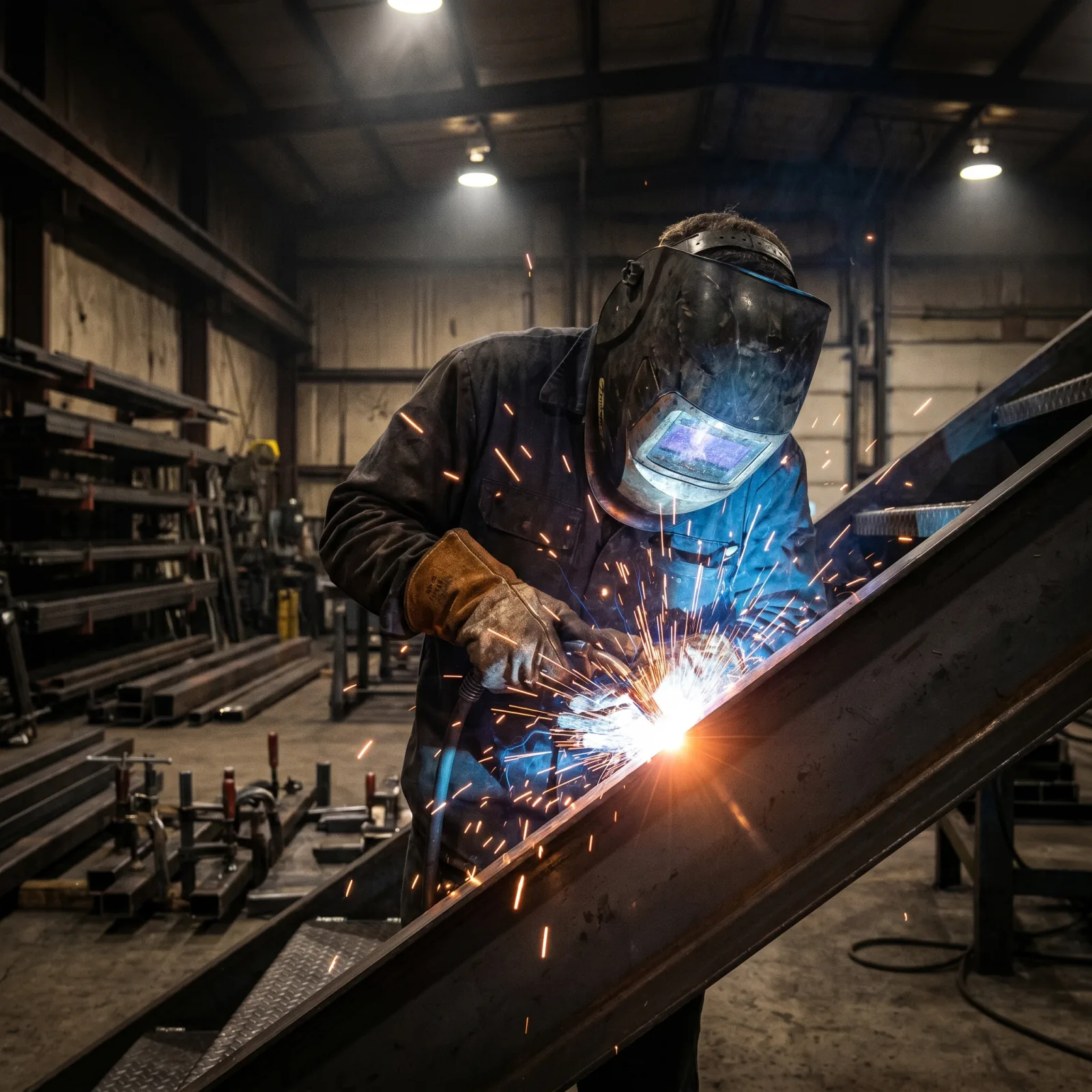
Inside a fabrication shop, welded connections are usually the path of least resistance. The pieces sit on a fixture, the welder makes a clean fit-up, and the joint comes out fast and structurally continuous. For internal connections that will never be assembled on site, the joint between a stringer and a tread bracket, the joint between two segments of a long stringer that ship as one piece, the joint between the stringer and a closed-end cap, welding is the default in our shop because it produces a single rigid object that travels and installs as one unit.
Welded joints in a visible location need a different level of finish. The weld bead has to be ground or feathered to match the surrounding steel before paint or powder coat, and the heat-affected zone has to be dressed so the finish reads uniformly across the joint. A skilled welder makes that grinding fast; a less experienced welder leaves the next finisher fighting the joint for an hour. We invest in welder skill specifically because of this, a clean shop weld saves more downstream finishing time than the wage differential costs.
Bolted connections own the site
The moment a stair is too large to ship as one piece, bolted connections enter the project. Site welding is technically possible and structurally valid, but it has real disadvantages for finished stair work. The finish gets burned at the weld location and has to be touched up, and touch-up paint never quite matches a factory-cured finish under raking light. Site welding requires power, ventilation, and a welder qualified for the position and material, all of which are expensive to mobilize for a small joint. Inspection of a site weld is harder than inspection of a bolted joint, because visual inspection of a bolt pattern and a torque check is straightforward, while inspecting a weld for full penetration or undercut requires more skill and sometimes non-destructive testing.
The site assembly of a large custom stair is usually a series of bolted joints, stringer-to-landing, stringer-to-base-plate, multi-piece-stringer-to-stringer at the splice, combined with welded joints made entirely in the shop. The shipping pieces are designed to bolt together cleanly and to hide the bolts behind treads, finishes, or wall framing wherever possible.
Finish system drives part of the choice
The finish system on a custom stair sits on top of the connection choice. A fully welded stair receives finish as a single object, which produces the cleanest, most consistent appearance. A multi-piece bolted stair receives finish on each piece separately and is assembled afterward, which means the bolt heads, the joint lines, and any touch-up between pieces are visible until covered.
For a powder coated stair, this matters. The powder coat process needs the parts to fit the oven, so most large feature stairs are powder coated in pieces and bolted on site. The bolted joints are then hidden behind treads or behind a wall finish so the visible stringer face reads continuously. Our earlier piece on powder coat vs wet paint for interior steel stairs walks through how the oven size shapes the assembly breakdown specifically for that finish choice.
For a wet-painted stair, the finish can be applied across a site weld and feathered to match, so a welded site joint becomes a viable choice for very large assemblies where shipping in pieces is impossible. The trade-off is the finish quality, the site safety, and the inspection workload, none of which are trivial.
Hidden bolts, featured bolts, and exposed welds as design
The architectural conversation about connections often comes down to whether the joint is hidden or featured. Three common approaches show up in our work.
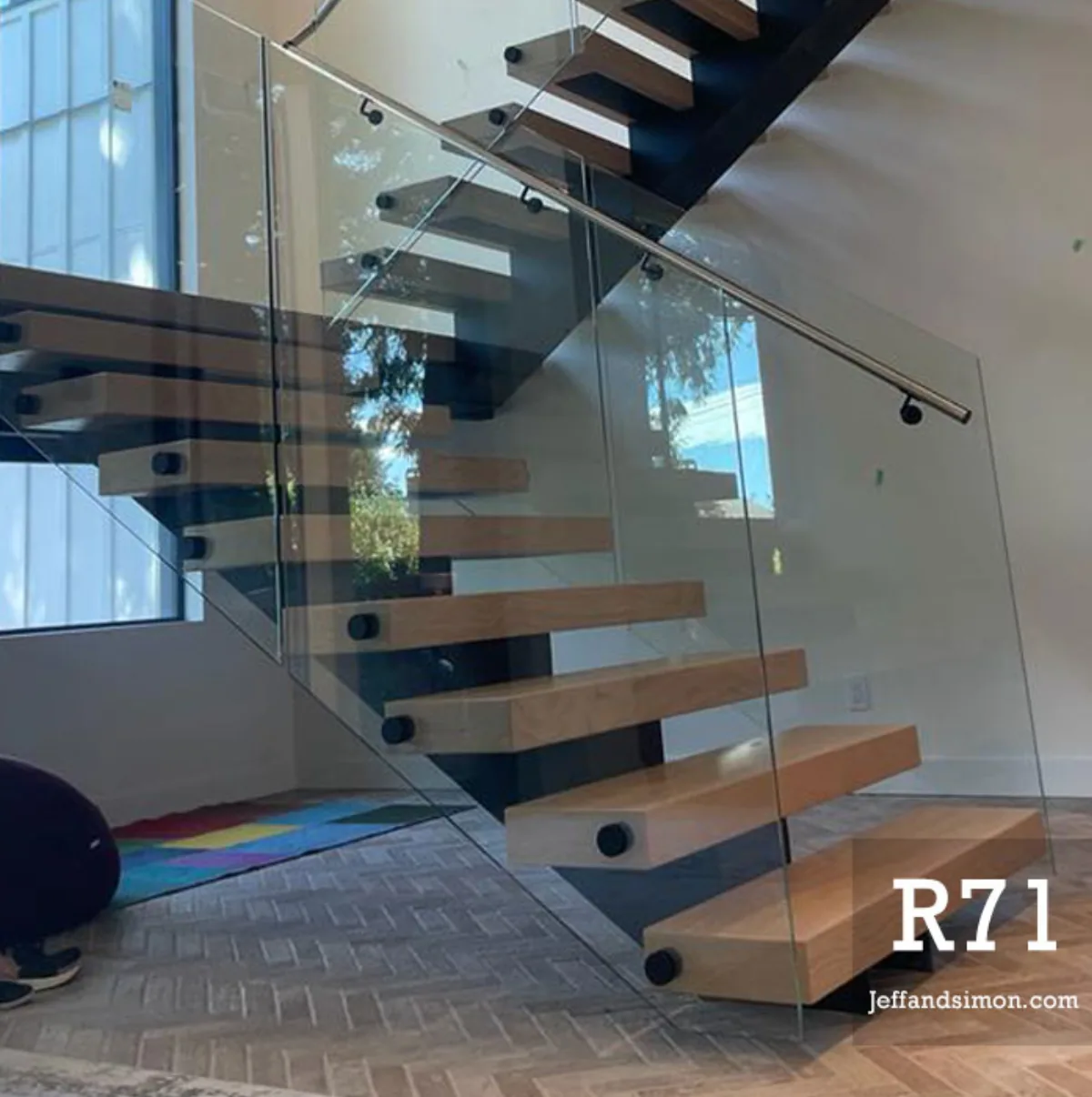
Hidden bolted joints are the default for feature residential stairs. The bolt pattern lands behind a tread, inside the closed back of a stringer, or behind a wall finish. The visible steel reads as a continuous piece because the joint is invisible. This approach demands disciplined connection design, the joint has to land exactly where the cover detail allows, and the bolt orientation has to be accessible for assembly without breaking the cover plane.
Featured bolted joints turn the bolt head into a deliberate visual element. A pattern of architectural-grade button-head bolts on a stringer face reads as a designed detail, especially in industrial or loft-style projects where exposed steel and exposed fasteners are part of the language. The bolt heads, the spacing, and the pattern get drawn on the architectural elevations alongside the steel itself.
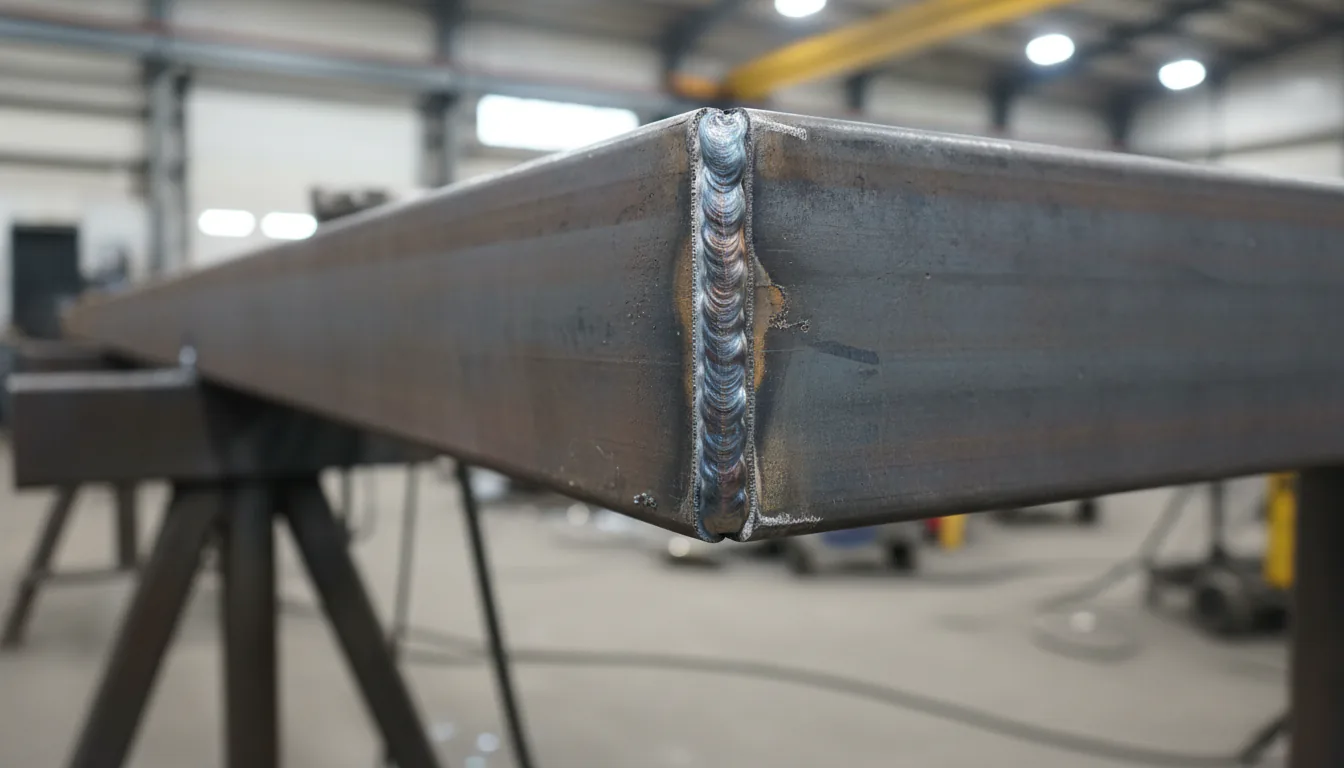
Exposed welded joints can do the same thing in a different visual register. A clean TIG weld bead at the joint between two stringer pieces, ground to a uniform crown, reads as an honest piece of metalwork. This works best on raw or hot-rolled finishes where the bead becomes part of the steel surface texture, and works less well on glossy painted finishes where any irregularity in the weld shows.
Inspection, traceability, and the engineer of record
For most commercial stair work in BC, the engineer of record specifies which connections are welded and which are bolted, and the welding and bolting are inspected to a standard sequence. Welds in critical structural locations are typically inspected visually and, for major joints, by non-destructive testing such as magnetic particle or ultrasonic inspection per CSA W178.2 for welding inspectors. Bolted connections are inspected for bolt grade, hole pattern, and final torque or tension per the structural drawings.
In our shop we keep a connection log for every commercial stair project, the welder ID for each weld, the inspection result, the bolt batch traceability, and the torque records. The log gets handed to the engineer of record at substantial completion. For residential custom work the documentation is lighter, but the same rigor applies to the joints that matter structurally.
The right joint, the right place
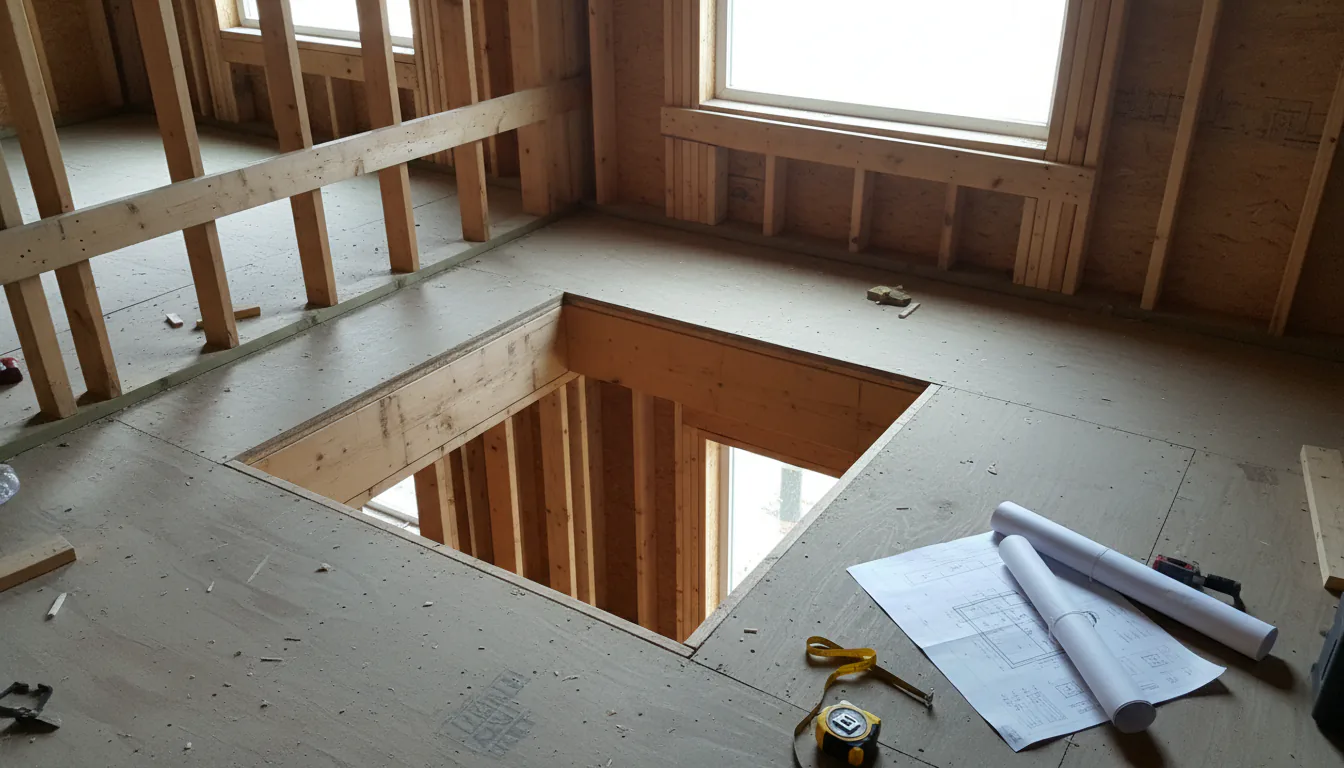
The cleanest custom stair we ever fabricate is the one where the connection plan was drawn before the steel was cut. Each joint in the stair has a reason it is welded or bolted, shop sequencing, finish coordination, site access, inspection, and the architectural intent is built around the joint plan rather than fighting it. When that order is reversed, when the joints are drawn last to fit a finished architectural look, the connections usually get harder, more expensive, and more fragile.
The strongest projects we work on settle the welded-versus-bolted question early. Shop welds where they save time and stiffness. Bolted joints where the site assembly demands them. Hidden joinery where the architecture asks for a continuous line, featured joinery where the architecture asks for an honest one. The joints are the stair, and treating them as the first design decision rather than the last produces the cleanest finished steel.
Sources
- CSA W47.1, Certification of companies for fusion welding of steel
- AISC Steel Construction Manual
- CSA S16, Design of steel structures
- CSA W178.2, Certification of welding inspectors
This article is not a substitute for the engineer of record’s connection design or the AHJ’s inspection requirements. Connection type, size, and inspection scope should be confirmed by the project engineer on every custom stair.
Related questions
Is a welded stringer connection stronger than a bolted one?
Not necessarily. Both can be designed for the same structural capacity. The choice is usually driven by fabrication sequence, the finish system, and whether the joint has to be visible or hidden. Engineered bolted connections in stair work routinely meet or exceed the welded alternative.
Why are bolted connections common at site joints?
Welding on site after a finish has been applied damages the finish and is awkward to control for quality. Bolted site connections preserve the finish, are inspectable visually, and can be tightened and torqued to a defined value. We default to bolted at every joint that will be assembled on site.
Can a stair be entirely welded?
Yes, for small stairs that can be shipped as a single shop-welded assembly. As soon as the stair has to be split into pieces for transportation or for finish reasons, at least one site joint becomes bolted. The choice is geometry, not preference.
Do bolted connections need to be hidden?
On feature stairs, usually yes. We hide bolted joints behind treads, behind wall finishes, or inside boxed sections so the visible stringer reads as a continuous piece of steel. Where bolts have to be exposed, the bolt head and pattern become a design element and we detail them deliberately.