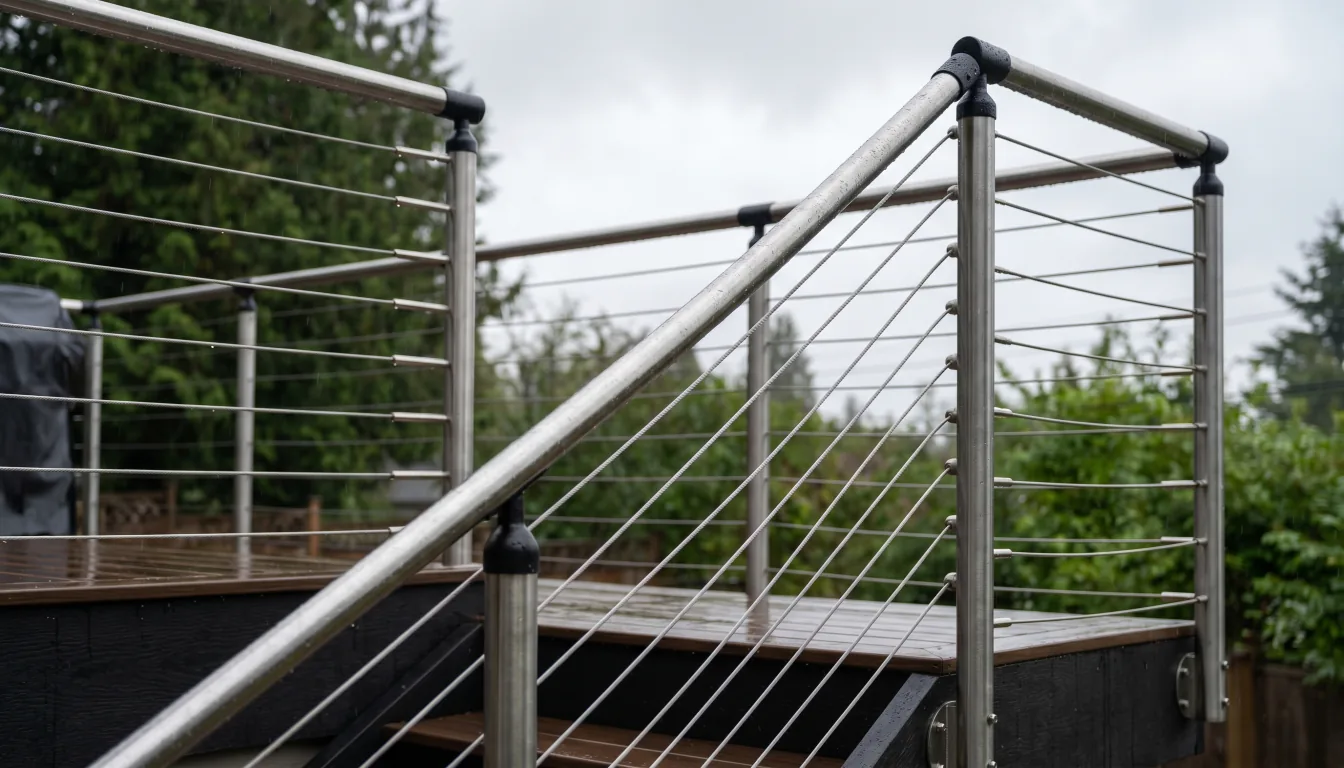
Railing quotes in Metro Vancouver span a wide range for the same measured length, which is why two quotes for the same balcony can differ by thousands of dollars. The spread is not arbitrary. It tracks the infill system, whether the run is a stair or a flat deck, the finish specification, and how hard the site is to work on. This page gives the per linear foot bands we quote by system as of September 2026, then explains which variables move a number within its band and which push a project into the next one.
What each system costs per linear foot, installed
These are installed Metro Vancouver figures as of September 2026, covering supply, fabrication, finish, and installation. They are ranges rather than prices because every railing is quoted after a site measure. Deck and balcony runs sit toward the lower end of each band, stairs toward the upper end.
| System | Cost per linear foot (installed) | Notes |
|---|---|---|
| Picket or steel infill | $110 to $185 | Lowest cost family, most predictable to fabricate |
| Cable railing | $175 to $425 | Post spacing and stainless grade drive the range |
| Semi-frameless glass | $250 to $350 | Visible top or side rail carries the panel |
| Frameless glass | $350 to $700 | Standoff or base shoe, low-iron glass at the top end |
| Strata and multi-family | $90 to $300 | Volume pricing, but access and height add cost |
Stairs cost more than decks, consistently
The same railing system costs more per linear foot on a stair than on a flat deck run, and the reason is geometry rather than material. Cable railing on a stair typically costs 20 to 35 percent more per linear foot than on a deck. Glass on a stair sits in the same $350 to $700 band but needs custom-cut angled panels instead of rectangles, so each panel is a one-off rather than a repeat.
- Angled post connections replace square ones, adding fabrication time at every post.
- Glass panels are cut to the stair pitch, so no two runs share a panel size.
- Handrail continuity requirements add hardware at the top and bottom of every flight.
- The triangular gap at the tread nosing needs a sphere-rule detail a flat run never needs.
The five variables that move a quote most
Within any system's band, five things decide where a specific project lands. In our experience they matter roughly in this order.
- Infill system: the single largest lever, and the reason the overall spread runs from $110 to $700.
- Stair versus flat run: 20 to 35 percent on cable, and a shift from repeat panels to custom cuts on glass.
- Finish specification: powder coat over prepared steel, versus hot-dip galvanizing plus a topcoat for exterior exposure.
- Site access: a ground-floor deck versus a fourth-floor balcony with no elevator changes the labour substantially.
- Substrate condition: an existing deck or slab that needs blocking, reinforcement, or a new anchor detail before the railing can be installed.
Cable versus glass, on the same run
At comparable post and hardware quality, cable is typically 40 to 60 percent less expensive per linear foot than glass. That is the clearest cost decision in the whole railing category, and it is why cable is so common on Metro Vancouver decks where the view matters and the budget is finite. Glass earns its premium where the sightline has to be completely unbroken, next to a feature window or across a view the design frames as one continuous surface. Where the guard faces a fence or a wall, the premium buys nothing. Our glass versus cable comparison covers the decision beyond cost.
Why strata pricing looks lower per foot
Strata and multi-family railing replacement runs $90 to $300 per linear foot installed, with per-unit project costs of $5,500 to $13,000 depending on system type, building height, and access conditions. The per-foot figure looks lower than residential because the work repeats across many identical balconies, so shop setup, drawings, and mobilization spread across the whole job. Building height and access work in the opposite direction: a high balcony with no elevator access for materials adds cost that a ground-level deck does not carry. The strata railing decision guide covers the council approval process.
What the cheapest quote usually leaves out
When one railing quote comes in far below the others, the gap is usually in items that are invisible on a quote sheet and expensive later. The common omissions are engineering for the guard connections, a substrate repair or reinforcement the existing structure actually needs, a finish specification appropriate to the exposure, and the handrail itself where the client assumed the guard covered it. Our guide on how to read a metal fabrication quote walks through the line items worth comparing.
Finish cost by exposure
Finish is where exterior projects separate from interior ones. An interior railing takes a powder coat over properly prepared steel and that is the end of the conversation. An exposed exterior railing in Metro Vancouver, and particularly a waterfront one, needs hot-dip galvanizing under a topcoat or a stainless specification, which costs more up front and far less over the life of the railing. Choosing an interior-grade finish for an exterior application is the most expensive saving available in this category, because the replacement arrives years early. The exterior railings and corrosion page covers the finish decision by exposure class.
How to get a quote that holds
A railing quote is only as good as the information behind it. What we need to give a number that does not move: the measured length of every run, whether each run is stair or flat, the drop below each guard so the required height is known, the substrate the railing will anchor into, photographs of the site access, and the infill and finish preference if there is one. Without the drop and the substrate, any number is a guess, and a guess that moves at the site measure helps nobody.
Related questions
How much does railing cost per linear foot in Vancouver?
As of September 2026, installed Metro Vancouver railing costs run $110 to $185 per linear foot for picket and steel infill, $175 to $425 for cable, $250 to $350 for semi-frameless glass, and $350 to $700 for frameless glass. Strata and multi-family replacement work runs $90 to $300 per linear foot. Every figure covers supply, fabrication, finish, and installation, and every project is quoted after a site measure.
Why is cable railing cheaper than glass?
At comparable post and hardware quality, cable is typically 40 to 60 percent less expensive per linear foot than glass in Metro Vancouver. Cable avoids the panel cost, the heavy mounting hardware, and the structural allowance a frameless glass guard demands from the substrate underneath it. Cable railing runs $175 to $425 per linear foot installed against $350 to $700 for frameless glass.
Does a stair railing cost more than a deck railing?
Yes, consistently. Cable railing on a stair typically costs 20 to 35 percent more per linear foot than the same system on a flat deck. Glass on a stair stays in the $350 to $700 band but requires custom-cut angled panels rather than repeating rectangles. The drivers are angled post connections, handrail continuity hardware at the top and bottom of each flight, and the sphere-rule detail where the guard meets the tread nosing.
What is the cheapest railing option in Vancouver?
Picket and steel infill railing is the lowest-cost family, at $110 to $185 per linear foot installed in Metro Vancouver. The material is inexpensive, the fabrication repeats, and compliance with the 100 mm sphere rule comes down to a single repeated spacing dimension. It is also the lowest maintenance exterior option when specified in hot-dip galvanized steel under a topcoat.
How much does frameless glass railing cost?
Frameless glass railing runs $350 to $700 per linear foot installed in Metro Vancouver, with low-iron glass and premium stainless hardware at the upper end. Semi-frameless systems, which use a visible top or side rail to carry the panel, run $250 to $350 per linear foot. The gap reflects the hardware carrying the full panel load without support posts in a frameless system.
Why do railing quotes vary so much for the same length?
Five variables move a railing quote: the infill system, whether the run is a stair or a flat deck, the finish specification, site access, and the condition of the substrate the railing anchors into. The infill choice alone spans $110 to $700 per linear foot. A quote far below the others is usually missing engineering, substrate repair, an exposure-appropriate finish, or the handrail itself.
What does strata railing replacement cost per unit?
Strata railing replacement in Metro Vancouver runs $5,500 to $13,000 per unit, or $90 to $300 per linear foot installed, depending on the system type, the building height, and balcony access conditions. The per-foot figure sits below residential pricing because shop setup, drawings, and mobilization spread across many identical balconies, while height and difficult material access push in the other direction.
Does the finish affect railing cost much?
Substantially on exterior work. An interior railing takes a powder coat over prepared steel. An exposed Metro Vancouver exterior, especially near salt water, needs hot-dip galvanizing under a topcoat or a stainless specification, which costs more up front and far less across the railing's life. Specifying an interior-grade finish for an exterior application is the most expensive saving in this category, because replacement arrives years early.
What information do you need to quote a railing?
The measured length of each run, whether each run is a stair or flat, the drop below each guard so the required height is known, the substrate the railing will anchor into, photographs showing site access, and any infill and finish preference. The drop and the substrate matter most. Without them a number is a guess that will move at the site measure, which serves nobody.
Is it cheaper to repair or replace an old railing?
It depends on what failed. Recoating a structurally sound guard is far cheaper than replacing it. Where the failure is at the connections, where posts have corroded at the base, or where the existing guard does not meet current height or sphere-rule requirements, replacement is usually the better value, because a renovation that touches the guard generally triggers a rebuild to current code rather than a patch.
Continue reading
- Previous: Exterior Railings & Corrosion
- Railings and guards hub overview
- BC Building Code for stairs and guards
Discuss railing cost guide vancouver: $110 to $700 per linear foot for a real Vancouver project
Send drawings, photos, or a rough scope and we will help define the practical next step.