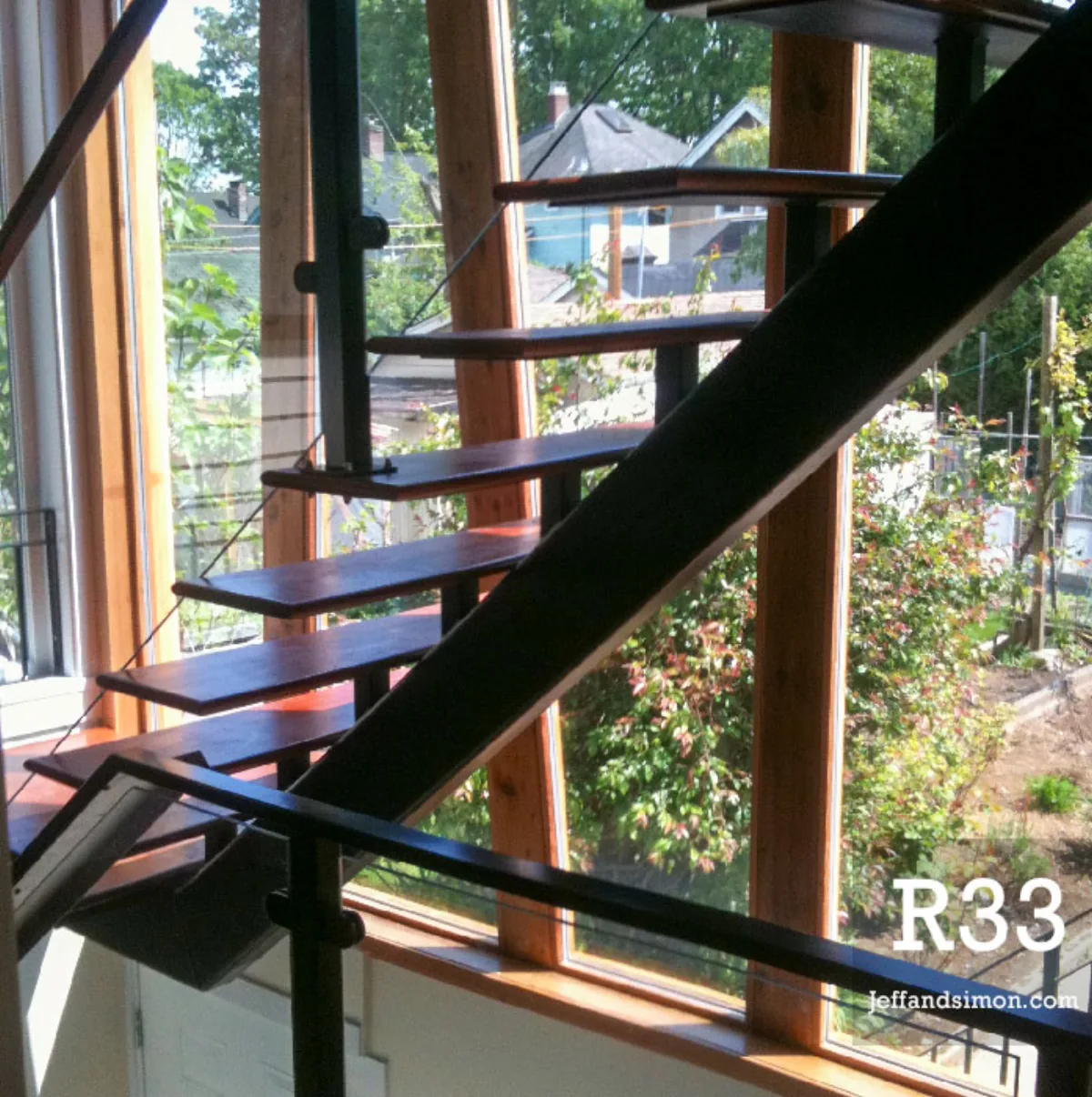
Glass and cable are the two guard infills Vancouver Stairs installs most often on floating and mono stringer staircases, and they solve the same problem, an open view with a code-compliant guard, in different ways. Neither is better across the board. The right one depends on budget, the view behind the stair, how much cleaning the homeowner wants to do, and how the guard reads against the rest of the house. This page compares them directly on the dimensions that actually change the decision.
Cost: cable starts lower, glass has a wider ceiling
Cable railing in Metro Vancouver runs $175 to $425 per linear foot installed. Glass railing runs $350 to $700 per linear foot installed, with frameless systems and low-iron glass at the top of that range. Stair applications cost more than deck applications for both products, angled post connections, continuous handrail hardware, and BC Code sphere-passage requirements all add labour that a flat deck run does not need. At comparable post and hardware quality, cable is typically 40 to 60 percent less expensive per linear foot than glass.
| Guard type | Cost per linear foot (installed) | Stair premium vs deck |
|---|---|---|
| Cable railing | $175 to $425 | 20 to 35% more than deck cable |
| Glass railing (semi-frameless) | $250 to $350 | included in stair range above |
| Glass railing (frameless) | $400 to $700+ | included in stair range above |
View: both disappear, differently
Glass gives an unobstructed, uninterrupted sightline, nothing crosses the view at any height. Cable is nearly as transparent in practice because the eye focuses past the thin horizontal lines rather than on them, but a cable run does introduce a faint horizontal texture that glass does not. For a stair backed by a feature wall or a view window, glass reads as closer to invisible. For a stair where the guard itself is part of the architectural language, cable's horizontal lines can be the more deliberate choice.
Maintenance: cable is the lower-effort system
Cable railing needs periodic tension checks and an occasional wipe-down, stainless cable does not water-spot the way glass does. Glass shows fingerprints, water spots, and dust more readily, especially near an entry or a kitchen, and needs regular cleaning to stay looking frameless. Homeowners who want a guard they do not think about tend to land on cable. Homeowners who are already committed to a high-maintenance material palette elsewhere in the house, glossy floors, a lot of glazing, rarely mind the extra glass cleaning.
Structure and code: both work on floating and mono stringer stairs
Cable and glass both meet the BC Building Code 100 mm sphere-passage rule for guards when the post spacing and cable tension, or the panel and post connection, are engineered correctly. Cable needs closer post spacing and a tensioning system that holds under load without the cables spreading past 100 mm. Glass needs a post or standoff system, or a base-channel system, rated for the actual panel size and expected lateral load. Both integrate cleanly with a mono stringer or floating stair's open-riser structure, since neither guard type depends on a closed stringer or riser to anchor to.
Which one fits the project
Choose cable when the budget is tighter, the stair backs onto a view worth keeping simple, or low maintenance matters more than a fully invisible guard. Choose glass when the sightline has to be completely unbroken, the stair sits next to a feature window or wall the client wants to read as one continuous surface, or the design language elsewhere in the home is already glass-forward. Either one pairs with a mono stringer, floating, or open-riser stair without a structural conflict, this is a finish decision layered onto a structure that is already decided.
Related questions
Is cable railing or glass railing cheaper for a Vancouver staircase?
Cable railing is cheaper. It runs $175 to $425 per linear foot installed in Metro Vancouver, compared to $350 to $700 per linear foot for glass railing. Cable is typically 40 to 60 percent less expensive than glass for a comparable post and hardware spec.
Does cable railing block the view as much as a solid guard?
No. Cable railing uses thin horizontal stainless cables spaced to meet the 100 mm sphere-passage code rule, and the eye tends to focus past the cables rather than on them, so the view behind the stair reads as close to open. Glass railing gives a fully unobstructed view with nothing crossing the sightline, which is the more transparent option of the two.
Which railing needs less maintenance, glass or cable?
Cable railing needs less maintenance. It needs periodic tension checks and an occasional wipe-down, and stainless cable does not water-spot the way glass does. Glass railing shows fingerprints, water spots, and dust more visibly and needs regular cleaning to keep the frameless look.
Can glass or cable railing be used on a floating staircase?
Yes, both integrate cleanly with a floating or mono stringer staircase because neither guard type depends on a closed stringer or riser to anchor to. The choice between them is a finish decision layered onto the stair's structure, not a structural constraint.
Does cable railing meet BC Building Code guard requirements?
Yes, when the post spacing and cable tensioning are engineered so the cables cannot spread past the 100 mm sphere-passage limit under load. The 100 mm rule is the same code test applied to any guard infill, including glass, pickets, and mesh, under the BC Building Code.
Is glass railing worth the extra cost over cable railing?
It depends on what the guard needs to do. Glass is worth the premium when the sightline must be completely unbroken, next to a feature window or a view the design intentionally frames as one continuous surface. When the budget is tighter or low maintenance matters more, cable delivers most of the same open feel for 40 to 60 percent less per linear foot.
Do glass and cable railing cost more on stairs than on a deck?
Yes for both. Cable railing on a stair typically costs 20 to 35 percent more per linear foot than on a deck, and glass railing on a stair sits at the same $350 to $700 range but requires custom-cut angled panels rather than the rectangular panels a deck uses. Angled post connections and BC Code handrail continuity requirements drive the premium for both products.
Which guard type is more common on Vancouver floating staircases?
Both appear regularly on Vancouver floating and mono stringer staircases, cable slightly more often on budget-conscious projects and glass more often on stairs positioned next to a feature window or an already glass-forward interior. Neither is the default; the choice tracks the view, the budget, and the maintenance preference of the homeowner.
Discuss glass railing vs cable railing for a staircase: vancouver guide for a real project
Send drawings, photos, or a rough scope and we will help define the practical next step.