Bar Grating Stair Treads for Vancouver Industrial Stairs
Where serrated and plain bar grating treads beat solid or checker plate on Vancouver warehouse stairs, plus drainage, galvanizing, nosing, and code.
Bar grating treads drain, let light through, and stay grippy when wet. On a Vancouver warehouse stair, that is often why they beat a solid plate. The nosing, the serration, and the galvanizing are the details that decide it.
Bar grating stair treads are the default tread for warehouse, plant, and access stairs because they drain water, let light through, and stay grippy when wet. The real decision on a Vancouver industrial stair is not whether to use grating, but which surface, nosing, and finish to specify, and where a solid or checker plate tread beats grating instead.
This post explains what bar grating treads are, the difference between serrated and plain, why grating drains better than a solid plate, how the nosing and galvanizing are detailed, what the BC Building Code asks for on an industrial stair, and the cases where grating is the wrong choice.
Bar grating treads are open steel steps
A bar grating tread is a step made from steel bar grating. Grating is a grid of parallel load-bearing bars, set on edge, held apart by cross bars welded or pressed across them. The bars carry the load along the tread. The cross bars hold the spacing and tie the panel together. Cut the panel to the stair width, add end plates and a front nosing, and it becomes a tread.
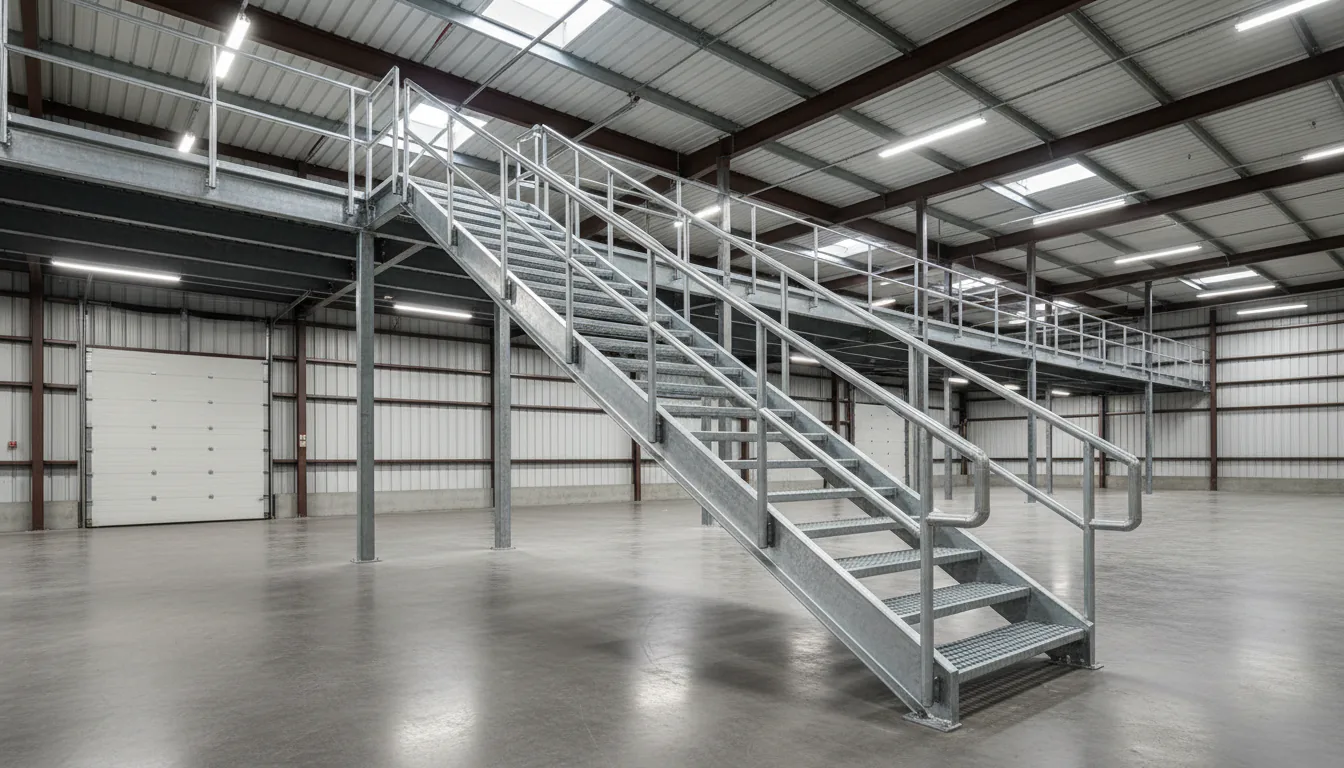
The open pattern is the whole point. Water, light, and small debris pass through the gaps between the bearing bars instead of sitting on the surface. On the switchback galvanized stair in the photo above, every tread is open grating, so nothing collects on the steps and the stair below still gets light.
Steel bar grating and grating stair treads are made to the ANSI/NAAMM MBG 531 Metal Bar Grating Manual, which sets the bar sizes, spacing, load tables, welding, tolerances, and standard tread nosings. A grating supplier such as Direct Metals lists these treads with plain or serrated surfaces and a choice of nosings, in galvanized, carbon steel, aluminum, or stainless. The shop drawing names the grating type, bar spacing, surface, nosing, and finish so the tread matches the load and the traffic.
Serrated grating grips a wet or oily stair
Grating comes in two surfaces, and the choice changes how the stair walks when it is not dry.
Plain grating is the flat top edge of the bearing bars. It is fine for a dry interior stair and it is a little easier underfoot. Serrated grating has a notched, toothed top edge on every bearing bar. Those small teeth bite through a thin film of water, oil, or grease, so the foot grips the metal instead of sliding on the film. The grating manufacturer offers both plain and serrated tops, with serrated aimed at areas prone to oil or other slip hazards.
For most Vancouver industrial and exterior stairs, serrated is the right call. Rain, wash-down, and tracked-in slush all leave a film on the tread, and serration is what keeps the stair grippy through it. Plain grating stays reasonable where the stair is indoors and dry. If you want a broader look at grip options, our guide to anti-slip finishes for exterior Vancouver stairs covers the choices for both grating and solid treads.
Drainage is why grating beats a solid plate
The strongest argument for grating on a Vancouver stair is water. A solid steel or checker plate tread holds water on its surface. That thin film of water, and the dirt and oil mixed into it, is what people slip on, and it is what freezes into a slick layer on a cold morning.
Open grating drains. Water passes straight through the gaps between the bearing bars and falls away, so the tread surface is wet metal instead of standing water. On an exterior stair in this climate, where treads sit under rain for much of the year, that difference matters every day. Grating also does not trap leaves, grit, and debris the way a solid tread with a raised lip does.
Grating is lighter than a solid plate of the same size too, which can matter for a long mezzanine run or a stair that has to be craned and bolted into place. Our overview of mezzanine stair design for Vancouver warehouses walks through where that weight and access saving changes the install.
This article is not a substitute for code review by the authority having jurisdiction, an architect, or an engineer.
The nosing is a separate, welded detail
Grating solves the drainage and grip problem across the middle of the tread, but it does not finish the front edge on its own. The open front bars at the nose are not a clean walking edge, so a nosing is added.
An integral nosing is welded to the leading edge of every grating tread. The common options are a checker plate strip, a cast abrasive nosing, or a grooved aluminum nosing. The nosing gives the foot a defined, solid edge to land on at the top of each step, and an abrasive or contrasting nosing marks that edge so users see where the tread starts. This is the detail that most affects how the stair feels the first time someone walks down it fast.
The nosing also carries the code detail at the front of the tread. On a stair that serves an occupancy other than a dwelling unit, the BC Building Code Part 3 exit and stair provisions set the rise, run, and nose geometry. A Building Code Appeal Board decision on Article 3.4.6.8 reads the rule as being about the riser and the nose: a step needs a closed riser or a limited rakeback, and where a nosing is provided it has specific limits. A welded front nosing on a grating tread is how the fabricator meets that detail. Confirm the exact requirement with the authority having jurisdiction, since the reading can turn on how the stair is classified.
The code governs the whole stair beyond the tread
The tread type is only one part of an industrial stair, and the BC Building Code governs the rest. For a stair serving an occupancy other than a dwelling unit, Part 3 sets the rise, run, guard, and handrail rules, and those apply whatever the tread is made of. A grating exit stair still has to hold the required run and rise, carry a compliant guard, and provide a graspable handrail.
Two grating-specific points come up at review. First, the opening size. Wide grating openings can catch canes, heels, small wheels, and mobility devices, so a stair or landing on an accessible route may need a smaller opening or a different surface. On a general industrial stair that is not an accessible path, a standard opening is usually fine. Second, the load. The grating has to be sized from the manufacturer’s load tables for the required loads of the occupancy, which is a design step, not a catalogue pick.
Because a required industrial stair ties into the building’s exit and life-safety design, the tread choice is confirmed alongside the guard, the connections, and the loads. Our piece on warehouse staircase safety and code in Vancouver covers the wider set of rules that a grating stair still has to meet.
Galvanizing is the default finish for wet use
For any grating stair that sees weather or wash-down, the finish is hot-dip galvanizing. The tread is dipped in molten zinc so every surface of every bar and cross bar is coated, inside the openings and out, to ASTM A123, the standard for hot-dip galvanized structural steel products. That full coverage is what protects a shape as complex as grating, where a brushed-on paint would miss the inner faces of the bars.
Galvanizing lasts. The American Galvanizers Association measures coating life as the time to first maintenance, the point where about 5% of the steel surface shows rust and a touch-up extends the life. In most atmospheric environments that time is measured in decades, so a galvanized grating stair rarely needs coating work for a long time. That long, low-maintenance life is a large part of why galvanized grating is the standard for exterior industrial access in a wet climate. For an interior dry stair, a powder coat or paint over the grating is sometimes used instead, mostly for appearance.
Where solid or checker plate is the better tread
Grating is not always right. The main reason to choose a solid tread is to stop things falling through. On a stair over a work area, walkway, or equipment, a dropped tool or part passing through open grating is a hazard, and a solid or checker plate tread closes that gap. Checker plate keeps a raised anti-slip pattern while staying solid.
The other reason is the look and the feel. Grating reads as industrial, and seeing through the open pattern from height bothers some users. Where a stair has to read as a finished interior element, or where comfort underfoot matters more than drainage, a solid tread wins. A grating tread with a solid infill panel is a middle option that keeps the grating frame but closes the surface.
The honest way to choose is to name the problem the tread has to solve. If the problem is water, grip, weight, or light, grating is usually the answer, and serrated galvanized grating with a welded nosing is the workhorse spec. If the problem is falling objects, a finished appearance, or comfort, a solid tread earns its place. Send the fabricator the occupancy, the loads, the exposure, and whether the stair is a required exit, and the tread choice follows from there rather than from a catalogue.
Sources
- BC Building Code Part 3, Section 3.4 Exits (Division B)
- BC Building Code Part 3, Section 3.3 Safety within Floor Areas (Division B)
- BC Building Code Appeal Board decision BCAB 1792, Article 3.4.6.8 stair nosings and rakeback
- Direct Metals, bar grating stair treads: surfaces, nosings, finishes, and NAAMM standard
- American Galvanizers Association, estimating the life of hot-dip galvanized coatings
- American Galvanizers Association, atmospheric longevity and time to first maintenance
Related reading: warehouse staircase safety and code in Vancouver, mezzanine stair design for Vancouver warehouses, and anti-slip finishes for exterior Vancouver stairs.
The strongest industrial stair specs start from the problem, not the part. Tell the fabricator the exposure, the loads, the occupancy, and whether the stair is a required exit, and the tread, nosing, and finish follow. On most wet Vancouver stairs, that path lands on serrated galvanized grating with a welded nosing.
Related questions
What is a bar grating stair tread?
A bar grating stair tread is a step made from steel bar grating: parallel load-bearing bars held apart by cross bars, cut to the width of the stair and finished with a front nosing. The open pattern lets water, light, and air pass through the tread. It is the standard tread type for warehouse, plant, mezzanine, and exterior industrial stairs where drainage and grip matter more than a solid, finished look.
Serrated or plain grating: which is better for a stair?
Serrated grating is usually better for a stair that gets wet, oily, or greasy, because each bearing bar has a notched top edge that bites through a thin film of liquid. Plain grating has a flat bar top and is fine for a dry interior stair. Serrated costs a little more and is slightly harder underfoot, so the choice depends on the environment. For most Vancouver warehouse and exterior stairs, we specify serrated.
Why use grating treads instead of solid steel plate?
Grating treads drain. Rain, wash-down water, and tracked-in slush pass straight through the open bars instead of sitting on the surface, and that standing film is what causes most wet-stair slips. Grating is also lighter, lets light reach the stair below, and does not trap debris. Solid or checker plate is the better choice when you need to stop small objects or tools from falling through, or when the stair has to read as a finished interior element.
Do bar grating treads need a nosing?
In practice, yes. The open front edge of a grating panel is not a finished walking edge, so an integral nosing is welded to the leading edge of the tread. Common options are a checker plate strip, a cast abrasive nosing, or an aluminum grooved nosing. The nosing gives the foot a defined edge to land on and carries the abrasive, contrasting front edge that the code and good practice ask for at the top of each tread.
What does the BC Building Code say about industrial stair nosings?
For stairs in occupancies other than dwelling units, BC Building Code Part 3 sets the rise, run, and nosing detail. A Building Code Appeal Board decision on Article 3.4.6.8 confirms the rule is about the riser and nose geometry: a step needs a closed riser or a limited rakeback, and where a nosing is provided it has specific limits. A grating tread meets this by adding a defined front nosing. Confirm the exact requirement with the authority having jurisdiction for your building.
Are grating stairs allowed as an exit stair?
It depends on the occupancy and whether the stair is a required exit. BC Building Code Part 3 governs exit stairs in commercial and industrial buildings, and it sets dimensions, guards, and detailing that any tread type has to meet. Grating exit stairs are common in industrial buildings, but the run, rise, guard, and handrail rules still apply in full. The authority having jurisdiction confirms whether the specific stair, tread, and layout are acceptable.
How are grating treads galvanized, and how long does it last?
Grating treads for exterior or wet use are hot-dip galvanized to ASTM A123, which coats every surface of every bar in zinc. The American Galvanizers Association measures coating life as the time to first maintenance, the point where about 5% of the steel shows rust. In most atmospheric environments that is measured in decades, so a galvanized grating stair rarely needs coating work for a long time. Interior dry stairs are sometimes powder coated instead.
What grating standard should a fabricator work to?
Steel bar grating and grating stair treads are made to the ANSI/NAAMM MBG 531 Metal Bar Grating Manual, which sets bar sizes, spacing, load tables, tolerances, welding, and standard tread nosings. Working to that standard is how a fabricator matches the tread to the load, span, and traffic. For a Vancouver project, the shop drawing should name the grating type, the bar spacing, the surface (plain or serrated), the nosing, and the finish.
How much weight can a grating stair tread carry?
Load capacity depends on the bearing bar depth, the bar spacing, and the span of the tread, all of which are set out in the grating manufacturer's load tables. A deeper, more closely spaced bar carries more load over a longer span. For an industrial stair, the fabricator sizes the grating to the required uniform and concentrated loads for the occupancy. This is a design step, not a catalogue pick, so it belongs in the shop drawing and any engineering review.
Does grating with big openings meet accessibility rules?
Not always. Wide grating openings can be a problem for canes, heels, small wheels, and mobility devices, so accessible routes often need a smaller opening or a different surface. Where a stair or landing is on an accessible path, the opening size has to be checked against the accessibility provisions. For a general industrial stair that is not an accessible route, a standard opening is usually fine. Confirm the path and the rule with the authority having jurisdiction.
Is grating noisy or uncomfortable to walk on?
Open grating can feel harder underfoot and can be noisy under boots, and some people dislike seeing through the open pattern from height. Serrated grating is slightly rougher than plain. For a working industrial stair those tradeoffs are usually acceptable, and grip and drainage win. Where comfort or a finished feel matters more, a solid tread or a grating tread with a solid infill panel is the alternative.
Can grating treads be used on an exterior stair in Vancouver's climate?
Yes, and it is one of the best uses for them. The wet coastal climate here means an exterior stair sits under rain and wash-down for much of the year, and a solid plate holds that water on the tread. Open grating drains it away, and hot-dip galvanizing protects the steel for a long service life. Serrated grating with a galvanized finish is a common specification for exterior industrial and access stairs in Metro Vancouver.