Anti-Slip Finishes for Exterior Steel Stair Treads in Vancouver
Anti-slip finishes for exterior steel treads in Vancouver: carborundum strips, expanded mesh, embossed plate, and grit coatings compared for wet climates.
Vancouver rain finds every smooth spot on a steel stair. The anti-slip choice has to be made at the drawing stage, not after the first wet morning.
Vancouver rain does not so much fall as it sits. An exterior steel stair in this climate spends most of the year either wet, drying, or about to be wet again, and the surface that felt grippy in a dry shop in June reads like a skating rink in a horizontal November rain. The anti-slip choice on an exterior stair is one of the few details where getting it wrong creates real liability, and one of the few where the decision has to be made before the steel is cut, not after the stair is installed and the first complaint comes in.
This post walks through the anti-slip options we use on exterior steel stairs across the Lower Mainland, the trade-offs in each, and where the decision usually lives in the project.
What the code actually asks for
BC Building Code Section 9.8 governs residential stair geometry and surface, including the requirement that treads and landings be slip-resistant. The public-facing BCBC 9.8 text does not name a specific anti-slip product, a coefficient of friction value, or a brand. It states intent. The authority having jurisdiction, the City of Vancouver, District of West Vancouver, City of Burnaby, City of Surrey, and so on, then decides at inspection whether a given finish meets that intent.
In practice this means two things. First, smooth painted steel will not pass an exterior stair inspection on a wet day. Second, almost any deliberate anti-slip detail, an embossed tread, a serrated grating, a flush carborundum strip, a profiled nosing, will pass, as long as the finish is intact and the geometry is right.
This article is not a substitute for code review by the authority having jurisdiction, an architect, or an engineer.
Embossed checker plate is the workhorse
The most common exterior tread on a Vancouver steel stair is a piece of checker plate, also called diamond plate or tread plate, with a raised pattern rolled into the surface during manufacture. The raised pattern breaks the water film and gives a boot enough to grip even in a downpour. The plate is hot-dip galvanized after fabrication for corrosion resistance, then either left bright or painted over with a system rated for galvanized steel.
The advantages are practical. The pattern is part of the steel, so it cannot wear off, peel, or delaminate. The galvanized substrate handles salt air and coastal moisture without the maintenance overhead of a painted carbon steel tread. The cost is well known and the lead time is short because the plate is a stock item at every steel service centre in the Lower Mainland.
The disadvantage is appearance. Checker plate reads industrial. On a back stair, a roof access stair, a commercial loading dock, or a coastal cabin where the visual matches the use, it is the right answer. On a feature exterior stair attached to a West Side custom home, it is rarely what the architect wants.
Carborundum strips give a flush tread
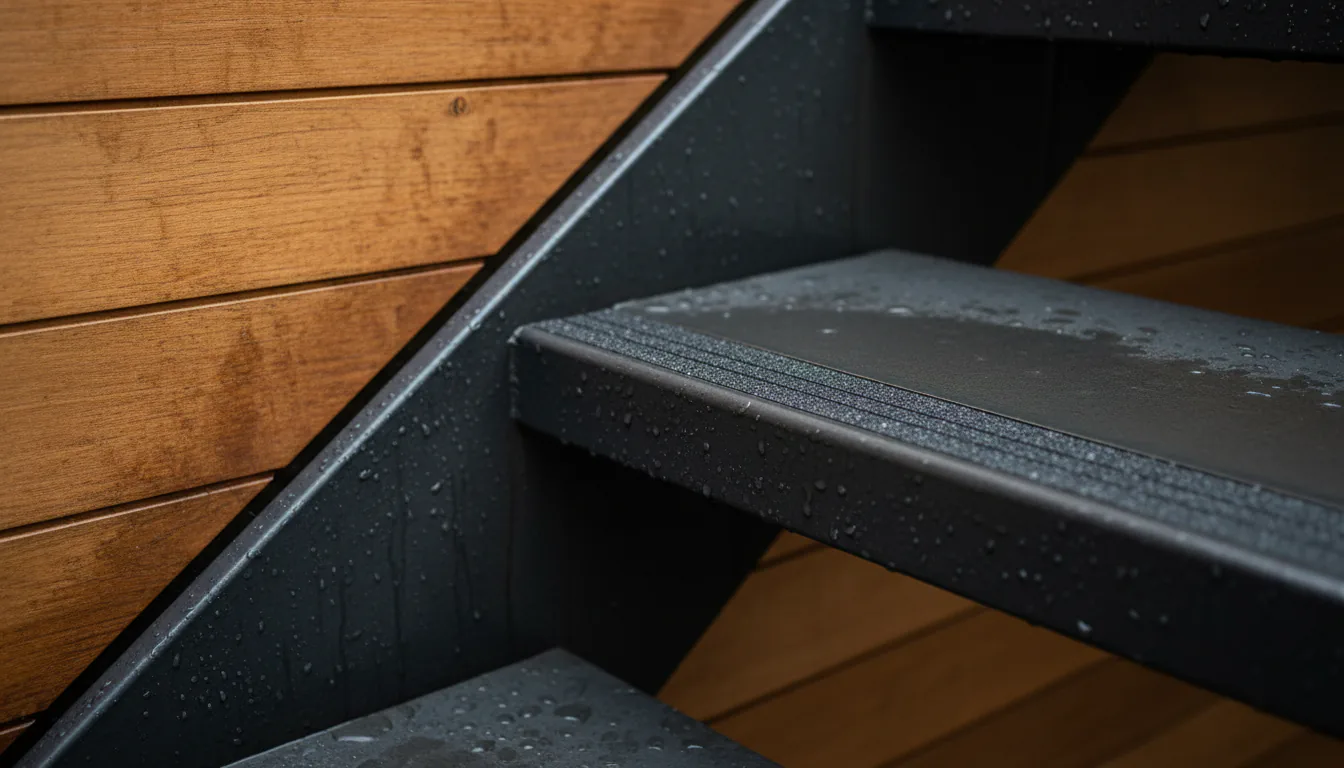
A flush plate tread with one or two carborundum strips inset across the nosing solves the appearance problem. The plate stays clean and architectural, the strip carries the slip resistance, and the strip can be specified in a colour and texture that either disappears or deliberately contrasts. We use this detail on most exterior residential stairs where the client wants a calm steel tread that still passes inspection.
Two specification notes that matter. The strip should be wider than the boot, a 50 mm strip is more forgiving than a 25 mm strip when the user is not looking at their feet. The strip should also sit flush with the tread surface, not proud of it. A strip proud of the tread becomes a trip edge in itself, and the proud edge is the first thing to wear once it has absorbed enough traffic.
The other decision is how the strip is attached. Adhesive-back grit tape is fast and cheap, and it has its place on an interior commercial stair where the substrate is clean and dry. On an exterior Vancouver stair, the adhesive sees freeze-thaw, UV, and standing water, and most tapes start to lift in two to four years. A mechanically fastened or epoxy-set strip, installed into a routed channel in the plate, holds up materially longer and is the default on anything we expect to last the life of the stair.
Expanded mesh and bar grating
Expanded mesh treads and serrated bar grating both let water and snow fall through the tread instead of pooling on it. Drainage is the structural anti-slip mechanism here. There is no water film to break because there is no water film.
Serrated bar grating is the standard for industrial stairs across the Lower Mainland and is specified by name in most commercial mechanical, electrical, and roof access details. The serration on the top edge of each bar gives the boot a grip even when the bar is wet, frozen, or oiled. The tradeoff is the same as checker plate, it reads industrial, and the further tradeoff that small heels and dropped objects can pass through the grating. Grating is wrong under a residential balcony where coffee cups and house keys will drop through; it is right on a maintenance stair where snow load matters more than dropped phones.
Expanded mesh is the more residential cousin. The pattern is tighter, the visual is lighter, and the drainage is still excellent. Mesh treads work well on exterior decks and stairs adjacent to gardens, where leaves and debris would clog a solid tread but pass through a mesh. The disadvantage is that small dogs and bare feet do not enjoy walking on it. On a stair that the client and the dog will both use, mesh is rarely the right answer.
Integral grit coatings and slip-resistant paints
A third path is to apply an anti-slip coating across the whole tread surface, a paint or epoxy with aggregate suspended in the coating, or a separate broadcast of aggregate over a wet base coat. The advantage is uniform texture across the whole tread, no visible strip, and a single colour that matches the rest of the steel.
The disadvantage on a Vancouver exterior stair is durability. The coating sits on top of the steel, not in it. The aggregate wears off the high spots of the traffic pattern first, and the worn pattern is exactly where the next user will plant their boot. We have walked off plenty of two-year-old aggregate coatings on exterior stairs in this market where the grit had vanished from the centre of every tread and the inspector was rightly skeptical.
If a coating is the right answer, usually because the client wants a uniform, painted tread and the architect will accept the maintenance overhead, the specification matters. A two-component aluminum oxide epoxy designed for exterior decks holds up better than a generic porch paint with sand mixed in. Surface prep is non-negotiable; the coating is only as durable as the bond to the steel under it. Reapply every three to five years and budget for it.
For a deeper look at how the corrosion protection layer interacts with the anti-slip layer on coastal stairs, see our piece on hot-dip galvanizing for exterior stairs on the North Shore. Galvanizing happens before any anti-slip detail and shapes how it has to be attached.
Coordination with finish and lighting
Anti-slip is not just a tread decision. It interacts with the rest of the exterior stair package. A blackened painted tread with a contrasting carborundum strip reads architectural. A galvanized checker plate with a clear lacquer reads industrial. A grating tread with under-tread lighting reads modern but does not work with lighting that needs a solid backing.
We resolve this at the same time we resolve the railing and the finish, not after. Sending the architect or the homeowner three actual physical tread samples, checker plate, plate with strip, grating, saves more revisions than a render. People decide what they think of a tread by stepping on it, not by looking at it.
Our piece on exterior steel stairs and coastal Vancouver finishes covers the finish system side of this decision in more depth.
Where the budget goes
A useful frame for clients: the anti-slip decision is rarely the most expensive line on an exterior stair, but it is often the line that the homeowner notices most after the stair is in. A $200 difference between an adhesive strip and a mechanically fastened strip is small against a $25,000 exterior stair. A slip in November on the cheaper detail is not.
In our shop, the default specification on any exterior residential steel stair is a plate tread with a mechanically fastened carborundum strip flush with the surface, hot-dip galvanized substrate, and a powder coat or industrial wet paint finish system rated for galvanized steel. We deviate when the architect has a reason, grating for a coastal cabin, embossed plate for a budget-driven roof access, integral coating for a uniform appearance, and the deviation is documented in the quote and the shop drawings so nobody is surprised at inspection.
Sources
- BC Building Code Section 9.8, Stairs, Ramps, Landings, Handrails and Guards
- NAAMM Metal Bar Grating Manual, slip resistance for serrated grating
The decision that matters on an exterior Vancouver stair is made in the shop drawings, not on site. Send the architectural intent, the use case, and a photo of the site, and the anti-slip detail can be specified before the first piece of steel is cut.
Related reading: the North Shore exterior stair and deck considerations, the hot-dip galvanizing piece, and the exterior steel stair coastal finish guide.
Related questions
What anti-slip finish does BC code require on exterior stairs?
BC Building Code Section 9.8 requires stair treads and landings to provide a slip-resistant surface, without naming a specific product. The authority having jurisdiction decides whether a given finish meets the intent. In practice, smooth painted steel does not pass; embossed plate, expanded mesh, grating, or an applied carborundum strip does.
How long do applied anti-slip strips last on an exterior Vancouver stair?
An adhesive grit strip on a wet, salted West Coast stair often shows wear in two to four years and needs replacement before the substrate becomes slippery. A mechanically fastened or epoxy-set strip on a properly prepared steel tread holds up materially longer. We default to mechanically fastened strips on any exterior stair that sees salt or steady foot traffic.
Is hot-dip galvanized grating enough on its own?
On industrial or back-of-house stairs, yes, serrated bar grating reads as slip-resistant under most code reviews. On a finished residential or commercial exterior stair where grating is too utilitarian, an embossed checker plate or a plate tread with a flush carborundum insert is the common path.