Staircase Renovation in Deer Lake and Buckingham Heights: Mid-Century Burnaby's Design-Led Market
What homeowners in Deer Lake and Buckingham Heights need to know about replacing stairs in mid-century character homes, structural planning, the renovation context, finish choices, and working with a fabricator minutes from the site.
The Deer Lake and Buckingham Heights pocket of Burnaby carries some of the Lower Mainland's most design-led residential renovation work, heritage character homes on large lots, architect-directed projects, and a fabrication shop that is a ten-minute drive away.
Deer Lake sits in the geographic centre of Burnaby, a short walk from the Shadbolt Centre for the Arts and the Burnaby Art Gallery, surrounded by the kind of large-lot residential fabric that the rest of Metro Vancouver has largely converted to townhouse density. The neighbourhood grew outward from the lake through the 1920s and 1930s, then filled in through the 1950s and 1960s with mid-century modern and West Coast Modernist homes. The J.D. Shearer House, built in 1912 in the British Arts and Crafts style, sits on the Heritage Burnaby register as an example of what early Deer Lake looked like. Baldwin House, designed by architect Arthur Erickson and built between 1963 and 1965, represents the other end, the kind of carefully considered mid-century residential design that the neighbourhood still carries (burnaby.ca).
Buckingham Heights is the ridge to the south of Deer Lake, a quieter pocket of detached housing on generous lots with mountain views to the north. The two areas share a character: design-conscious, well-maintained, with a high share of owner-directed renovation projects where the homeowner has lived in the house for years and is now updating it to match how they actually use it.
That context creates a specific kind of staircase replacement project.
Mid-century framing and what it means for a modern stair
Homes built around Deer Lake in the 1950s and 1960s split roughly between two structural approaches. Post-and-beam construction, influenced by the West Coast Modern movement centred at the UBC School of Architecture, uses large timber posts and beams as the primary structure, with infill walls between posts that may be lightly structural or non-structural depending on the specific design. Platform-framed homes from the same era use a more conventional stud-and-joist system, but with the shallower floor depths and tighter spans typical of the period.
Both types create challenges for a modern open-riser stair that were not present in the original design. The original stair openings were sized for a closed-stringer wood stair, typically a straight run with a bullnose tread, baluster guard, and a wood handrail. The headers and trimmers around that opening were sized for the dead load of that stair. When the replacement is a mono stringer steel stair, with point loads at the top bearing and bottom bearing rather than distributed load along a run of joists, the existing framing almost always needs to be assessed and often upgraded.
On post-and-beam homes, the assessment question is where the new stair bears and whether the infill wall at the stair run is structural. A mono stringer bears at two floor points; if those points land on a post-and-beam bay, the attachment can usually be made to the structural frame directly. If the points land on infill, the infill needs to either be reinforced or the stringer needs to bear elsewhere. The engineer confirms this on a site visit, before shop drawings are issued.
On platform-framed Deer Lake homes, the question is whether the existing trimmer joists and double header can carry the new loads. For most residential mono stringer stairs, the loads are not extreme, but they are concentrated in a way that the original header was not designed for. Sistering additional trimmers and adding blocking is a routine wood-scope item that should be identified before steel is ordered rather than discovered during installation.
The renovation character of the Deer Lake area
Deer Lake and Buckingham Heights renovation projects are disproportionately design-led. The neighbourhood attracts homeowners who care about architecture, partly because the existing housing stock is interesting, partly because the area’s association with the arts centre and the heritage lake has always drawn a design-oriented demographic. A large share of the stair replacements in this pocket involve an architect or interior designer, which changes the project dynamic.
When a stair replacement is architect-directed, the fabricator typically receives a design intent drawing, a sketch or a measured drawing showing the desired stair type, tread dimensions, guard concept, and finish intent. The fabricator’s job is to translate that into fabrication drawings that confirm the structural approach, specify the section sizes the engineer needs, and communicate the information that the permit application requires. That process works cleanly when the fabricator is engaged early, when the architect’s design is still a concept, before dimensions are locked and before the opening is framed.
When the fabricator is engaged late, after the architect has issued construction drawings, after the contractor has framed the opening to suit the wood stair that was there before, there is often a gap between the design intent and what the structure can deliver. The opening may be the wrong width for a mono stringer with the tread length the architect specified. The floor-to-floor dimension may not divide evenly into the code riser range at the desired tread depth, requiring a design change that triggers another round of architect review. Engaging the fabricator at the conceptual stage, not at the construction stage, is how these projects avoid that sequence.
The other renovation context at Deer Lake is homeowner-directed, without an architect. These projects are often the result of a homeowner who has been living in a mid-century house for ten years and has been mentally redesigning the stair that whole time. They know what they want, a mono stringer with walnut treads and cable railing, or a floating stair with a glass guard, but they have not worked through the structural implications. The fabricator’s role in these projects is partly design input and partly structural reality-check: confirming whether the existing wall layout supports the desired option, whether the opening needs to change, and what the permit path looks like.
Finish choices for a mid-century interior
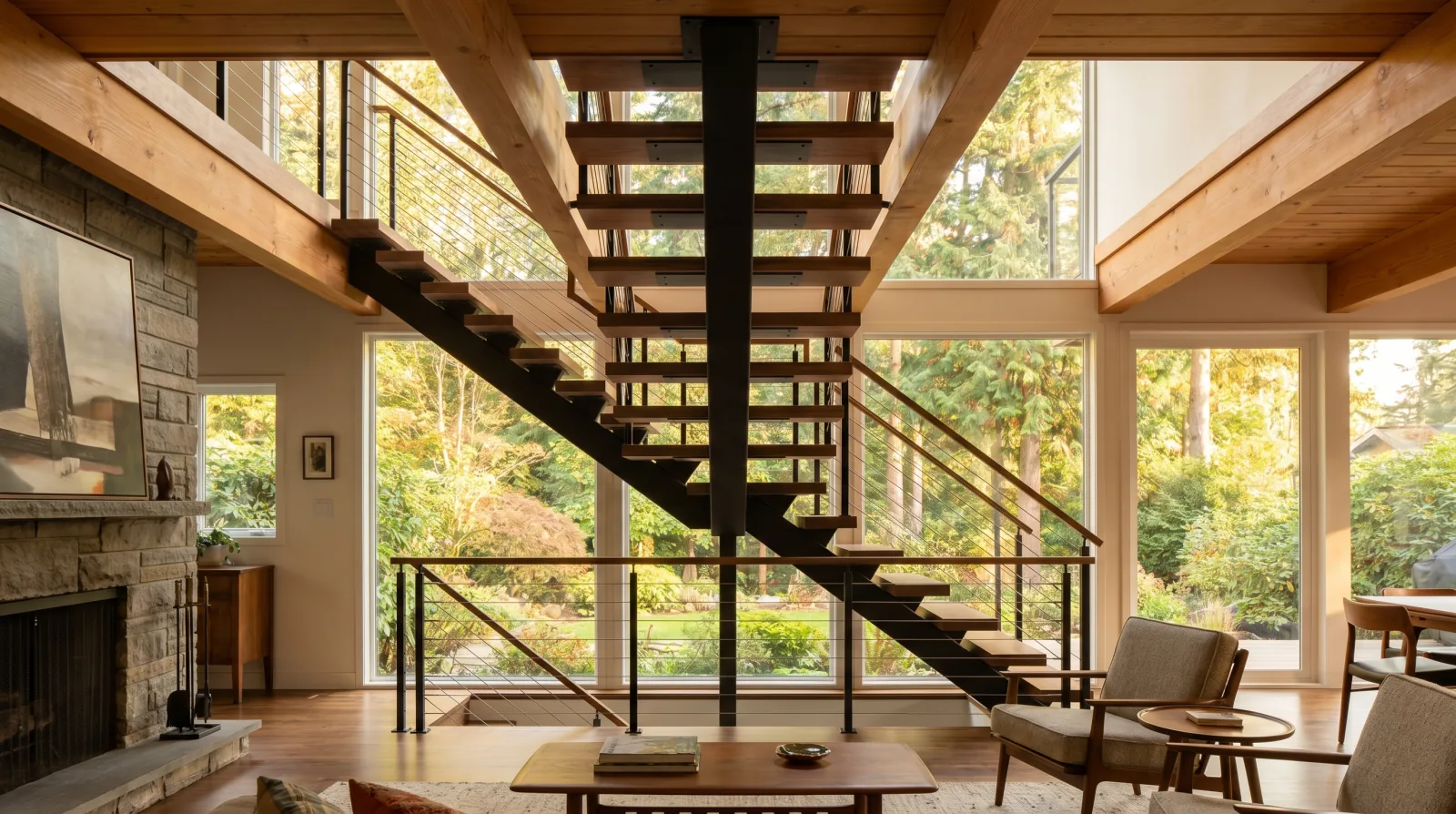
Mid-century West Coast Modern interiors at Deer Lake have a distinct material palette: exposed Douglas fir or cedar ceiling boards, stone fireplace surrounds, fir flooring, large windows framing tree and garden views. Newer renovations of the same homes often keep the structural expression but update the palette: white oak replaces fir on the floors, painted millwork replaces natural wood trim, and the fireplace gets a new stone or tile surround.
The steel finish for a staircase in this context works best when it anchors the material palette rather than competing with it.
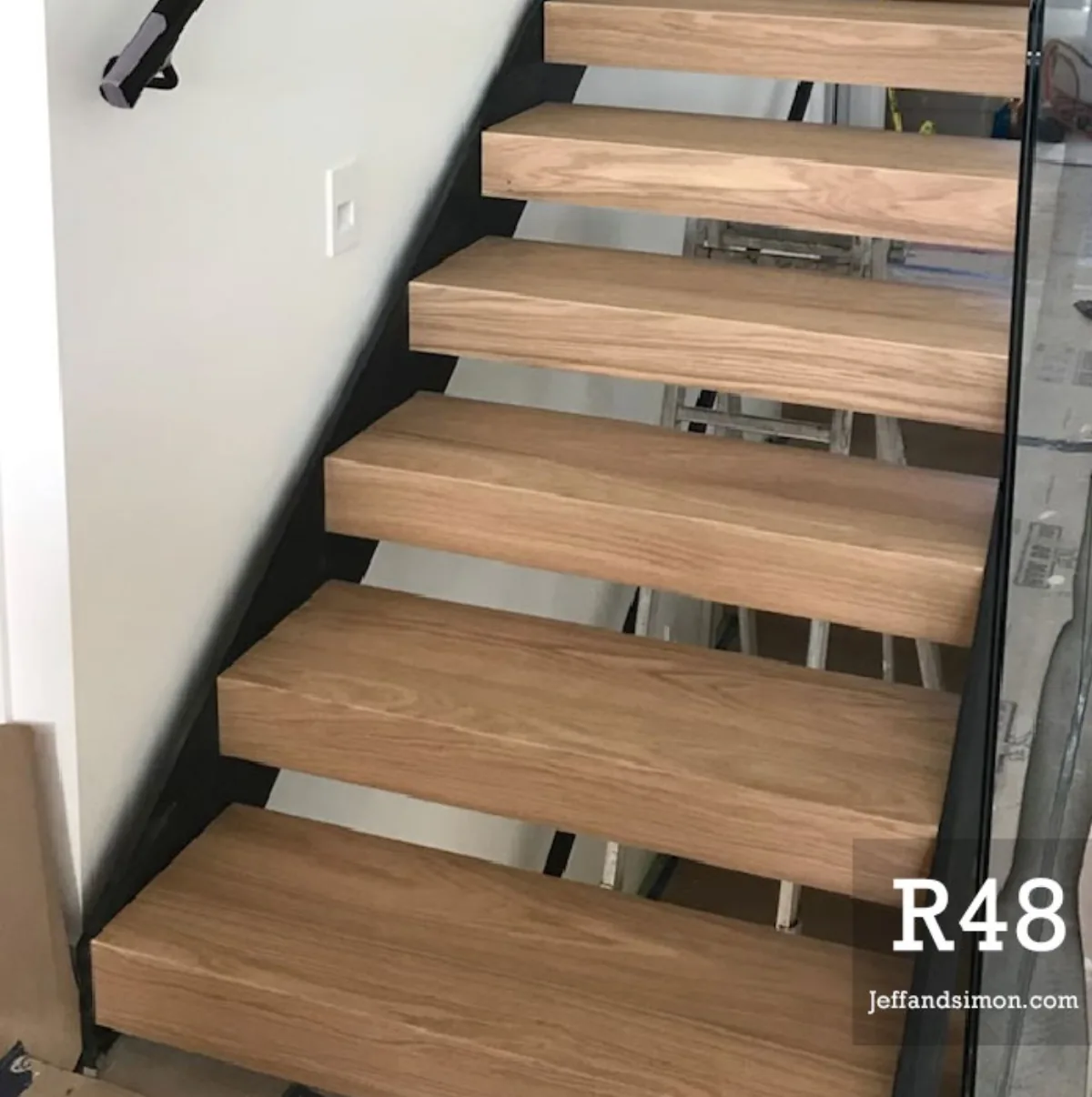
Matte black powder coat is the most consistent choice across both the period-authentic and the updated-interior versions of a Deer Lake home. It has enough weight to anchor the stair as a visual element, it is warm enough to sit against oak and walnut, and it is neutral enough that the tread material becomes the focal point. A flat or low-satin sheen is appropriate; gloss reads as hardware rather than custom fabrication.
Bronze and warm charcoal come up on projects where the tread is a pale material, light white oak, or a concrete tread, and the homeowner wants the steel to provide contrast. Both finishes carry well against the stone and timber of a mid-century interior without competing.
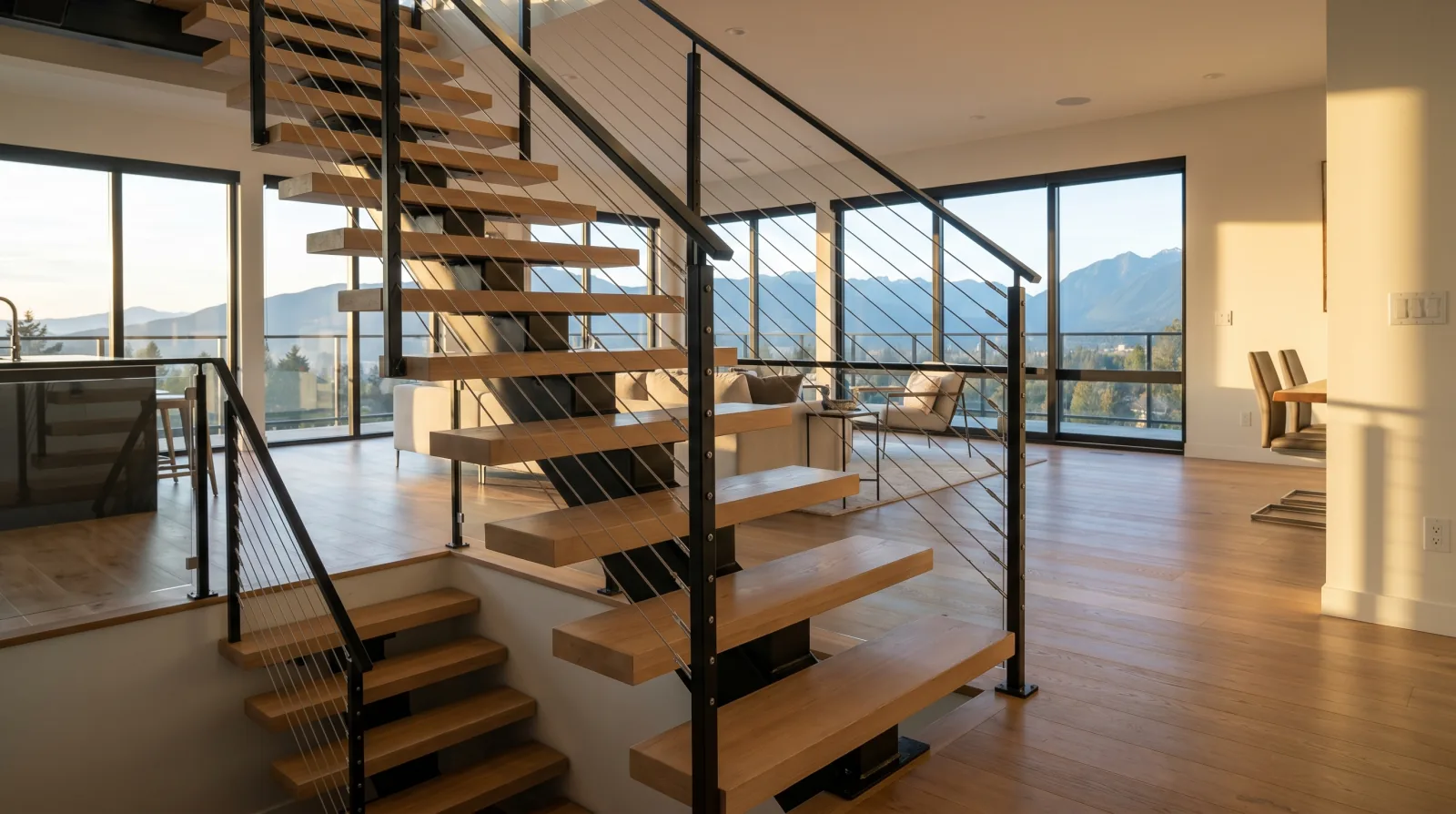
Cable railing in black powder coat with stainless cables is the guard combination that suits the horizontal emphasis of West Coast Modern architecture most directly. The horizontal cable lines continue the motif of exposed beams and band windows. Posts in a flat black or matte dark finish read as structural elements rather than as applied decoration. The combination is low-maintenance relative to glass and is appropriate for homes where the mid-century character is being honoured rather than erased.
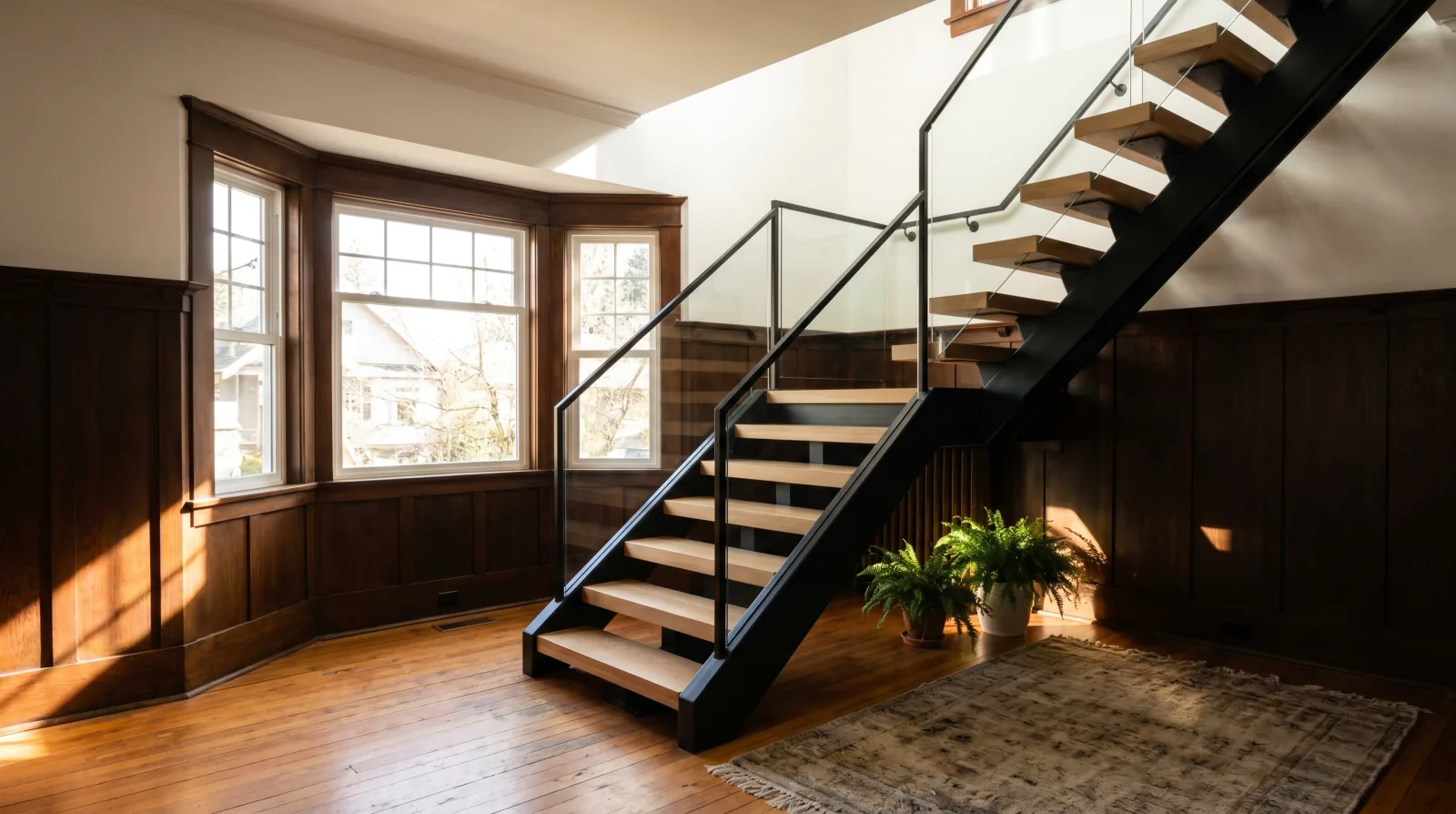
Frameless glass is the alternative where sightlines to the garden are the dominant priority. Glass guard disappears, which can be appropriate in a Deer Lake home where the stair faces a rear window with a mature tree canopy beyond. The trade-off is cleaning, glass shows fingerprints and water spots that cable railing does not, and on tight interiors the glass panels need to be sized for hand-carry and single-person installation if vehicle access to the site is limited.
Permit path through the City of Burnaby
The City of Burnaby requires a building permit for structural stair replacements, guard changes, and structural connections to floor framing. From January 1, 2026, Burnaby accepts permit applications exclusively through its digital submission portal, and permits issued on or after March 31, 2026 are provided in digital format only (burnaby.ca, confirm with the authority having jurisdiction). That changes the format in which shop drawings and engineer’s letters need to be packaged, PDF with a digital professional seal is the correct format; paper-stamped drawings cannot be submitted.
For structural stair geometries, mono stringer, cantilevered, floating with a hidden stringer, a Schedule B Letter of Assurance from a registered professional engineer is the standard requirement. The Schedule B confirms the structural design and the engineer’s commitment to field review. A Schedule C-B is signed off after the site review at the end of the project.
Deer Lake heritage properties, homes that appear on the Burnaby Heritage Register, should be checked for any overlay that applies to exterior changes. Interior staircase replacements generally do not trigger heritage review, but exterior stair, deck, or guard changes on a designated heritage property may require additional review (burnaby.ca). The right move on any heritage-listed address is to confirm the path with the City before drawings are finalized.
Why proximity to the shop matters on a Deer Lake project
The Vancouver Stairs shop is at 2544 Douglas Road, which puts Deer Lake and Buckingham Heights at approximately a 10-minute drive from the saw, the bender, and the welding bay. That proximity is not a marketing point, it is a practical operational fact that changes how a project runs.
A same-day site visit for a pre-construction measure is a morning task, not a half-day. A re-measure after framing changes happens before the week is out, not two weeks later. If a component comes off the truck with a finish issue, a powder coat run, an incorrect bracket dimension, the shop can fabricate a replacement piece and have it on site the same afternoon. None of those outcomes requires anything special; they are just what happens when the fabrication shop and the job site are separated by 10 minutes rather than 45.
For Deer Lake and Buckingham Heights renovation projects, that logistical proximity translates directly into a cleaner project. Faster response at every coordination point, fewer schedule holds while waiting for a re-measure or a replacement part, and an install crew that can return on short notice if a field adjustment needs to happen after the general contractor’s work is complete.
Starting a Deer Lake staircase project
The inputs that make a Deer Lake stair scope accurate: the existing floor plan with the stair location, the finished floor-to-floor measurement taken on site, photos of the existing stair opening and the surrounding framing (including any visible trimmer and header work), the preferred tread material and guard type, the target install window, and whether an architect or structural engineer is already involved.
If the project is early, framing is not yet complete, or the renovation is in the concept phase, the fabricator can provide a structural opinion on whether the preferred stair type suits the existing framing before any drawings are issued. On a Deer Lake mid-century home where the floor system is unusual or where the desired stair type is a cantilevered wall-anchored option, that early conversation is the difference between a stair that is sequenced correctly from the start and one that is redesigned partway through construction.
Related reading: the Burnaby service area page, the mono stringer staircase deep dive, the Burnaby Heights and Capitol Hill staircase guide, and the cantilevered floating stair wall framing guide.
Related questions
Are Deer Lake heritage homes harder to replace stairs in than other Burnaby properties?
Not harder, different. Heritage-character homes around Deer Lake tend to have pre-war or mid-century framing that needs assessment before a modern stair is designed to it. The original stair opening was sized for the original stair, the floor system was sized for the original dead load, and the wall layout was fixed before open-concept design was an expectation. None of that is a barrier to a custom steel stair, it is a reason to do a structural review early and confirm the framing plan before shop drawings are issued.
Does the City of Burnaby require a permit to replace a stair in a Deer Lake home?
Yes, for structural changes. New stairs, alterations to existing stair openings, changes to guard systems, and structural connections to floor framing all require a building permit from the City of Burnaby. Burnaby moved to fully digital permit submission for applications filed on and after January 1, 2026. A Schedule B Letter of Assurance from a registered professional engineer is required for most structural stair geometries.
What stair type works best in a mid-century Deer Lake interior?
Mono stringer stairs with cable railing suit the horizontal emphasis and natural material palette of mid-century West Coast Modern architecture. The single steel spine reads as a deliberate structural element rather than an enclosure, which fits the aesthetic. Cable railing continues the horizontal language of exposed beams and band windows. For properties where sightlines to the garden are the priority, frameless glass guard eliminates the infill entirely.
How far is the Vancouver Stairs shop from Deer Lake?
About 10 minutes by road. The shop is at 2544 Douglas Road in Burnaby, which is roughly the same distance from Deer Lake as Metrotown. That proximity is a practical advantage: same-day site visits during pre-construction, fast re-measures after framing changes, and rapid swap-outs of hardware that came in wrong all stay inside one workday rather than spanning two.
Can I get a floating stair in a 1960s Deer Lake home?
Yes, with the right structural preparation. Wall-anchored cantilevered stairs require a reinforced support wall that needs to be engineered before drywall closes. A mono stringer, which looks similar but bears at two floor points rather than into a wall, is typically more practical in 1960s framing because it does not require an existing structural wall at the stair run. The right choice depends on the existing wall layout, which the engineer confirms on a site visit.