Staircase Renovation in Dunbar and Kerrisdale: Large Lots, Craftsman Framing, and the West Side Renovation Standard
What Dunbar and Kerrisdale homeowners need to know about replacing a staircase in a pre-1940 character home, Craftsman framing realities, West Side finish expectations, and when a heritage consultation applies.
Dunbar and Kerrisdale have some of the most consistent pre-war housing stock in Metro Vancouver, large-lot Craftsman and Edwardian homes that combine a demanding renovation standard with structural constraints specific to their era of construction.
Dunbar and Kerrisdale sit at the southwest corner of Vancouver’s west side, bounded roughly by 16th Avenue to the north, Southwest Marine Drive to the south, Granville to the east, and the UBC Endowment Lands to the west. The housing stock in both neighbourhoods is among the most consistent pre-war residential fabric in Metro Vancouver: large 50-foot and 66-foot lots, Craftsman bungalows and Edwardian two-storeys, and a renovation culture shaped by property values that reward high-quality work.
The staircase replacement context in Dunbar and Kerrisdale is specific. The structural constraints are older-framing problems. The finish expectations are West Side renovation problems. And the permit path is straightforward, except where heritage or character designations add a step.
The housing stock is mostly pre-1940 Craftsman and Edwardian
The dominant housing form in both neighbourhoods is the detached single-family house built between 1900 and 1940. Craftsman bungalows, one-and-a-half to two storeys, with front gable, wide eaves, and exposed rafter tails, are the most recognizable. Edwardian two-storeys with box bays, original wood sash windows, and tall ceilings are also common, particularly on the larger lots near 41st Avenue and through Dunbar-Southlands.
Both types share structural characteristics that affect every stair replacement:
- Balloon framing or early platform framing. Pre-war homes in this area used framing conventions that differ from post-war platform construction. Balloon-framed walls run studs continuously from foundation to roof without intermediate platforms. Load paths and opening modifications need to be understood in that structural context.
- Original stair openings sized for closed wood stairs. The opening in most of these homes was designed for a closed-stringer wood stair with bullnose treads, typically 850 to 950 mm clear width and steep at 40 to 45 degrees. A modern code-compliant stair at a gentler pitch needs more horizontal run and usually a wider opening, which means re-framing.
- Headers sized for wood dead loads. The trimmer joists and header over the original opening carry the weight of the old wood stair. A steel mono stringer introduces concentrated point loads at the top bearing that the original header may not be designed to carry. The assessment happens before shop drawings are issued.
None of these are disqualifying. They are known conditions on West Side character home stair work, and they are resolved at the design and engineering stage, not on installation day.
The original opening almost always needs to be enlarged
The original opening in a Dunbar or Kerrisdale character home was sized for the stair that was in it when the house was built. That stair was steep, narrow, and closed. A modern stair, open riser, mono stringer, gentler pitch, needs more run and usually more width.
The BC Building Code establishes minimum tread depth of 235 mm and maximum riser height of 200 mm for residential stairs (bccodes.ca, confirm with the authority having jurisdiction). A stair that rises 2,900 mm floor-to-floor at 200 mm risers has 14 or 15 risers and needs a horizontal run of roughly 3,290 to 3,525 mm on the tread line. An original opening designed for a stair at 210 mm risers is roughly 2,800 to 3,100 mm long. The new stair needs more space than the old stair occupied.
The additional length has to come from somewhere, either by extending the stair opening into the floor above, or by reconfiguring the stair geometry (adding a landing, changing direction) to fit within the existing opening’s constraints. Extending the opening is more common in West Side renovations where the structural ceiling at the second floor has enough span capacity to allow the header to move. Adding a landing is more common where the ceiling can’t move or where the room geometry above the stair prevents a longer opening.
Both options are resolved at the design stage, with the structural engineer confirming the header and trimmer capacity and the opening geometry, before steel is ordered.
West Side finish expectations are high
Dunbar and Kerrisdale are high-renovation neighbourhoods. The combination of large lots, pre-war character homes, and significant underlying property values creates a renovation context where finishes and details are expected to hold up to comparison with the kitchen and millwork quality in the same room.
For staircases, that standard means several things in practice:
- Black powder coat over a carefully prepared surface. The powder coat finish on a high-quality residential stair in this context is applied over a blast-cleaned or chemically prepared steel surface with a zinc-rich primer, not directly over mill scale. The difference shows at close inspection, a properly primed powder coat has a consistent texture and depth; an improperly prepared surface shows telegraphing mill scale and thin edges.
- Tight tolerances at the wall. The gap between the stringer and the wall surface, the reveal at the base plate, and the alignment of the guard posts are visible at finish quality in a well-crafted West Side renovation. These are set by the site measure and the shop drawing, not adjusted in the field.
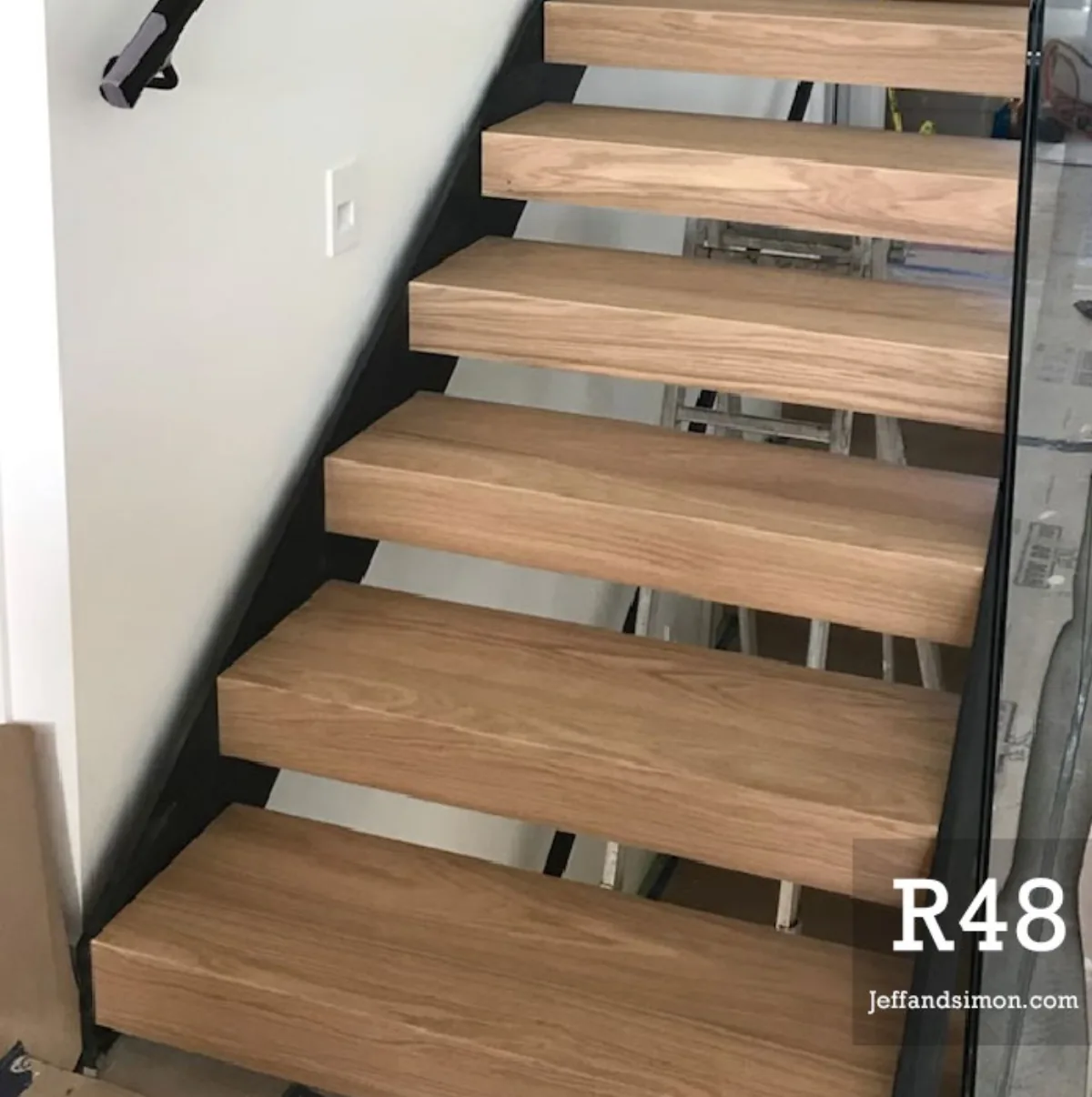
- Tread species and thickness matched to the room. Dunbar and Kerrisdale renovations often use white oak or Douglas fir treads, species that connect to the existing floors and millwork in the house rather than importing a neutral material. Tread thickness matters: a 38 mm tread has a different visual weight than a 50 mm tread, and both read differently against the same stringer profile.
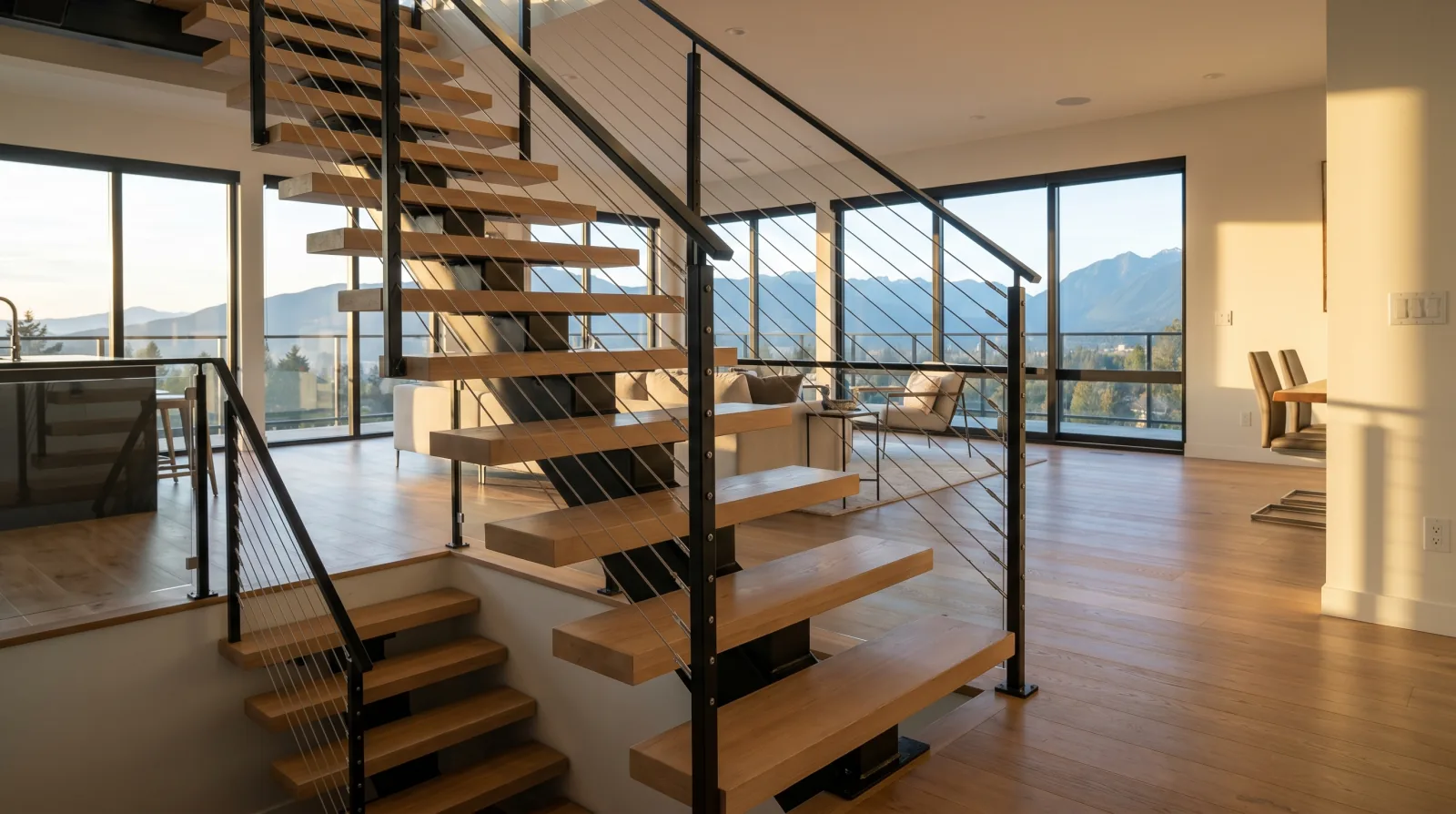
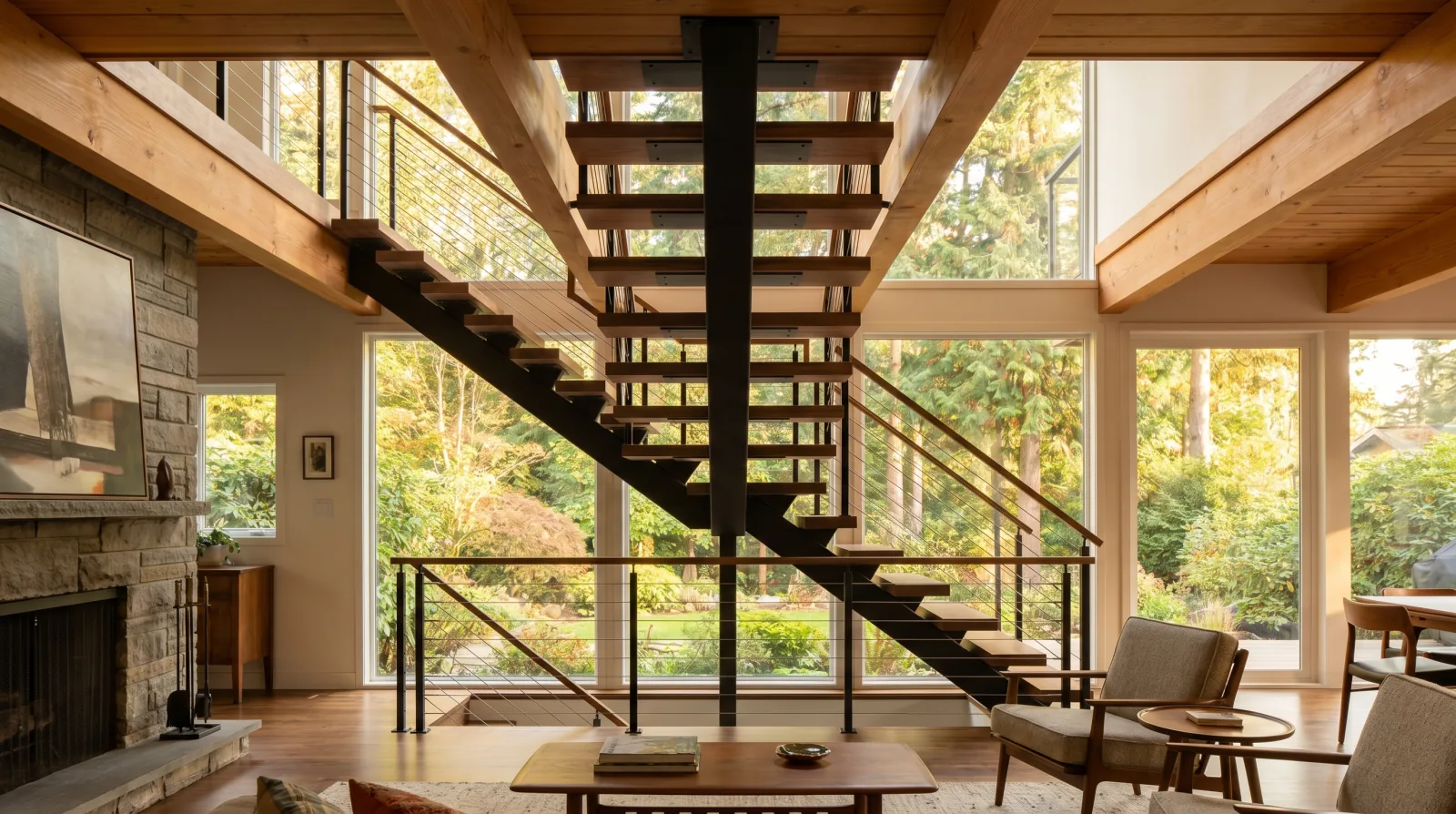
- Guard detail resolved to the same level as the rest of the interior. Frameless glass with polished stainless standoffs reads cleanly in an open-plan West Side renovation. A properly detailed cable guard, stainless fittings, tensioned cables with consistent spacing, clean end conditions at the wall, also works in character home contexts where the horizontal cable line picks up window muntin geometry.
Heritage considerations apply in a few specific cases
Most Dunbar and Kerrisdale homes are not formally heritage-designated. Interior stair work in these homes follows the standard building permit process, a permit for structural changes, an engineer’s Schedule B where required, a standard review timeline.
Two situations add a step:
First Shaughnessy Heritage Conservation Area borders the north edge of Kerrisdale. Properties within First Shaughnessy (designated as an HCA in 2015, vancouver.ca) require an Advisory Design Panel review for exterior changes. Interior stair replacements in First Shaughnessy homes generally do not trigger this review, but any exterior stair, canopy, or guard visible from the street does. Confirm the property boundary and any applicable designations before design is finalized.
Individually designated heritage properties exist throughout Dunbar and Kerrisdale, though they are less common than in some other west side neighbourhoods. An individually designated property requires a Heritage Alteration Permit (HAP) through the City of Vancouver for any exterior changes and, in some cases, for interior changes that affect character-defining elements. The City’s online Heritage Register confirms whether a specific property is listed.
For the majority of Dunbar and Kerrisdale homes, post-1910 character homes without individual designation and outside First Shaughnessy, the standard permit path applies and no heritage consultation is required.
The permit process for structural stair work
Structural stair work in a City of Vancouver property requires a building permit. The permit application for a residential stair replacement typically includes:
- Architectural drawings showing the proposed stair geometry, opening dimensions, and guard system.
- A structural drawing or Schedule B Letter of Assurance from a registered engineer confirming that the structural design, opening modifications, header sizing, stringer connections, has been reviewed and sealed.
- Site address and building age, which help the City determine whether additional reviews apply.
The City of Vancouver processes residential building permit applications through its online portal (vancouver.ca). Review timelines vary and should be confirmed with the City at the time of application, not assumed based on historical experience.
For projects that include a larger renovation scope, kitchen, structural, addition, the stair permit can often be combined with the overall building permit rather than pulled separately. The GC or building designer leading the renovation typically manages this coordination.
Starting a Dunbar or Kerrisdale stair project
The strongest starts on West Side character home projects come when the fabricator sees the site, or detailed photos and measurements, before design is committed. What matters most for a Dunbar or Kerrisdale stair quote is:
- The floor-to-floor height, measured precisely.
- The existing opening dimensions, clear width and clear length.
- The ceiling height above the lower half of the stair run (headroom).
- The floor structure visible in the basement or crawl space below the existing stair, what size are the joists, what direction do they run, and what is the header condition at the opening.
- The finish floor material and thickness on both levels (affects the actual structural floor-to-floor dimension).
Photos of the existing stair from above and below, and of the wall structure near the top connection, are useful. If architectural drawings exist from a previous permit, they help confirm the framing assumptions before a site visit.
Related reading: staircase renovation in Point Grey, modern staircases in Kitsilano character homes, the Vancouver service area page, and the floating staircase process.
Related questions
Does a stair replacement in Dunbar or Kerrisdale require a permit?
Yes, for structural changes. The City of Vancouver requires a building permit for work that modifies the stair opening, changes the load path, or alters the guard system. Properties in First Shaughnessy Heritage Conservation Area, which borders Kerrisdale, have additional design review requirements for exterior changes, though interior stair work in those properties generally does not trigger heritage review unless it affects a designated interior element.
What is the most common structural issue when replacing a staircase in a Dunbar or Kerrisdale character home?
The existing opening was sized for a closed-stringer wood stair, and the trimmer joists and headers were sized for that original dead load. A steel mono stringer introduces new concentrated loads at the top and bottom connections that the existing framing may not carry without reinforcement. Assessing the existing header size and trimmer capacity before finalizing the design prevents scope additions discovered on installation day.
What finish suits a Dunbar or Kerrisdale interior renovation?
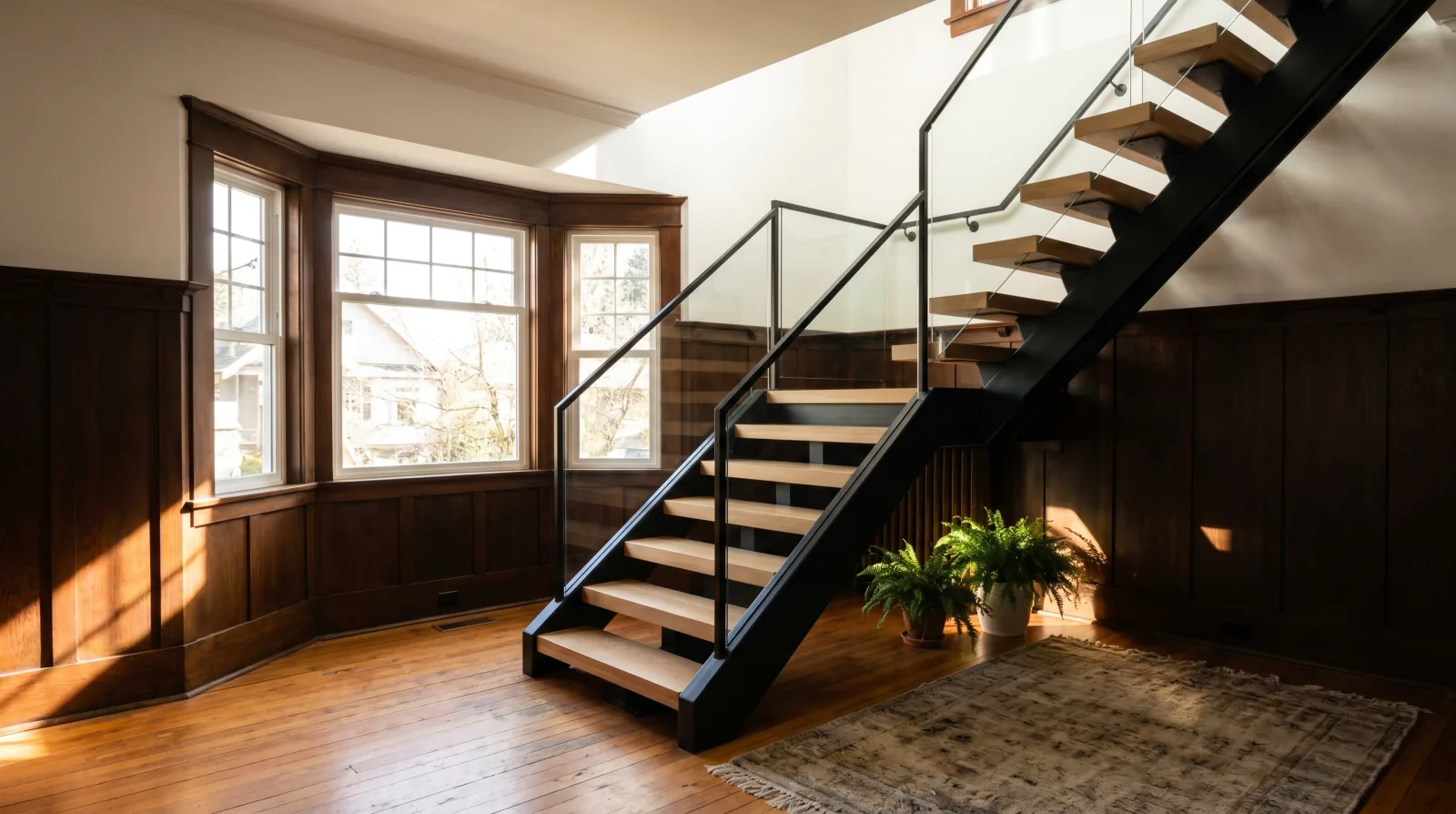
The dominant material palette in West Side character home renovations, Douglas fir floors, stone fireplaces, white walls, fir or oak millwork, suits a black powder-coated steel stringer with warm wood treads. Frameless glass or cable railing on the guard keeps the visual field open without adding a heavy element. Bronze or warm grey powder coat is an option where the stair sits in a room with high-contrast dark millwork.
Do Kerrisdale homes need a Heritage Alteration Permit for stair work?
Heritage Alteration Permits (HAPs) apply to properties with formal heritage designation or within Heritage Conservation Areas. Kerrisdale is not a designated Heritage Conservation Area, though First Shaughnessy, adjacent to Kerrisdale's northern edge, is. Standard character homes in Kerrisdale that are not formally designated follow the standard building permit process. Confirm whether your specific property has a heritage designation with the City of Vancouver before assuming the standard path applies.
How does balloon framing in a pre-1940 Dunbar home affect the stair opening?
Balloon-framed homes run the wall studs continuously from foundation sill to roof rafter without the platform breaks of post-war construction. Modifying a stair opening in a balloon-framed wall requires careful assessment of which studs carry structural load and which are non-bearing partitions. The opening modification is not just a matter of removing studs, the continuity and load path of the balloon frame need to be understood before header and trimmer work begins.
What floor-to-floor heights are typical in Dunbar and Kerrisdale character homes?
Pre-war Craftsman and Edwardian homes on the West Side typically measure 2,800 to 3,100 mm floor-to-floor, with the taller end more common in earlier construction. Kerrisdale homes from the 1910s and 1920s often have high ceiling heights that give a modern stair good headroom over the full run without requiring ceiling modification. Homes from the 1930s and early 1940s tend to be slightly lower.
Can a floating stair work in a Kerrisdale character home without visible support?
A true wall-anchored floating stair, treads embedded into a reinforced wall with no stringer, requires a structural wall at the stair run that can carry the tread loads. Many pre-war Kerrisdale homes have the wall geometry for this, but the wall needs structural assessment and often a reinforced stud bay or moment frame before tread anchors can be installed. A concealed mono stringer achieves the same visual with significantly less structural intervention and is more predictable in older framing.
What is the renovation standard in Dunbar compared to Kerrisdale?
Both neighbourhoods carry high renovation expectations. Dunbar-Southlands has seen single-family home sales at significant values in recent years, and renovation quality reflects the underlying property values, custom millwork, premium finishes, and architect-designed scopes are common. Kerrisdale has a similar expectation, particularly in the larger homes along 41st Avenue and the streets approaching Shaughnessy. In both neighbourhoods, a staircase is typically a design-led element rather than a code-minimum replacement.
Does Vancouver Stairs do the structural engineering, or is that a separate consultant?
We coordinate with a structural engineer on projects that require it, typically anything involving a new opening, a modified load path, or a Schedule B submission to the City. The engineer is a separate consultant who reviews and stamps the structural design. We provide shop drawings that reflect the engineer's structural requirements and coordinate the review process so both are complete before steel is ordered.
How long does a typical Dunbar or Kerrisdale stair project take from first contact to installation?
From initial contact to installed stair, most residential mono stringer projects take 8 to 14 weeks. That includes site measure, structural assessment, drawing coordination, permit review (which varies in duration), fabrication, and installation. Projects that require significant structural work, re-framing, engineer coordination, heritage consultation, add time. Starting the conversation at the framing or rough-in stage of a larger renovation, rather than at the end, keeps the stair on the critical path rather than behind it.